
Quick Answer: The beisa oryx (Oryx beisa) is northern Kenya’s most formidable desert antelope, recognized by its straight, spear-like horns exceeding one meter in length. Inhabiting the dry scrublands of Samburu National Reserve, this endangered species displays remarkable survival traits—from processing toxic desert plants and digging for water bulbs to forming defensive horn walls against predators.
Written by Gerard Murero. Reviewed by Benson Kungu.
Field Spec | Beisa Oryx (Oryx beisa beisa) Feature |
Local Vernacular | Choroa (Swahili) |
IUCN Status | Endangered (IUCN Red List) |
Key Physical Trait | Needle-straight horns (up to 1.2 m), black facial mask, plain tuftless ears |
Water Adaptation | Digs Ipomoea water bulbs; carotid rete vascular cooling |
Prime Samburu Hotspots | Loroki Ridge, Bisona Plains, Nderoi Lugga, Champagne Ridge |
Best Viewing Window | 06:15 AM – 08:30 AM & 04:30 PM – 06:30 PM |
Kenya hosts two distinct subspecies of oryx separated by geographic boundaries:
A herd of beisa oryx marching through dry thorn scrub is hard to miss. Their long, needle-straight horns look like polished steel spears rising above the acacia.
Swahili speakers call them Choroa. Traditional Samburu warriors (Morans) hold deep respect for the animal, and it is easy to see why. Most gazelles turn and bolt at the first sign of danger. An oryx doesn’t. When cornered by a lion or hyena pack, a full-grown bull lowers its head and charges straight ahead, and those meter-long horns can drive clear through a big cat — so even a hungry pride thinks twice before closing in.
The species is one of the Samburu Special 5, five endemic northern animals built for dry country. The IUCN Red List classifies the Beisa oryx as Endangered, which makes protected reserves like Samburu essential to keeping these herds alive.
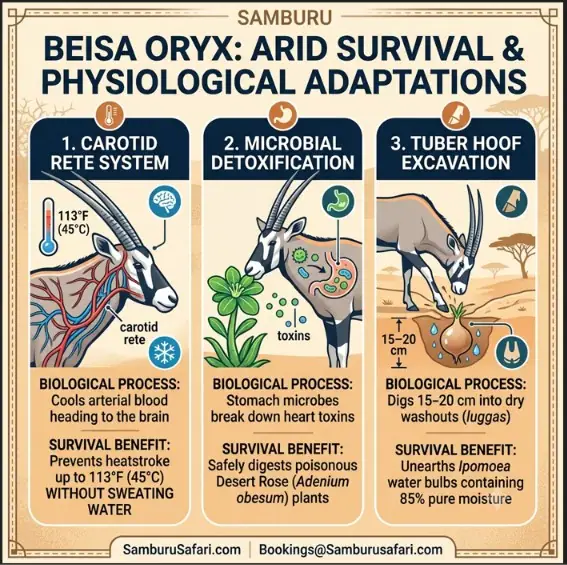
By 11:00 AM, when the dust on the windshield gets hot enough to bake bread, the herd stops moving. They turn sideways to the wind and point their narrow backs directly to the sun—turning short silver coats into optical solar shields that bounce radiation back into the sky.
Midday heat in Samburu easily pushes past 100°F. To keep their brain from cooking, oryx rely on an internal network of blood vessels called the carotid rete. This vascular system cools blood on its way to the brain, letting body temperature climb to a staggering 113°F (45°C) without sweating away vital fluid. The Somali ostrich sharing these same flats solves the identical problem from the outside, lifting its wings to bare blue skin to the breeze.
The oryx is not the only antelope up here that has given up on drinking; the long-necked gerenuk never drinks at all, pulling every drop it needs from green leaves. When long dry spells turn green grass to dust, oryx go a step further and eat plants that would kill other grazers. They chew on toxic Desert Rose (Adenium obesum) bushes. The cardiac toxins in this plant destroy heart muscle in most animals, but specialized microbes inside an oryx’s stomach break down the poison safely.
Water comes from underground too. Along dry sandy washouts like Nderoi Lugga, oryx use their sharp front hooves to dig 15 to 20 centimeters into the sand and pull up buried Ipomoea water bulbs, natural canteens packed with around 85% pure water. It is how herds stay healthy miles from the Ewaso Nyiro River — often drinking from the very sand-scoops that Grevy’s zebra mares dig nearby.
“How do Beisa oryx survive in the desert?” / “Beisa oryx water adaptations”
Thriving in Samburu’s extreme heat demands high-level physiological and behavioral adaptations that set the Beisa oryx apart from southern antelope. Through specialized vascular network cooling, toxic plant neutralization, and underground tuber excavation, this desert specialist survives long periods without standing drinking water. The table below highlights the key survival mechanisms that allow herds to range far across dusty plains. Use this reference to understand their unique physiology while out on morning game drives.
Adaptation Mechanism | Biological Process | Survival Benefit in Samburu |
Carotid Rete System | Cools arterial blood heading to the brain | Prevents heatstroke up to 113°F (45°C) without sweating water |
Microbial Detoxification | Stomach microbes break down heart toxins | Safely digests poisonous Desert Rose (Adenium obesum) plants |
Tuber Hoof Excavation | Digs 15–20 cm into dry washouts (luggas) | Unearths Ipomoea water bulbs containing 85% pure moisture |
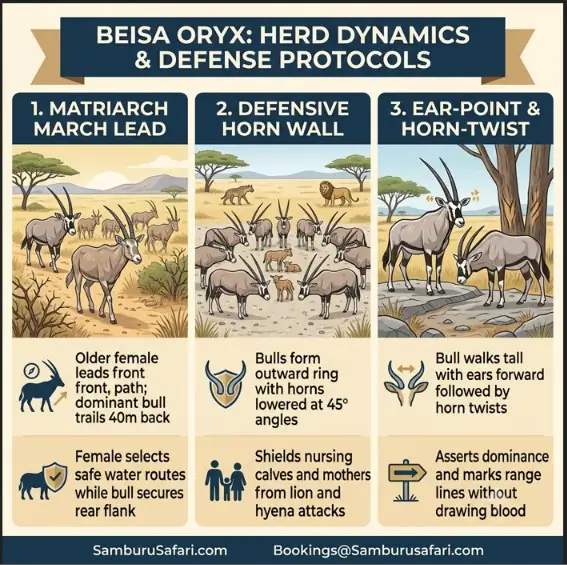
If you spot a herd crossing the gravel flats near Buffalo Springs at dawn, watch who is leading. It is almost never the biggest male. An old female takes the front, picking the path to water, while the dominant bull trails 40 yards behind to guard the rear.
Bulls keep order without wasting blood. A dominant male uses an ear-point display—walking tall with ears pushed forward and horns held high, followed by a slow, deliberate horn-twist. Subordinate males lower their heads, press their horns flat against their backs, and yield the track.
Along Loroki Ridge and near West Gate border tracks, territorial males mark home ranges of two to four square kilometers. They scrape their ringed horns against the bark of Commiphora (myrrh) and Boscia (shepherd’s) trees, leaving deep wood gouges and fragrant sap trails that warn off rivals. The same mineral-poor soil that sends the reticulated giraffe chewing on old bones keeps every browser here working hard for calcium.
If a lion pride corners a herd out on the open flats near Bisona Plains, the oryx do not scatter. Adult bulls form a tight outer ring facing outward with their horns lowered at a 45-degree angle. This wall of spears shields vulnerable calves and nursing mothers tucked safely inside. It is one of the few sights that will make the big cats of Samburu break off a hunt and look for easier prey. Those hunts mostly run at dusk and after dark, which is exactly why a conservancy night game drive shows you a side of the predator-prey standoff the day loops never will.
“Beisa oryx herd behavior” / “Beisa oryx defensive ring lion defense”
Social structure and collective defense are key to the survival of Beisa oryx herds surrounded by northern predators. Unlike species that flee indiscriminately when threatened, oryx maintain strict March orders and form coordinated physical barriers to safeguard vulnerable members. Territorial bulls also establish boundaries using subtle, visual horn signals rather than resorting to costly physical fights. This breakdown outlines the key social roles and defense tactics observed across Samburu’s open plains.
Social / Defensive Behavior | Action Details | Primary Purpose |
Matriarch March Lead | Older female leads front path; dominant bull trails 40m back | Female selects safe water routes while bull secures rear flank |
Defensive Horn Wall | Bulls form outward ring with horns lowered at 45° angles | Shields nursing calves and mothers from lion and hyena attacks |
Ear-Point & Horn-Twist | Bull walks tall with ears forward followed by horn twists | Asserts dominance and marks range lines without drawing blood |
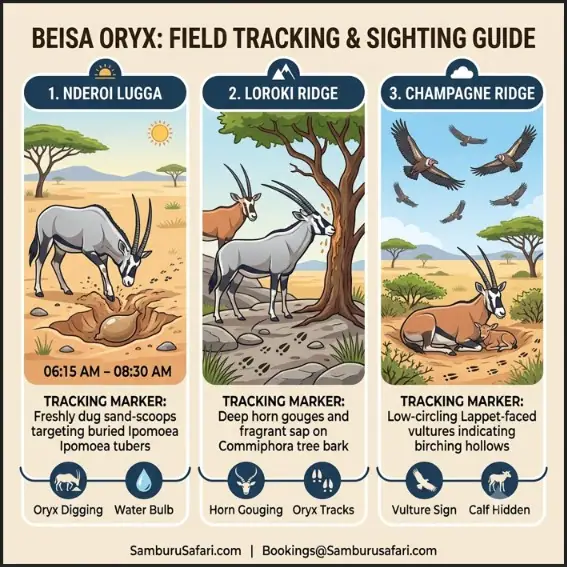
Finding herds takes patience and knowing where they feed during different hours of the day:
Those horns and vultures are just two entries on a reserve bird-and-mammal list that runs past 450 recorded species — worth a scan every time you stop.
“Where to find Beisa oryx in Samburu” / “How to track Beisa oryx”
Locating Beisa oryx across Samburu’s expansive terrain requires matching their daily routines to key geographic landforms. From early morning water bulb excavation in dry washouts to midday solar alignment under open scrub, field sign tells tracking guides exactly where a herd is heading. Recognizing territory marks on tree trunks and tracking scavenger activity also yields consistent sightings. This quick reference guide pairs prime Samburu locations with field signs for efficient tracking.
Key Samburu Location | Prime Activity Window | Tracking Marker / Field Cue |
Nderoi Lugga | 06:15 AM – 08:30 AM | Freshly dug sand-scoops targeting buried Ipomoea tubers |
Loroki Ridge | Morning / Late Afternoon | Deep horn gouges and fragrant sap on Commiphora tree bark |
Champagne Ridge | Seasonal (Calving Window) | Low-circling Lappet-faced vultures indicating birthing hollows |
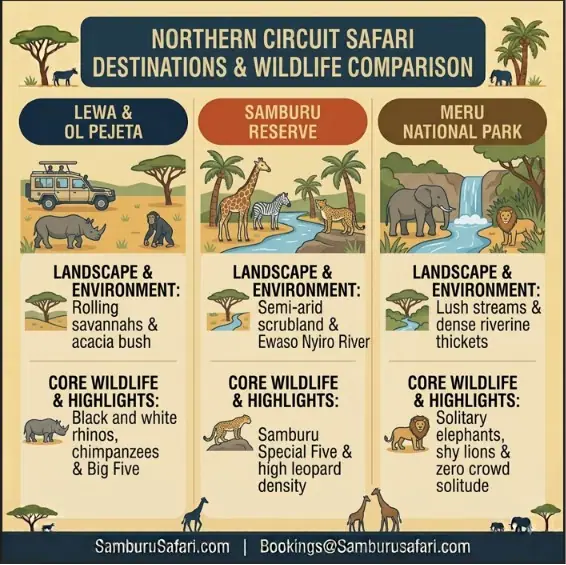
At Samburusafari.com, we design multi-destination itineraries that pair Samburu’s dry river circuits with neighboring highland areas like Ol Pejeta Conservancy. This setup lets you track desert specialists in Samburu before traveling south to see black rhinos and chimpanzees.
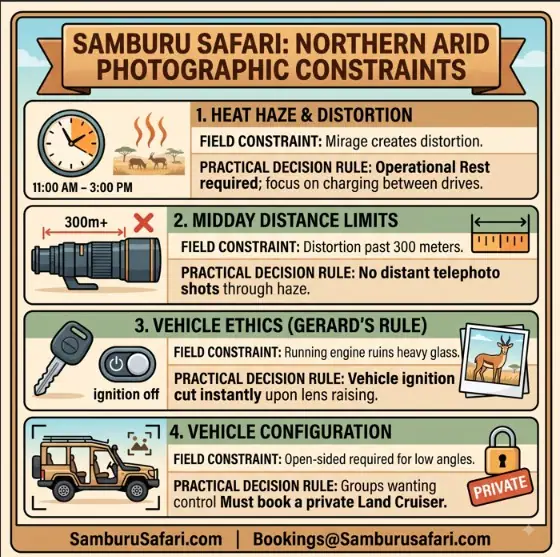
I was out on Bisona Plains with Benson last dry season, and his rule for oryx held up all week: shoot between 6:30 and 8:30, because once the shimmer starts rising off the gravel, a silver coat at fifty yards turns to soup. Every trip below rolls gate tickets, vehicle, guide, and lodging into one fixed price, and the full range sits under our Samburu safari packages.
The pricing table outlines our primary multi-destination packages for 2027, calculated for two adults sharing a private 4×4 Safari Land Cruiser.
Package | Trip & Lodges | Price Per Person |
Budget Overland Tier | 4D/3N road safari • Samburu Riverside Camp + Comfort Gardens Ol Pejeta • Private cruiser, driver-guide, full board | $1,480 — Get a quote |
Mid-Range Overland Tier | 4D/3N classic circuit • Samburu Simba Lodge + Sweetwaters Tented Camp • Waterhole views, rhino tracking, extended drives | $1,820 — Price this trip |
Luxury Fly-In Tier | 4D/3N premium air package • Elephant Bedroom Camp + Sanctuary Tambarare • Roundtrip bush flights, riverfront tents | $3,250 — Check dates |
Luxury Plus Sky Circuit | 4D/3N luxury flight loop • Sasaab Lodge + Ol Pejeta Bush Camp • All bush flights, open-front suites, night drives | $6,120 — Build my itinerary |
First-time guests often spot an oryx with only one horn and wonder if it is a distinct species. Horns lost during fights with predators or rival males do not grow back. When viewed directly from the side, a two-horned oryx’s horns align perfectly, creating the appearance of a single horn—the origin of early unicorn myths.
By 9:30 AM, heat radiating off volcanic stones creates thick air distortion that ruins long telephoto lens shots. Plan your photography drives between 6:15 AM and 8:30 AM when air is cool and light catches their silver coats cleanly.
Never. A cornered oryx bull will charge, and those horns are lethal to predators far larger than a person. Stay in the vehicle and keep a respectful distance from any herd holding a defensive formation on the open flats.
The Beisa oryx (Oryx beisa beisa) lives north of the Tana River in Samburu and has plain ears. The Fringe-Eared oryx (Oryx beisa callotis) lives south of the Tana River in Amboseli and Tsavo and features black hair tufts on its ear tips.
Beisa oryx can survive for extended stretches without surface water by extracting moisture from desert plants, tubers, and night-moistened foliage, while using internal cooling to prevent water loss.
No. Beisa oryx live exclusively in the dry northern circuit of Kenya, including Samburu, Buffalo Springs, Shaba, Meru, and Laikipia conservancies.
Herd tracks and calving-ground notes logged on the Bisona and Loroki loops by our guides. Last updated August 2026.
Message us directly for custom itineraries and the latest seasonal offers.