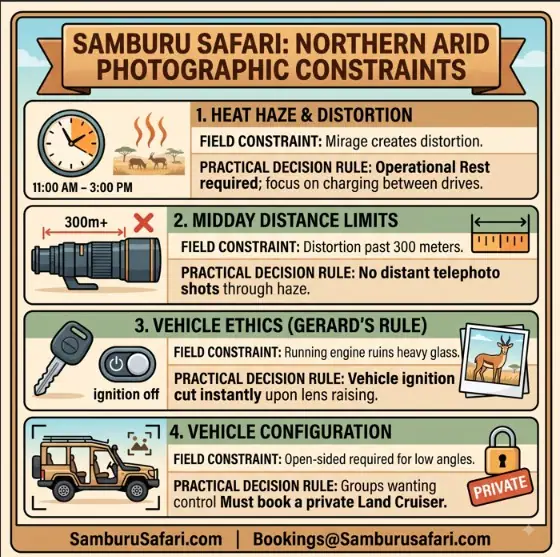

Picking the best time to visit Samburu can completely change what you see out on the tracks. This seasonal planning guide breaks down the dry months, the rainy transitions, and the hidden wilderness patterns that regular travel blogs miss. Learn how shifting water lines alter animal behaviors, find out how to budget for your park gate tickets, and find out when to book your trip to catch the top northern Kenya wildlife sightings.
The absolute best time to visit Samburu for a safari is during the long dry season from June to September and the short dry season from January to February. During these months, vegetation thins out and wildlife congregates predictably around the permanent waters of the Ewaso Nyiro River, offering the highest density of predator and prey sightings.
Season / Months | Average Temp (Day) | Rainfall Risk | Wildlife Tracking Conditions | Crowd Levels |
Cool Dry Season (June – August) | 28°C – 30°C | Low | Excellent: High concentration around the Ewaso Nyiro River. | High (Peak Season) |
Autumn Transition (Sept – December) | 30°C – 33°C | Moderate (Short Rains) | Good: Migratory birds arrive; scenery begins to green. | Medium |
Hot Dry Spell (January – March) | 32°C – 35°C | Very Low | Excellent: Arid conditions force game to permanent water holes. | Low to Medium |
Long Rains (April – May) | 29°C – 31°C | High (Heavy Storms) | Challenging: Wildlife scatters; high bush thickets reduce visibility. | Low (Green Season) |
The weather up in northern Kenya does not follow the same soft rules as the southern plains. Out here, the climate is brutal, direct, and shapes everything from the thickness of the thorn brush to the daily paths of the elephant herds. When you check out general vacation websites, they usually give you a flat summary of regional weather. They tell you to just go in July or January and leave it at that. But if you want a true, deep safari experience, you need to understand the weird, local natural shifts that happen on the ground week by week. If you are still mapping out the whole trip, start with our master Samburu safari guide, which covers routes, lodges, and costs in one place.
When you organize your timing through Samburusafari.com, you are accessing the actual daily field experience of our driving teams. Our senior travel coordinator Angie Muthoni monitors the upcountry rainfall gauges constantly because mountain storms miles away change the river tracks in a few hours. In the field, independent silver-level trackers like Gerard Murero know how to read the dry sand luggas to locate hidden predator prides when the heat index climbs past 90 degrees.
Gerard tells guests that every single month up north carries a specific environmental trade-off. He rarely hands over a single perfect date when people push him for one, because nature does not run on a clean loop. You learn the local seasons, or you end up sitting in camp staring at empty bush.
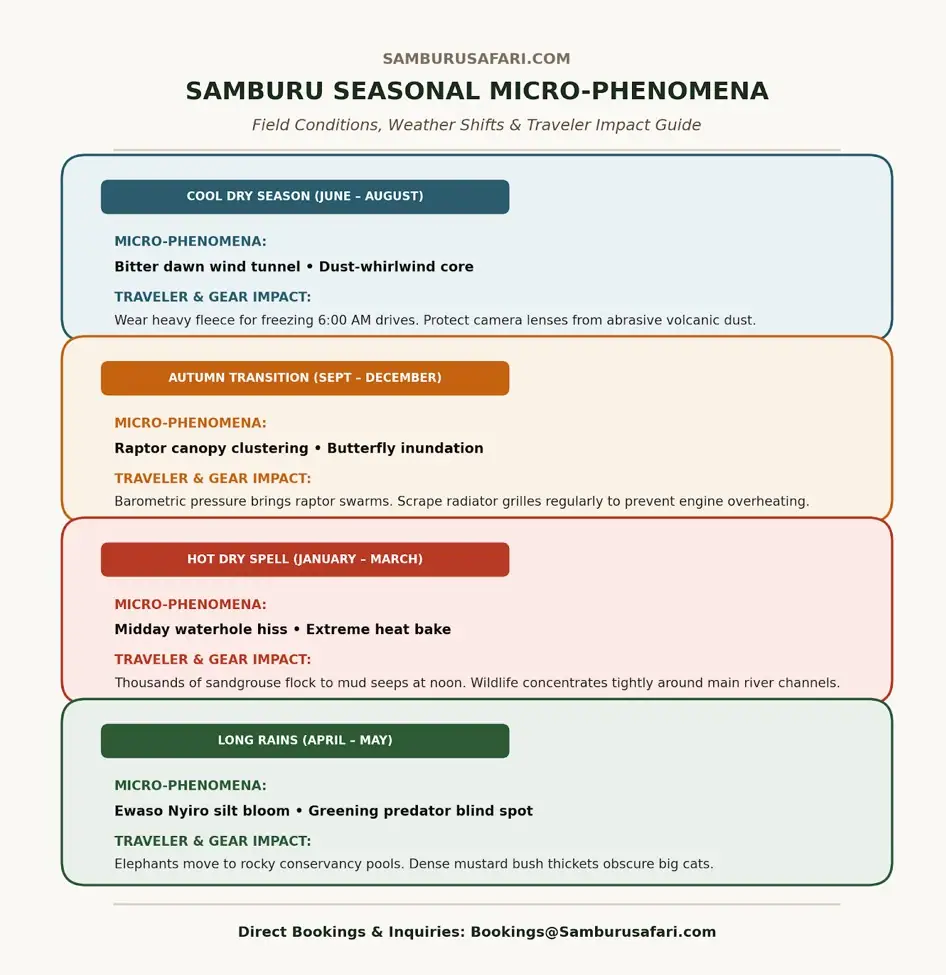
| Season / Months | Micro-Phenomenon | Traveler & Gear Impact |
Cool Dry
(June – August) | • Bitter dawn wind tunnel
• Dust-whirlwind core | • Wear heavy fleece for freezing 6:00 AM drives.
• Cover camera lenses to prevent volcanic dust damage. |
Autumn Transition
(Sept – Dec) | • Raptor canopy clustering
• Butterfly inundation | • High barometric pressure brings raptor swarms.
• Scrape radiator grilles to prevent engine overheating. |
Hot Dry
(Jan – March) | • Midday waterhole hiss
• Extreme heat bake | • Sandgrouse flock to wet mud seeps at noon.
• Game concentrates tightly around main river channels. |
Long Rains
(April – May) | • Ewaso Nyiro silt bloom
• Greening predator blind spot | • Elephants move to rocky conservancy pools.
• Thick vegetation obscures big cats in mustard bushes. |
June and July are widely listed as peak travel months, but many first-time travelers are shocked by what we call the bitter dawn wind tunnel. Even though the days are dry and hot, early morning drives between 5:45 AM and 7:00 AM can feel like a refrigerator. Cold mountain air drops off the snowy peaks of Mount Kenya and shoots directly across the low-lying northern scrub plains. If you only packed light linen clothes, you will freeze in an open-sided 4×4 cruiser until the sun fully clears the horizon after 7:30 AM.
Keep in mind that while this June-to-August stretch gives you the easiest animal tracking, it also brings the highest vehicle density along the main river loops. If you hate sharing sightings with other trucks, the short hot dry spell from January to March offers comparable wildlife viewing with significantly fewer crowds on the tracks. By late August, the terrain transitions into the dust-whirlwind core. This is the deepest part of the dry season. Sudden, localized mini-whirlwinds sweep across the open clay clearings of Buffalo Springs and the main reserve. If you are a photographer, you must roll up your truck windows the second you see these wind eddies approaching on the flats. The microscopic red volcanic dust is highly abrasive and will permanently jam a DSLR camera lens barrel or mirror mechanism in seconds. Our safari photography gear guide covers the sealed bags and dust covers that actually survive this season.
October brings a shift that we call the migratory raptor canopy clustering. In the two weeks just before the short rains break, the humidity spikes dramatically. If you watch the old, dead acacia branches along the ridge lines, you will see hundreds of arriving Amur falcons and lesser kestrels packing the canopy. They gather in these massive numbers to target the swarms of flying termites triggered by the sudden drops in barometric pressure.
Once the short November rains settle the desert dirt, the entire reserve rings with the Vulturine Guineafowl breeding chorus. This is easily the loudest time of the year in the bush. These massive, blue-breasted birds gather in huge breeding flocks under the riverine trees. Their high-pitched, metallic rattling calls completely dominate the canopy at sunrise. It is a spectacular sound for birders, but if you are a light sleeper, you should probably bring a pair of earplugs for dawn.
By early December, the short rains stop, triggering the butterfly inundation. Within ten days of the last storm, a massive flurry of yellow and white pierid butterflies explodes across the northern circuit. You will find yourself driving through literal blizzards of butterflies along the river loops. It looks amazing in photos, but it creates a serious mechanical issue for your truck. Your driver will have to pull over every few miles to manually scrape the crushed insects out of the Land Cruiser’s front radiator mesh grille to keep the engine from overheating in the mid-morning sun.
January and February bring intense, baking heat. The grass burns down to open dirt, and smaller streams vanish completely. If you park your vehicle quietly near the remaining mud seeps at noon, you will notice a strange acoustic phenomenon known as the midday waterhole hiss. When the wind drops, the mud holes produce a loud, continuous buzzing sound. This noise comes from thousands of sandgrouse dropping out of the sky at the exact same time. They crowd the wet mud to soak their specialized belly feathers, carrying water back to their chicks hidden miles away in the burning scrub.
Late April brings the peak of the long rains, causing the Ewaso Nyiro silt bloom. The river swells rapidly, turning into a thick, swirling soup of dark red topsoil washed down from the farmed highlands upcountry. Our local elephant families actually avoid drinking from the main river channels during these high-silt weeks. The heavy red grit irritates the delicate inner lining of their trunks. Instead, the herds shift their movements into the private community conservancies to drink from clean rainwater pools that gather on the flat basalt rock shelves. Standing water across the plains also increases mosquito activity during these weeks. Read our guide to travel health in northern Kenya before booking these green shoulder months so your malaria plan is sorted early.
By May, the heavy storms fade, opening up the greening predator blind spot. The air becomes completely dust-free, and the red volcanic cliffs of Mount Ololokwe stand out sharply against a sea of bright emerald bushes. It is stunningly beautiful, but tracking leopards becomes twice as difficult. The big cats cheat by tucking deep into the newly leafed, eye-level thickets of Salvadora persica (the local Mustard bush). To find them, your guide cannot just drive the loops; they have to execute dead-stop engine cuts every few hundred yards to listen for the specific alarm calls of baboons and vervet monkeys.
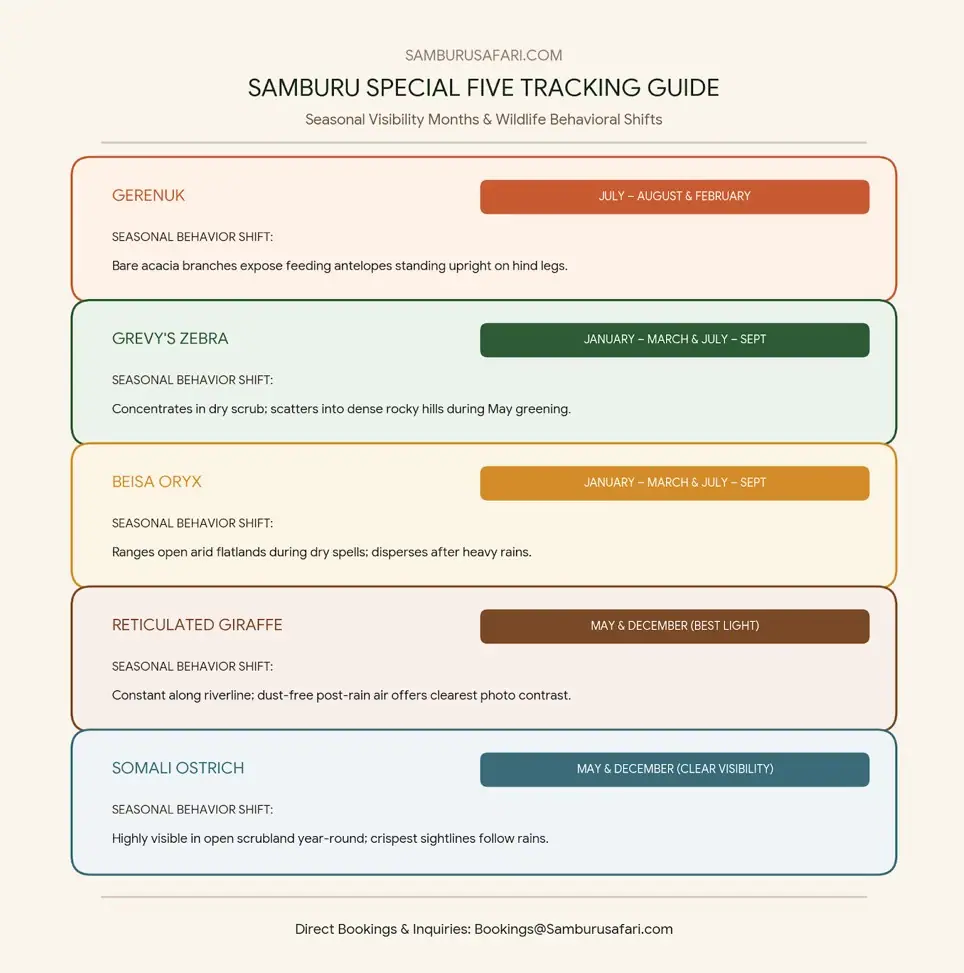
Unlike southern destinations, the primary drawcard up north is our resident rare northern species. Because they do not migrate out of the ecosystem, your seasonal timing alters their visibility, not their actual presence in the bush:
This quick-reference chart breaks down when and where to track each unique northern species.
Species | Peak Visibility Months | Seasonal Behavior Shift |
Gerenuk | July – August & February | Bare acacia branches expose feeding antelopes standing upright on hind legs. |
Grevy’s Zebra | January – March & July – Sept | Concentrates in dry scrub; scatters into dense rocky hills during May greening. |
Beisa Oryx | January – March & July – Sept | Ranges open arid flatlands during dry spells; disperses after heavy rains. |
Reticulated Giraffe | May & December (Best Photo Light) | Constant along riverline; dust-free post-rain air offers clearest photographic contrast. |
Somali Ostrich | May & December (Clear Visibility) | Highly visible in open scrubland year-round; crispest sightlines follow rains. |
No matter what month you choose for your trip, navigating the local county gate systems requires pre-planning. This northern zone is not managed by the central Kenya Wildlife Service network. Instead, the land is co-managed directly by the Samburu County Government and the Isiolo County Council.
Your mandatory park entry fees for Samburu National Reserve must be uploaded and cleared before your truck reaches the gate barrier. Do not plan on setting up your online account while sitting at the entrance booth; register on the official government eCitizen Kenya portal days before you travel. Mobile internet connectivity drops out entirely for long miles on the main highway past Isiolo town. If you do not have a physical paper printout or a digital PDF copy of your cleared eCitizen invoice saved directly to your phone storage, the gate rangers will hold your vehicle at the barrier.
Another issue to watch out for is the credit card setup at the regional entry gates. If you have sudden itinerary adjustments or extra vehicle fees, trying to swipe a card at the gate offices often hits you with a hidden 7% card surcharge from the local processing banks. Carrying extra cash USD avoids this billing issue entirely.
Visitor Category | Samburu National Reserve (Daily) | Buffalo Springs / Shaba | Vehicle & Aircraft Tariffs |
Non-Resident Adult | $85 USD | $70 – $80 USD | Safari Cruiser / Van: KES 1,000 |
Non-Resident Child | $50 USD | $40 USD | Saloon Car / Small SUV: KES 300 |
EAC Resident Adult | KES 1,600 | KES 1,000 | Light Aircraft Landing: KES 4,800 |
Kenyan Citizen Adult | KES 800 | KES 500 | Public Campsite Fee: $20 / KES 600 |
Gate tickets are only one line on your trip budget. Our full Samburu price guide breaks down vehicle hire rates, tipping habits, and flight costs so you can see the complete daily math before committing to dates.
Once your numbers make sense, take a look at our Samburu safari packages to see how we structure our travel days and routing plans around these dynamic wildlife patterns.
When booking your Samburu safari, the type of vehicle you choose shapes your entire experience. Budget operators frequently offer tours in standard two-wheel-drive safari minibuses or vans. While these vans are perfectly fine for the smooth tarmac highway leading up from Nairobi, they quickly face serious challenges once you pass through Archer’s Gate.
The tracks throughout this region consist of deep, soft river sand, sharp volcanic stones, and steep lugga crossings. A standard safari van lacks the ground clearance and the heavy-duty four-wheel-drive low-range gears needed to pull through these traps. Our team uses modified 4×4 Safari Land Cruisers. The superior suspension handles the rough corrugated roads easily, and the higher seating position gives you a much clearer view over the thick thorn bushes when tracking animals. A solid 4×4 vehicle saves you from getting stuck in remote areas where recovery trucks take hours to reach you. Planning to skip the tour vehicle entirely and rent your own? Read our practical guide to driving in Samburu before you commit to a rental.
A common mistake we see travelers make is assuming that the entire northern circuit has the same driving rules. Inside the official borders of the main public reserve, you are under strict reserve regulations enforced by the county. Your driver must keep the vehicle on the pre-marked dirt tracks at all times, and every truck must be back inside their lodge gates by 6:30 PM.
If you want the freedom of off-road tracking to follow a leopard into the brush, or if you want to use night-vision spotters after dark, you need to alter your itinerary layout. We recommend spending at least two nights inside the adjacent community lands like the Kalama, West Gate, or Namunyak Conservancies. These areas are run directly by local communities, allowing for guided walking safaris and evening spot-lighting drives that are completely banned inside the public reserve.
To get the most out of your trip, you have to look at the whole map. Samburu National Reserve is just one piece of a giant, connected wilderness. It sits right next to Buffalo Springs National Reserve, which is just across the water on the south side. Shaba National Reserve sits just to the east. Animals do not care about park borders; they cross back and forth constantly. On a typical morning drive, you will likely cross the concrete low-water tracks between Samburu and Buffalo Springs multiple times.
You must be careful with those concrete low-water tracks, though. They look simple, but they act as major high-water traps. If a sudden mountain storm hits the Aberdares or Mount Kenya hills miles upcountry, a wall of water rushes down the channel. A dry crossing can turn into a roaring, impassable muddy barrier in under forty minutes, splitting your morning tracking route in half.
The Ewaso Nyiro River keeps this whole dry country alive. Without this muddy brown water line, the wildlife could not survive the midday sun. Dense groves of Doum Palms grow along the banks, giving elephants and big cats a cool place to hide when the heat gets heavy.
When you are out on the river tracks, you learn to use specific land markers. Passing the old Isiolo Bridge means you are heading into the thicker, quieter patches of the forest. If you pull your truck up to the high banks at Crocodile Point, you can look straight down at massive Nile crocodiles sleeping on the open sandbars.
Where you choose to sleep depends on what you want to spend and how close you want to be to the wild animals. The choices are split between canvas tents pitched right on the river banks and high-end eco-lodges built up on the rocky hills.
If you want that old-school safari feel, stay by the water. Places like Elephant Bedroom Camp put you right on the natural wildlife paths. But you have to accept how these riverside locations operate. These properties sit inside active corridor paths, meaning wild elephants walk straight through the guest pathways to eat the palm nuts. We frequently deal with “corridor camp holds.” Your lunch schedule or game drive departure might be delayed for an hour because a bull elephant decided to stand directly next to your wooden guest walkway, forcing a temporary room lockdown until he moves on.
Another practical lodging issue is the solar power bottleneck. Many riverside tents run on simple independent solar loops. You will often find only two wall sockets and one single USB port for the whole cabin. If you are traveling as a pair with multiple camera bodies, drones, and phone battery banks, a compact multi-plug extension power strip in your bag is non-negotiable.
If you want massive views and zero crowds, look at the lodges inside the private community conservancies, where amenities run to private stone plunge pools, open-front rooms, and night tracking drives. At night in these conservancies, we use specialized ultraviolet torches. Under the UV beams, burrowing desert scorpions glow a bright, radioactive green against the dark sand.
When you lay back at night, look up. Because you are sitting right on the equator with zero light pollution, you can experience dual-hemisphere star sightings. You can track the northern Big Dipper and the southern Southern Cross constellations in the same clear sky. Locals call this blazing band of the Milky Way the Ntapar sky.
While exploring the tree lines, keep your eyes open for the local vervet monkeys. The dominant males display glowing, bright neon-blue skin markings on their genitalia. During active breeding weeks, these markings shift into an incredibly sharp, radioactive shade of blue that you can spot from yards away through binoculars.
To see how the elephant herds are tracked and managed, our trips often stop by the research huts run by the Save the Elephants conservation network, whose field team monitors collar data from these families year-round.
To design a balanced regional trip, you should look beyond the main river loops and incorporate specialized conservation projects nearby:
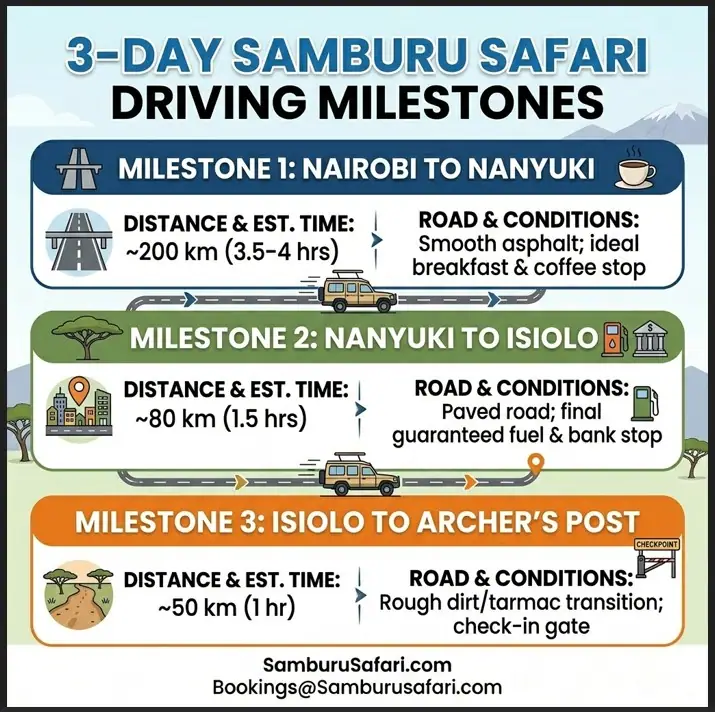
If you want a quick, logistically smooth run that hits the best tracking loops, here is how we lay out our standard three days on the ground:
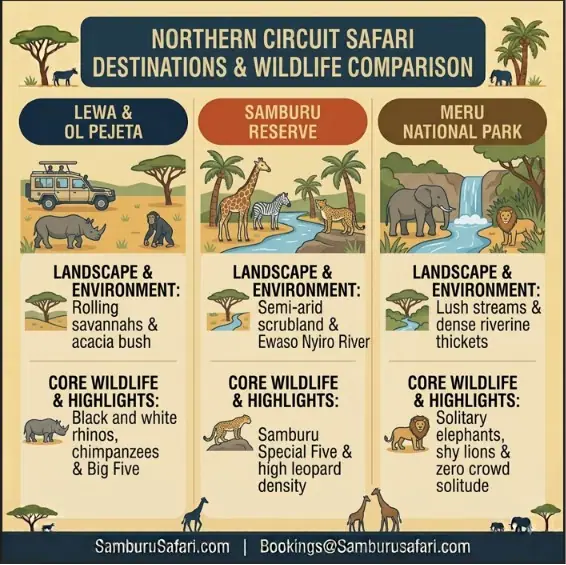
Our ground team does not recommend booking more than three nights in a single isolated reserve. The most rewarding way to see the region is to combine the dry northern plains with a private rhino sanctuary down in the closer highlands. Our standard multi-destination trips loop directly into the neighboring Ol Pejeta Conservancy to give you a complete contrast of environments without long, exhausting days on the highway.
Review our standard routing packages below to see how we tailor our daily tracking runs around the local regional weather shifts.
The pricing table below displays the total all-inclusive cost per person, calculated for two people traveling together in a private 4×4 Safari Land Cruiser. So there are no surprises when the invoice arrives, here is exactly what your money covers — and what it does not.
Package | Trip & Lodges | Price Per Person |
Budget Tier | 4D/3N road safari • Samburu Riverside Camp + Comfort Gardens Ol Pejeta • Full board, private 4×4, daily game drives | $1,340 — 👉 Book Now |
Mid-Range Tier | 4D/3N road trip • Samburu Simba Lodge + Sweetwaters Tented Camp • Waterhole views, extended drives | $1,720 — 👉 Book Now |
Express Fly-In Mini | 3D/2N getaway • Larsens Camp (Samburu only) • Wilson Airport flights included | $1,980 — 👉 Book Now |
Luxury Tier | 4D/3N luxury tented stay • Elephant Bedroom Camp + Sanctuary Tambarare • Riverside access, evening drives | $2,450 — 👉 Book Now |
Private Photographic Tour | 5D/4N tailored route • Elephant Bedroom Camp + Sanctuary Tambarare • Open-view cruiser, big-cat focus | $3,100 — 👉 Book Now |
The Deep North Circuit | 7D/6N complete loop • Samburu Simba + Sarara Camp + Sweetwaters • Mountain trekking, rhino tracking | $3,850 — 👉 Book Now |
Luxury Plus Tier | 4D/3N fly-in package • Sasaab Lodge + Ol Pejeta Bush Camp • Return flights, total privacy | $5,120 — 👉 Book Now |
If you pack the wrong clothing styles, the climate up north will make your morning game drives miserable. Because the plains sit at a lower altitude than Nairobi, the midday sun handles raw heat, but the early mornings are freezing.
When you leave camp at 6:00 AM, the wind rushing through an open-sided tracking vehicle is biting. You will want a heavy fleece jacket or a lined windbreaker that you can easily layer down as the sun climbs higher. To verify you have covered all critical gear and seasonal footwear requirements before departure, check our Samburu safari packing list.
Stick strictly to lightweight, highly breathable, neutral-colored clothing styles like khaki, tan, or olive drab. Avoid packing solid dark blues or deep blacks; these specific shades actively attract biting tsetse flies when driving through thick river brush, and their stings are incredibly painful. A wide-brimmed sun hat, high-factor sunscreen, polarized sunglasses, and a heavy-duty dust cover for your camera lenses are essential items for the field.
When your travel dates are locked in, request a custom quote and our team will match your chosen season to the right camps and tracking routes.
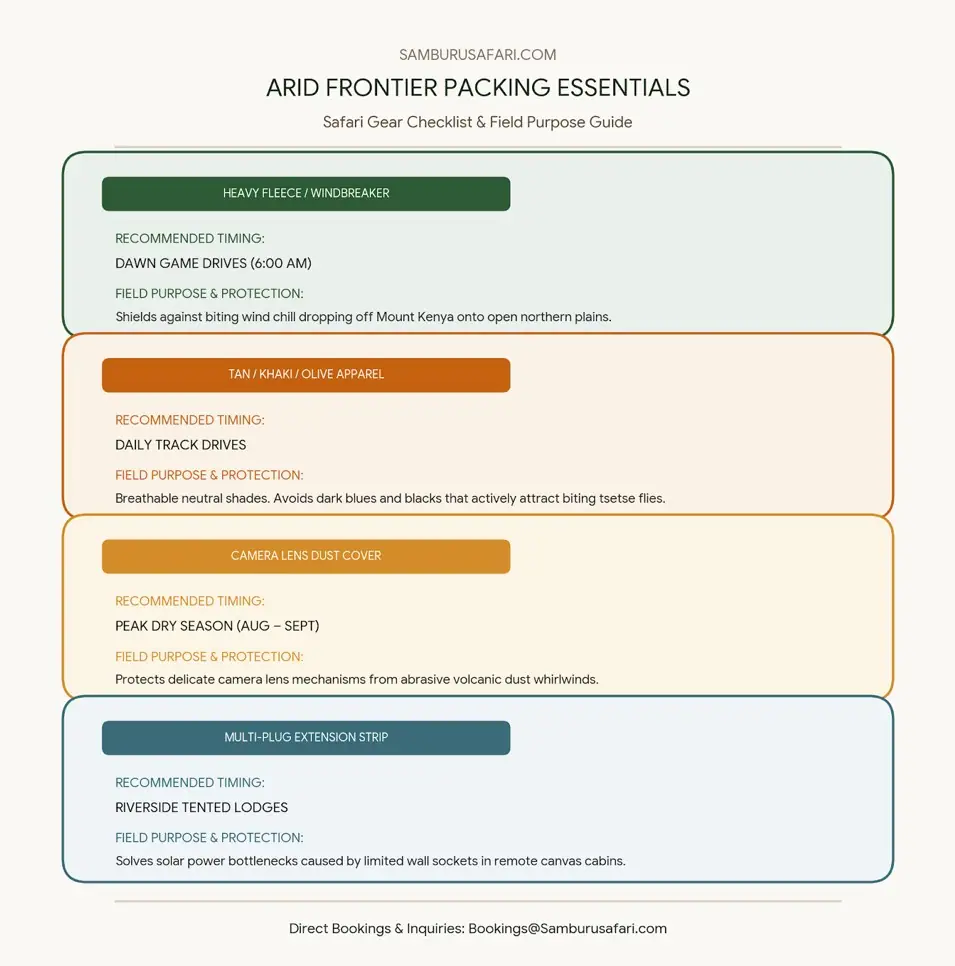
Reference this field-tested checklist to build your ultimate northern safari pack.
Essential Gear Item | Recommended Condition | Field Purpose & Protection |
Heavy Fleece / Windbreaker | Dawn Game Drives (6:00 AM) | Shields against biting wind chill dropping off Mount Kenya onto open plains. |
Tan / Khaki / Olive Apparel | Daily Track Drives | Breathable neutral shades; avoids dark blues/blacks that attract biting tsetse flies. |
Camera Lens Dust Cover | Peak Dry Season (Aug – Sept) | Protects delicate camera mechanisms from abrasive volcanic dust whirlwinds. |
Multi-Plug Extension Strip | Riverside Tented Lodges | Solves solar power bottlenecks with limited outlet sockets in canvas cabins. |
The peak dry months of July, August, and September offer the most reliable elephant encounters. As the smaller bush waterholes dry up across the northern frontier, hundreds of elephants are forced to congregate along the permanent banks of the Ewaso Nyiro River to drink and forage.
During extreme dry years, the Ewaso Nyiro River can stop flowing on the surface, leaving a dry bed of sand. However, water still moves underneath. You can watch the local elephant families use their feet and trunks to scoop out deep wells in the sand to access this clean, subterranean water.
No, this region does not experience a massive seasonal migration of wildebeest or zebra. Most of our unique northern species, like the Grevy’s zebra and the reticulated giraffe, are resident year-round. Their movements are localized, shifting between the public reserves and the community conservancies based on where the recent showers fell.
Message us directly for custom itineraries and the latest seasonal offers.