
Quick Answer: 7-Day Classic Route: Nairobi → Laikipia/Lewa (2 days) → Samburu National Reserve (2 days) → Meru National Park (2 days) → Nairobi. 10–12 Day Remote Pioneer Route: extends from Samburu north into Sera Rhino Sanctuary, the Mathews Range (Kitich Forest walking safaris), and Marsabit Mountain cloud forests or Lake Turkana. Best Time to Go: July to October & January to March (peak dry season).
Written by Angie Muthoni. Reviewed by Gerard Murero.
We design multi-destination itineraries combining Samburu with Ol Pejeta, Lewa, Meru, or the Mathews Range. Browse the full catalogue of Samburu safari packages for shorter options and every price tier.
The table details our 2026 / 2027 multi-destination packages for two adults sharing a private 4×4 Safari Land Cruiser.
Package | Trip & Destinations | Price Per Person |
Budget Overland Tier | 4D/3N road safari • Samburu Riverside Camp + Comfort Gardens Ol Pejeta • Private cruiser, driver-guide, full board and game drives | $1,480 — Get a quote |
Mid-Range Northern Circuit | 5D/4N classic circuit • Sweetwaters Tented Camp + Samburu Simba Lodge • Rhino sanctuary, waterhole lodge, river drives, full board | $2,280 — Price this trip |
Luxury Fly-In Circuit | 6D/5N premium air loop • Elephant Bedroom (Samburu) + Lewa Safari Camp • Bush flights from Wilson, triangle hops, open 4×4 drives, conservancy fees | $4,150 — Check dates |
Luxury Plus Sky Circuit | 7D/6N remote wilderness loop • Sasaab Lodge (Samburu) + Kitich Forest Camp (Mathews) • Private flights, guided walking safaris, spa, eco-villas, Samburu trackers | $7,850 — Build my itinerary |
Inclusions: Full board, private 4×4 Safari Land Cruiser, TRA-licensed guide, park and conservancy fees, AMREF flying doctor cover, regional flights on fly-in options.
Exclusions: International flights, e-visas, personal insurance, premium drinks, laundry, tips, manyatta fees ($20–$30 USD), Reteti entry fees.
Travelling on a tighter budget? Our scheduled group joining departures share the vehicle cost without cutting the route short. Couples building a longer trip should look at the honeymoon circuit, which runs the same north with private vehicles and bush dinners built in.
Choosing a northern kenya safari itinerary trades busy Maasai Mara minibus queues for vast open wilderness, low tourist numbers, and rare endemic species. Up here you track the Samburu Special Five: reticulated giraffes with sharp liver-red net patterns, Grevy’s zebras with fine pinstripes, Beisa oryx, gerenuks browsing upright on two legs, and blue-necked Somali ostriches.
You smell crushed sage when the 4×4 brushes past acacia thickets, feel dry 35°C heat, and hear baboons squabbling on tin camp roofs at night. If Samburu itself is new to you, the master Samburu safari guide covers the wildlife, seasons, and lodges that anchor this whole circuit.
If you want both landscapes in one trip, our combined Maasai Mara and Samburu package contrasts the two ecosystems end to end.
“Best northern kenya safari destinations” / “where to go northern kenya circuit”
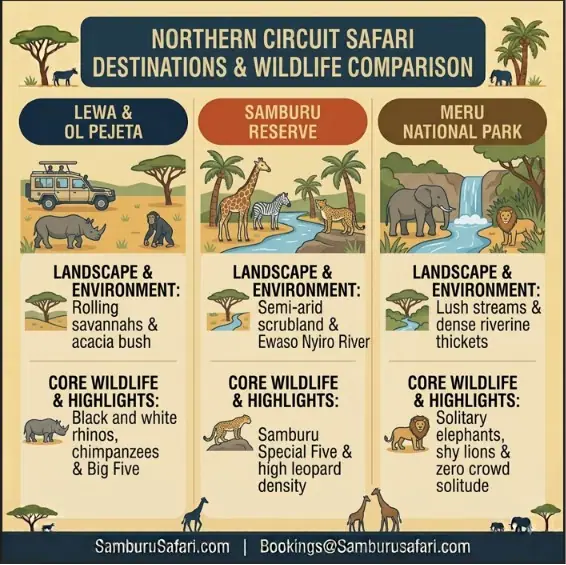
Planning a northern Kenya safari itinerary requires balancing iconic wildlife viewings with distinct wilderness landscapes. From private rhino sanctuaries in Laikipia to the arid riverine loops of Samburu and the isolated wilderness of Meru, each park offers a specialized highlight. The comparison matrix below outlines primary wildlife focuses, landscape types, and optimal night stays for core destinations along the circuit.
Destination | Landscape & Environment | Core Wildlife & Highlights |
Lewa & Ol Pejeta | Rolling savannahs & acacia bush | Black and white rhinos, chimpanzees & Big Five |
Samburu Reserve | Semi-arid scrubland & Ewaso Nyiro River | Samburu Special Five & high leopard density |
Meru National Park | Lush streams & dense riverine thickets | Solitary elephants, shy lions & zero crowd solitude |
Leg / Route Sector | Distance | Drive Time (4×4) | Flight Time | Surface Type |
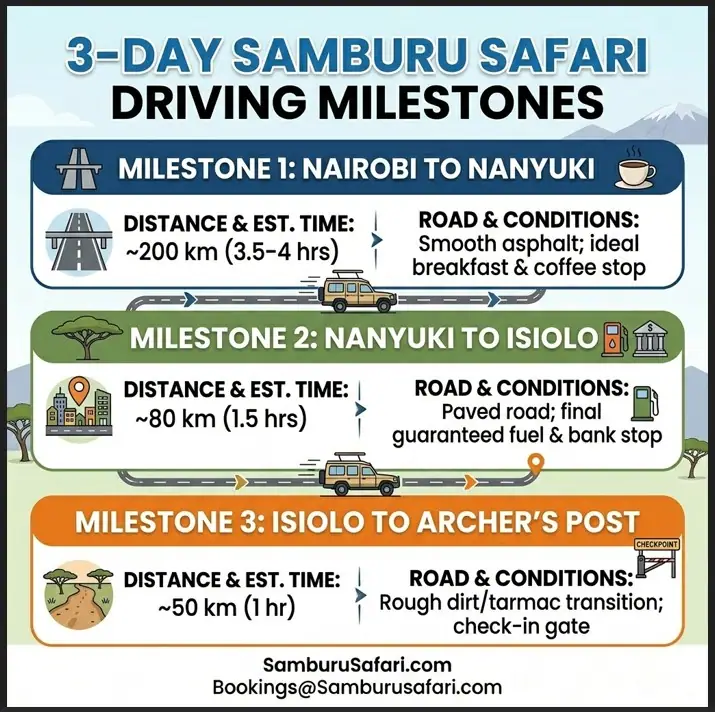
Nairobi → Nanyuki / Lewa | 240 km | 4.0 – 4.5 hrs | 45 min | Smooth tarmac (A2 Highway) |
Lewa → Samburu (Archer’s Post) | 65 km | 1.5 hrs | 15 min | Tarmac to red murram dust |
Samburu → Meru National Park | 120 km | 2.5 – 3.0 hrs | 20 min | Paved Muriri-Ruiri / dirt tracks |
Samburu → Mathews Range (Kitich) | 140 km | 3.5 – 4.0 hrs | Helicopter / charter | Lava track & dry luggas |
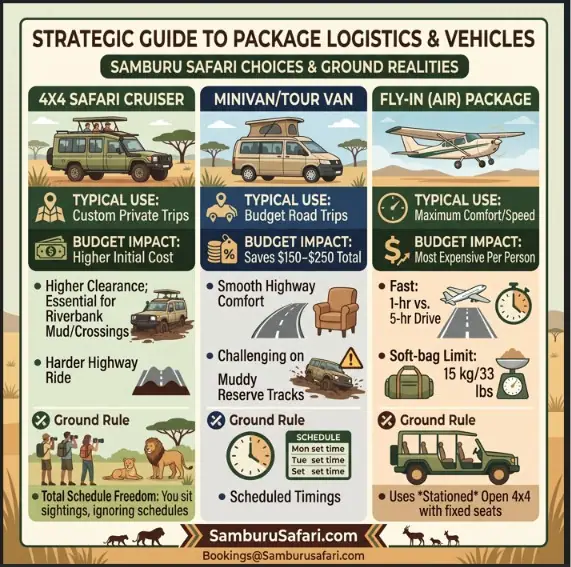
Decision Factor | Overland 4×4 Safari | Fly-In Bush Circuit |
Best For | Budget flexibility, scenery, village stops | Limited time, avoiding rough dirt tracks |
Average Cost Impact | Lower ($1,480–$2,500/pp) | Higher ($4,000–$8,000+/pp) |
Transit Time | 4–6 hrs between hubs | 15–45 min bush hops |
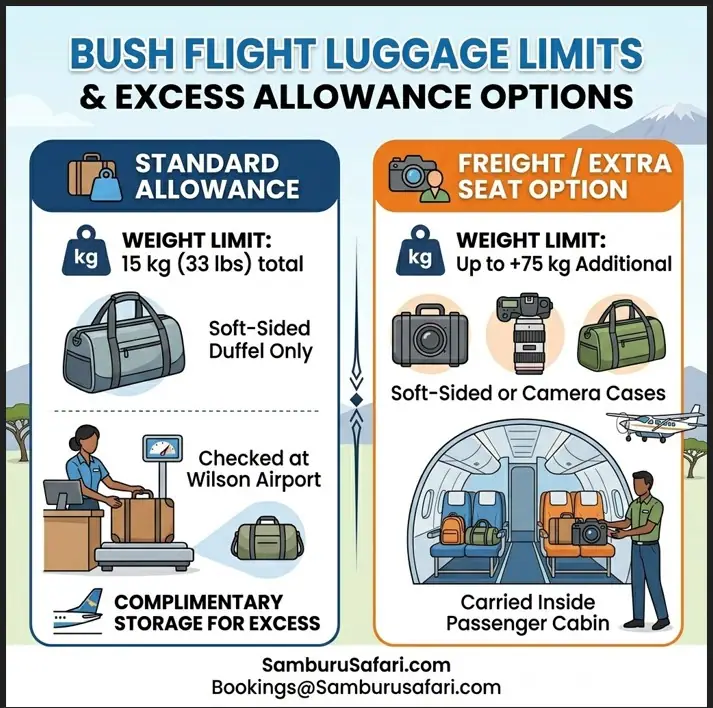
Luggage Restriction | Hard suitcases allowed | Soft duffel bags only (15 kg / 33 lbs) |
Our dedicated fly-in safari package covers the Wilson Airport connections, airstrip transfers, and luggage rules in detail. Groups of four or more should price a private Land Cruiser hire against four bush flight tickets before deciding.
This is the core circuit for first-time visitors, pairing private rhino conservancies with riverine game drives and quiet wilderness parks.
Morning: Depart Nairobi along the A2 toward Nanyuki. Enter Ol Pejeta or Lewa by midday.
Afternoon: At Ol Pejeta, visit Najin and Fatu — the world’s last two Northern White Rhinos — and Kenya’s only chimpanzee sanctuary. At Lewa, track black and white rhinos across open savannah. Combining Lewa and Borana, you cross between both on a single ticket thanks to the removed boundary fences.
If you only have four days rather than seven, the Samburu and Ol Pejeta combo covers this rhino-plus-river pairing on its own.
Gerard’s field note: “People ask whether Oryx or Kalama airstrip is better for rhinos. The truth is Samburu has no rhinos. If a black rhino is top of your list, spend the first two days at Lewa or Ol Pejeta. Once we cross north past Isiolo we trade rhino country for big cats and the Special Five.”
Wildlife focus: The Samburu Special Five along the banks of the Ewaso Nyiro.
Morning: Dawn drives along the river loops where leopards hunt among the Doum palms. Visit Reteti Elephant Sanctuary in Namunyak to watch keepers bottle-feed rescued calves.
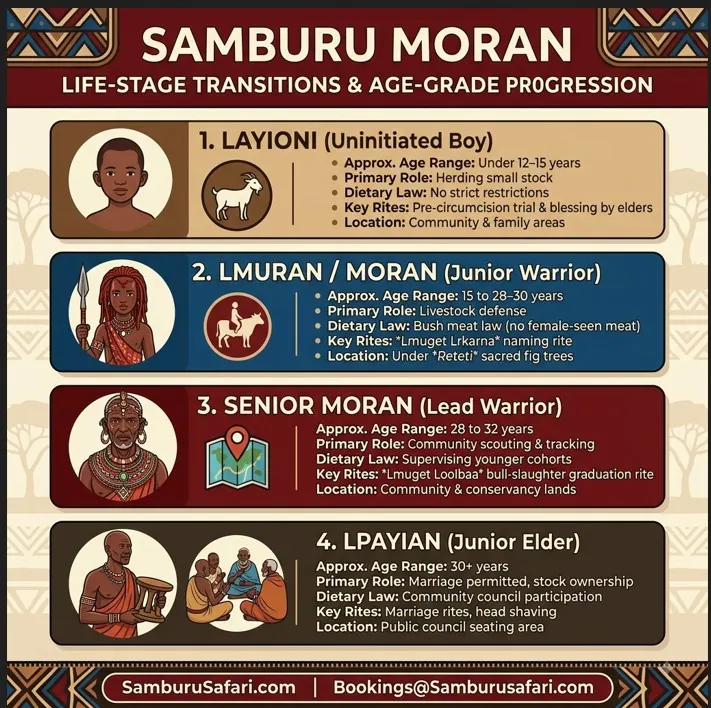
Afternoon: In the dry months, visit the singing wells. Warriors dig deep water holes in the dry riverbeds and sing traditional family chants to call their cattle down to drink. It is one of the few genuinely unstaged cultural experiences left on the circuit.
Bridge logistics: During heavy rains, a mountain storm can submerge low concrete crossings like Archer’s Bridge within hours. If you are on the north bank when the river rises, shift the afternoon drive to dry interior loops like Koitogor rather than gambling on the crossing.
Morning: Drive 2.5 hours east into Meru, dropping into a lush valley fed by permanent streams.
Afternoon: Game drives in near-total solitude. Adding Meru drops vehicle numbers to almost zero. But the animals here — shy forest elephants, solitary leopards — are far less used to engines than Samburu’s herds. Cut the engine early and hold wider distances so they stay settled.
Morning: Sunrise drive, check out, and the drive south. Grab roasted maize or a cold Stoney Tangawizi at the Equator marker near Nanyuki, then charcoal-grilled trout at Trout Tree before reaching Nairobi by late afternoon.
“7 day vs 10 day northern kenya safari itinerary” / “how many days northern kenya safari”
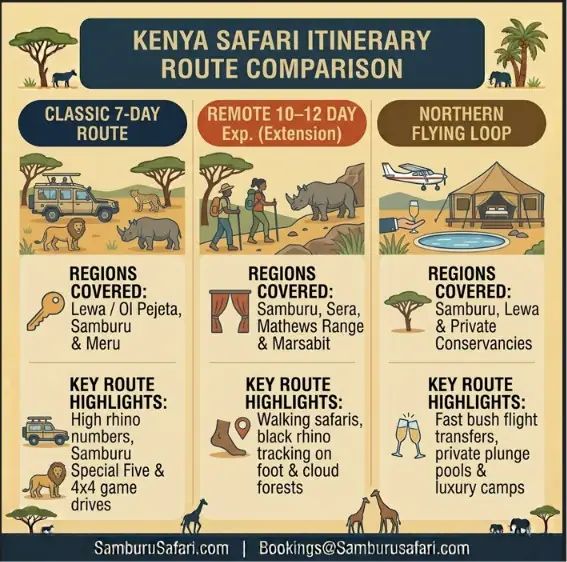
Deciding between a classic 7-day wildlife route and an extended 10 to 12-day pioneer expedition depends on your budget, time, and appetite for remote adventure. While shorter itineraries focus on high-density wildlife hubs, longer routes venture into ancient mountain forests and crater lakes. Review the matrix below to match your travel goals with the ideal route duration.
Circuit Option | Regions Covered | Key Route Highlights |
Classic 7-Day Route | Lewa / Ol Pejeta, Samburu & Meru | High rhino numbers, Samburu Special Five & 4×4 game drives |
Remote 10–12 Day Route | Samburu, Sera, Mathews Range & Marsabit | Walking safaris, black rhino tracking on foot & cloud forests |
Northern Flying Loop | Samburu, Lewa & Private Conservancies | Fast bush flight transfers, private plunge pools & luxury camps |
Extend the 7-day route north into mountain forests, rhino sanctuaries, desert craters, and remote lakes.
Sera Rhino Sanctuary: Just north of Samburu in Namunyak, Sera is the only place in East Africa where guests track black rhinos on foot inside a community conservancy. Managed under the Northern Rangelands Trust, your conservancy fees fund Samburu Moran ranger patrols and local water boreholes.
Walking safari shift: The moment you step into the Mathews Range you leave the Land Cruiser behind, tracking forest elephants on foot through podocarpus alongside Samburu warriors.
Highlights: Ancient mountain forest with no vehicle tracks at all. Melanistic leopards, forest elephants, and rare De Brazza’s monkeys along the dry sand luggas.
The cloud forest surprise: Driving north toward Lake Paradise inside Marsabit National Park brings a genuine climate shift. Travellers expect desert heat and find an isolated high-altitude cloud forest instead — heavy morning mist and 15°C temperatures that call for fleece jackets and moisture protection for cameras until the midday sun breaks through.
Lake Turkana: Option to extend west to the Jade Sea and Central Island National Park, by helicopter over Mount Kulal or rugged 4×4 overland tracks.
Photographers running this far north should look at our custom photographic safari, which builds the route around light windows rather than driving distances.
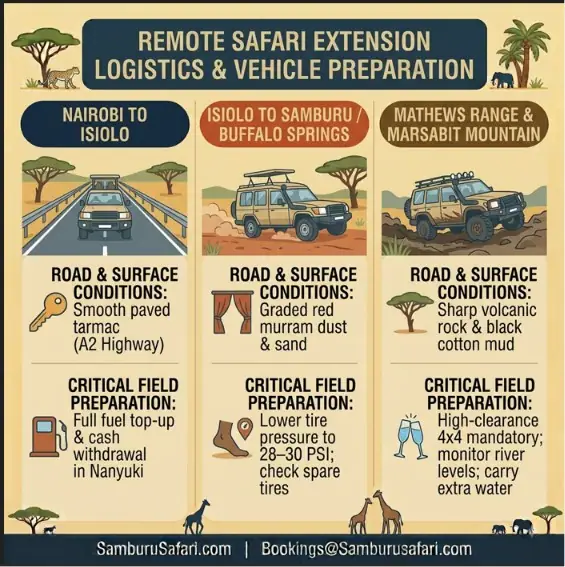
An overland northern circuit shifts through three terrain tiers:
Once you clear Isiolo and hit the murram, pull over and drop tire pressure to about 28–30 PSI. Driving rock-hard tires across volcanic lava is a quick way to slice a sidewall.
Nanyuki is the hard operational boundary for the trip. Past Nanyuki and Isiolo, international card ATMs get scarce, mobile money agents dry up, and rural fuel quality degrades. Fill the tank completely in Nanyuki and withdraw cash there.
Note that gate entry fees themselves are pre-paid online and the barriers are cashless — the cash you carry is for village visits, manyatta entry, tips, roadside repairs, and the community fees that local agents collect directly. Crisp Kenyan Shillings, and bring more than you think.
Moving between Samburu, Meru, and Laikipia means clearing administrative barriers around Isiolo and the Archer’s Post police post. Guides who keep guest passports and printed entry passes in a dashboard folder avoid 30-minute side-parking inspections.
On fly-in itineraries linking Samburu to Meru or Lewa, regional carriers operate triangle routing (Wilson → Samburu → Lewa → Meru → Wilson). You do not fly back to Nairobi between parks. Flights land at Oryx, Buffalo Springs, or Kalama airstrips, where lodge Land Cruisers do a direct bag handover beside the plane on the gravel.
Families should note the walking-safari legs have age limits — our family safari packages route around them rather than leaving you to discover it at the trailhead.
“Northern Kenya safari driving logistics” / “Overland driving tips northern Kenya”
Venturing north past Isiolo into remote conservancies and mountain ranges requires specific vehicle prep, fuel planning, and terrain awareness. As road conditions shift from smooth asphalt to sharp volcanic rock and river crossings, preparing your logistics in advance guarantees a seamless overland journey. The table below outlines critical transit requirements across three distinct northern terrain tiers.
Terrain Sector | Road & Surface Conditions | Critical Field Preparation |
Nairobi to Isiolo | Smooth paved tarmac (A2 Highway) | Full fuel top-up & cash withdrawal in Nanyuki |
Isiolo to Samburu | Graded red murram dust & sand | Lower tire pressure to 28–30 PSI; check spare tires |
Mathews & Marsabit | Sharp volcanic rock & black cotton mud | High-clearance 4×4 mandatory; monitor river levels |
Trying to visit four parks in five days produces transit fatigue and nothing else. You spend hours on dusty murram instead of sitting quietly by a river watching elephants. Two nights minimum at each stop. That is the single most useful piece of advice on this page.
The other thing people underestimate is the climate range. Marsabit at dawn is cold enough for fleece. Samburu at midday is 35°C. Same trip, same bag.
Roughly $350–$450 USD per person per day for budget overland safaris, $500–$750 per day for mid-range lodge circuits, and $1,100–$1,800+ per day for luxury fly-in packages including private conservancy fees and regional flights.
About 2.5 to 3 hours from Archer’s Post Gate via the paved Muriri-Ruiri road or via Isiolo, covering roughly 120 kilometres.
June through October and December through March give you dry trails, thin vegetation for tracking, active singing wells, and reliable gatherings along the Ewaso Nyiro and the waterholes.
A high-clearance 4×4 is mandatory. Top up fuel and withdraw cash in Nanyuki, drop tire pressure to 28–30 PSI north of Isiolo, download your PDF park passes before entering the cellular dead zones, and carry extra water and two spare tires.
The classic route runs Nairobi to Ol Pejeta or Lewa for rhinos, north to Samburu for river wildlife, then out to Meru National Park or the Mathews Range before returning south.
Route timings and transit distances verified against operator schedules. Last updated July 2026.
Message us directly for custom itineraries and the latest seasonal offers.