
Summary: If you want to hire a land cruiser for a samburu safari, selecting the right 4×4 setup isn’t just about comfort—it’s what keeps you from getting stranded in a dry riverbed three hours out from Archer’s Post. From choosing between extended chassis and short-wheelbase models to daily rental rates, 180-liter dual fuel tanks, heavy-duty suspension, and PSV clearance, this guide covers everything you need to know for a smooth trip.
Written by Patrick Mulei. Reviewed by Anthony Mule.
When planning to hire a land cruiser for a samburu safari, knowing bare vehicle rates helps you budget before adding park permits and lodge stays.
Hire Option | Dry Rate (Vehicle + Driver, Excl. Fuel) | Wet Rate (Vehicle + Driver + Unlimited Fuel) | Best For |
Short Wheelbase (HZJ76 – 5 Seater) | $210 – $250 / day | $310 – $370 / day | Couples, photographers needing tight turning radii |
Extended Chassis (HZJ79 – 7/9 Seater) | $250 – $300 / day | $350 – $420 / day | Families, groups, heavy camera setups |
Self-Drive 76/79 (Subject to Approval) | $180 – $230 / day | N/A (Client fuels vehicle) | Experienced 4×4 off-roaders only |
Note on Seasonal Variance: Rates reflect Low Season periods (April to June). During High Season months (July to October and December to March), daily vehicle rates increase by $40 to $80 USD per day due to high demand.
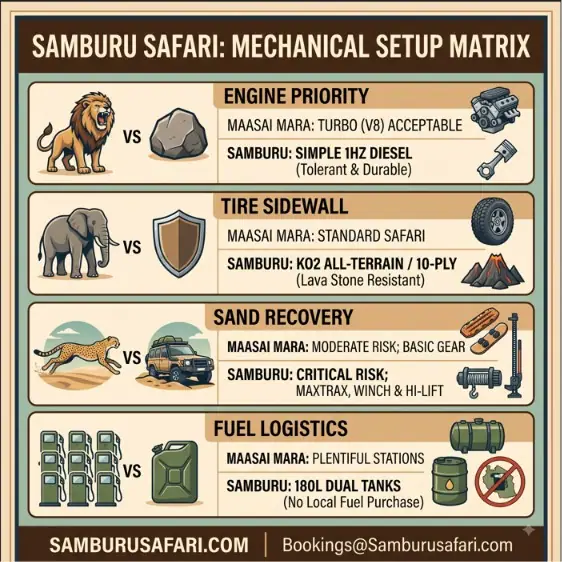
A successful Samburu safari depends on precise mechanical execution, contrasting sharply with standard requirements in southern Kenya. This matrix synthesizes specialized technical advice—from non-turbo engine selection to reinforced tire sidewalls—structuring standard descriptions as authoritative ground rules. Understanding these distinct mechanical realities ensures your vehicle is engineered to match the arid, lava-strewn terrain of the northern circuit.
Mechanical Metric | Maasai Mara Requirement | Samburu Requirement (North) |
Engine Priority | Turbo (V8) acceptable | Simple 1HZ Diesel (Tolerant & Durable) |
Tire Sidewall | Standard Safari | KO2 All-Terrain / 10-Ply (Lava Stone Resistant) |
Sand Recovery | Moderate risk; basic gear | Critical Risk; MaxTrax, Winch & Hi-Lift |
Fuel Logistics | Plentiful stations | 180L Dual Tanks (No local fuel purchase) |
The first choice when booking a 4×4 comes down to vehicle body type: the short-wheelbase Toyota Land Cruiser HZJ76 (5-seater) or the extended HZJ79 chassis (7-9 seater).
The extended HZJ79 offers extra legroom, individual window seats, pop-up roof hatches, and power sockets for camera gear. The trade-off? Squeezing an extended 79 through dense thickets or narrow sandbar entrances along the Ewaso Nyiro River takes extra wheel work.
In contrast, the short-wheelbase 76 cuts through narrow bush tracks easily, though it holds fewer passengers and less luggage.
Under the hood, standard safari Land Cruisers run the reliable non-turbo Toyota 1HZ 4.2-liter 6-Cylinder Diesel engine rather than the complex 1VD-FTV 4.5-liter V8 Turbo Diesel. The simple 1HZ tolerates lower-grade rural diesel past Isiolo and lacks electronic sensors that fail in deep river washes (laggas).
Standard highway tires shred on sharp volcanic lava stones (Lparagunya). Our 4x4s run heavy-duty BFGoodrich All-Terrain KO2 tires with 10-ply reinforced sidewalls. Upgraded Old Man Emu (OME) heavy-duty leaf springs and dual shock absorbers absorb washboard vibrations along the A2 highway.
Inside the cabin, vehicles feature USB charging ports at every row, 220V inverter sockets for camera gear, and a built-in 40-liter 12V fridge to keep water ice-cold in 35°C (95°F) heat.
By the time you hit corrugated dirt past Isiolo, everything in the cabin rattles. If your suspension isn’t upgraded, you’ll feel every washboard vibration straight through your spine.
Any 4×4 you hire for northern Kenya must feature a functional dual sub-tank system holding 180 liters of diesel. We always check the secondary tank pump switch on the dash before leaving Nanyuki—you’d be surprised how many drivers forget to switch over until the primary tank runs dry. Carrying 180 liters gives you over 1,000 km of driving range without buying fuel near Archer’s Post.
Game drives in Samburu frequently involve crossing soft riverbed sand. Relying solely on 4WD low-range can get a 3.5-ton Land Cruiser stuck. Safari hires must carry MaxTrax sand recovery boards, a hi-lift jack, and a front-mounted winch.
Our lead guide Patrick always reminds guests: don’t wait until you’re stuck in deep sand to engage low range. As soon as you hit laggas, lock your hubs, drop tire pressure to 28 PSI, and keep momentum going.
Never hire a Land Cruiser that carries its spare tire underneath the chassis. Undercarriage spares reduce clearance and expose valve stems to flying rocks. Your vehicle must have two spare tires mounted on a rear swing-away carrier.
To review park guidelines, see our guide on samburu park rules.
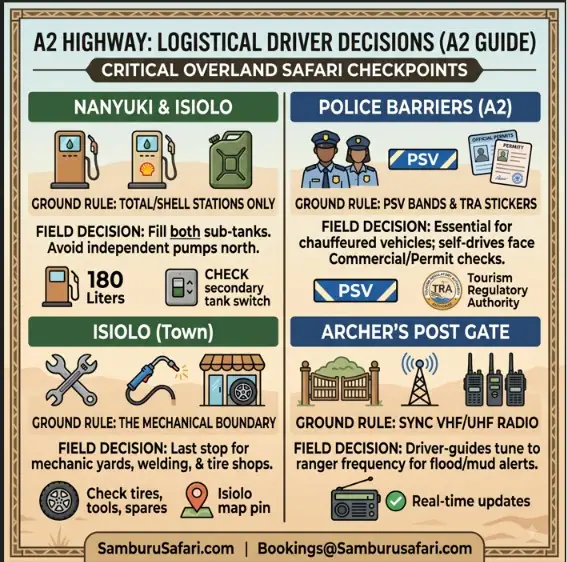
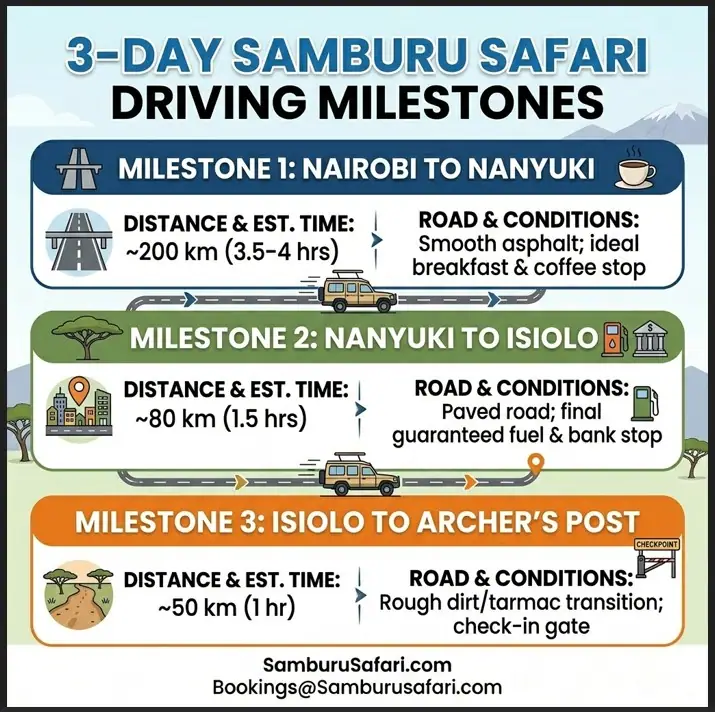
Planning a smooth overland drive requires understanding key operational stops along the A2 highway corridor:
Nairobi ➔ Nanyuki (Fill Tanks) ➔ Isiolo (Mechanical Check) ➔ Archer’s Post Gate
Navigating the A2 highway corridor requires precise operational checks at specific checkpoints north of Nanyuki. This table synthesizes critical field advice scattered throughout the article, transforming descriptions into rule-oriented instructions. By strictly following these logistical mandates—from selecting verified fueling stations to syncing with ranger frequencies—driver-guides ensure a seamless overland transit and reserve entry.
Operational Checkpoint | Practical Decision (Ground Rule) | Crucial Field Decision |
Nanyuki | Total/Shell Stations ONLY | Fill both sub-tanks. Avoid independent pumps north. |
Isiolo (Town) | The Mechanical Boundary | Last stop for mechanic yards, welding, & tire shops. |
Police Barriers (A2) | PSV Bands & TRA Stickers | Essential for chauffeured vehicles; self-drives face commercial/permit checks. |
Archer’s Post Gate | Sync VHF/UHF Radio | Driver-guides tune to ranger frequency for flood/mud alerts. |
When planning your budget, remember that national reserves charge separate daily entry fees for the vehicle and driver-guide:
A quick warning on self-drive: Northern Kenya is not the place to learn off-roading. Most rental agencies lock $1,500 to $3,000 USD on your credit card upfront, and standard insurance won’t cover sliced tire sidewalls on sharp lava stones or a flooded engine if you misjudge a river crossing.
If you get stuck in a lagga near West Gate, expect to pay $500 to $1,200 USD for a recovery truck from Isiolo.
Also, Google Maps miscalculates travel times on northern murram roads and routes drivers down disused tracks. Download offline apps like Maps.me or Gaia GPS with topographic maps before leaving Nanyuki. Read our full advice on self drive samburu.
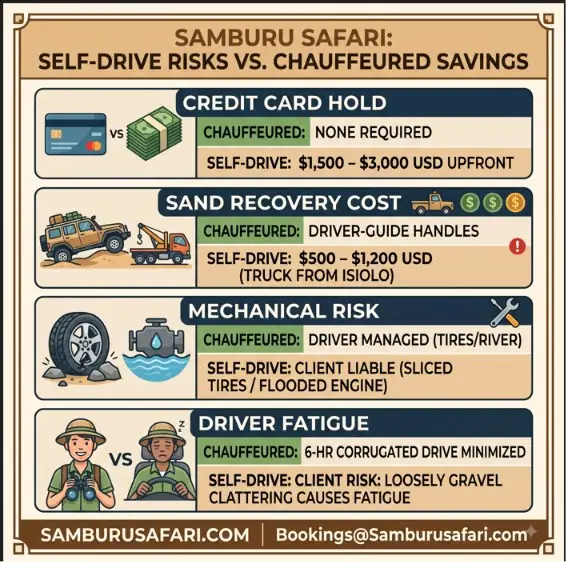
The debate between hiring a chauffeured vehicle or a self-drive 4×4 often ignores the complex risk/reward structure specific to northern Kenya. This synthesis converts the blunt warnings in the text into a scannable matrix, explicitly quantifying the potential financial and operational risks. Reviewing these distinct differences will ensure you understand the long-term cost implications of managing driver fatigue, mechanical liability, and sand recovery logistics.
Risk / Cost Metric | Chauffeured Land Cruiser Hire | Self-Drive 76/79 Hire (Subject to Approval) |
Credit Card Hold | None required | $1,500 – $3,000 USD upfront |
Sand Recovery Cost | Driver-guide handles | $500 – $1,200 USD (Truck from Isiolo) |
Mechanical Risk | Driver managed (Tires/River) | Client liable (sliced tires/flooded engine) |
Driver Fatigue | 6-hr corrugated drive minimized | Client risk: loosely gravel clattering causes fatigue. |
Clearing police barriers along the A2 highway and the Isiolo military bypass requires proper credentials.
Land Cruisers hired with a driver-guide carry official yellow PSV bands and Tourism Regulatory Authority (TRA) stickers, allowing driver-guides to pass through checkpoints smoothly. Unmarked self-drive rentals are routinely pulled aside for commercial permit checks and luggage inspections.
Upon crossing Archer’s Post Gate, chauffeured vehicles tune VHF/UHF multi-channel radios to the local ranger frequency for real-time updates on flash floods, mud traps, and river crossings.
Safari Land Cruisers driving overland from Nairobi feature rigid pop-up roof hatches with canvas skirts for high-speed highway travel. In contrast, open-sided Land Cruisers (with drop-down canvas sides) are restricted from driving on the paved A2 highway and remain stationed inside private corridors like Kalama Conservancy.
At Samburusafari.com, our safari packages include a private 4×4 Safari Land Cruiser, an experienced TRA-licensed guide, fuel, park permits, and lodge accommodation.
Check samburu national reserve park fees, samburu safari cost, driving from nairobi to samburu, flights from nairobi to samburu, luxury lodges in Samburu, or Samburu safari packages.
The pricing table details our 2027 multi-destination packages for two adults sharing a private 4×4 Safari Land Cruiser setup.
Safari Tier & Selected Lodges | Route Highlights & Vehicle Setup | Price Per Person |
Budget Overland Tier
• Samburu Riverside / Comfort Gardens | • 4D/3N road trip
• Private 4×4 Land Cruiser & guide | $1,480 USD
|
Mid-Range Overland Tier
• Samburu Simba / Sweetwaters | • 4D/3N classic circuit
• Private 4×4 Land Cruiser & guide | $1,820 USD
|
Luxury Fly-In Tier
• Elephant Bedroom / Sanctuary Tambarare | • 4D/3N air package
• Stationed open 4×4 Land Cruiser | $3,250 USD
|
Luxury Plus Sky Circuit
• Sasaab Lodge / Ol Pejeta Bush Camp | • 5D/4N sky loop
• Private 4×4 drives & night drives | $6,420 USD
|
Inclusions: Full board accommodation, private 4×4 Land Cruiser with pop-up roof and charging ports, TRA guide, park/conservancy fees, AMREF evacuation, regional flights (fly-in options).
Exclusions: International flights, e-visas, personal insurance (managing malaria risks in northern Kenya), premium drinks, laundry, tips.
Spending 6 hours behind the wheel on corrugated dirt tracks causes real driver fatigue. The clattering of loose gravel against the undercarriage and the smell of hot diesel exhaust mixed with wild sage are part of driving the A2 highway.
During his 10+ years guiding in the bush, Moses notes that hiring a Land Cruiser with a driver-guide lets you focus on spotting wildlife rather than wrestling with ruts and rocky washouts.
Learn about endemic wildlife in our guide on the samburu special 5, review seasonal weather on best time to visit samburu, and see gear tips in our samburu safari packing list. Official guidelines are on Kenya Wildlife Service and Northern Rangelands Trust.
Hiring a private 4×4 Safari Land Cruiser with a driver-guide, fuel, and vehicle insurance costs between $210 and $250 USD per person sharing per day for non-peak periods, rising to $430 USD per person sharing per day during peak season.
Yes. While the main A2 highway to Isiolo is paved tarmac, tracks inside Samburu National Reserve consist of rough murram, soft sand riverbeds, and volcanic rocks that require high clearance and 4WD.
The HZJ76 is a short-wheelbase 5-seater with a tighter turning radius for narrow tracks. The HZJ79 is an extended 7-to-9-seater offering more legroom, individual window seats, and extra luggage space.
Written by Patrick Mulei — Lead Wildlife & Field Contributor at SamburuSafari.com. Patrick has spent over 12 years tracking endemic northern wildlife species across Samburu, Buffalo Springs, and Laikipia conservancies.
Reviewed by Anthony Mule — Head Safari Operations Director. TRA-licensed wilderness guide with extensive experience organizing multi-destination itineraries across East Africa.
Message us directly for custom itineraries and the latest seasonal offers.