Spot a herd of Grevy’s near Westgate and guests ask two things, in this order: why are their ears so huge, and why aren’t they mixed in with the common zebras?
That is when I cut the ignition. These are a different species entirely, holding on in heat that pushes plains zebra back south, and the reason they are still here has less to do with the reserve than with the community land around it. Travelers who ask our team at Samburusafari.com about the Grevy’s Zebra Trust usually end up on a longer drive than they planned. Founded in 2007, the trust works across 10,000 square kilometres of community rangeland, and its story is bound up with the Samburu people who share that ground with the herds.
The Grevy’s Zebra Trust (GZT) is an independent conservation organization headquartered in Westgate Community Conservancy, Kenya. Working to conserve the endangered Grevy’s zebra (Equus grevyi), GZT partners with Samburu and Rendille communities through female scout networks (Mama Grevy), citizen-science stripe censuses (the Great Grevy’s Rally), dry-season water digging, and emergency drought feeding.
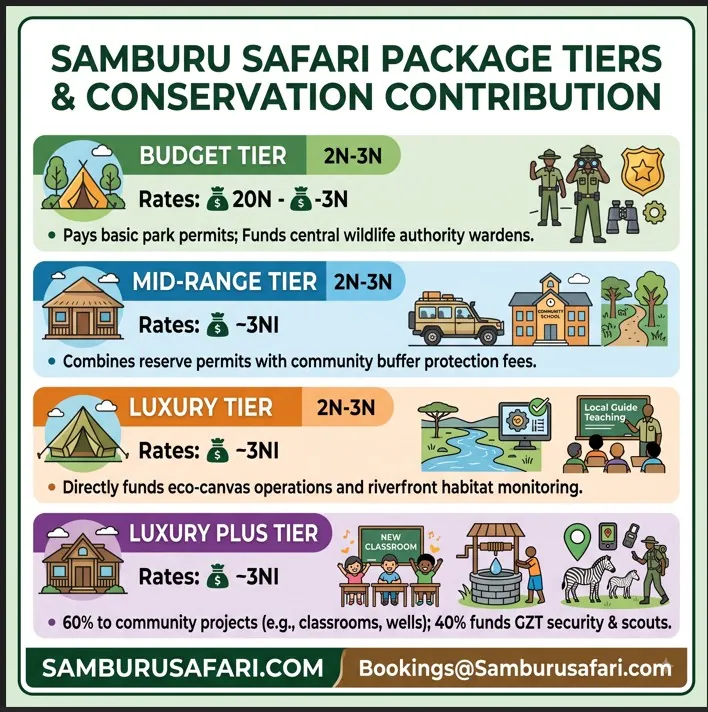
The leap from Samburu Simba at $1,390 to Sasaab at $3,270 is a question of how close you sleep to the work. Simba sits inside the public reserve. Sasaab is built inside Westgate, a short drive from the trust’s headquarters, and the conservancy fee you pay each day is what funds the Samburu women out digging water basins in the dry sandwashes.
Package Tier | Hotels / Camps Included | Transport & Details | Total Rate Per Person | |
Budget Tier | Samburu Public Camp / Umoja Camp | 3 Days private 4×4 Land Cruiser & guide • Dome tents & camp chef | $930 USD | |
Mid-Range Tier | Samburu Simba Lodge | 3 Days private 4×4 Land Cruiser & guide • Full board stone chalet | $1,390 USD | |
Luxury Tier | Elephant Bedroom Camp | 3 Days private 4×4 Land Cruiser & guide • Luxury riverfront tent | $2,250 USD | |
Luxury Plus Tier | Sasaab Camp (Westgate Conservancy) | 3 Days private 4×4 Land Cruiser & guide • Luxury suite near GZT HQ | $3,270 USD |
Package Tier | Hotels / Camps Included | Transport & Details | Total Rate Per Person | |
Budget Tier | Samburu Camp (2N) + Sweetwaters Camp Ol Pejeta (1N) | 4 Days private 4×4 Land Cruiser & guide • Tented bush circuit | $1,280 USD | |
Mid-Range Tier | Samburu Simba (2N) + Sweetwaters Serena Ol Pejeta (1N) | 4 Days private 4×4 Land Cruiser & guide • Full board safari lodges | $1,890 USD | |
Luxury Tier | Elephant Bedroom (2N) + Ol Pejeta Bush Camp (1N) | 4 Days private 4×4 Land Cruiser & guide • Luxury eco-canvas stay | $3,050 USD | |
Luxury Plus Tier | Sasaab Camp (2N) + Lewa Safari Camp (1N) | 4 Days private 4×4 Land Cruiser & guide • High-end conservancy stay | $4,280 USD |
What your package covers: Full board at the named lodges or campsites, private 4×4 safari Land Cruiser with guide and fuel, Samburu Reserve daily permits ($85 USD/day non-resident), and Westgate or Kalama conservancy fees ($100–$120 USD/day). Sixty percent of the conservancy fee goes into community escrow for classrooms, borehole maintenance and scout salaries, with the remaining 40% funding security — the mechanics of that split are covered in our guide to how tourism revenue reaches communities. AMREF Flying Doctors evacuation cover and bottled water are included.
What you need extra cash for: International flights, Kenya e-visas, personal travel insurance, premium drinks, driver-guide tips, and Reteti Elephant Sanctuary entry fees.
Booking around the conservation calendar? Send us your dates and we will work the route around it.
Samburu safari package rates and conservancy fee splits
Choosing your safari accommodation tier directly influences field conservation inside the Westgate and Kalama conservancies. Daily conservancy fees paid by travelers actively fund scout gear, waterhole restoration, and local community infrastructure. The breakdown below links nightly package levels to their direct financial and ecological impact on the ground.)
Safari Package Tier | Estimated Rate Range (2N–3N) | Direct Conservation Contribution |
Budget Tier | $930 – $1,280 USD | Pays basic park entrance permits funding central wildlife authority wardens. |
Mid-Range Tier | $1,390 – $1,890 USD | Combines reserve permits with community buffer protection fees. |
Luxury Tier | $2,250 – $3,050 USD | Directly funds eco-canvas operations and riverfront habitat monitoring. |
Luxury Plus Tier | $3,270 – $4,280 USD | 60% of conservancy fee goes to community projects; 40% funds GZT security & scouts. |
Tourists lump all zebras together. Samburu and Rendille herders never have.
You can pick out a Grevy’s stallion long before the white belly shows. The bray sounds like a donkey with a grievance, and he holds his stretch of dry riverbed hard against any rival. Plains zebra are Loitiko in Northern Maa. The Grevy’s is Loibor Korma — white belly, or white rear — sometimes Kangal, for the unstriped underside, the tall mule-like ears and the fine pinstriping.
The naming runs deeper than description. Northern Maa carries vocabulary that southern Maa speakers do not use, which is one of the sharper markers between the Samburu and the Maasai and a reminder that these herders have been classifying this wildlife for a long time.
Difference between Grevy’s zebra and common plains zebra
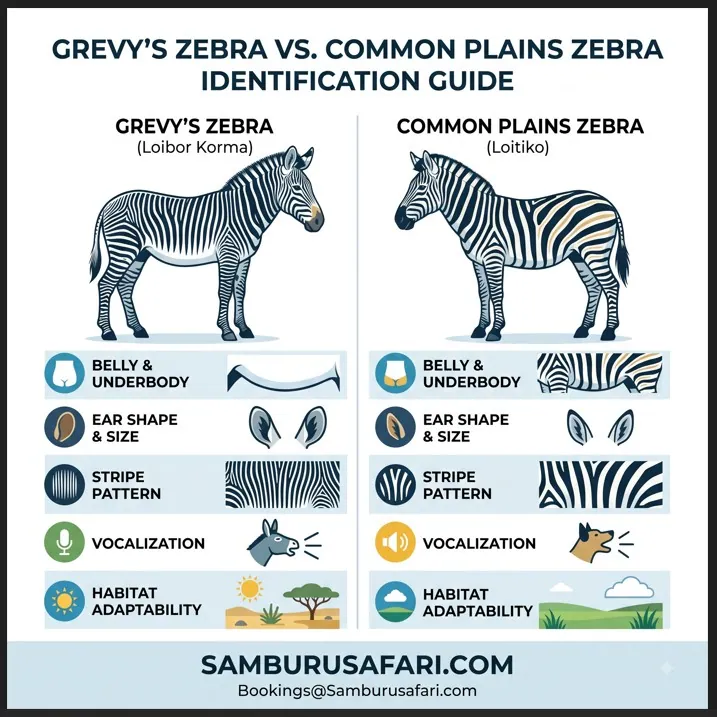
Identifying Grevy’s zebras on a game drive comes down to key physical and behavioral traits. While most visitors confuse wild equids, Samburu and Rendille herders have distinguished the two species for generations. This quick guide outlines the clear visual markers used by guides and field trackers to separate the endangered Loibor Korma from the common Loitiko.
Visual Feature | Grevy’s Zebra (Loibor Korma) | Plains Zebra (Loitiko) |
Belly & Underbody | Pure white, unstriped belly (Kangal) | Stripes wrap under the belly |
Ear Shape & Size | Broad, tall, rounded mule-like ears | Smaller, narrow, pointed ears |
Stripe Pattern | Fine, narrow, dense pinstripes | Broad, thick, widely spaced stripes |
Vocalization | Deep donkey-like braying call | High-pitched barking call |
Habitat Adaptability | Heat-tolerant; ranges in arid scrub | Prefers well-watered, lush plains |
Grevy’s zebra is listed as Endangered on the IUCN Red List and carries CITES Appendix I protection, the highest level of international trade defence available.
The numbers explain why. An estimated 15,000 ranged across eastern Africa in the late 1970s. Habitat loss, poaching and repeated drought cut that by more than 80%. Roughly 3,000 survive globally today, about 2,800 of them in Kenya, and more than 90% of those live on northern community rangeland rather than inside any park. Where the species sits among the region’s other endemics is covered across our wildlife of Samburu section.
The research team works out of Westgate, with a second field base in Kalama.
That siting is the whole strategy. Over 90% of wild Grevy’s live outside protected areas, on land where pastoralist families share grazing and water with the herds. Put the biologists in the reserve and they study the easy 10%. Put them in Westgate and they work alongside the people who decide, in practice, whether the species has water in October.
Every two years, camera teams fan out to photograph the right flank of every zebra they can find. The Great Grevy’s Rally covers 10,000 square kilometres of northern Kenya, and it is the census the population estimates rest on.
More than 120 survey teams drive assigned grid tracks. The images run through Wildbook and its HotSpotter stripe-recognition tool, using modified spatially explicit capture-recapture modelling. Every Grevy’s carries a unique stripe pattern, so the software identifies individuals and follows foal survival after drought without a single ear tag or radio collar.
The 2024 rally recorded a juvenile ratio approaching 30%, which points to real reproductive recovery after the drought years.
A lactating Grevy’s mare needs water every 24 hours to keep producing milk. Drought does not negotiate on that.
When the surface water goes, scouts walk the dry laggas — the Lablab lugga among them — with spades, digging shallow basins into the riverbed sand so zebra can drink without fighting livestock for a trough. In the wet, the same teams pull foals and weakened mares out of mudholes that have turned into sinkholes.
Out toward Laisamis and El Barta, black basalt makes 4×4 driving pointless. Sharp rock, no tracks. So the patrols go on foot.
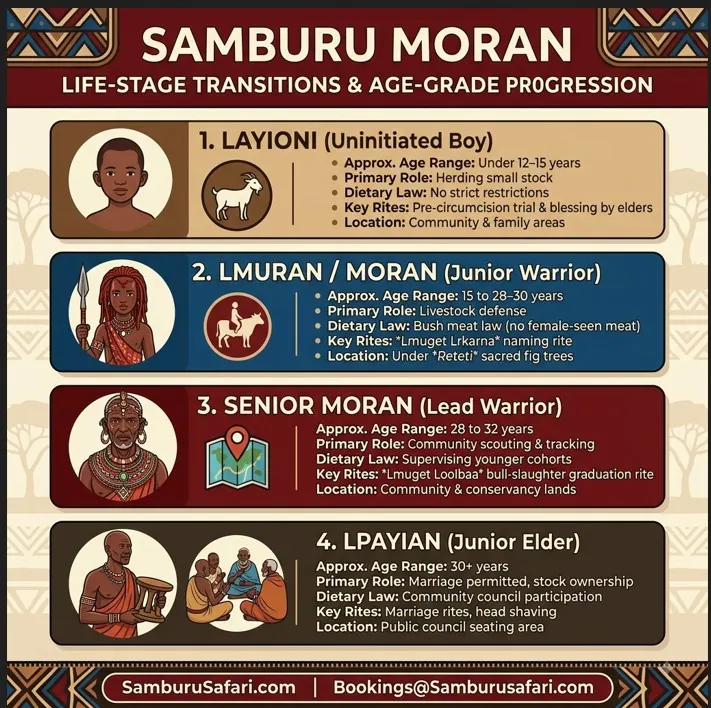
The Grevy’s Zebra Warriors run multi-week camel caravans, pack animals carrying water bladders, tents and field gear across the lava. They track zebra movements, watch for poaching, and mediate water access between herders who all need the same hole. That the patrols are young Morans is not incidental — this is the same age-set that samburu warriors have always used for long-range work away from the settlements.
Horn of Africa droughts hit wild equids hard. Through the worst spells, field teams set up emergency feeding stations across Westgate, Kalama and Laisamis, hauling tons of grass hay into dry scrub.
Working with Kenya Wildlife Service vets, the same teams run emergency anthrax vaccinations and tick treatment when outbreaks threaten lactating mares and foals.
How Grevy’s Zebra Trust conserves endangered zebras in Kenya
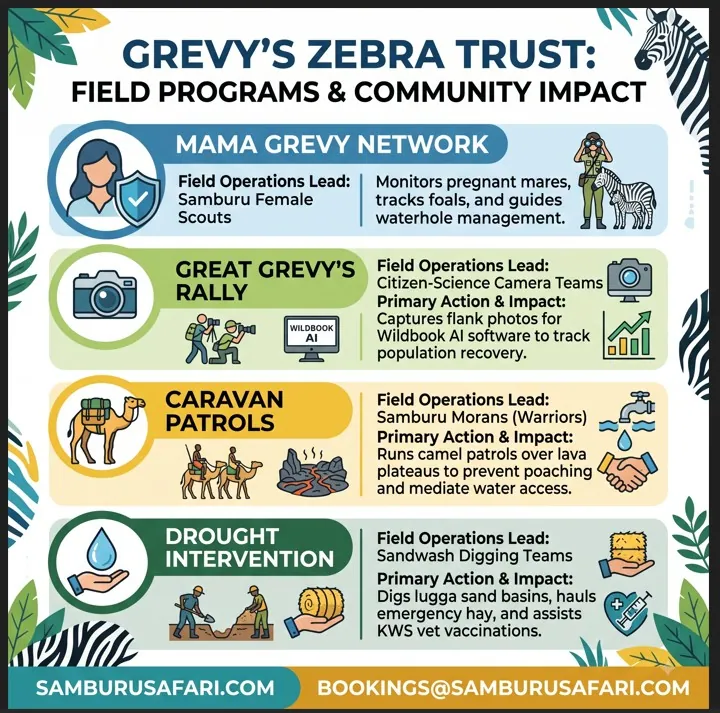
With over 90% of the world’s remaining Grevy’s zebras living on community rangelands rather than inside protected national parks, conservation depends entirely on pastoralist communities. The Grevy’s Zebra Trust coordinates four specialized field teams across 10,000 square kilometers of northern Kenya. This summary highlights how indigenous knowledge and citizen science power daily protection efforts on the ground.
Conservation Program | Field Operations Lead | Primary Action & Impact |
Mama Grevy Network | Samburu female scouts | Monitors pregnant mares, tracks foals, and guides waterhole management. |
Great Grevy’s Rally | Citizen-science camera teams | Captures flank photos for Wildbook AI software to track population recovery. |
Caravan Patrols | Samburu Morans (Warriors) | Runs camel patrols over lava plateaus to prevent poaching and mediate water access. |
Drought Intervention | Sandwash digging teams | Digs lugga sand basins, hauls emergency hay, and assists KWS vet vaccinations. |
Arrange a field HQ visit. Guests at Sasaab can request an educational tour of the headquarters and meet the research coordinators. Ask at booking.
Contribute photo scans. Take right-flank photographs of any Grevy’s you see on a game drive. We pass the images and GPS coordinates to the researchers for the Wildbook database, and tourist photos genuinely feed the census.
Donate to field programmes. Money goes to specific things — a Mama Grevy scout field kit, GPS units, fuel for the lugga digging teams, bales of hay in a bad year.
They are skittish outside the parks. Grevy’s on community land are warier of vehicles than the animals inside the reserve. Keep your distance and bring a long lens.
They scatter in the rains. Through April–May and November, herds disperse across the whole range because water is everywhere. July to October concentrates them at permanent water, which is when you want to be here.
The transits are rough. Reaching corridors like Laisamis means hours on corrugated dirt.
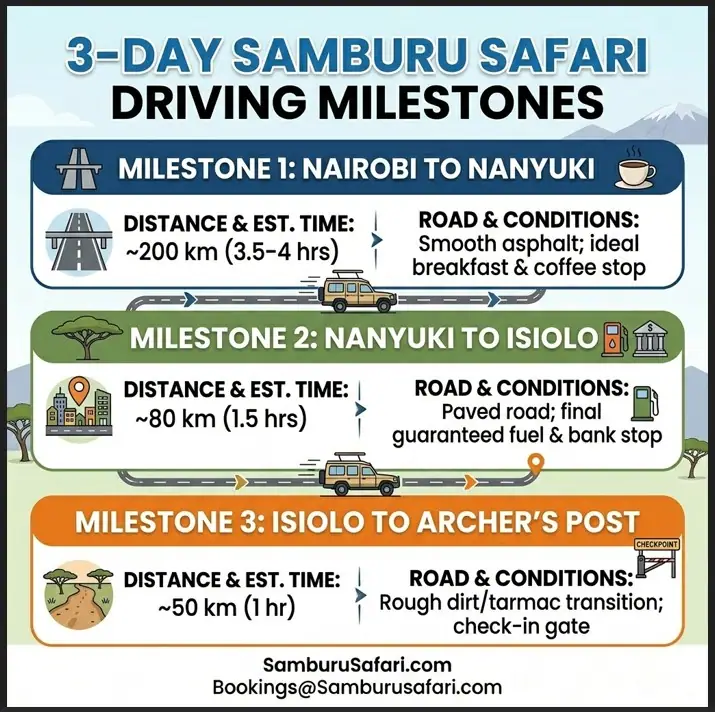
For road conditions, flight options, permits and health precautions, start with planning your Samburu trip.
What is the difference between a Grevy’s zebra and a common zebra? Grevy’s (Loibor Korma) are taller, with large rounded ears, fine narrow stripes and plain white bellies. Plains zebra (Loitiko) are smaller, with broader stripes that wrap under the belly and smaller ears.
Where is the Grevy’s Zebra Trust headquarters located? The primary field research team is based inside Westgate Community Conservancy, near Sasaab Camp in northern Kenya.
How many Grevy’s zebras are left in the wild? Roughly 3,000 remain globally, with over 90% of them living in northern Kenya.
Written by Gerard Murero — TRA silver-level guide working the northern rangelands routes through Samburu, Buffalo Springs and the community conservancies.
Reviewed by Benson Kungu — safari guide and photography specialist.
Message us directly for custom itineraries and the latest seasonal offers.