
Driving the river road near Archer’s Post, guests go quiet when young men step out of the acacia scrub — red cloth, chest beads, hair braided and packed with ochre. I wind the window down and call out Sopa!, and the temperature in the vehicle drops back to normal.
What follows is usually a run of questions, and almost none of them are about the dancing. Travellers who ask our team at Samburusafari.com about Samburu warriors want to know what these men actually do: how they hold livestock together through a drought, what the age-set ceremonies cost them in years, why half the conservancy scouts in the north are Morans. It is the working end of the Samburu people.
Samburu warriors — Morans, or Lmuran — are young initiated men of the pastoralist Samburu of northern Kenya. Initiated through ritual circumcision in their teens, Morans live under strict dietary law, wear red-braided hair dyed with natural ochre (Lkaria), and work as herders, traditional protectors and, increasingly, community conservation rangers.
The step from Samburu Simba at $1,390 to Saruni Samburu at $3,270 buys location and cultural access. Simba sits inside the public reserve under county gate rules. Saruni is built inside Kalama Conservancy, where the daily fee pays Samburu rangers and we can arrange private village visits led by Morans rather than a scheduled gate performance.
Package Tier | Hotels / Camps Included | Transport & Setup | Total Rate Per Person | |
Budget Tier | Umoja Women’s Camp / Bandas | 3 Days private 4×4 Land Cruiser & guide • Full board stay | $930 USD | |
Mid-Range Tier | Samburu Simba Lodge | 3 Days private 4×4 Land Cruiser & guide • Full board stone chalet | $1,390 USD | |
Luxury Tier | Elephant Bedroom Camp | 3 Days private 4×4 Land Cruiser & guide • Luxury riverfront tent | $2,250 USD | |
Luxury Plus Tier | Saruni Samburu (Kalama) | 3 Days private 4×4 Land Cruiser & guide • Cliffside villa | $3,270 USD |
Package Tier | Hotels / Camps Included | Transport & Setup | Total Rate Per Person | |
Budget Tier | Samburu Camp (2N) + Sweetwaters Camp Ol Pejeta (1N) | 4 Days private 4×4 Land Cruiser & guide • Tented bush circuit | $1,280 USD | |
Mid-Range Tier | Samburu Simba (2N) + Sweetwaters Serena Ol Pejeta (1N) | 4 Days private 4×4 Land Cruiser & guide • Full board safari lodges | $1,890 USD | |
Luxury Tier | Elephant Bedroom (2N) + Ol Pejeta Bush Camp (1N) | 4 Days private 4×4 Land Cruiser & guide • Luxury eco-canvas stay | $3,050 USD | |
Luxury Plus Tier | Saruni Samburu (2N) + Lewa Safari Camp (1N) | 4 Days private 4×4 Land Cruiser & guide • High-end conservancy stays | $4,280 USD |
What your package covers: Full board at the named lodges or campsites, private 4×4 safari Land Cruiser with guide and fuel, Samburu Reserve daily permits ($85 USD/day non-resident) and conservancy fees, AMREF Flying Doctors evacuation cover, and bottled drinking water.
Extra expenses to budget for: International flights, Kenya e-visas, personal travel insurance, alcoholic drinks, driver-guide tips, and Reteti Elephant Sanctuary entry fees.
Want a village visit built into the route rather than bolted on? Send us your dates.
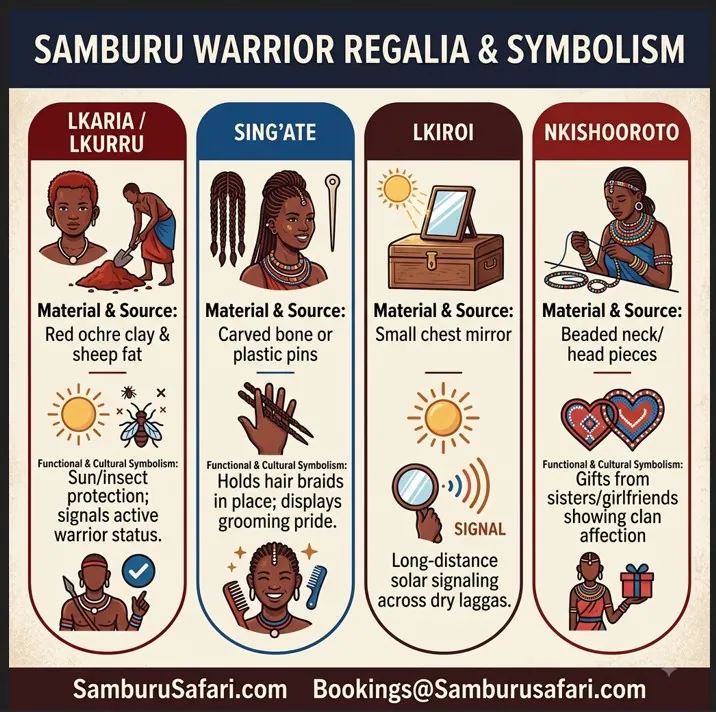
The look starts with red mineral clay — Lkaria, sometimes Lkurru — dug from the slopes of Mount Ololokwe and the dry laggas. Morans grind it to powder and work it into rendered sheep fat (Lkyil), then pack the paste through the hair and across the face. It is not decoration alone. The layer holds off equatorial sun and insects through long days in open scrub, which is where these men spend most of their lives. Ololokwe itself sits on the wider northern circuit and is sacred ground in its own right.
Long white pins of bone or plastic, Sing’ate, run horizontally through the braids. Around the neck hangs a small round mirror, Lkiroi. Out on the grazing, a Moran uses that mirror to throw sunlight across a valley — a flash another herder can read from miles off, which is faster than any phone signal up there.
“Meaning of Samburu warrior red ochre hair and beads”
Every item worn by a Samburu warrior serves a functional environmental purpose or communicates a precise social standing. Far from mere adornment, the red ochre, bone pins, and woven beads reflect clan ties, courtship status, and field utility in northern Kenya’s dry scrubland. Use this field identification key to decode the symbolism behind traditional Moran regalia.
Regalia Item | Material & Source | Functional & Cultural Symbolism |
Lkaria / Lkurru | Red ochre clay & sheep fat | Sun/insect protection; signals active warrior status |
Sing’ate | Carved bone or plastic pins | Holds hair braids in place; displays grooming pride |
Lkiroi | Small chest mirror | Long-distance solar signaling across dry laggas |
Nkishooroto | Beaded neck/head pieces | Gifts from sisters/girlfriends showing clan affection |
Eating is governed by the Lpiron, the fire-elders, and the rules are absolute. A Moran cannot eat meat a married woman has seen. He cannot eat inside a woman’s house. He cannot drink milk alone without another warrior present.
The workaround is a camp called Singira, built well down a dry sandy riverbed. Under the river acacias the men slaughter and roast over acacia coals. You smell it before you see it — fat and woodsmoke moving along the channel.
Young men will walk several miles into empty riverbed to share a meal that could have been eaten at home in ten minutes. That is the measure of how seriously the law is still taken.
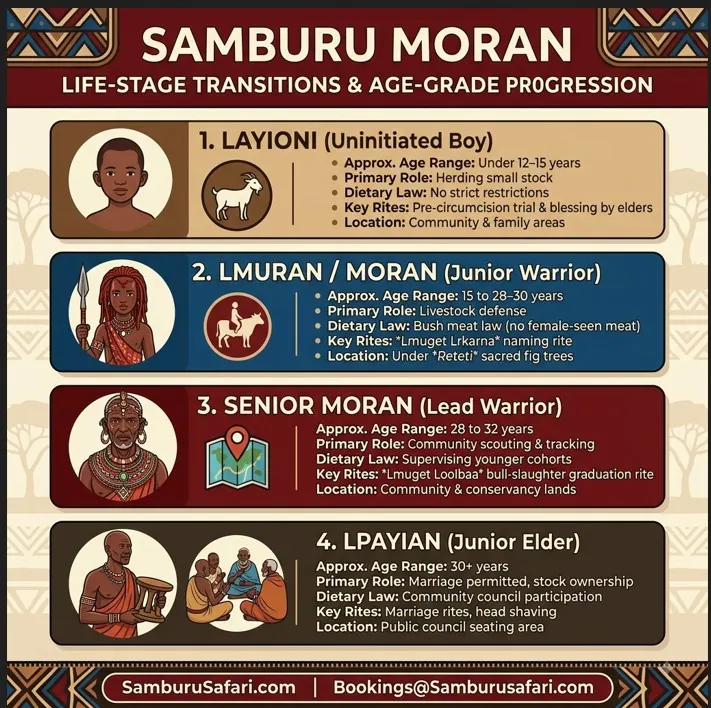
Becoming a senior elder takes six formal Lmuget ceremonies spread across a 12- to 15-year cycle. Nobody shortcuts it.
Each takes place under the canopy of a sacred fig — Reteti. Elders sacrifice specific steers and mark the warriors with fat and milk while praying for peace and rain, in that order.
“Samburu warrior age sets and life stages”
Progression through the Samburu gerontocracy is defined by strict 12- to 15-year age-grade cycles managed entirely by community elders. A young man transitions from boyhood to senior elderhood by moving through non-negotiable cultural status tiers marked by public rites. This structural matrix details the responsibilities, cultural prohibitions, and core rituals governing each phase of a Moran’s life.
Life Stage & Title | Approx. Age Range | Primary Role & Dietary Law | Key Rites & Sacred Locations |
Layioni (Uninitiated Boy) | Under 12–15 years | Herding small stock; no dietary restrictions | Pre-circumcision trial & blessing by elders |
Lmuran / Moran (Junior Warrior) | 15 to 28–30 years | Livestock defense; bush meat law (no female-seen meat) | Lmuget Lrkarna naming rite under Reteti tree |
Senior Moran (Lead Warrior) | 28 to 32 years | Community scouting, tracking, training younger cohorts | Lmuget Loolbaa bull-slaughter graduation rite |
Lpayian (Junior Elder) | 30+ years | Marriage permitted, stock ownership, community council | Marriage rites, head shaving, public council seating |
Every warrior carries three things:
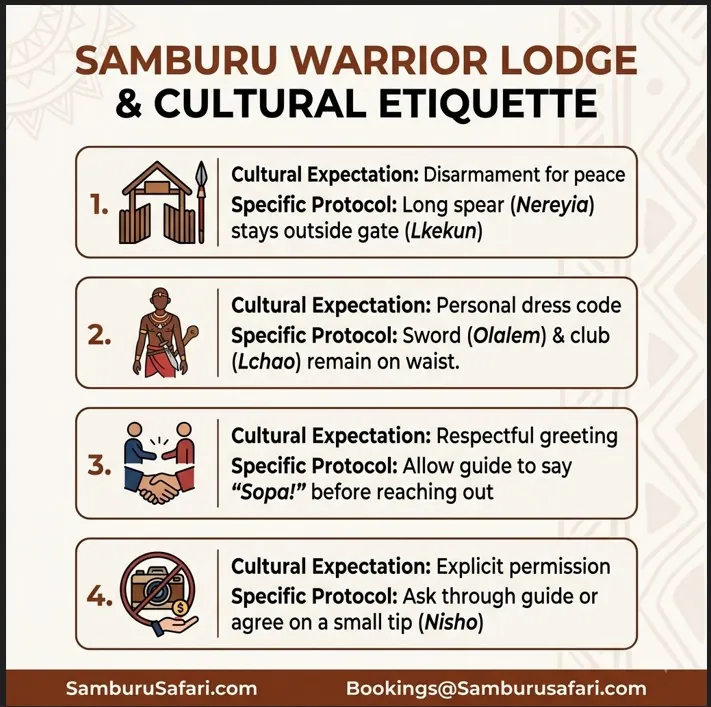
At a lodge or research base, protocol takes over. The spear stays outside the entry gate (Lkekun) as a gesture of peace. The sword and club stay on, because those are not weapons in this context — they are what a grown man wears.
“Samburu warrior weapon rules and safari etiquette”
Interacting with Samburu Morans requires understanding traditional rules of peace and mutual respect. Whether encountering community scouts at a safari lodge or visiting a rural manyatta, following local protocols ensures authentic, respectful cultural exchanges. This guide outlines standard ground rules for safari guests when meeting initiated warriors.
Setting / Scenario | Cultural Expectation | Specific Protocol to Follow |
Lodge Entry Gate | Disarmament for peace | Long spear (Nereyia) stays outside gate (Lkekun) |
Lodge / Camp Common Area | Personal dress code | Sword (Olalem) & club (Lchao) remain on waist |
Roadside / Bush Walks | Respectful greeting | Allow guide to say “Sopa!” before reaching out |
Photography | Explicit permission | Ask through guide or agree on a small tip (Nisho) |
Across Kalama, Westgate and Namunyak, the tracking skills that used to follow cattle now follow elephants.
Morans work as community wildlife scouts alongside the Northern Rangelands Trust and Kenya Wildlife Service, carrying GPS handhelds instead of only a spear, monitoring herd movement and heading off conflict before it turns into a dead animal. The clearest version of this is the Warrior Watch lion project, which recruited the same young men who once speared lions and put the monitoring data in their hands.
The dance — Nkamoragi, or Kipeta — sounds nothing like a tourist performance if you hear it properly. The chanting sits low and guttural, pitched at the grunt of a lion and the rumble of a charging elephant.
Shoulder to shoulder, the men thrust their chests forward and leap straight up (Adumu). The height demonstrates stamina; the chest work imitates the predator. Together it says these men will stand between the herd and whatever is coming.
Headbands (Nkiri) carry polished brass buttons (Lmaroi), with ear ornaments (Lkisoi) alongside. None of it is bought. Sisters and girlfriends weave and gift these pieces as Nkishooroto, and the meanings behind the colours and metals are set out in our guide to samburu beadwork.
No. Morans are welcoming to guests who behave decently. On a guided bush walk, let your guide greet them first, stand back, and wait for the introduction before you put a hand out.
Ochre and sheep fat come off on upholstery, and they do not come out easily. Operators who run village transfers regularly keep washable canvas covers on the seats. Ours do.
Never raise a long lens at a warrior on a public road without asking. Inside an organized village like Umoja, photography is covered by the entry fee. On open roads, ask through your guide and agree a small tip (Nisho) — the full etiquette is in our guide to photographing people respectfully.
For the village side of things, a cultural safari experience at Umoja or Unity puts you with families rather than a performance crew. Road conditions, permits, flights and health precautions are covered in our planning a samburu safari section.
What is a Samburu warrior called? A Moran, or Lmuran, in the Northern Maa language.
Why do Samburu warriors colour their hair red? The braids are worked with ground red ochre clay (Lkaria) mixed into rendered sheep fat (Lkyil). It shields the scalp from equatorial sun, repels insects, and marks the man’s standing inside his warrior age-set.
What weapons do Samburu warriors carry? A short double-edged waist sword (Olalem), a heavy hardwood throwing club (Lchao), and a long-bladed iron spear (Nereyia).
Written by Gerard Murero — TRA silver-level guide working the northern rangelands routes through Samburu, Buffalo Springs and the community conservancies.
Reviewed by Benson Kungu — safari guide and photography specialist.
Message us directly for custom itineraries and the latest seasonal offers.