
Step out of the Land Cruiser at a village near Archer’s Post and the colour hits before anything else — neon pink, yellow and white throwing back the desert sun. Then the sound: stacked collars shifting against each other every time someone moves. Wild sage, goat leather, warm acacia dust.
Travellers who ask our team at Samburusafari.com about beadwork usually want to know what they are looking at. How to read status in a woman’s collar. Why a warrior’s headband follows different rules from a marriage necklace. Where the money goes when you buy. All of it belongs to a wider story about the Samburu people, who read a collar the way you would read a passport.
Samburu beadwork (Saen) is a traditional art form practised by Samburu women in northern Kenya. Through distinct colour patterns — neon pink (Nanyokie), red, yellow and white — handcrafted glass and metal ornaments signal age-set, social standing and marital status, from wide neck discs (Nnkami) to sacred giraffe-hair wedding necklaces (Mporo).
“Samburu beadwork names and meanings guide” / “Samburu beadwork names and meanings guide” / Samburu beadwork names and meanings guide
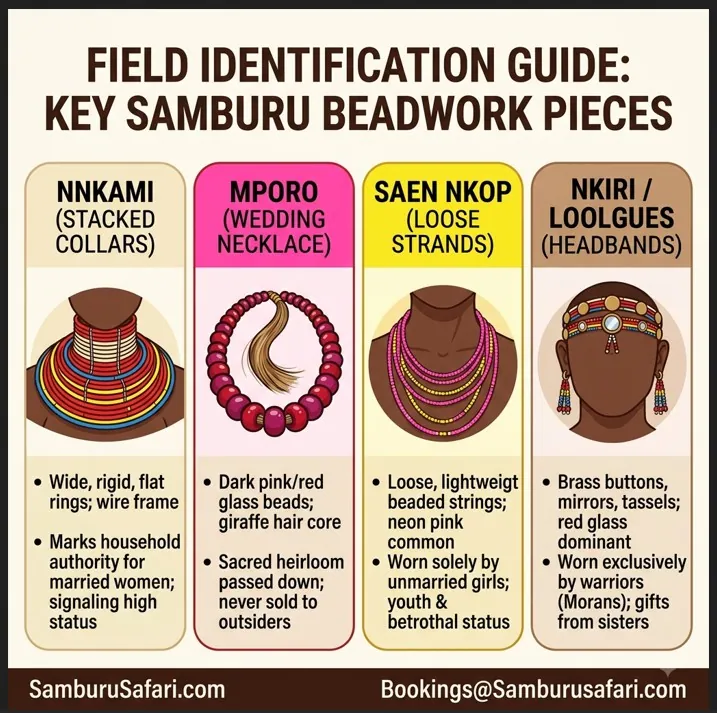
While dozens of specific ornaments exist, certain signature pieces define Samburu aesthetic identity and social signaling. This quick-reference matrix decodes the core items visitors will encounter in northern Kenya, providing local terminology alongside visual and cultural context.
Local Name & Piece | Key Visual Features | Cultural Signalling & Meaning |
Nnkami (Stacked Collars) | Wide, rigid, flat concentric rings; telephone wire frame | Marks household authority for married women; signaling high status |
Mporo (Wedding Necklace) | Dark pink/red heavy glass beads; giraffe tail hair core | Sacred heirloom passed down; never sold to outsiders |
Saen Nkop (Loose Strands) | Loose, lightweight beaded strings; neon pink common | Worn solely by unmarried girls; indicates youth and betrothal status |
Nkiri / Loolgues (Headbands) | Brass buttons, mirrors, tassels; red glass dominant | Worn exclusively by warriors (Morans); gifts from sisters/girlfriends |
These 2027 quotes cover two adults travelling together in a private 4×4 Land Cruiser. Every price includes full board at the lodge or camp, vehicle transit with our guide and fuel, park entry permits, conservancy fees, and AMREF evacuation cover.
Package Tier | Hotels / Camps Included | Transport & Details | Total Rate Per Person | |
Budget Tier | Umoja Women’s Camp / Bandas | 3 Days private 4×4 Land Cruiser & guide • Full board stay | $930 USD | |
Mid-Range Tier | Samburu Simba Lodge | 3 Days private 4×4 Land Cruiser & guide • Full board stone chalet | $1,390 USD | |
Luxury Tier | Elephant Bedroom Camp | 3 Days private 4×4 Land Cruiser & guide • Luxury riverfront tent | $2,250 USD | |
Luxury Plus Tier | Saruni Samburu (Kalama) | 3 Days private 4×4 Land Cruiser & guide • Cliffside eco-villa | $3,270 USD |
Package Tier | Hotels / Camps Included | Transport & Details | Total Rate Per Person | |
Budget Tier | Samburu Camp (2N) + Sweetwaters Camp Ol Pejeta (1N) | 4 Days private 4×4 Land Cruiser & guide • Tented bush circuit | $1,280 USD | |
Mid-Range Tier | Samburu Simba (2N) + Sweetwaters Serena Ol Pejeta (1N) | 4 Days private 4×4 Land Cruiser & guide • Full board safari lodges | $1,890 USD | |
Luxury Tier | Elephant Bedroom (2N) + Ol Pejeta Bush Camp (1N) | 4 Days private 4×4 Land Cruiser & guide • Luxury eco-canvas stay | $3,050 USD | |
Luxury Plus Tier | Sasaab Camp (2N) + Lewa Safari Camp (1N) | 4 Days private 4×4 Land Cruiser & guide • High-end conservancies | $4,280 USD |
What your package covers: Full board at the named lodges or campsites, private 4×4 safari Land Cruiser with guide and fuel, Samburu Reserve daily permits ($85 USD/day non-resident) and conservancy fees, AMREF Flying Doctors evacuation cover, and bottled drinking water.
What you need extra cash for: International flights, Kenya e-visas, personal travel insurance, premium drinks, driver-guide tips, and Reteti Elephant Sanctuary entry fees.
Want the cultural side built into your route? Send us your dates and we will shape the itinerary around it.
The wide flat collars are Nnkami. A full ceremonial outfit runs to 10 or 15 stacked concentric rings, and the whole assembly weighs 4 to 6 kilograms.
Carrying that through an afternoon of dancing is a structural problem, and the solution is worth looking at closely. Artisans line the inner ring with softened goat leather or cut-up rubber inner tube so the wire cannot bruise the collarbone. The rigidity comes from stiff telephone wire threaded through the glass seed beads, which holds the disc flat and level on the shoulders instead of letting it collapse inward.
Commercial souvenirs are strung on synthetic fishing line. The Mporo is not.
Inside the traditional wedding necklace sits a core of tightly bound wild giraffe tail hair (ol-kiuka), wrapped in palm fibre and covered in heavy dark pink and red glass. On her wedding day a daughter receives beads from her mother’s own Mporo, and the necklace passes down that way through generations.
You will not be offered one. The Mporo is not sold to visitors, and a stall selling you a “Mporo” is selling you something else.
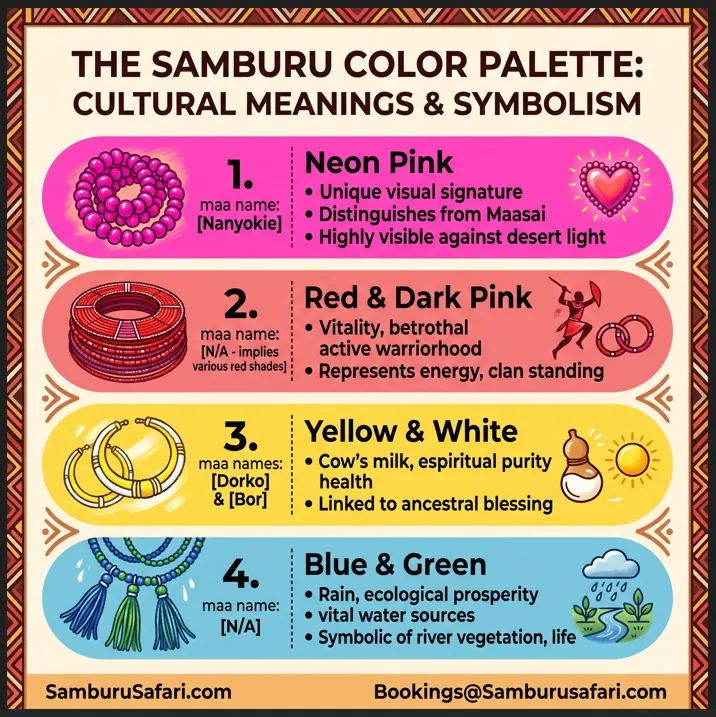
Beads are Saen in Northern Maa, and the colour choices carry explicit social information:
Unmarried girls wear loose lightweight strands called Saen Nkop. After marriage a woman moves to the heavy rigid Nnkami stacks that mark household authority — one of several places where the Samburu and the Maasai diverge sharply in how the same Maa-speaking tradition gets expressed.
“Samburu beadwork color meanings and symbolism” / “Samburu beadwork color meanings and symbolism” / Samburu beadwork color meanings and symbolism
Samburu beadwork operates as a precise visual language. Colors are rarely aesthetic choices alone; they carry specific, non-negotiable social information about age-set, clan ties, or marital standing. The matrix below defines the core Samburu color spectrum and its relationship to the environment and ancestral blessing.
Color (Maa Name) | Symbolic Meaning | Functional & Ecological Link |
Neon Pink (Nanyokie) | Unique visual signature; highly visible against desert light | Distinguishes Samburu from Maasai beadwork; rarely used south |
Red & Dark Pink | Vitality, betrothal, clan standing | Represents energy, close family ties, and active warriorhood |
Yellow (Dorko) & White | Ancestral blessing, peace, health | Linked to cow’s milk and spiritual purity |
Blue & Green | Rain, ancestral water sources | Symbolic of river vegetation, life, and ecological prosperity |
Morans do not wear the women’s flat collars. They wear forehead bands — Nkiri, or Loolgues — built from brass buttons, small glass mirrors and beaded tassels that swing across the face during the jumping dance.
A warrior does not make his own. The headband arrives as a gift from his sisters or his girlfriends, with bright red glass marking his clan standing, which fits the wider pattern of how samburu warriors are equipped and recognised by the people around them.
Watch before a dance and you will see young men polishing the brass with sand and ash, working it until it catches the late light properly.
Beadwork at Umoja and Unity Cultural Village carries a history most visitors do not expect. Warriors historically practised Aisho-Ntoyie Saen — girl beading — gifting red strands (Nkishooroto e saen e lmuran) to young girls as a non-marital pledge, a custom that left the girls with little say in it.
The cooperatives inverted that. Women now sell “freedom beads” directly to visitors, and the income funds rescue centres, school fees for girls, and household independence from the men who once did the gifting. A cultural safari experience at Umoja is the clearest way to see what that shift looks like in practice.
Buy inside the village and the payment splits: cash straight to the artisan, plus 15–20% into a village emergency escrow for healthcare, drought grain reserves and orphan tuition. That structure is the same logic running through how tourism revenue reaches communities across the northern conservancies.
Nineteenth-century trade routes brought heavy Venetian and Czech glass seed beads — rocaille — and those remain the base of the work.
What changed is everything around them. Discarded telephone wire now frames the Nnkami rings. Hammered aluminium from old milk cans gets cut into small leaf-shaped pendants called Imasit, which hang from the collar edge and jingle through a dance. The tradition absorbs whatever the century hands it.
“Authentic Samburu beadwork vs mass produced” / “Authentic Samburu beadwork vs mass produced” / Authentic Samburu beadwork vs mass produced
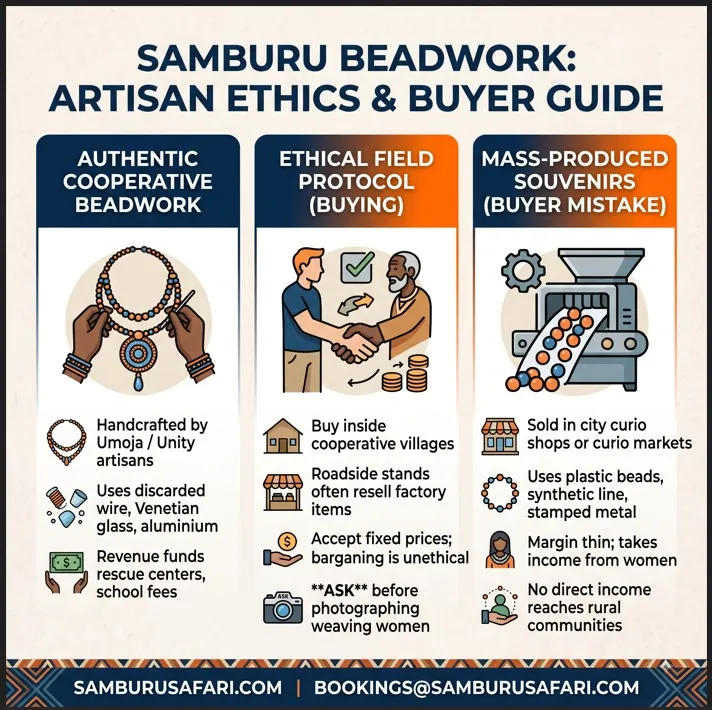
Authentic Cooperative Beadwork | Ethical Field Protocol (Buying) | Mass-Produced Souvenirs (Buyer Mistake) |
Handcrafted by artisans in Umoja/Unity villages | Buy inside cooperative villages, not roadside stands | Sold in large Nairobi/city markets or curio shops |
Materials: Discarded wire, Venetian glass, aluminium | Accept fixed prices; thin margins mean bargaining is unethical | Materials: Plastic beads, synthetic line, factory-stamped metal |
Revenue funds rescue centers, school fees, and grain reserves | Ask before photographing any woman weaving | No direct income reached rural artisans or community escrows |
Buying factory imports in city markets. Mass-produced plastic beadwork in Nairobi souvenir shops takes income away from the women who make the real thing. Buy at the village cooperatives instead.
Bargaining hard. Talking a $10 bracelet down to $3 is not a win. Cooperative prices are already set fairly and the margin is thin.
Photographing without asking. Ask before you photograph a woman weaving, every time — photographing people respectfully is the difference between a welcome and a closed door.
Road conditions, permits, flights and health precautions all shift by season, and our planning a samburu safari section covers them before you commit to dates.
What is the local Maa word for beads in Samburu? Beads are Saen in Northern Maa. Flat neck collars are Nnkami, and sacred marriage necklaces are Mporo.
How can I tell Samburu beadwork apart from Maasai beadwork? Samburu work uses neon pink (Nanyokie), large rigid flat collars (Nnkami) and brass buttons. Southern Maasai work runs to royal blue, dark red and drop-pendant styles.
Where is the best place to buy authentic Samburu beadwork? Direct from the women-led cooperatives near Archer’s Post — Umoja Women’s Village and Unity Cultural Village.
Written by Gerard Murero — TRA silver-level guide working the northern rangelands routes through Samburu, Buffalo Springs and the community conservancies.
Reviewed by Benson Kungu — safari guide and photography specialist.
Message us directly for custom itineraries and the latest seasonal offers.