
Quick Answer: A samburu photographic safari offers exceptional opportunities to capture northern Kenya’s unique wildlife, from long telephoto shots of endemic species to ultra-low angle hide photography. Mastering Ewaso Nyiro golden-hour lighting, volcanic dust protection, camera settings, and vehicle beanbag setups is what separates sharp images from a card full of near-misses.
Written by Benson Kungu. Reviewed by Gerard Murero.
If your vehicle is on the wrong side of the Ewaso Nyiro at 7:00 AM, you shoot into harsh flare and there is nothing to be done about it. The river runs west to east through the reserve, which creates strict morning and afternoon lighting zones.
From 06:15 to 07:30 AM, work the south bank inside Buffalo Springs for front-light on drinking animals. The sandbars there give low-angle access where Vulturine Guineafowl gather near the natural pools.
By late afternoon, 04:30 to 06:15 PM, switch to the north bank in Samburu so the setting sun lights elephant herds against the Doum palms.
The deep river loops lose sunlight a full 30 minutes early because of the tall palms and clay banks. By 05:15 PM, get up onto the rocky ridges — Koitogor Hill or Champagne Ridge — which hold warm light until dusk and let you frame giraffes or oryx against Mount Ololokwe.
When elephants kick up the crimson soil at sunset, put the vehicle between the sun and the dust cloud. Shooting backlit at f/4 makes the particles bloom into an orange halo. It is the shot people come here for.
Shot on Canon R5 + 600mm f/4 IS III · 1/2000s, f/4, ISO 400 · Ewaso Nyiro riverbanks, 06:45 AM.
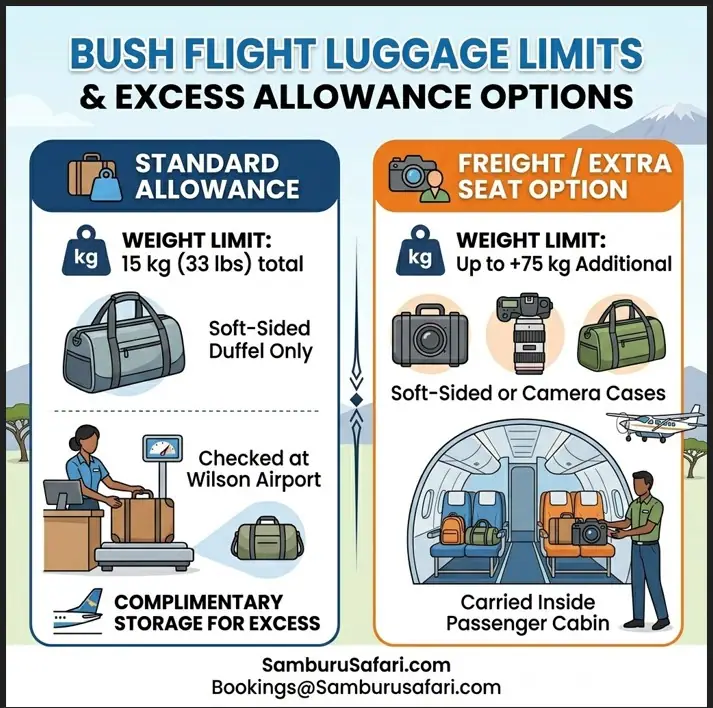
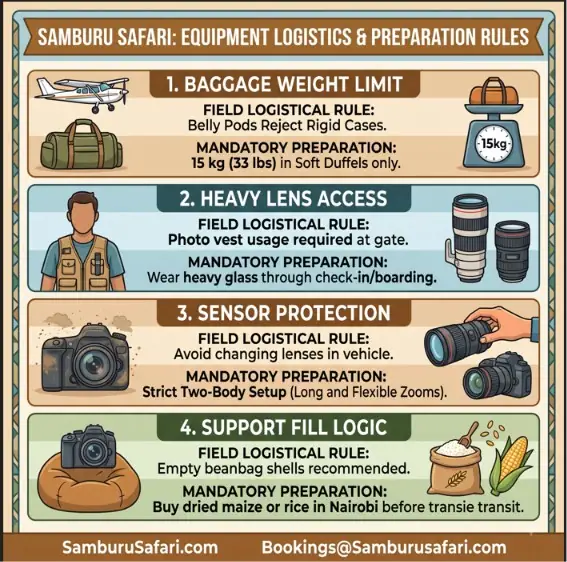
A successful Samburu photographic safari hinges on precise logistical execution, ensuring your specialized equipment reaches the field ready to perform. This matrix converts critical advice Scattered in the article—from bush plane restrictions to sensor protection—into binding operational rules. Understanding how to navigate these strict mandates—such as using soft duffels and adhering to mandatory two-body configurations—is paramount for any professional photographic circuit.
Field Logistical Rule | Ground Reality | Mandatory Preparation |
Baggage Weight Limit | Belly Pods Reject Rigid Cases | 15 kg (33 lbs) in Soft Duffels only. |
Heavy Lens Access | Photo vest usage required at gate | Wear heavy glass through check-in/boarding. |
Sensor Protection | Avoid changing lenses in vehicle. | Strict Two-Body Setup (Long and Flexible Zooms). |
Support Fill Logic | Empty beanbag shells recommended. | Buy dried maize or rice in Nairobi before transit. |
In Kalama Conservancy, Saruni runs a subterranean hide beside a waterhole for ground-level shots of elephants, leopards, and Grevy’s zebras. Bring a 24–70mm f/2.8 for wide, low-angle frames of trunks drinking four feet away, and a 70–200mm f/2.8 on a second body for eye-level leopard portraits. The hide keeps you cool, but elephant dust settles fast — keep a microfiber cloth over the front element.
Shot on Sony A1 + 70–200mm f/2.8 GM II · 1/800s, f/2.8, ISO 1600 · Kalama underground hide, 05:15 PM
On game drives, open-sided Land Cruisers give flexible low-angle framing, but a running engine ruins sharpness with heavy glass. Gerard forbids handheld shooting with a 600mm in his vehicle and cuts the ignition the moment anyone raises a lens.
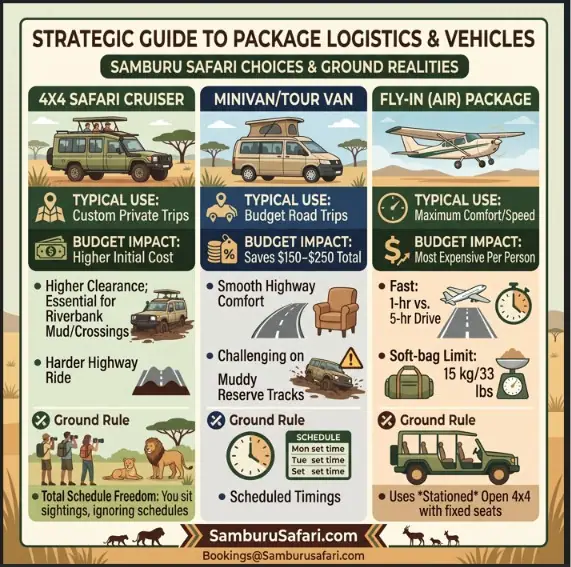
Coordinate before you shoot. If one person shifts weight, everybody’s 600mm frame blurs. Use a beanbag over the door frame or a clamp mount supporting a gimbal head. Our vehicles carry 12V inverters so you can charge between drives. Groups wanting full control over vehicle positioning should book a private Land Cruiser rather than sharing.
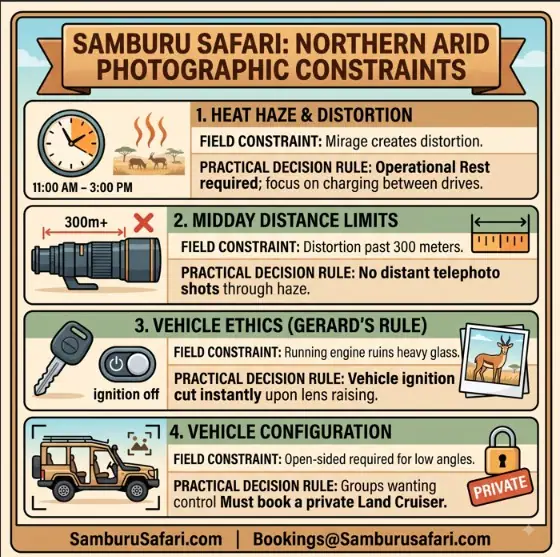
The unique environmental challenges of northern Kenya require specific operational adjustments that go far beyond standard camera settings. This table structures critical field constraints Scattered in the text—such as extreme heat haze and vehicle ethics—into authoritative decision-oriented rules. Reviewing these logistical realities ensures your transport, budget, and targeting choices match the unavoidable demands of the Samburu ecosystem.
Field Constraint | Ground Reality | Practical Decision Rule |
Heat Haze & Distortion | 11:00 AM – 3:00 PM Mirage | Operational Rest required; focus on charging between drives. |
Midday Distance Limits | Distortion past 300 meters | No distant telephoto shots through haze. |
Vehicle Ethics (Gerard’s Rule) | Running engine ruins heavy glass. | Vehicle ignition cut instantly upon lens raising. |
Vehicle Configuration | Open-sided required for low angles. | Groups wanting control Must book a private Land Cruiser. |
Having the camera dialled in before an encounter is what saves the shot when something happens fast:
Shooting Scenario | Exposure Mode | Shutter Speed | Aperture | ISO & Metering | AF & Focus Mode |
Dust & Backlight | Manual | 1/1600s | f/5.6 | Auto ISO (max 3200) · Spot | Single Point AF |
Low-Light Hide | Aperture Priority | Min 1/500s | f/2.8–f/4 | Auto ISO (max 12800) · Evaluative | Eye-AF tracking |
Action & Crossings | Shutter / Manual | 1/2500s | f/5.6–f/8 | Auto ISO · Centre-weighted | Zone AF / 3D tracking |
Species | Optimal Focal Length | Shooting Angle & Composition Tip | Best Time & Location |
Gerenuk | 400–600mm | Eye-level on hind legs, shot from the door sill | River scrub (morning) |
Grevy’s Zebra | 300–500mm | Side-profile to show the fine stripe pattern | Kalama open plains |
Reticulated Giraffe | 70–200mm | Low-angle vertical for the net pattern | Doum palm groves (sunset) |
Beisa Oryx | 500–600mm | Keep distance — they flush early | Koitogor foot slopes |
Somali Ostrich | 400–600mm | 1/2000s or faster for the neck movement | Acacia savannah loops |
Gerard’s tip on gerenuk: “Never stop the Land Cruiser directly parallel to them. They startle and drop to all fours instantly. Coast fifteen meters past, cut the engine, and let them settle back onto their hind legs. Then shoot.”
Getting camera gear onto a Safarilink or Airkenya bush flight out of Wilson takes planning. Cessna Grand Caravans landing at the Samburu airstrips enforce a strict 15 kg (33 lbs) limit in soft duffels, and on tight flights ground crews weigh your hand luggage and your body weight together at the gate.
Full flight logistics, airstrip transfers, and the luggage rules sit in our fly-in safari package guide. If the gear list makes flying impractical, the 3 day road safari carries unlimited vehicle luggage instead.
By 10:30 AM the temperature is past 35°C and fine red powder is sticking to sweaty forearms and camera grips. Avoid shooting distant animals at midday — heat haze past 100 meters distorts everything regardless of glass quality. Go back to camp, rest, charge batteries.
To protect sensors, run a strict two-body setup so you never change a lens inside an open vehicle:
Keep everything wrapped in dry bags or pillowcases on your lap until you shoot.
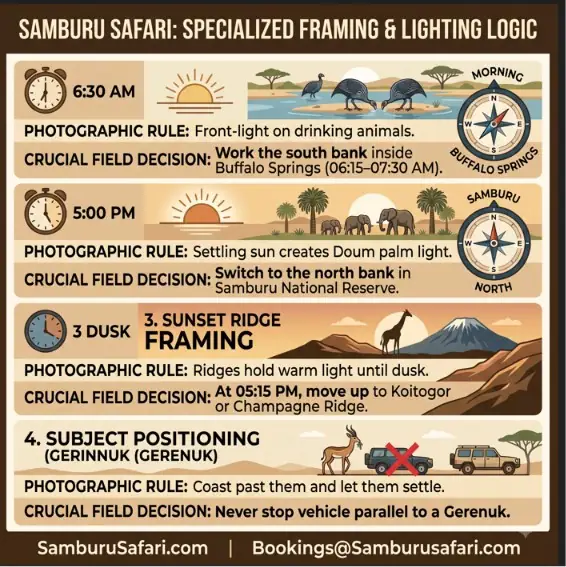
Mastering the Ewaso Nyiro golden-hour light and positioning for specific species is what separates sharp, compelling images from near-misses. This cheatsheet quantifies the scattered behavioral tips and strict lighting axes discussed in the article into decision-oriented rules. From adhering to Moses’ specific gerenuk positioning guide to exploiting warm dusk light on the rocky ridges, this synthesis creates authoritative, high-gain transactional value for any planning photographer.
Photographic Rule | Ground Reality | Crucial Field Decision |
River Axis Morning | Front-light on drinking animals | Work the south bank inside Buffalo Springs (06:15–07:30 AM). |
River Axis Afternoon | Settling sun creates Doum palm light | Switch to the north bank in Samburu National Reserve. |
Sunset Ridge Framing | Ridges hold warm light until dusk. | At 05:15 PM, move up to Koitogor or Champagne Ridge. |
Subject Positioning (Gerenuk) | Coast past them and let them settle. | Never stop vehicle parallel to a Gerenuk. |
We build photographic packages pairing Samburu with Ol Pejeta for rhino tracking. Browse the full catalogue of Samburu safari packages, or start with the master Samburu safari guide if the destination itself is new to you.
The table details our 2027 packages for two adults sharing a private 4×4 Land Cruiser setup.
Package | Trip & Lodges | Price Per Person |
Budget Photo Tier | 4D/3N overland road trip • Samburu Riverside + Comfort Gardens • Private 4×4 Land Cruiser, open drives | $1,480 — Get a quote |
Mid-Range Photo Tier | 4D/3N classic circuit • Samburu Simba + Sweetwaters • Beanbag rests, river drives, rhino tracking | $1,820 — Price this trip |
Luxury Fly-In Photo Tier | 4D/3N air package • Elephant Bedroom + Sanctuary Tambarare • Roundtrip flights, open 4×4 Land Cruiser | $3,250 — Check dates |
Luxury Plus Sky Circuit | 5D/4N luxury sky loop • Saruni Samburu + Ol Pejeta Bush Camp • Subterranean hide access, night drives | $6,420 — Build my itinerary |
Inclusions: Full board stay, private 4×4 with open sides and beanbag rests, TRA-licensed guide, park and conservancy fees, AMREF evacuation cover, regional flights on fly-in options.
Exclusions: International flights, e-visas, personal insurance, premium drinks, tips, excess baggage fees.
The Ol Pejeta leg is covered in depth in our Samburu and Ol Pejeta combo. Photographers wanting the far north — the Mathews Range, Marsabit, Lake Turkana — should look at the 7 day northern Kenya circuit, and anyone contrasting arid north against savannah should consider the combined Maasai Mara and Samburu route.
Between 11:00 AM and 3:00 PM, ground heat creates mirage haze. Distant telephoto shots beyond 300 meters show distortion regardless of what lens you paid for. Rest through the middle of the day. Every photographer who ignores this comes home with a folder of soft frames and no idea why.
The other honest note: two nights is not enough. The light windows are short, and a single overcast morning can cost you a third of your shooting time.
Couples who want the photography without turning the whole trip into a workshop should look at our honeymoon circuit, which runs private vehicles at the same golden-hour timings. Solo photographers on a budget can share vehicle costs through our scheduled group joining departures, though you give up control of the drive timing.
A long telephoto zoom (100–500mm or 150–600mm) for the shy northern species, plus a medium zoom (70–200mm or 24–70mm) for river crossings and sunset scenery.
Yes. A private vehicle lets you control drive timing, cut the ignition for sharp frames, position for golden hour, and stay at a sighting without other travellers pressing you to move on.
The first 90 minutes after sunrise (06:15 to 07:45 AM) and the last 90 before sunset (04:30 to 06:00 PM) give you the best light and the most active behaviour along the river.
Lighting notes and shot data logged on the river loops by our photo safari team. Last updated July 2026.
Message us directly for custom itineraries and the latest seasonal offers.