
Quick Answer: Packing the right safari photography gear for Samburu requires balancing long focal reach with severe environmental conditions. High daytime heat, fine volcanic silt, and dense riverbank shade demand dual camera bodies, a versatile 100–400mm or 200–600mm telephoto lens, dual-saddle beanbags for vehicle stabilization, dual-slot card redundancy, and native 12V USB-C chargers to maintain battery power on the trail.
Before heading into northern Kenya, organize your camera bag around essential field gear and backup accessories:
Category | Primary Gear | Backup / Field Accessory |
Camera Bodies | Primary mirrorless body (High FPS) | Secondary body (avoids lens swapping in dust) |
Lenses | 100–400mm / 200–600mm telephoto | 24–70mm f/2.8 (river shade & Reteti) |
Support | Dual-saddle canvas beanbag | Window clamp with fluid gimbal head |
Power | 4x OEM batteries per camera body | 65W+ USB-C PD car charger (12V native) |
Protection | Neoprene lens covers + shower caps | Static-dissipative sensor gel sticks |
Storage | Dual UHS-II / CFexpress cards | Rugged NVMe SSDs (IP67 dust-rated) |
Our safari Land Cruisers are modified with wide drop-down side windows, removable pop-up roof hatches, and built-in power points to support wildlife photographers. Gerard Murero’s first rule on the river loops: big cats seek shelter under riverbank foliage early in the day, so understanding heat, light, and dust behavior matters as much as owning good glass. If the camera plan is only one part of the trip you are still shaping, the main Samburu safari guide covers routes, seasons, and lodges in one place.
Choosing the right camera system comes down to autofocus tracking performance, weather sealing, and lens availability across major camera brands.
System Brand | Primary Telephoto Lens | Environmental / Wide Lens | Ideal Sensor Setup |
Sony E-Mount | Sony FE 200–600mm f/5.6–6.3 G | Sony FE 24–70mm f/2.8 GM II | High-res full-frame (A7R V / A1) |
Canon RF | Canon RF 100–500mm f/4.5–7.1 L | Canon RF 24–70mm f/2.8 L | Dual-card full-frame (R5 II / R6 II) |
Nikon Z | Nikon Z 180–600mm f/5.6–6.3 VR | Nikon Z 24–120mm f/4 S | Fast readout full-frame (Z8 / Z9) |
Micro Four Thirds | OM System 150–400mm f/4.5 TC | OM System 12–40mm f/2.8 | APS-C / MFT 2x crop reach advantage |
You do not need an expensive 600mm prime lens for great wildlife shots. Camera bodies with APS-C sensors (1.5x crop) or Micro Four Thirds systems (2.0x crop) give mid-tier lenses significant extra reach. A 70–300mm lens on an APS-C body provides an effective field of view of 105–450mm. On Micro Four Thirds, that same lens reaches an effective 140–600mm, offering a budget-friendly way to capture distant animals across dry riverbeds.
While long focal lengths capture distant details, high temperatures put physical limits on image sharpness.
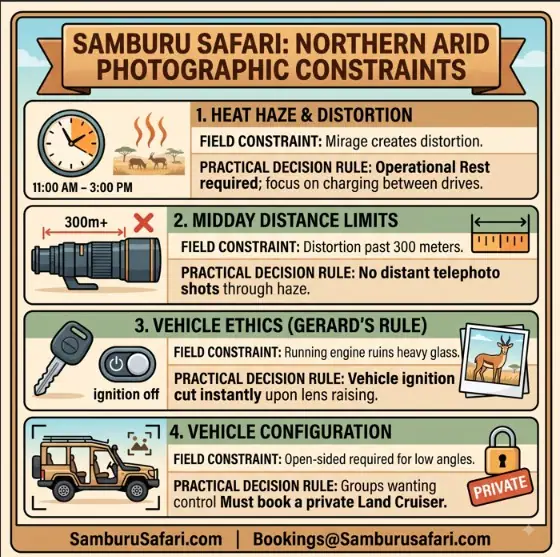
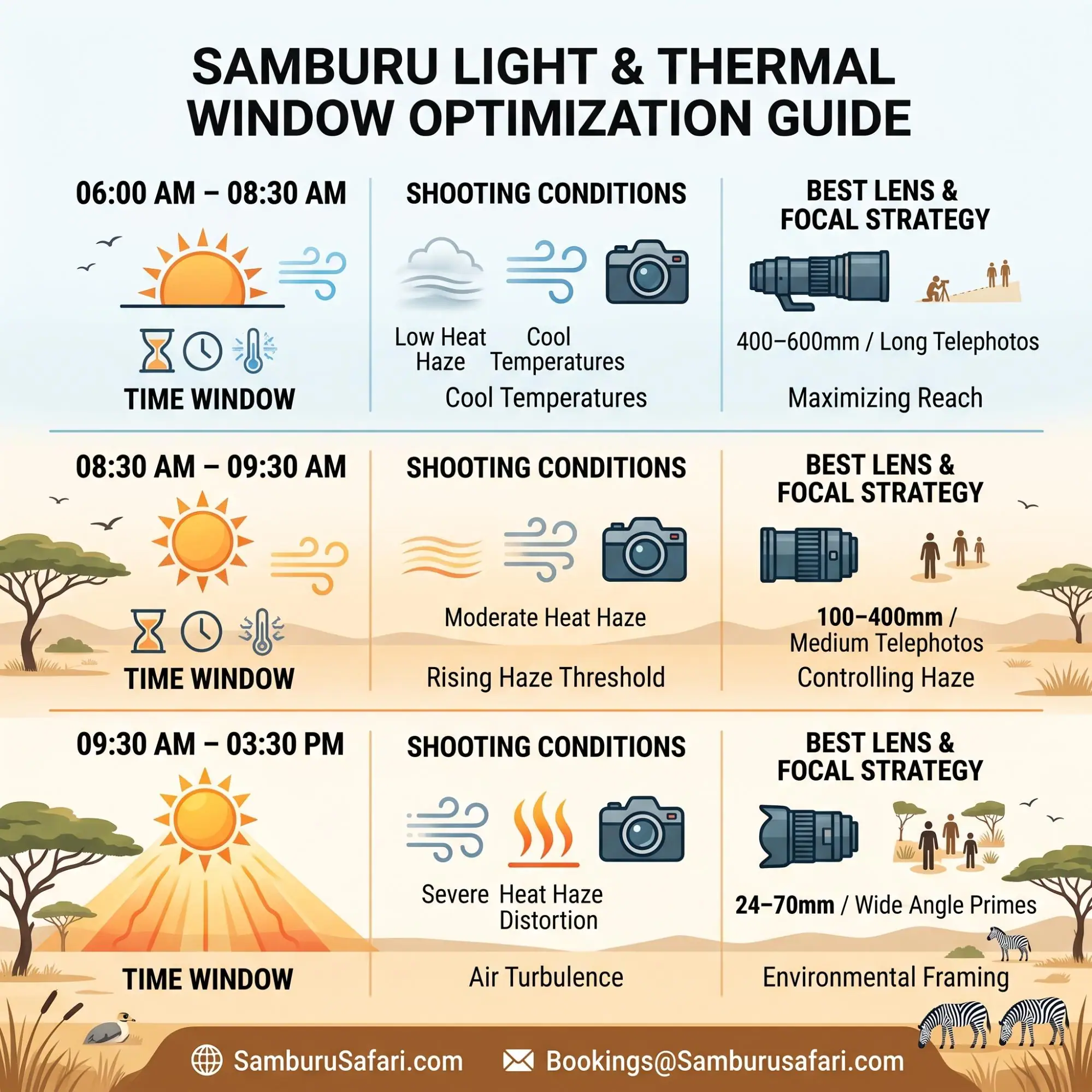
Past 9:30 AM, ground temperatures radiating off red clay and volcanic gravel trigger severe thermal air turbulence (“heat haze”). Photographers using 500mm or 600mm super-telephoto lenses past mid-morning end up with soft, heat-distorted images regardless of shutter speed or glass quality.
Work with high-magnification telephotos between 6:00 AM and 8:30 AM. Once thermal shimmer sets in during late morning, switch to wider focal lengths (70–200mm) to capture animals framed by their environment. The month you travel matters as much as the hour: the best months to visit for clean air are May and December, right after the rains knock the dust down.
When visiting the Reteti Elephant Sanctuary in nearby Namunyak Conservancy, the public observation platform sits directly above feeding troughs at a steep 45-degree downward angle, just 5 to 10 meters from orphaned elephant calves. Super-telephoto prime lenses (400mm or 600mm) are completely unusable here. Bring a fast 24–70mm f/2.8 or a 35mm prime lens to capture wide interaction without cutting off trunk details.
Navigating Equatorial light and extreme field temperatures requires precise timing to avoid soft, heat-distorted images. As ground temperatures rise off volcanic gravel, thermal air turbulence imposes physical limits on high-magnification telephoto lenses. Refer to this operational field guide to align your target subject, optimal focal reach, and shooting window throughout the day.
Time Window | Shooting Conditions | Best Lens & Focal Strategy |
06:00 AM – 08:30 AM | Low heat haze, dark river shadows | 400–600mm telephotos; wide aperture (f/2.8–f/5.6), high ISO |
08:30 AM – 09:30 AM | Moderate light, rising air shimmer | 100–400mm zoom; mid-range focal lengths to control haze |
09:30 AM – 03:30 PM | Severe heat haze & harsh overhead sun | 24–70mm / 35mm wide primes; environment framing & wide shots |
Northern Kenya’s red dust is far finer than standard dirt and penetrates camera gear easily.
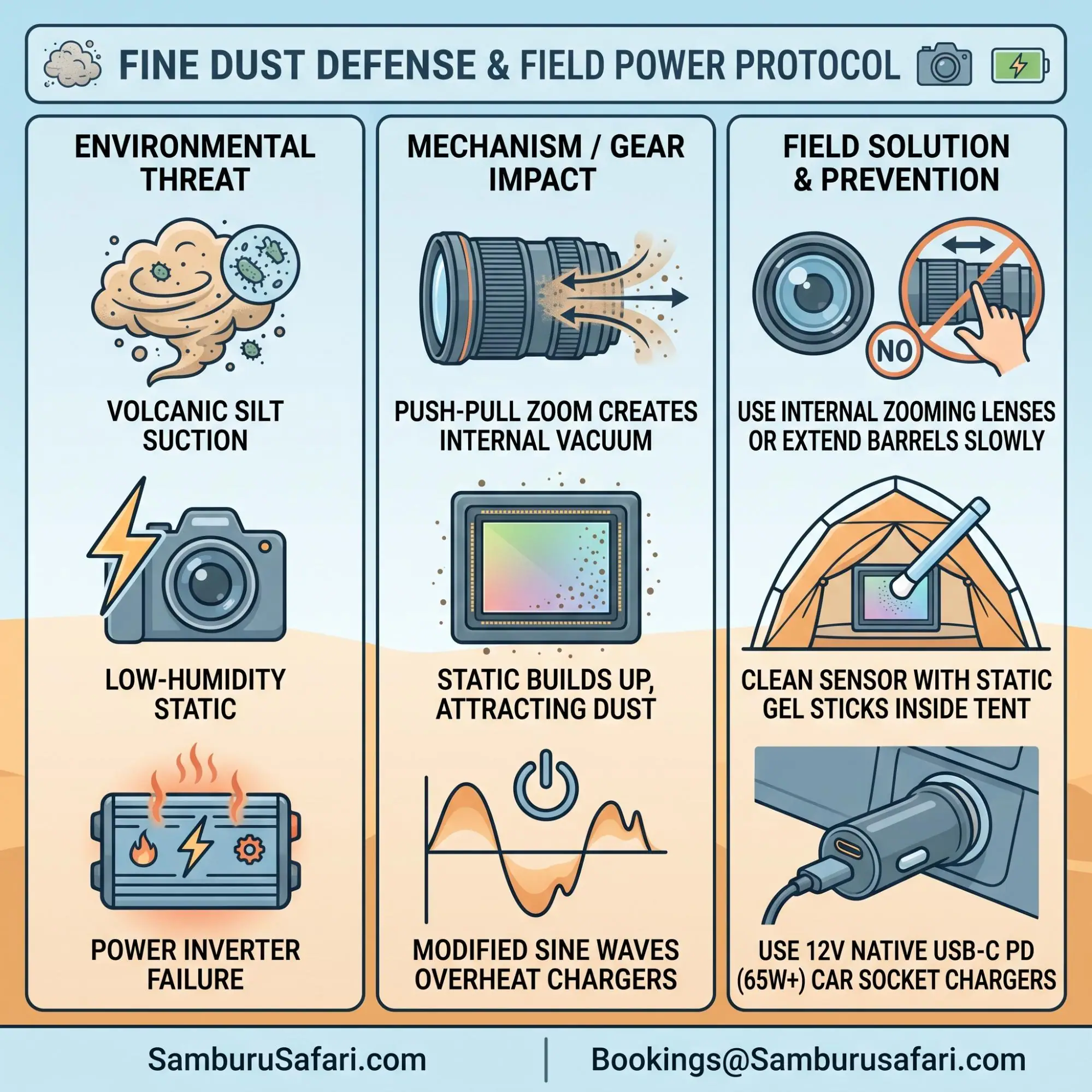
Rapidly extending external zoom lenses (such as 100–400mm or 150–600mm push-pull barrels) creates an internal air vacuum that sucks floating dust particles straight through weather seals into internal lens elements. Zoom slowly during dusty tracking runs, or use internal-zooming lenses like a 200–600mm. Neoprene lens barrels also add an extra layer of protection on sand tracks.
Air humidity in the reserve frequently drops below 15%. In conditions this dry, static builds up fast on sensor glass and actively pulls floating dust toward it, so field cleaning can leave a sensor dirtier than it started. Skip wet swabs entirely while in camp. Clean your sensor inside a closed tent using dry, static-dissipative gel sticks, and save any wet cleaning for your return to Nairobi.
Northern Kenya’s fine volcanic silt and ultra-low relative humidity create a challenging environment for sensitive electronic gear. Vacuum suction from extending zoom barrels and static charge on sensor glass can cause sudden equipment issues in the field. This quick-reference guide breaks down common environmental threats alongside immediate preventive steps and field workarounds.
Environmental Threat | Mechanism / Gear Impact | Field Solution & Prevention |
Volcanic Silt Suction | Push-pull zoom creates lens vacuum | Use internal-zooming lenses or extend barrels very slowly |
Low-Humidity Static | High static charge attracts dust to sensor | Clean with dry static gel sticks inside tent; avoid wet swabs |
Power Inverter Failure | Modified sine waves overheat chargers | Use direct 12V USB-C PD (65W+) native car socket chargers |
Keeping your camera steady while handling electrical quirks inside tracking vehicles prevents missed opportunities. Shooting from your own rental instead of a guided cruiser? The self drive Samburu page covers vehicle choice, window setups, and power sockets in detail.
Single-pod beanbags easily slip off rounded vehicle roof rails on corrugated washboard tracks. Heavy-duty dual-saddle canvas beanbags drape securely over vehicle door frames and roof hatches. You can buy dry rice or beans at local shops past the main roundabout in Isiolo town to fill your beanbags before entering the reserve. Alternatively, pair a window clamp with a fluid gimbal head mounted directly to the open roof frame.
Vehicle VHF radios transmit powerful bursts from an antenna sitting a meter from your gear. If your 2.4GHz wireless flash triggers start misfiring near an active radio during low-light camp or hide photography, shift them to offset channels or fall back to optical TTL sync until the radio traffic quiets down.
Lighting along the Ewaso Nyiro River shifts dramatically between open sandbanks and dense tree canopy, requiring careful camera settings and reliable power management.
Early morning leopard tracking beneath dense Doum Palm (Hyphaene thebaica) groves creates extreme light contrast. Dark frond shadows combined with bright dawn water reflections require dual-gain camera sensors that remain clean at ISO 3200–6400. You need fast shutter speeds (1/1000s minimum) to freeze cat movement under heavy palm shade before full sunrise.
Using a circular polarizing filter (CPL) on a wide-angle lens (16–35mm) under midday equatorial sun creates a dark, uneven band across the sky due to the solar angle. Use a 4-stop Neutral Density (ND) filter or graduated ND filter instead to cut reflection glare off white sandbanks without ruining sky gradients.
Dashboard power inverters in safari trucks often produce modified sine wave AC power that can overheat camera battery chargers. Use native 12V USB-C Power Delivery (65W+) car chargers connected directly to vehicle sockets, or bring a compact Pure Sine Wave inverter to charge camera batteries safely while driving.
Cellular internet in Samburu is too slow for cloud photo backups. Protecting your images requires a solid field data workflow:
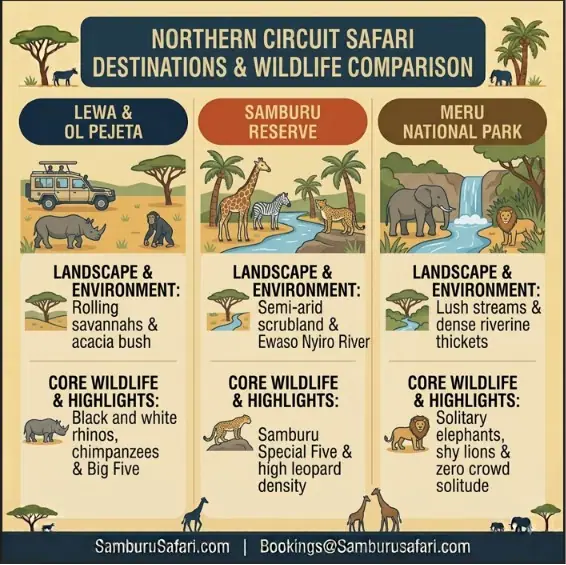
A well-planned itinerary balances prime morning photography hours in the reserve with afternoon drives in private conservancies. Pairing the river loops of Samburu with the cool highland plains of Ol Pejeta Conservancy gives photographers varied terrain — from desert specialists up north to black rhinos and chimpanzees down south.
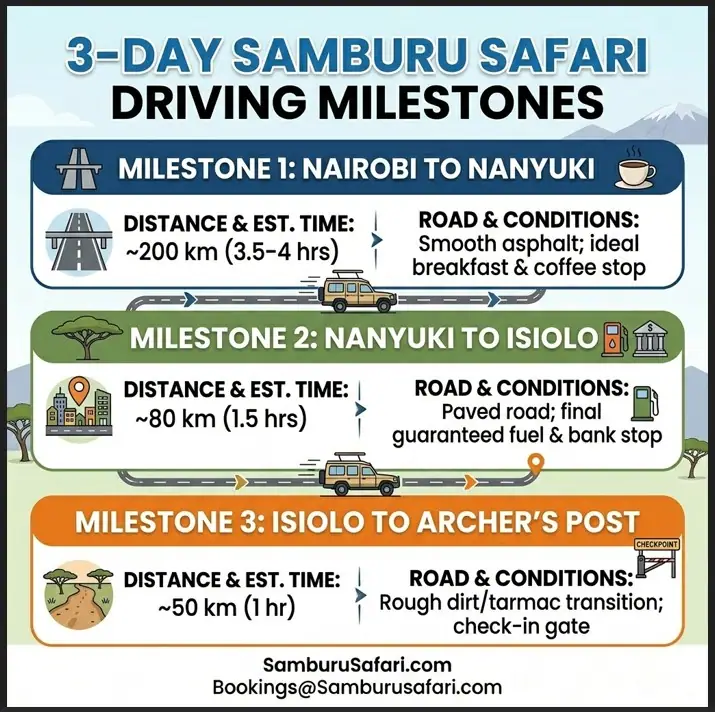
The gate fee schedule tells you what entry actually costs per 24 hours, and the road route from Nairobi maps the drive up with fuel and coffee stops. Everything bundled into a fixed price lives under our Samburu safari packages, including the custom photographic tour with an open-view cruiser.
The pricing table below outlines our main multi-destination packages for 2027 travel dates, based on two adults sharing a private 4×4 Safari Land Cruiser.
Package | Trip & Lodges | Price Per Person |
Budget Overland Tier | 4D/3N road safari • Samburu Riverside Camp + Comfort Gardens Ol Pejeta • Private cruiser, driver-guide, full board | $1,480 — Get a quote |
Mid-Range Overland Tier | 4D/3N classic circuit • Samburu Simba Lodge + Sweetwaters Tented Camp • Waterhole views, rhino tracking, extended drives | $1,820 — Price this trip |
Luxury Fly-In Tier | 4D/3N premium air package • Elephant Bedroom Camp + Sanctuary Tambarare • Roundtrip bush flights, riverfront tents | $3,250 — Check dates |
Luxury Plus Sky Circuit | 4D/3N luxury flight loop • Sasaab Lodge + Ol Pejeta Bush Camp • All bush flights, open-front suites, night drives | $6,120 — Build my itinerary |
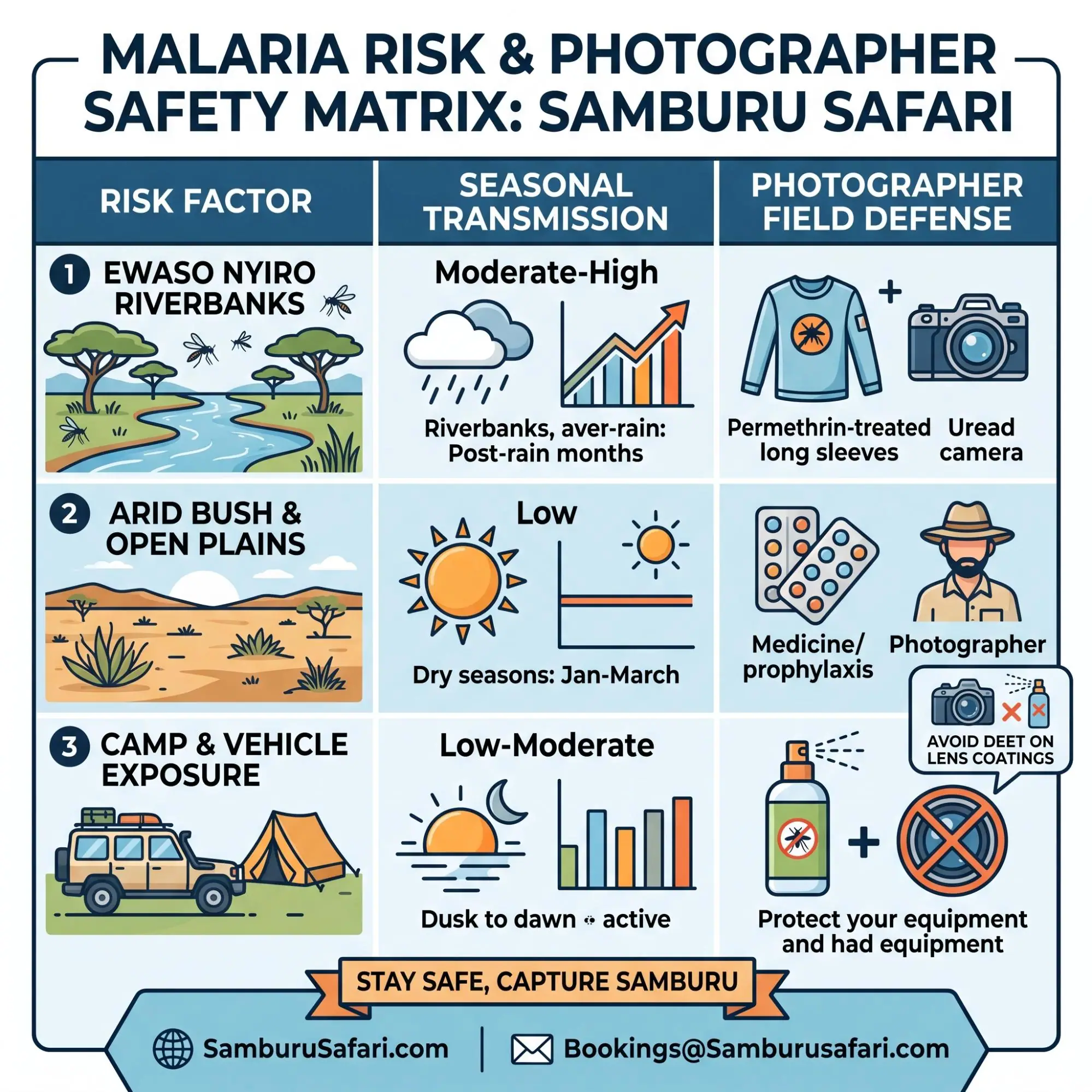
When planning a photo safari to Northern Kenya, understanding health precautions is as essential as gear preparation. While Samburu is a low-to-moderate transmission zone due to its arid climate, seasonal rains and riverbank shooting drastically increase vector exposure. The table below outlines key malaria transmission factors, preventive measures, and field gear management tips tailored specifically for wildlife photographers.
Risk Factor | Seasonal Transmission | Photographer Field Defense |
Ewaso Nyiro Riverbanks | Moderate-High (Post-rain months) | Wear Permethrin-treated long sleeves during dawn/dusk river loops |
Arid Bush & Open Plains | Low (Dry seasons: Jan–March) | Take prescribed oral prophylaxis (Atovaquone-Proguanil or Doxycycline) |
Camp & Vehicle Exposure | Low-Moderate (Dusk to dawn active) | Use DEET/Picaridin on skin; avoid spraying directly near lens coatings |
Keep camera bodies wrapped in elasticated plastic shower caps while sitting on vehicle seats. Store spare lenses inside heavy-duty slider freezer bags containing silica gel packets inside your daypack.
Avoid pure white clothing, which reflects glare into camera viewfinders, and dark blue or black, which attract tsetse flies. Wear neutral tan, khaki, or olive tones; the full Samburu safari packing list covers clothing down to boot soles.
No, recreational drones are completely banned inside the reserve. The confiscation process and vault fees are laid out in the park rules overview, or consult the official Kenya Civil Aviation Authority portal.
A 100–400mm or 200–600mm zoom lens provides the best versatility. It allows you to frame distant wildlife across riverbeds while zooming back for larger mammals close to the vehicle.
Leave heavy tripods at camp during game drives, as vehicle interiors leave little floor space for tripod legs. A dual-saddle beanbag or window clamp gimbal head provides far better stability on open vehicle frames.
Regional bush flights operated by Safarilink or AirKenya enforce a strict 15kg soft-bag weight limit per passenger. Wear heavy camera gear in a multi-pocket photo vest during check-in at Wilson Airport to keep your hand luggage within limits. Fares, schedules, and the full baggage rules sit under flights from Nairobi to Samburu.
Field techniques tested on the river loops by our photo safari team. Written by Benson Kungu. Reviewed by Gerard Murero. Last updated July 2026.
Message us directly for custom itineraries and the latest seasonal offers.