
Quick Answer: Bird watching in samburu offers access to over 450 avian species across northern Kenya’s dry acacia scrub and riverine forests. Known for rare dry-country endemics like the Vulturine Guineafowl, Golden-breasted Starling, Somali Ostrich, and Golden Pipit, Samburu National Reserve provides world-class birding along dry luggas, volcanic ridges, and the Ewaso Nyiro River.
Written by Gerard Murero. Reviewed by Benson Kungu.
Field Metric | Samburu Birding Profile |
Recorded Species | 450+ resident and palaearctic migratory species |
Key Endemic Stars | Vulturine Guineafowl, Golden-breasted Starling, Somali Ostrich, Golden Pipit |
Threatened Raptors | White-backed Vulture, Martial Eagle, Bateleur, Lappet-faced Vulture |
Prime Habitats | Ewaso Nyiro riverine forest, Nderoi Lugga, open gravel plains, Swara Loop |
Best Season | Nov – Apr (migratory species & breeding plumage) | Year-round for endemics |
Birding in Samburu is a completely different game from southern Kenya. You are not scanning open green grasslands from a cruiser window. You are tracking camouflaged dry-country specialists through thick thorn scrub and sand washouts, where sharp ears matter as much as good optics.
According to global monitoring data from BirdLife International, Samburu’s ecosystem protects critical populations of Horn of Africa endemics that cannot survive in wetter southern parks. If the birds are your reason for coming north but the trip is still unplanned, the master Samburu safari guide covers routes, seasons, and lodges around them.
Unlike the common helmeted guineafowl, Vulturine guineafowl (Acryllium vulturinum) carry cobalt-blue chests, long lancet-like neck hackles, and bare red-eyed heads. Local drivers call them the unofficial sixth member of the Samburu Special 5, and once you have seen a flock in morning light you understand why.
Flocks of 30 to 50 gather on the dusty gravel tracks near Archer’s Gate around 7:00 AM, taking communal dust baths in fine alkaline silt before 35°C ground heat pushes them into dense thorn shade.
Unlike the common African Ostrich found down south, the Somali Ostrich (Struthio molybdophanes) shows blue-gray neck and thigh skin that turns bright cobalt on males during courtship. Small groups roam the open volcanic gravel plains near Buffalo Springs and Archer’s Post.
If there is one bird guests constantly ask to see along Swara Loop, it is the Golden-breasted Starling (Lamprotornis regius). But here is the trick: unlike Superb Starlings that hop around lodge lawns looking for crumbs, these Royal Starlings stay high in the Acacia reficiens canopy.
You will not see them sitting out in the open. What you are actually looking for around 7:30 AM—just as the morning sun hits the upper branches—is a sudden flash of electric violet and yellow catching the light inside the thorn thickets. Keep your engine off, listen for their raspy contact calls, and let them come to the outer branches on their own terms.
The brilliant yellow Golden Pipit (Tmetothylacus tenellus) flashes through dry thorn scrub alongside three classic hornbill species: the Northern Red-billed, Eastern Yellow-billed, and Von der Decken’s Hornbill.
Keep an eye on the big mammals too. Red-billed and yellow-billed oxpeckers ride the backs of every reticulated giraffe herd along the river, and their sharp hissing alarm is often the first warning that something is moving in the grass below.
When we drive past Koitogor Hill, I always stop the Land Cruiser near the massive social weaver grass nests. Nine times out of ten, guests assume we are looking at weavers. Then I point out a tiny 19 cm Pygmy Falcon (Polihierax semitorquatus) sitting quietly in one of the lower chamber entrances, waiting on a lizard.
The same thickets hold the endemic mammals people come north for — the browsing gerenuk works the mid-height branches while you are scanning them for barbets.
“What rare birds live in Samburu” / “Samburu endemic bird species habits”
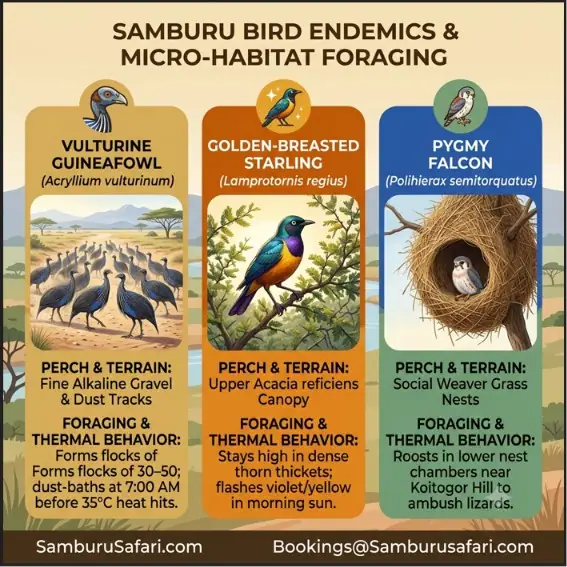
Samburu’s harsh desert ecosystem has forced resident bird species to develop distinct foraging habits and micro-habitat preferences to beat the extreme midday heat. While common species occupy wide territories, dry-country endemics depend on precise vegetation layers and ground conditions throughout the reserve. The table below details where these specialized birds forage and the precise physical behaviors that allow them to thrive in northern Kenya. Use these environmental cues on morning drives to locate target species quickly.
Target Endemic Species | Canopy & Terrain Layer | Foraging & Thermal Survival Behavior |
Vulturine Guineafowl | Fine alkaline gravel & dust tracks | Forms flocks of 30–50; dust-baths at 7:00 AM before 35°C heat hits |
Golden-breasted Starling | Upper Acacia reficiens canopy | Stays high in dense thorn thickets; flashes violet/yellow in morning sun |
Pygmy Falcon | Social weaver grass nests | Roots in lower nest chambers near Koitogor Hill to ambush lizards |
Finding rare birds in dense scrub takes patience. Most people drive right past them.
Unlike migratory European bee-eaters, the resident Somali Bee-Eater (Merops revoilii) excavates horizontal nesting tunnels directly into dry mud banks along Nderoi Lugga. Early morning drives along the washout rim offer close views of these small blue-green birds hawking insects over dry sand.
Male and female Rosy-patched Bushshrikes sing antiphonal duets from deep inside Grewia bushes along the dry washout edges. The male whistles a sharp “wheee-oh”, and his partner answers instantly with “chack-chack”. Once you learn that call-and-response, you start hearing them everywhere.
In the quiet garden paths of Samburu Simba Lodge and Samburu Intrepids, D’Arnaud’s barbets perform a mechanical courtship dance on low dead branches, bowing frantically and wagging their tails in sync while singing a rhythmic “d’ar-naud… d’ar-naud” call.
At dusk, between 6:15 PM and 6:45 PM, head toward Buffalo Springs. Thousands of Lichtenstein’s and Black-faced Sandgrouse drop to the natural pools, soaking their specialized belly feathers to carry water back to chicks in dry nests miles away. I was set up on that pool edge with Benson one evening when he checked his watch at 6:10 and told me to stop fiddling with the lens. Two minutes later the sky filled. Arrive fifteen minutes before sunset or you miss the whole thing.
Owls and nightjars pick up where the sandgrouse leave off, but the reserve gates lock at 6:00 PM, so the after-dark list belongs to the conservancies — a night game drive on private land is the only legal way to work it.
“Best birding hotspots in Samburu” / “How to identify Samburu bird calls”
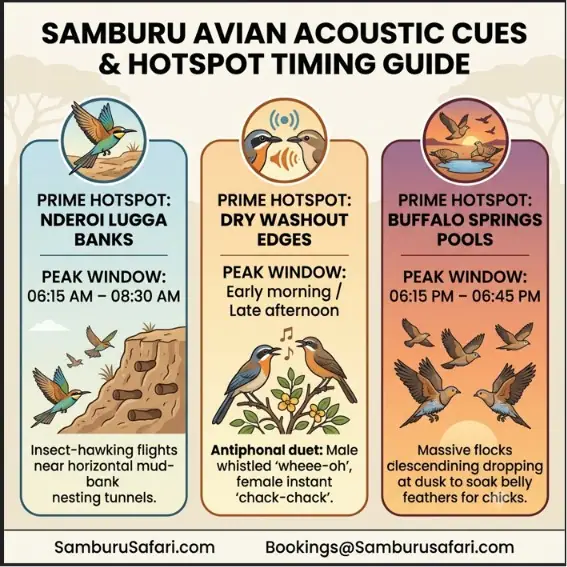
Finding camouflaged birds in dense thorn scrub relies far more on listening for distinct acoustic signals than scanning empty branches. From the rhythmic duets of bushshrikes along washouts to the evening flight paths of sandgrouse, specific audio cues signal hidden avian activity across Samburu’s top hotspots. Tracking these calls allows birders to anticipate movements before the birds emerge into view. This quick reference guide connects key hotspots, peak observation windows, and diagnostic calls.
Prime Hotspot | Peak Observation Window | Diagnostic Call & Tracking Signal |
Nderoi Lugga Banks | 06:15 AM – 08:30 AM | Insect-hawking flights near horizontal mud-bank nesting tunnels |
Dry Washout Edges | Early morning / Late afternoon | Antiphonal duet: Male whistled “wheee-oh”, female instant “chack-chack” |
Buffalo Springs Pools | 06:15 PM – 06:45 PM | Massive flocks dropping at dusk to soak belly feathers for chicks |
Samburu’s dry open skies are a refuge for large raptors facing severe habitat loss across Africa. High basalt cliffs and tall Acacia elatior trees along the Ewaso Nyiro River serve as vital nesting structures:
Serious birders who want to work the riverine forest properly should consider a guided walking safari with an armed ranger in the bordering conservancies. On foot, at bird-level, you hear ten times what you catch from a vehicle.
“Eagles and vultures in Samburu” / “Samburu raptor nesting sites”
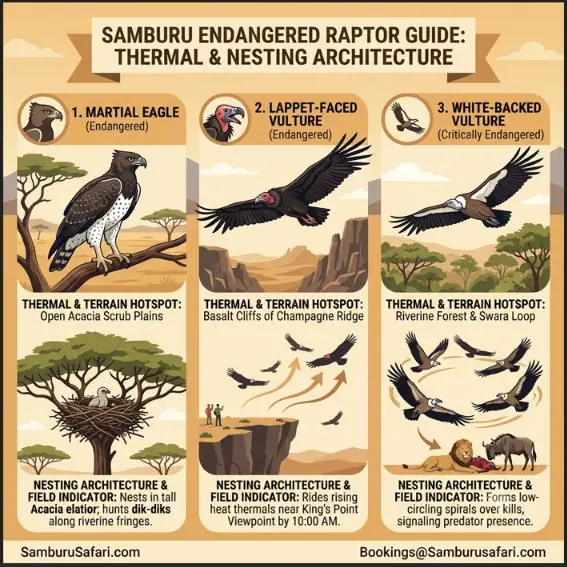
Northern Kenya’s open skies, high basalt cliffs, and tall riverine trees provide a critical sanctuary for Africa’s declining large raptor populations. Thermal air currents radiating off dark rock formations give heavy scavengers the lift needed to patrol vast distances without burning energy. Understanding where these birds nest and how they utilize landscape thermals makes locating them far easier during midday game drives. The table below outlines nesting architectures, thermal hotspots, and key field indicators for Samburu’s threatened birds of prey.
Raptor Species | Thermal & Terrain Hotspot | Nesting Architecture & Field Indicator |
Martial Eagle (Endangered) | Open acacia scrub plains | Nests in tall Acacia elatior; hunts dik-diks along riverine fringes |
Lappet-faced Vulture (Endangered) | Basalt cliffs of Champagne Ridge | Rides rising heat thermals near King’s Point Viewpoint by 10:00 AM |
White-backed Vulture (Critically Endangered) | Riverine forest & Swara Loop | Forms low-circling spirals over kills, signaling predator presence |
To track your sightings where mobile coverage is limited:
We design multi-destination itineraries pairing Samburu’s dry river tracks with neighboring highland reserves like Ol Pejeta Conservancy, so you can work the northern endemics before heading south for highland forest species.
Every trip below rolls gate tickets, vehicle, guide, and lodging into one fixed price, with the full range under our Samburu safari packages.
The pricing table details our 2027 multi-destination packages for two adults sharing a private 4×4 Safari Land Cruiser. Prices shift with seasonal lodge adjustments — traveling in the low season (April–May) can bring these costs down by roughly 20%.
Package | Trip & Lodges | Price Per Person |
Budget Overland Tier | 4D/3N road safari • Samburu Riverside Camp + Comfort Gardens Ol Pejeta • Private cruiser, driver-guide, full board | $1,480 — Get a quote |
Mid-Range Overland Tier | 4D/3N classic circuit • Samburu Simba Lodge + Sweetwaters Tented Camp • Waterhole views, rhino tracking, extended drives | $1,820 — Price this trip |
Luxury Fly-In Tier | 4D/3N premium air package • Elephant Bedroom Camp + Sanctuary Tambarare • Roundtrip bush flights, riverfront tents | $3,250 — Check dates |
Luxury Plus Sky Circuit | 4D/3N luxury flight loop • Sasaab Lodge + Ol Pejeta Bush Camp • All bush flights, open-front suites, night drives | $6,120 — Build my itinerary |
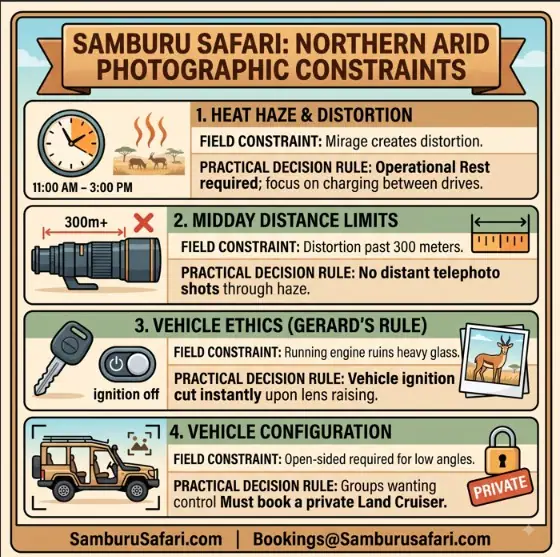
By 9:30 AM, temperatures climb toward 35°C and heat radiating off volcanic gravel creates thick air shimmer. Long 500mm telephoto shots lose focus fast. Shoot early, between 6:15 AM and 9:00 AM. Fine red dust also gets everywhere along the unpaved tracks, so keep lenses wrapped in padded bags while driving between spots.
Many small birds — finches, larks, cisticolas — feed deep inside Acacia reficiens thickets. Staring through sharp thorns without a decent pair of 8×42 binoculars gets old fast. Go slow. Work the calls first and the eyes second.
Stay on marked tracks at all times. Driving off-road to chase a bird is illegal, carries heavy county fines, and flattens the exact scrub the birds nest in. Park, cut the engine, and let them come to you.
The Vulturine Guineafowl and the Somali Ostrich are Samburu’s two best-known avian stars, both carrying that unmistakable cobalt-blue coloring.
Birds of East Africa by Terry Stevenson and John Fanshawe remains the standard for accurate identification in this region.
November to April gives the highest total species counts, as European migrants arrive and resident species come into breeding plumage. Dry-country endemics are present year-round.
Over 450 species have been recorded across Samburu, Buffalo Springs, and Shaba, making the northern circuit one of East Africa’s strongest arid birding destinations.
Species lists and hotspot timings logged on the river loops and lugga edges by our guides. Last updated August 2026.
Message us directly for custom itineraries and the latest seasonal offers.