
Quick Answer: The Somali ostrich (Struthio molybdophanes) is northern Kenya’s endemic blue-necked flightless bird, found in Samburu National Reserve. Key field traits are the male’s cobalt-blue neck and thighs, a browser diet, communal ground nests (Laro), and a two-note subterranean roar through breeding season. It is one of the five northern endemics covered across our wildlife of Samburu section.
Written by Gerard Murero. Reviewed by Benson Kungu.
Somali Ostrich (Struthio molybdophanes) | Feature |
Local Vernacular | Blue-necked Ostrich |
IUCN Status | Vulnerable (IUCN Red List) |
Key Physical Trait | Cobalt-blue neck and thighs on males, wide flat browsing beak |
Voice / Mating Call | Deep subterranean roar (kant-kant) carrying over 3 km |
Prime Samburu Hotspots | Central Airstrip flats, Kalama Gate plains, open scrub past Archer’s Gate |
Best Viewing Hours | 06:30 – 09:00 & 16:00 – 18:15 |
Feature | Somali Ostrich (S. molybdophanes) | Masai Ostrich (S. c. massaicus) |
Male Skin Colour | Vivid cobalt-blue (neck and thighs) | Pink to reddish-pink |
Feather Tail | Pure white with grey tint | Dirty white / brownish |
Primary Range in Kenya | North of the Equator (Samburu, Shaba, Laikipia) | South of the Equator (Masai Mara, Amboseli, Tsavo) |
Feeding Strategy | Specialised browser (bushes, seed pods) | Grazing herbivore (fresh grasses) |
Neck Ring | Lacks a broad white feather collar | Prominent white feather ring at base of neck |
You notice the colour first. Out on the gravel flats past Archer’s Gate, a male stands against golden grass in a cobalt blue that looks wrong against red earth — too saturated, like something painted.
The species is one of the Samburu Special 5, the north’s five signature endemics, and BirdLife International lists it as Vulnerable. That makes this reserve central to its survival, and it headlines a bird list running past 450 recorded species.
Samburu herders read these birds as sentinels. When a flock stops feeding all at once, drops its heads and freezes, there is a lion or a rustler in the thorn scrub. Learn to watch for it and the ostriches will tell you about the predators before your guide does.
Southern ostriches graze. This one browses, which is the whole reason it survives up here.
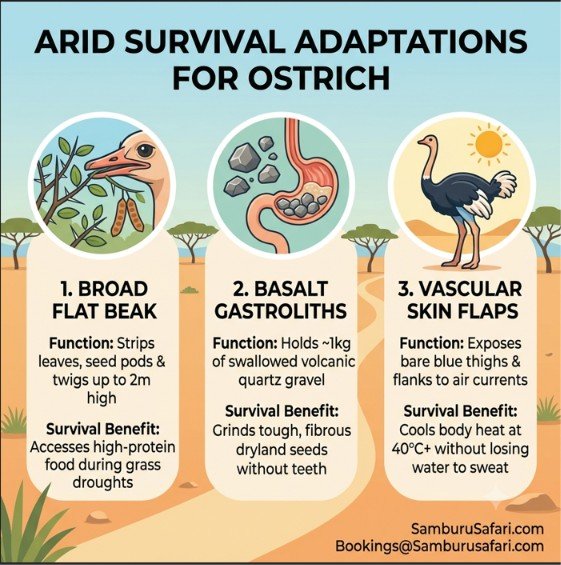
A wide flat beak strips high-protein leaves (Barleria), desert flowers and seed pods off thorn bushes up to two metres off the ground. When the ground grass dies back in the dry, the food is still there at head height — the same high-thorn niche the gerenuk works from below, standing on its hind legs.
No teeth. So they swallow coarse volcanic basalt and quartz gravel from the dry washouts, and an adult carries close to a kilogram of gizzard stones to grind down seed pods, woody twigs and fibrous desert plants.
Past 40°C along the Ewaso Nyiro, ostriches stay out of the riverine thickets where lions wait. They stand in open sun instead and hold their wings away from the body, exposing bare blue skin on the thighs and flanks to any breeze going.
It cools them without spending water on sweat — a different solution to the same problem the Beisa oryx handles internally with its carotid rete.
“How do Somali ostriches survive in dry conditions?” / “Somali ostrich desert adaptations”
Operating in Samburu’s high-temperature semi-arid ecosystem requires unique evolutionary features that distinguish the Somali ostrich from southern grazing populations. From specialized jaw mechanics for high-protein browsing to thermal regulation via exposed vascular skin, every physiological trait reduces water loss. The table below outlines how this flightless bird thrives in northern Kenya’s harsh scrubland without competing directly with ground grazers. Use this quick reference guide to understand their survival mechanics on game drives.
Adaptation Mechanism | Physiological Function | Survival Benefit in Samburu |
Broad Flat Beak | Strips leaves, seed pods & twigs up to 2m high | Accesses high-protein food during grass droughts |
Basalt Gastroliths | Holds ~1kg of swallowed volcanic quartz gravel | Grinds tough, fibrous dryland seeds without teeth |
Vascular Skin Flaps | Exposes bare blue thighs & flanks to air currents | Cools body heat at 40°C+ without losing water to sweat |
From September to November, males inflate the bare blue neck sacs to twice normal size and produce a low two-note roar — kant-kant — that carries more than 3 km across dry ground.
Guests at the riverfront camps wake at dawn certain there is a lion outside the tent. There usually is not.
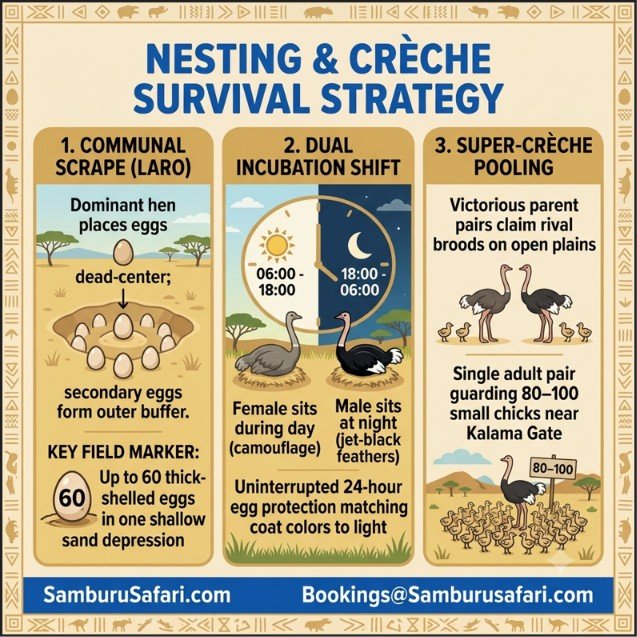
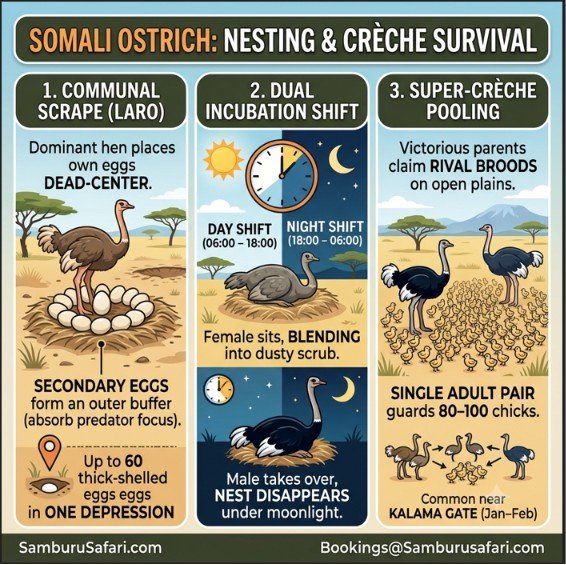
Females lay into one shared ground scrape called a Laro, which can hold up to 60 eggs. The dominant hen puts her own eggs dead centre, where incubation temperature holds steady, and pushes the secondary females’ eggs out to the rim.
Those outer eggs are a buffer. When Egyptian vultures or jackals hit the nest, they take those first.
Incubation runs on a shift system set by plumage:
When rival parent pairs meet on open ground they fight over custody of the chicks, and the winners take both broods. The result is a super-crèche of 80 to 100 chicks under one adult pair.
Look for them on the open plains near Kalama Gate between January and February. Grevy’s zebra mares pool their foals into guarded crèches the same way — two animals with nothing in common landing on the identical trick.
“Somali ostrich nesting strategy” / “What is a Laro nest super crèche”
Reproduction in Samburu’s open scrub requires a collective defense strategy against opportunists like Egyptian vultures, hyenas, and jackals. By pooling eggs into a central ground scrape (Laro) and sharing incubation shifts, parent pairs maximize chick survival while minimizing thermal exhaustion. Winning adult pairs often merge multiple broods into massive super-crèches after hatching. This breakdown highlights the key stages and survival mechanisms of the Somali ostrich nesting lifecycle.
Nesting Stage | Role & Strategy | Key Field Marker |
Communal Scrape (Laro) | Dominant hen places eggs dead-center; secondary eggs form outer buffer | Up to 60 thick-shelled eggs in one shallow sand depression |
Dual Incubation Shift | Female sits during day (camouflage); male sits at night (jet-black feathers) | Uninterrupted 24-hour egg protection matching coat colors to light |
Super-Crèche Pooling | Victorious parent pairs claim rival broods on open plains | Single adult pair guarding 80–100 small chicks near Kalama Gate |
I was out near the Central Airstrip flats with Benson at 7:00 AM last dry season when he pulled the Cruiser over by the ash beds on the southern edge. Flocks of four to eight gather there most mornings to roll in loose alkaline dust, which suffocates the parasites living in their skin folds.
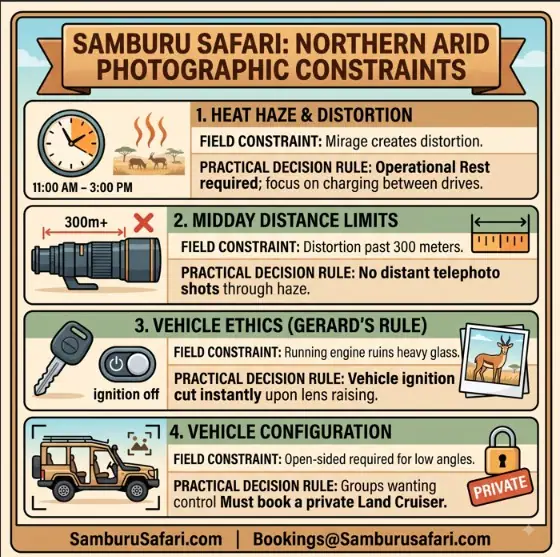
His timing rule was simple: shoot the blue neck before nine. After that the ground heat shimmers and anything past thirty metres goes soft.
That early window between 06:30 and 09:00 gives the crispest rendering of the male’s neck skin. Reticulated giraffe work the same acacia edges at that hour, so the loop makes for an easy two-species dawn.
The birds are resident year-round. The behaviour is not — mating, nesting and brooding each peak in their own window.
Month Window | Climate Conditions | Key Ostrich Behaviour | Sighting Probability |
Jan – Feb | Post-rain dry spell | Super-crèches of 80–100 chicks active on open plains | High (90%) |
Mar – May | Long rains | Dispersal into dense acacia scrub; feeding on fresh seed pods | Moderate (65%) |
Jun – Aug | Cool dry season | Flocks gather near the Ewaso Nyiro for midday water | High (85%) |
Sep – Nov | Peak dry / short rains | Male breeding displays, blue skin intensifies, boom calls | Peak (95%) |
Dec | Post-short rains | Incubation of communal Laro ground nests | High (80%) |
September to November is the visual peak, but every month puts something different on the plains — January super-crèches, June river gatherings.
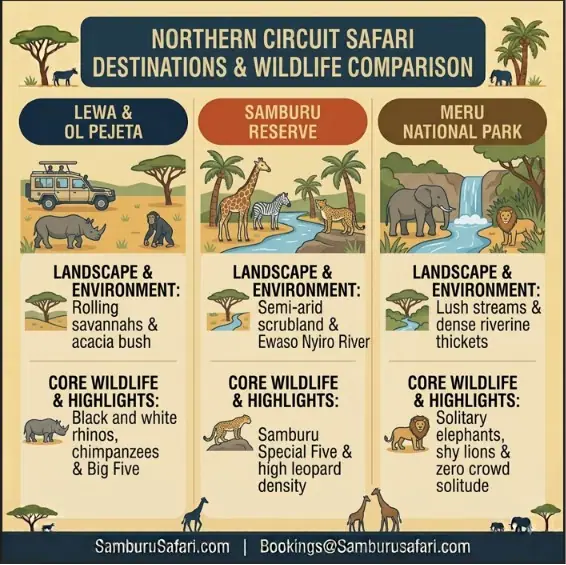
At Samburusafari.com we build itineraries that pair Samburu’s dry river loops with neighbouring reserves like Ol Pejeta, so you track northern endemics along the river tracks first, then head south for black rhino and chimpanzees. Every trip below rolls gate tickets, vehicle, guide and lodging into one fixed price, and the full range sits under our Samburu safari itineraries.
Package | Trip & Lodges | Price Per Person | |
Budget Overland Tier | 4D/3N road safari • Samburu Riverside Camp + Comfort Gardens Ol Pejeta • Private cruiser, driver-guide, full board | $1,480 | |
Mid-Range Overland Tier | 4D/3N classic circuit • Samburu Simba Lodge + Sweetwaters Tented Camp • Waterhole views, rhino tracking, extended drives | $1,820 | |
Luxury Fly-In Tier | 4D/3N premium air package • Elephant Bedroom Camp + Sanctuary Tambarare • Roundtrip bush flights, riverfront tents | $3,250 | |
Luxury Plus Sky Circuit | 4D/3N luxury flight loop • Sasaab Lodge + Ol Pejeta Bush Camp • All bush flights, open-front suites, night drives | $6,120 |
Did I hear a lion or an ostrich near my camp? Easy to confuse, and most guests get it wrong the first night. A lion’s roar trails off into a series of grunts. A male ostrich gives a smooth two-note boom — kant-kant — and stops.
Are ostriches dangerous if you drive close to a nest? Males are fiercely protective through nesting season, and the forward kick from those legs will break bone. Do not leave the vehicle and do not walk toward a ground nest.
How do you approach a flock without spooking it? Slowly, quietly. If the birds lift their heads high and start pacing away, stop the engine. Pushing closer drives them into thick scrub and ends the sighting for every vehicle behind you.
“Somali ostrich sound vs lion roar” / “Somali ostrich field behavior Samburu”
Distinguishing Somali ostrich behaviors and calls in the bush can alert travelers to nearby predators long before they come into visual range. Because their deep low-frequency mating calls closely resemble a distant lion’s roar, knowing the subtle audio pattern differences prevents early morning confusion at camp. Furthermore, observing sudden shifts in flock positioning offers real-time intelligence on predator movement in the thorn scrub. This quick cheat sheet translates common ostrich field cues into actionable safari intelligence.
Observed Behavior / Call | Ecological Meaning | Guide / Traveler Action |
Two-Note “Kant-Kant” Boom | Male mating display (inflated blue neck sacs) | Check tree lines for territorial males; don’t confuse with lion grunts |
Sudden Head-Freeze & Stare | Predator detection (lion or leopard in scrub) | Stop vehicle engine and scan direction of ostrich gaze for cats |
Alkaline Dust Rolling | Dusting in ash beds to suffocate skin parasites | Positioning for photography between 06:30 AM and 09:00 AM |
What is the difference between a Somali ostrich and a Masai ostrich? Male Somali ostriches carry bright cobalt-blue skin on the neck and thighs; male Masai ostriches are pinkish-red. The Somali is also a specialised browser rather than a grass grazer.
Can Somali ostriches fly? No. They are flightless, but the long legs push them to around 70 km/h across open gravel, with the wings used for balance through sharp turns.
Can I see Somali ostriches in the Masai Mara? No. They live only in Kenya’s dry northern circuit — Samburu, Buffalo Springs, Shaba, Meru and the Laikipia conservancies.
Nesting sites and crèche counts logged on the Kalama and Central Airstrip plains by our tracking guides. Last updated August 2026.
Message us directly for custom itineraries and the latest seasonal offers.