
Quick Answer: The gerenuk (Litocranius walleri) is northern Kenya’s most specialised desert gazelle, known for standing fully erect on its hind legs to browse high acacia. It never drinks surface water, condenses moisture from its own breath through labyrinth nasal passages, and lives in dense thorn thicket across Samburu National Reserve. It is one of the five northern endemics covered in our wildlife of Samburu section.
Gerenuk Antelope (Litocranius walleri) | Feature |
Local Vernacular | Guguftu or Nnyani (Samburu) / Swara Twiga (Swahili) |
IUCN Status | Near Threatened (IUCN Red List) |
Anatomical Edge | Wedge-shaped hooves, atlas/axis 90° head tilt, nasal turbinate condensation |
Water Requirement | Zero open water (extracts 100% moisture from leaves, shoots and resins) |
Prime Samburu Hotspots | Lpus Lugga, Swara Loop thickets, Loroki Corridor scrub |
Best Viewing Hours | 06:30 – 08:30 & 16:30 – 18:00 |
Written by Gerard Murero. Reviewed by Benson Kungu.
Last month near Sasaab a guest spent a full minute photographing what he was certain was a dead acacia branch. Then the branch stood up on two legs and pulled down an overhead shoot.
That is the animal in one image, and it is also why first-time visitors mistake female impala and Grant’s gazelle for gerenuk at distance. The gerenuk is one of the Samburu Special 5, and of the five it is the one people walk straight past.
Feature | Gerenuk (Litocranius walleri) | Impala (Aepyceros melampus) | Grant’s Gazelle (Nanger granti) |
Neck & Body | Unusually long, pencil-thin neck; reddish-brown saddle | Medium neck; uniform reddish-tan coat | Sturdy neck; pale fawn coat with bright white rump |
Feeding Stance | Stands upright on 2 hind legs (up to 2m) | Browses and grazes on all 4 legs | Grazes and browses on all 4 legs |
Rump Markings | Small, short dark-tipped tail; plain pale rear | Black “M” vertical stripes on tail and thighs | Large white patch extending above tail onto rump |
Water Need | Zero surface water required | Must drink daily (stays near the Ewaso Nyiro) | Highly water-independent, but drinks when available |
Watch one reach two metres up an acacia and you are looking at a skeleton built for the job. The gerenuk does not simply lean back — the whole animal is engineered around feeding on its hind legs.
Balancing upright on loose volcanic gravel is the hard part. The hind hooves are pointed and wedge-shaped, with a hard horn rim and a soft rubbery central pad.
It works like a climbing shoe. The rim bites into stone while the pad grips, and the animal props its front hooves against high branches without slipping. The height it reaches this way — around two metres — is the same band the Somali ostrich strips with a flat beak, standing flat on the ground.
The top two neck vertebrae carry flexible ligament attachments that let the head tilt back through a full 90 degrees while the body stays vertical. That is what allows a gerenuk to nip shoots directly overhead without pinching a spinal nerve or straining a muscle.
Gerenuk live kilometres from the Ewaso Nyiro through the worst droughts and never come down for a drink.
Labyrinth-like nasal turbinates cool exhaled breath and condense the moisture out of it before the air leaves the nostrils. Add kidneys that produce dry urine pellets and the animal loses almost nothing to the atmosphere — the same arid-country accounting that the Beisa oryx runs on a larger frame.
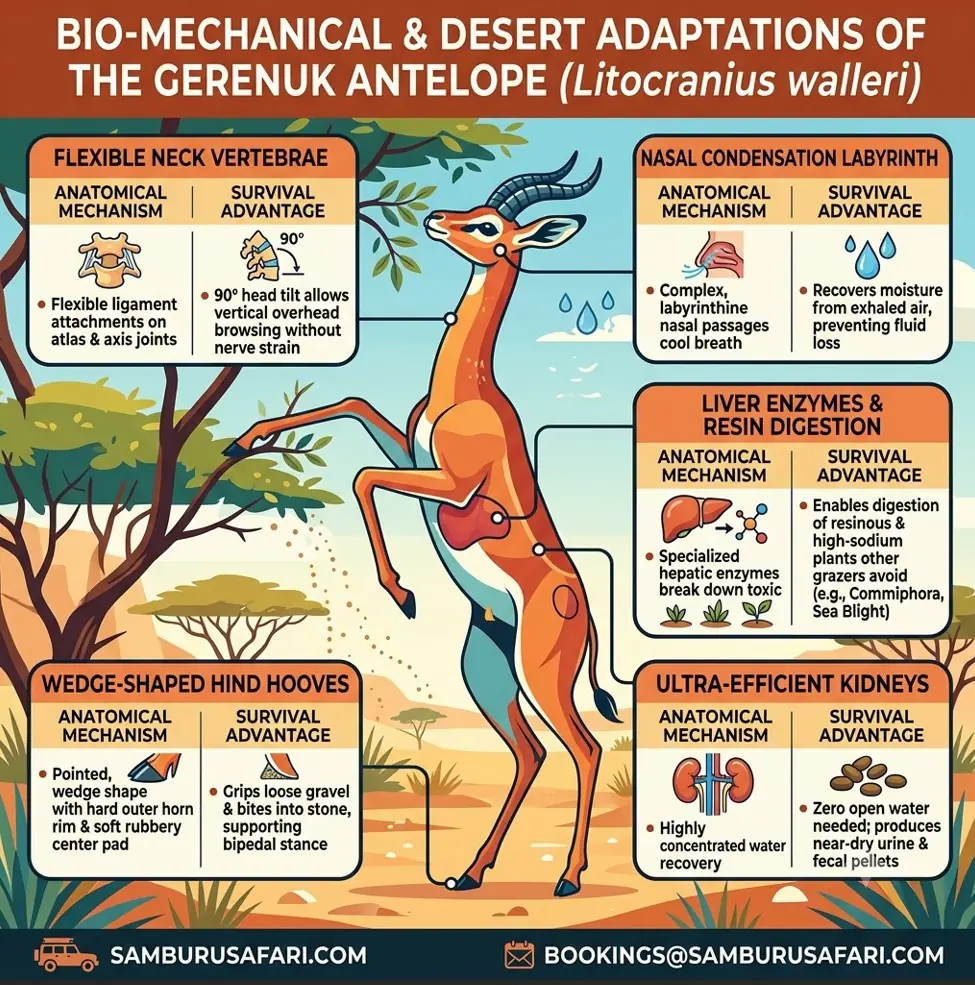
To survive in Samburu’s waterless scrublands, the gerenuk relies on extreme anatomical and physiological evolutions. While competing herbivores remain bound to ground-level grazing, these specialized adaptations allow the gerenuk to dominate the two-meter browsing canopy and conserve maximum bodily moisture. The table below breaks down how each anatomical feature directly enables high-reach feeding and total water independence.
Adaptation | Anatomical Mechanism | Survival Advantage |
Hind Hooves | Rubberized center pad with sharp outer horn rim | Prevents slipping on loose volcanic rock while leaning against branches. |
Neck Vertebrae | Modified atlas/axis joints allowing 90° tilt | Enables vertical overhead browsing without pinching spinal nerves. |
Nasal Turbinates | Labyrinthine internal nasal passages | Cools exhaled air and condenses breath moisture back into the bloodstream. |
Metabolic Waste | Dry kidney filtration & moisture recovery | Produces bone-dry fecal pellets and concentrated urine to prevent fluid loss. |
Liver Physiology | Specialized toxin-neutralizing enzymes | Safely breaks down bitter resins and high-sodium plants like sea blight. |
Swahili speakers call it Swara Twiga — giraffe gazelle — which is exactly what it looks like browsing beside a reticulated giraffe on the same acacia line. To Samburu herders it is Guguftu, or Nnyani.
Samburu tradition forbids hunting or harming them. The folklore calls the gerenuk “the animal that prays,” for the way it stands with forelegs folded near its chest. That protection shows: gerenuk here have little fear of herders and browse close to the manyattas.
Impala bolt. Gerenuk do the opposite — they go completely still and stretch the neck straight up to match the line of an acacia trunk.
Then, as your vehicle moves, the animal pivots slowly around the trunk, keeping solid wood between itself and your lens the whole way past. Trackers call them phantom gazelles, and a standing animal will disappear without a sound while you are looking at it.
Territorial males hold small ranges of one to two square kilometres. The male works a thick black tar-like secretion from the preorbital glands beside his eyes onto the sharp tips of Acacia reficiens twigs, at eye level.
Driving the scrub tracks near Sasaab, I scan low branch tips for fresh black spots. Wet tar means an active male somewhere in that block, which is usually worth ten minutes of patience.
Gerenuk also eat what nothing else will. They browse Commiphora shoots and Suaeda monoica — sea blight — carrying bitter resins and high sodium, and specialised liver enzymes break the compounds down. In dry zones like the Loroki Corridor they feed with no competition at all.
Specialized Dietary Profile & Vegetation
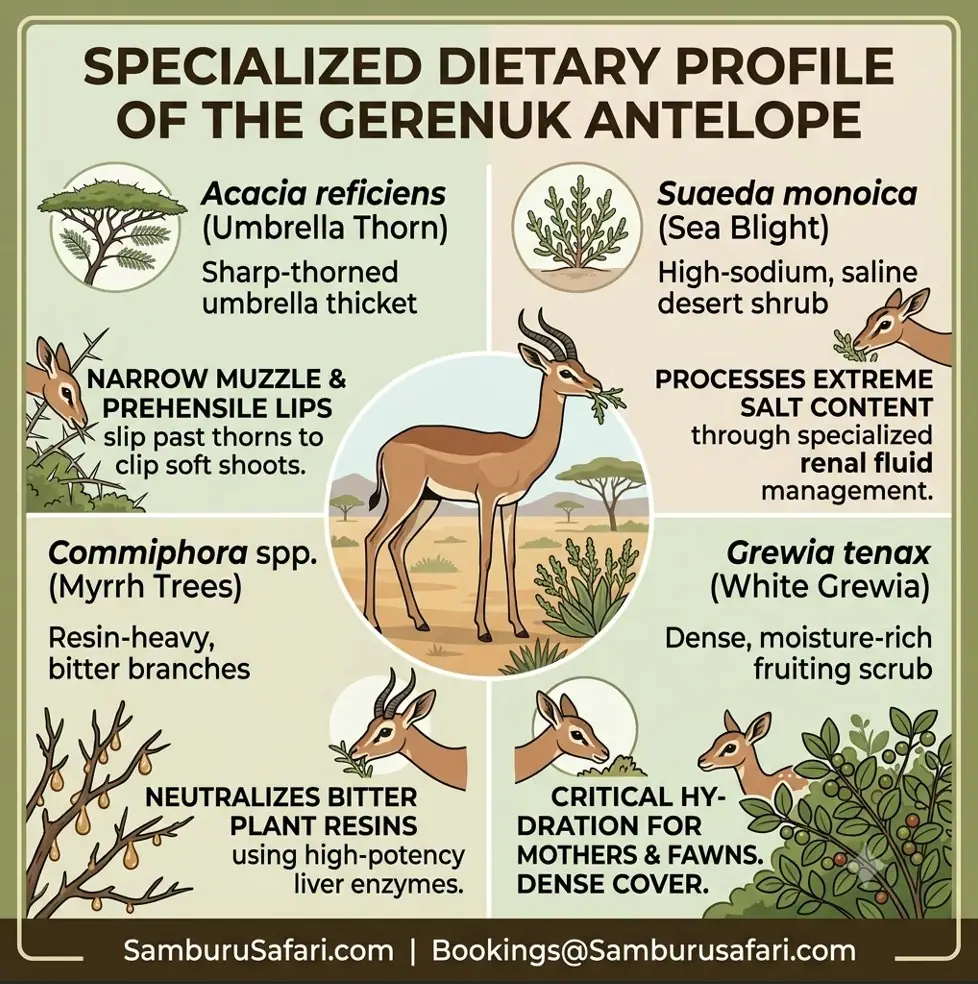
The gerenuk thrives in northern Kenya by exploiting a harsh, highly specialized diet that other ungulates actively avoid or cannot reach. By pairing its two-meter vertical reach with specialized digestive processing, it feeds on foliage defended by sharp thorns, high salinity, and toxic resins. The following dietary breakdown highlights the primary desert flora that sustain the gerenuk across Samburu’s dry ecosystems.
Plant Species | Bush Type & Defense Mechanism | Gerenuk Foraging Advantage |
Acacia reficiens | Sharp-thorned umbrella thicket | Narrow muzzle and prehensile lips slip past thorns to clip soft shoots. |
Suaeda monoica | High-sodium, saline desert shrub | Processes extreme salt content through specialized renal fluid management. |
Commiphora spp. | Resin-heavy, bitter branches | Neutralizes bitter plant resins using high-potency liver enzymes. |
Grewia tenax | Dense, moisture-rich fruiting scrub | Provides critical hydration for nursing mothers and dense cover for fawns. |
Females drop single fawns deep inside Grewia tenax thicket and leave them there for up to four months, returning at dawn and dusk to nurse.
After each feed the mother licks and swallows everything the fawn has passed. No scent trail, nothing for a hyena or jackal to follow.
Rainfall decides whether you see the standing posture at all.
Dry season (July–October, January–March). Lower foliage dries and drops, so gerenuk stand far more often to reach evergreen shoots higher up. This is the window for photographing bipedal feeding. Animals concentrate along drainage lines like Lpus Lugga and the Loroki Corridor where deep-rooted bushes hold their green.
Green season (April–May, November–December). Fresh browse comes back at ground level and the animals barely stand at all — no reason to. Herds disperse into thick Acacia reficiens away from the main tracks, and finding them means slow driving and good binoculars.
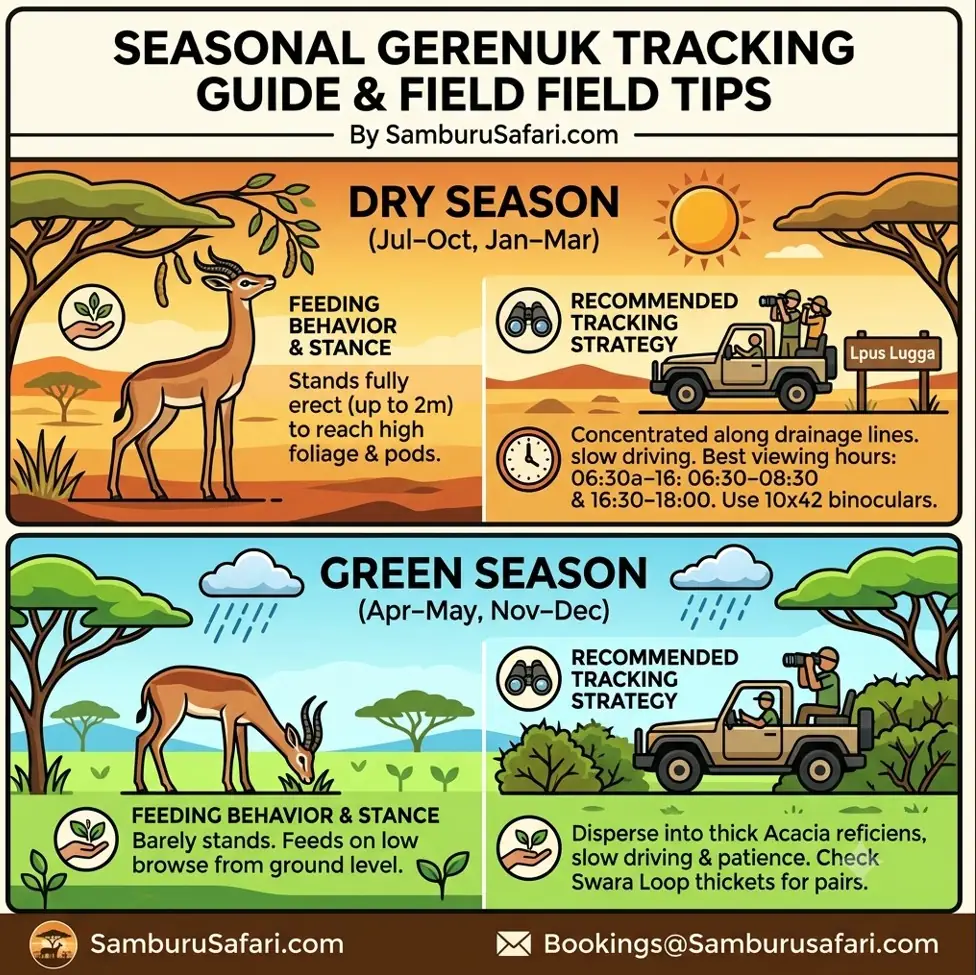
Field tracking the gerenuk in Samburu National Reserve requires tailoring your game drives to seasonal rainfall patterns and foliage density. During dry spells, their signature upright standing behavior peaks as ground-level vegetation dies off. Use the following seasonal field guide to align your safari timing, optics, and tracking locations for optimal sightings and photography.
Season & Months | Feeding Behavior & Stance | Recommended Tracking Strategy |
Dry Season
(Jul–Oct, Jan–Mar) | Frequent 2m bipedal standing to reach high evergreen foliage | Target Lpus Lugga & Loroki Corridor drainage lines from 06:30–08:30. |
Green Season
(Apr–May, Nov–Dec) | Four-legged ground browsing; rarely stands upright | Scan dense Acacia reficiens thickets slowly using 10×42 binoculars. |
Birthing Peak
(Post-Rains) | Females isolate single fawns deep inside dense thickets | Focus on Grewia scrub margins at dawn and dusk when mothers nurse. |
Lpus Lugga thickets. Low thorn bush along the lugga sits at about 1.5 metres, which matches their feeding height. Best between 06:30 and 08:00.
Swara Loop thickets. The bush tracks near Samburu Simba Lodge hold feeding pairs consistently before the midday heat.
Loroki Corridor. A dry stony drainage on the western boundary where territorial males work the resinous shrubs.
Timing, gear and gate rules for all three are covered in our planning a samburu safari section.
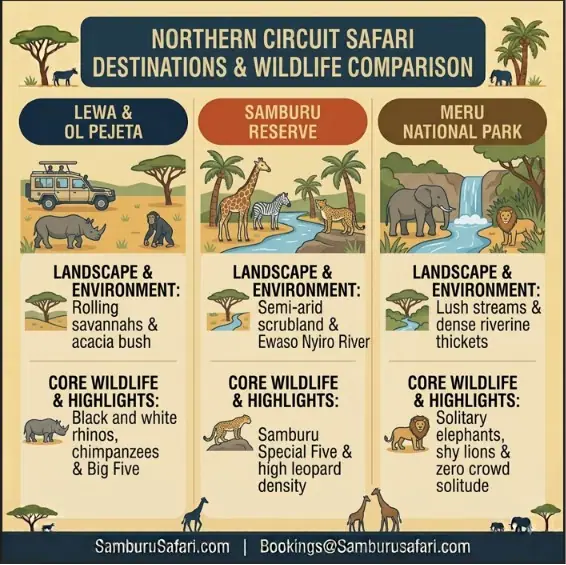
We build multi-destination itineraries that pair Samburu’s dry river tracks with Ol Pejeta, so you track desert endemics first and head south for black rhino and chimpanzees. The full range sits under our Samburu safari itineraries.
Prices below are per person, two adults sharing a private 4×4 Land Cruiser.
Safari Style & Selected Lodges | Route Highlights & Vehicle Setup | Price Per Person | |
Budget Overland Tier<br>Samburu Riverside Camp • Comfort Gardens Ol Pejeta | 4 Days / 3 Nights road safari • Private 4×4 Land Cruiser & driver-guide • Full board | $1,480 USD | |
Mid-Range Overland Tier<br>Samburu Simba Lodge • Sweetwaters Tented Camp | 4 Days / 3 Nights classic circuit • Waterhole lodge views & rhino tracking • Extended game drives | $1,820 USD | |
Luxury Fly-In Tier<br>Elephant Bedroom Camp • Sanctuary Tambarare | 4 Days / 3 Nights premium air package • Roundtrip bush flights from Wilson • Riverfront tented stay | $3,250 USD | |
Luxury Plus Sky Circuit<br>Sasaab Lodge • Ol Pejeta Bush Camp | 4 Days / 3 Nights luxury flight loop • All bush flights & conservancy permits • Open-front suites & night drives | $6,120 USD |
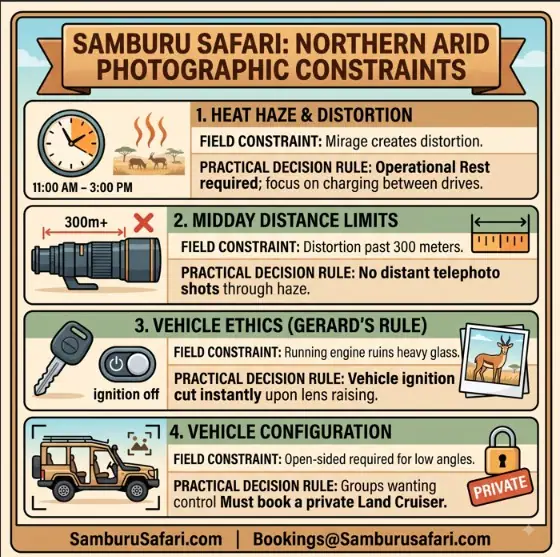
Bring 8×42 or 10×42 binoculars. Spotting a gerenuk is mostly a matter of scanning thicket carefully enough to catch one before it rotates behind a trunk, and that is not work you can do with the naked eye at range.
Why do gerenuks stand on their hind legs? To reach leaves, acacia pods and shoots up to two metres off the ground — foliage no other gazelle in the reserve can get to.
Do gerenuks ever drink from rivers? No. They take all their moisture from leaves, shoots and succulents, then recycle body fluid through the nasal turbinates and kidneys.
Can I see gerenuks in southern parks like the Masai Mara? No. They live almost exclusively in Kenya’s dry northern circuit — Samburu, Buffalo Springs, Shaba, Meru and the Laikipia conservancies.
Written by Gerard Murero — TRA silver-level guide working the northern rangelands routes through Samburu, Buffalo Springs and the community conservancies.
Reviewed by Benson Kungu — safari guide and photography specialist.
Message us directly for custom itineraries and the latest seasonal offers.