
Summary: The grevys zebra samburu population represents the primary remaining wild stronghold of East Africa’s most endangered equid. Instantly recognizable by its fine narrow pinstripes, broad radar-dish ears, pure white belly, and dark tan muzzle patch, this desert-adapted zebra displays unique field behaviors—from digging shallow sand wells in dry riverbeds to deep hippo-like alarm calls.
Field Trait | Grevy’s Zebra (Equus grevyi) Spec |
Global Population | ~2,500 individuals (Endangered | IUCN Red List) |
Samburu Stronghold | Primary habitat across Samburu, Buffalo Springs & Westgate |
Key Visual ID | Fine narrow pinstripes, unstriped white belly, tan leather muzzle |
Voice / Alarm Call | Deep bray-grunt (e-oogh) echoing like a hippo or braying donkey |
Water Adaptation | Non-lactating adults survive 5 days; mares dig 50 cm sand wells |
Best Tracking Zone | Lerata Plains, Buffalo Springs gravel ridges, Ewaso Rongi lugga |
Written by Patrick Mulei. Reviewed by Anthony Mule.
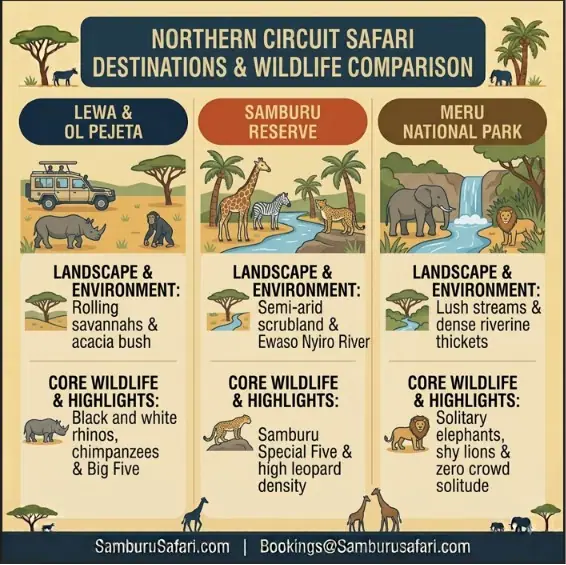
Travelers planning a northern Kenya safari often ask whether they should track Grevy’s zebras in Samburu National Reserve or head to Lewa Wildlife Conservancy. Both areas protect critical populations, but the terrain and tracking experience feel completely different on the ground.
Parameter | Samburu National Reserve | Lewa Wildlife Conservancy |
Terrain | Arid red gravel, dry luggas, acacia scrub | Rolling grassy hills, fenced sanctuaries |
Tracking Experience | Wild, unfenced, authentic wilderness tracking | High density, managed conservation monitoring |
Unique Behavior | Riverbed sand-scooping, lugga crossings | Open meadow grazing, mixed herds |
If you want a rugged, unfenced wilderness, Samburu is ideal. Lewa offers higher animal density behind managed boundaries, but Samburu gives you the raw experience of watching animals adapt to a dry, harsh river ecosystem.
Timing your trip around rainfall patterns makes a huge difference when searching for herds. Use this seasonal guide to plan your daily tracking routes:
Month / Season | Sighting Difficulty | Primary Tracking Strategy | Key Behavior to Spot |
Jan – Mar (Dry) | Very Easy | Focus on Ewaso Riverbanks & luggas | Riverbed sand digging |
Apr – May (Long Rains) | Challenging | Track higher gravel ridges & basalt slopes | Herd dispersal into dense bush |
Jun – Oct (Long Dry) | Very Easy | Afternoon drives on Lerata Plains (2 PM–4 PM) | Nursery crèches & stallion wallowing |
Nov – Dec (Short Rains) | Moderate | Monitor open tracks near Westgate border | Fresh green-grass grazing |
Most tourists rush straight to the riverbanks at dawn, but my favorite spot for early morning light is the open gravel flat near Koitogor Hill. That is where you often catch stallions standing clear of the thorn brush before the sun gets too heavy.
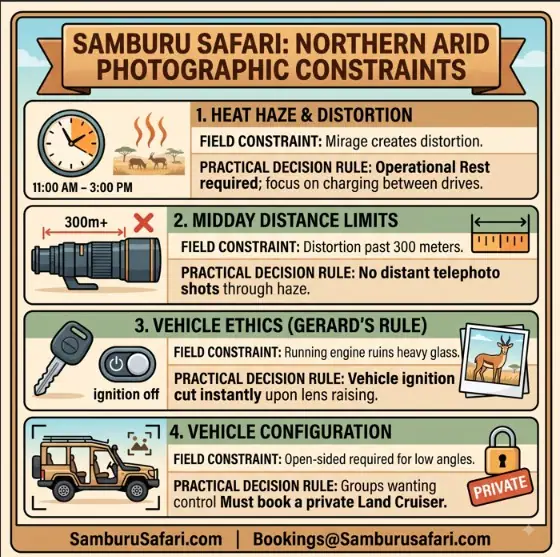
By 10:00 AM, the heat shimmer off the red rocks gets so thick that taking a clean photo from 50 yards out is basically impossible. That is usually when we pull over under an acacia for a cup of tea and let the midday heat pass.
While plains zebras roam the open grasslands of the Masai Mara, Grevy’s zebras (Equus grevyi) are built for dry country. Local Samburu herders call them Kuri, distinguishing them from the smaller plains zebra (Pundamilia).
When you scan a herd through binoculars, three field details stand out right away:
First, their black pinstripes are narrow and closely spaced. They stop abruptly along the lower flank, leaving a clean, unstriped white belly.
Second, their ears are huge. Broad and rounded like radar dishes, they turn independently to catch subtle sounds across the scrub.
Third, they have a thick, dark tan leather patch covering their nose and nostrils, with a stiff mane that runs all the way onto the forehead between their ears.
If you talk to the guys over at the Grevy’s Zebra Trust, they will tell you that northern Kenya holds over 90% of the world’s remaining wild population. It is an endangered species, which makes every solid sighting special.
Tracking these zebras along dry sandy washouts (luggas) shows you just how smart they are about finding water.
Forget the high-pitched barking sound plains zebras make. A Grevy’s stallion utters a deep, booming bray. It sounds like a strange mix of a braying donkey, a hippo’s roaring grunt, and a heavy whistle (e-oogh).
When a stallion catches wind of a leopard hiding near the riverbank, that deep vibration rattles right through the dry brush. Guests often ask if a lion is roaring nearby.
Non-lactating adults can go five days without drinking surface water if they feed on moisture-heavy plants like wild sisal (Sansevieria). But nursing mothers with young foals need water every day or two.
In dry sandy riverbeds like the Ewaso Rongi lugga, mares use their hooves to scoop out shallow wells up to 50 cm deep. They find underground water tables long before surface pools appear. Those hand-dug water scoops save other animals too, giving gerenuks and birds a place to drink later in the afternoon.
Keep a minimum distance of 50 meters from foaling crèches on the Lerata Plains. Driving too close forces nursing mares to scatter, leaving young foals exposed to spotted hyenas and black-backed jackals. Always cut your engine and let the animals move at their own pace.
Solitary stallions mark their territories on basalt ridges near Buffalo Springs and Kalama Gate by digging out deep dust-wallows in fine red dirt. Rolling in red dust shields their skin against tsetse flies and leaves scent markers for rival males.
Female Grevy’s zebras do not live in permanent harems. They roam freely across male territories based on where water is best. When a mare in season enters a territory, neighboring males cross the line to challenge the owner, creating wild, dust-filled chases across the gravel flats.
Photographing mares with young foals takes patience, especially around the eastern plains.
Mares carry their foals for 13 months—a full month longer than plains zebras. Expectant mothers gather in open, short-grass areas on the Lerata Plains near the eastern reserve line where they can spot predators coming from far off.
Mothers form temporary nursery groups, or “foaling crèches.” One or two mares stay behind to guard a group of brown-coated foals against hyenas while the other mothers walk down to the river to drink.
Newborn foals are born with fuzzy, russet-brown stripes and a long mane down their spine. Between three and four months of age, that brown coat sheds in patches to reveal the sharp black-and-white pinstripes of an adult.
You can help track these zebras using digital pattern recognition tools like HotSpotter. Every zebra’s stripe pattern is unique like a fingerprint. Taking a clear photo of the animal’s right side and submitting it to conservation teams helps researchers track individual health and herd movements.
While driving near the Westgate Conservancy line, you will see local Samburu scouts called “Grevy’s Zebra Ambassadors.” Equipped with VHF tracking antennas and GPS units, these scouts monitor radio-collared matriarchs daily. My team stays in radio contact with them so we can find active herds without burning fuel driving blindly through thick scrub.
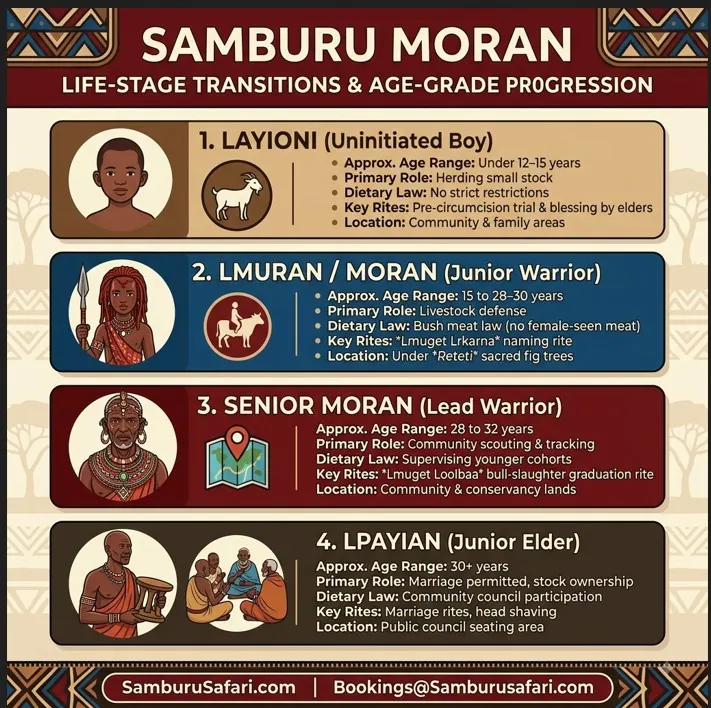
During dry spells, Samburu elders coordinate water-sharing at community boreholes near Sasaab. Livestock drink during the morning hours (8:00 AM to 2:00 PM), leaving late afternoon and night hours open for wild Grevy’s herds.
Review full entry fee details in our guide on samburu national reserve park fees and our overview of the samburu special 5.
We organize multi-destination itineraries combining Samburu’s dry river tracks with neighboring Ol Pejeta Conservancy so you can track Grevy’s zebras up north before heading south to see black rhinos and chimpanzees.
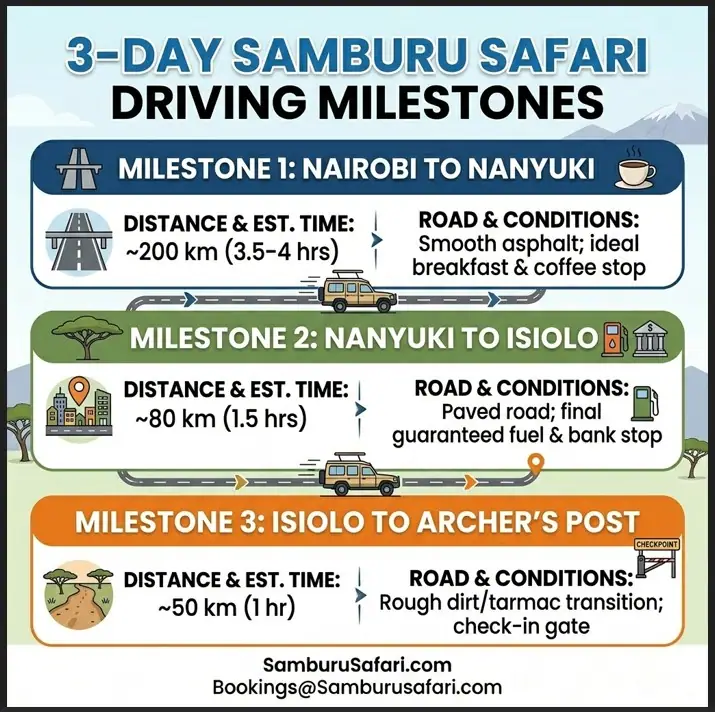
Compare rates in our guide on samburu safari cost, check driving routes on driving from nairobi to samburu, or review flight options on flights from nairobi to samburu. You can also browse lodge choices in our guide to luxury lodges in Samburu or check full routes across our Samburu safari packages.
The pricing table below outlines our primary multi-destination packages for 2027 travel dates, calculated for two adults sharing a private 4×4 Safari Land Cruiser.
Safari Style & Selected Lodges | Route Highlights & Vehicle Setup | Price Per Person |
Budget Overland Tier
• Samburu Riverside Camp
• Comfort Gardens Ol Pejeta | • 4 Days / 3 Nights road safari
• Private 4×4 Land Cruiser & driver-guide
• Full board accommodation | $1,480 USD
|
Mid-Range Overland Tier
• Samburu Simba Lodge
• Sweetwaters Tented Camp | • 4 Days / 3 Nights classic circuit
• Waterhole lodge views & rhino tracking
• Extended cruiser game drives | $1,820 USD
|
Luxury Fly-In Tier
• Elephant Bedroom Camp
• Sanctuary Tambarare | • 4 Days / 3 Nights premium air package
• Roundtrip bush flights from Wilson Airport
• Luxury riverfront tented stay | $3,250 USD
|
Luxury Plus Sky Circuit
• Sasaab Lodge
• Ol Pejeta Bush Camp | • 4 Days / 3 Nights luxury flight loop
• All bush flights & conservancy permits
• Open-front suites & night drives | $6,120 USD
|
Focus on the ears and belly. Grevy’s zebras have massive rounded ears and a plain white belly with no stripes underneath. Plains zebras have smaller, pointed ears, and their black stripes wrap all the way around their stomach.
When rains hit in April, May, or November, water collects in temporary pools right across the bush. Zebras do not need to visit the main river, so they scatter deep into dense scrub near mountain ridges. Check seasonal details in our guide on the best time to visit samburu.
Yes, but you must stay on marked park tracks. Driving off-road to get closer to animals is illegal and carries heavy fines under samburu park rules. Read our route advice on self drive samburu and our clothing guide on the samburu safari packing list.
The most reliable areas are the open Lerata Plains near the eastern gate, the gravel ridges around Buffalo Springs and Kalama Gate, and dry riverbed crossings like the Ewaso Rongi lugga in late afternoon.
Historical poaching, loss of grazing ground, and competition with domestic livestock for water boreholes reduced their numbers across the Horn of Africa. Community conservancies are now helping numbers stabilize.
No. Grevy’s zebras live almost exclusively in Kenya’s northern dry circuit—including Samburu, Buffalo Springs, Shaba, Lewa, and Laikipia. The Masai Mara has plains zebras.
Written by Patrick Mulei — Lead Wildlife & Field Contributor at SamburuSafari.com. Patrick has spent over 12 years tracking endemic northern wildlife species across Samburu, Buffalo Springs, and Laikipia conservancies.
Message us directly for custom itineraries and the latest seasonal offers.