
Written by Patrick Mulei. Reviewed by Anthony Mule.
Sera Community Conservancy sits in the arid lowlands of northern Kenya, roughly 90 kilometres northeast of Archer’s Post inside the Northern Rangelands Trust network. In 2015 it became the first community-owned conservancy in East Africa to manage black rhino on its own land, and today it is the only place in Kenya where you can track them on foot with community rangers.
All rates below are for two adults travelling together in a private 4×4 Safari Land Cruiser — licensed driver-guide, fuel, full-board accommodation, conservancy permits, and community fees.
Sera is genuinely remote. Do not try to squeeze it into a day trip from a Samburu lodge, because the drive alone eats most of the daylight and the tracking has to start early. Two nights inside the conservancy is the minimum that makes sense, and on the way back Ol Pejeta or Lewa gives you a natural staging point rather than one long haul to Nairobi.
Tier | Lodges Included | Total Per Person | |
Mid-Range | Sera community bandas / mobile camp | $1,940 | |
Luxury | Saruni Rhino (riverbed bandas) | $3,180 | |
Luxury Plus | Saruni Rhino + Saruni Samburu (fly-in) | $4,860 |
Tier | Lodges Included | Total Per Person | |
Mid-Range | Sera (1N) + Samburu Simba Lodge (2N) | $2,410 | |
Luxury | Saruni Rhino (1N) + Saruni Samburu (2N) | $4,120 | |
Luxury Plus | Saruni Rhino (1N) + Sarara Camp (1N) + Sirikoi Lewa (1N), fly-in | $6,640 |
Our full write-up on the base lodge is in the Saruni Samburu review, and the Ol Pejeta pairing runs on our Samburu and Ol Pejeta combo page.
Included:
Not covered:
Optional add-ons: a stop at Reteti Elephant Sanctuary on the way in or out, a night drive in the neighbouring conservancies, or a climb up Mount Ololokwe. Each carries its own fee.
Sera works differently from a national reserve. Your money goes to the community that owns and protects the land.
Fee Component | What It Covers |
Conservancy entry | Daily access to Sera Community Conservancy |
Rhino tracking permit | The tracking activity itself, per person, per walk |
Armed ranger escort | Mandatory security team for every walking group |
Community levy | Ranger salaries, bursaries, and local water projects |
Tracking is capped at a small number of guests per walk, and permits must be secured in advance. Rates change, so confirm the current schedule when you book.
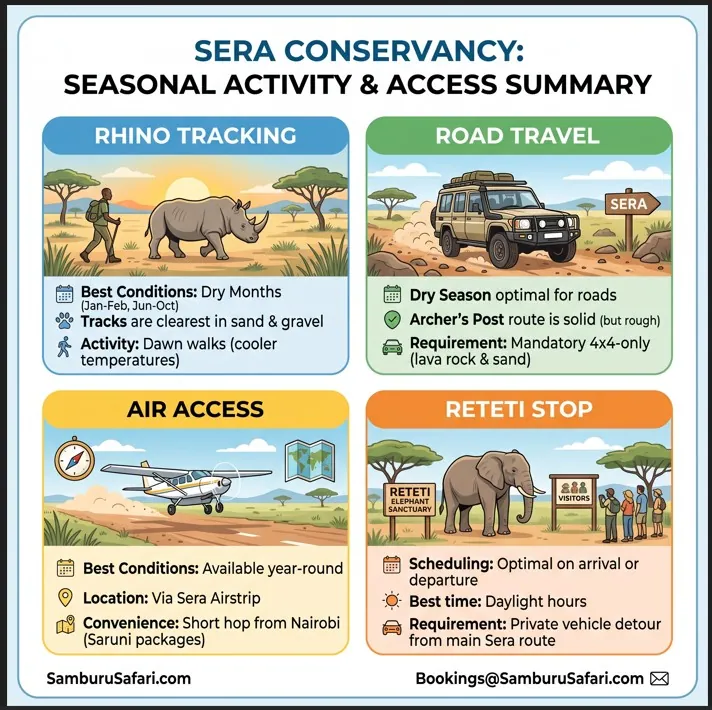
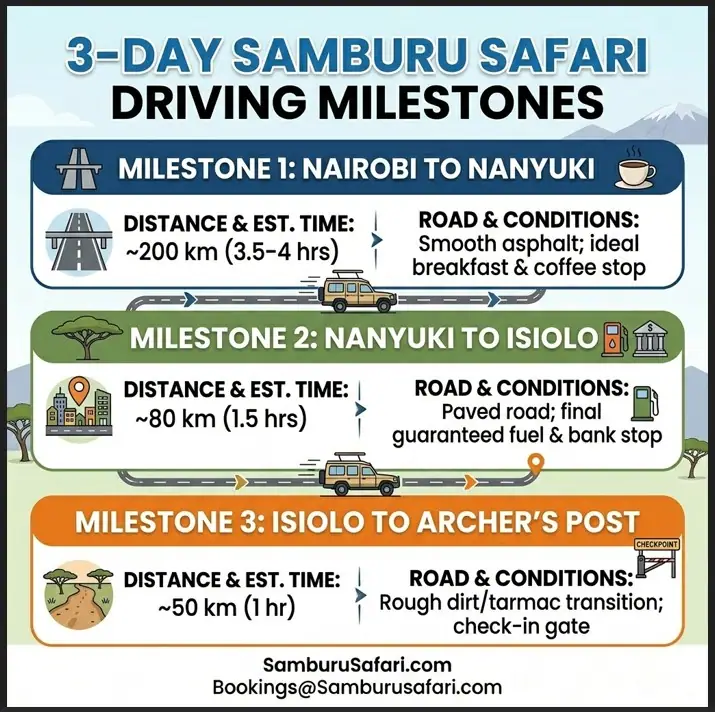
By road: From Archer’s Post the route runs northeast on rough dirt and lava track. Depending on conditions this takes three to four hours from central Samburu, and it is 4×4-only country — sharp volcanic stone, dry sand crossings, and long stretches with no phone signal. Fill the tank at Archer’s Post; there is no fuel beyond it. Full route detail from Nairobi is on our driving from Nairobi to Samburu page.
By air: Charter flights land at the Sera airstrip inside the conservancy, which turns a half-day drive into a short hop and is what most guests on the luxury packages choose. Our fly-in safari package covers the Wilson Airport connections.
Sera conservancy rhino tracking best time to visit and how to get there
Planning a successful trip to Sera Conservancy means understanding both the seasonality of tracking and the logistics of reach. While tracking is possible year-round, road conditions can dramatically affect travel times, and dry sand riverbed riverbed tracks are optimal for clear spoor. This guide helps you time your northern Kenyan loop to maximize your rhino sightings while ensuring a smooth arrival.
Factor / Activity | Best Conditions | Transport / Access |
Rhino Tracking | Dry Months (Jan–Feb, Jun–Oct): Clearest tracks in sand/gravel. | Walk times: Dawn (cooler temperatures). |
Road Travel | Dry Season: Archer’s Post route is solid (but rough). | Mandatory 4×4-only (lava rock & sand). |
Air Access | Available year-round via Sera Airstrip. | Short hop from Nairobi (Saruni packages). |
Reteti Stop | Optimal on arrival/departure (daylight). | Requires private vehicle detour from main Sera route. |
The full clothing list is in our Samburu safari packing list.
What to wear and pack for rhino tracking on foot Kenya
Before leaving your vehicle to trail a wild black rhino, your gear must match the environment. This quick checklist ensures your clothing is safe, your scent is correct, and your daypack is light enough for a two-hour walk across rough gravel and scrub. Following these protocols is critical for the success and safety of your group’s approach.
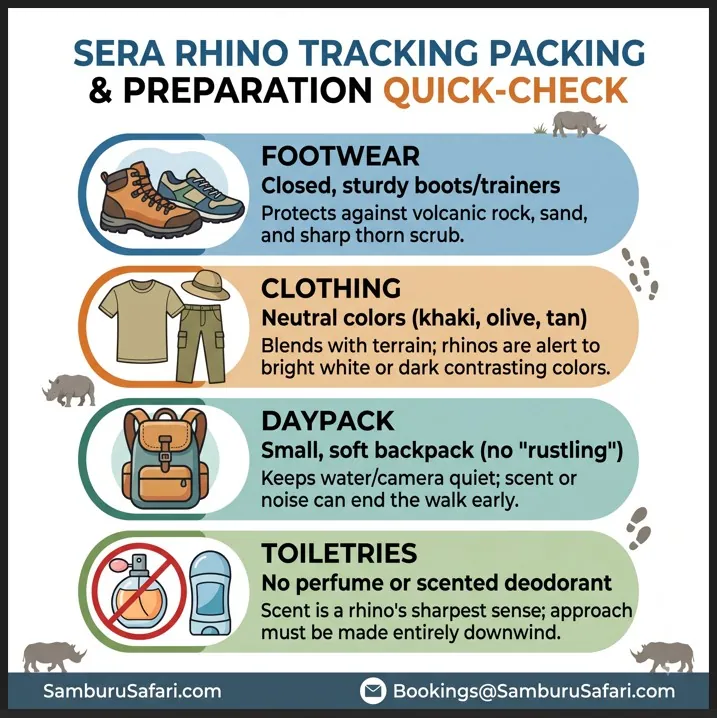
Essential Item | Recommended Type | Reason / Protocol |
Footwear | Closed, sturdy boots/trainers | Protects against volcanic rock, sand, and sharp thorn scrub. |
Clothing | Neutral colors (khaki, olive, tan) | Blends with terrain; rhinos are alert to bright white or dark contrasting colors. |
Daypack | Small, soft backpack (no “rustling”) | Keeps water/camera quiet; scent or noise can end the walk early. |
Toiletries | No perfume or scented deodorant | Scent is a rhino’s sharpest sense; approach must be made entirely downwind. |
Standing in the dry riverbed before dawn, the air is cool and still, and the only sound is boots on gravel. Then the head ranger signals everyone to stop, points at fresh tracks in the sand, and the whole group goes quiet.
In 2015 Sera became the first community conservancy in East Africa to own and manage black rhino. Before that, every rhino in Kenya lived under government or private management. Samburu, Rendille, and Borana communities lobbied for years to bring the animals back to land their families had lived on for generations, then built the ranger force to protect them.
This is the part most travellers do not realise until they arrive. You do not track from a Land Cruiser roof hatch. You get out and walk, following rangers reading spoor across the sand and scrub.
Approaches are made downwind, in single file, and the last stretch is often at a crouch. Standing 40 metres from a wild black rhino on level ground with nothing between you and it is a completely different feeling from watching one through a windscreen.
Watch what the head ranger does before the group sets off. He drops a handful of fine dust and watches which way it drifts. Rhino eyesight is poor, but their sense of smell is superb, so the entire approach route is planned around wind direction rather than the shortest line to the animal.
The rangers use radio telemetry to locate collared animals in the general area, then switch entirely to tracking on foot — dung, browse damage, hoof prints in dry sand. The technology narrows the search; the tracking finds the rhino.
Nobody guarantees you a rhino. The country is vast and open, the animals move, and the wind changes. On some mornings you walk for three hours and turn back without one.
I tell clients this before we book. The people who enjoy Sera most are the ones who came for the tracking itself rather than the photograph at the end of it.
The luxury option here is a handful of open-fronted stone bandas built into a dry riverbed under doum palms. There are no walls facing the sand, and elephants use the same riverbed as a route through at night. You hear everything.
The tracking team are Samburu and Rendille men and women from the surrounding villages, trained as rhino monitors and armed rangers. Several came out of families who lost livestock to drought and now earn a living protecting wildlife on the same land.
That link between conservation and household income is the whole reason the model works out here — the same principle behind the goat milk economy at Reteti Elephant Sanctuary further west.
Sera is remote enough that most people build it into a longer northern loop rather than visiting alone. It slots naturally alongside Namunyak Conservancy and the Mathews Range, and our 7 day northern Kenya circuit runs the whole route.
Early starts. Walks leave at first light because the animals move into shade as the heat builds and the tracking window closes fast.
Real heat. The lowlands here run hot and dry with very little shade. Carry more water than you think you need.
Physical, but not technical. You are walking two to three hours over uneven ground, gravel, and thorn scrub. No climbing, no scrambling, but steady footwork and a reasonable level of fitness.
Strict discipline. You do exactly what the ranger says, when he says it. No talking above a whisper on the approach, no breaking formation, no wandering for a better camera angle.
Sera conservancy rhino tracking experience and what to expect on foot
The experience of tracking a wild rhino across open ground is highly structured to ensure both human safety and the animal’s welfare. While it involves hiking and strict ranger discipline, the unique skill required is understanding the intersection of technology and ancient tracking wisdom. Use this visual guide to see how the sequence unfolds from dawn until (hopefully) the moment of sighting.
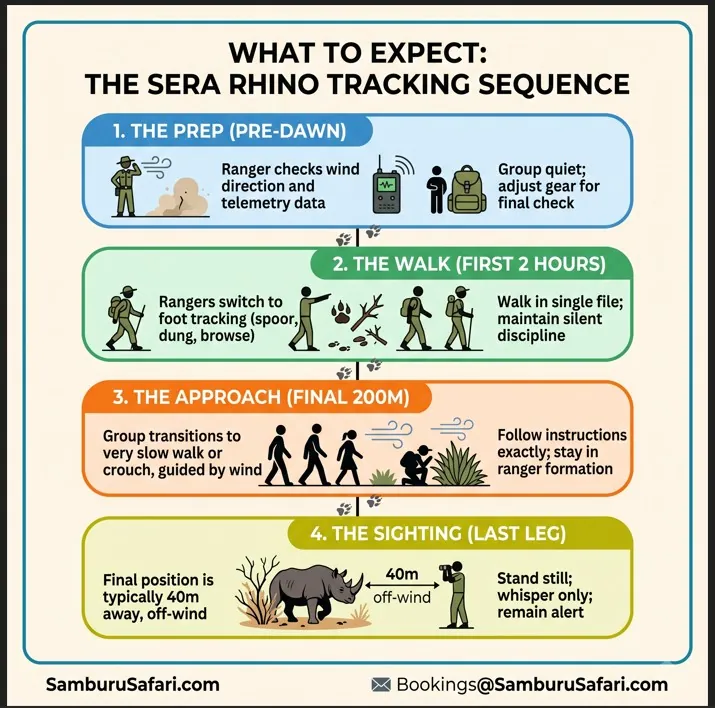
Tracking Stage | Activity / Method | Required Guest Action |
1. The Prep (Pre-Dawn) | Ranger checks wind direction and telemetry data. | Group quiet; adjust gear for final check. |
2. The Walk (First 2 Hours) | Rangers switch to foot tracking (spoor, dung, browse). | Walk in single file; maintain silent discipline. |
3. The Approach (Final 200m) | Group transitions to very slow walk or crouch, guided by wind. | Follow instructions exactly; stay in ranger formation. |
4. The Sighting (Last Leg) | Final position is typically 40m away, off-wind. | Stand still; whisper only; remain alert. |
Yes, with the protocols in place. Every group is led by trained community rangers with an armed escort, groups are kept small, and approaches are managed on wind and distance. Following ranger instructions exactly is the condition of the activity.
No. Sera is wild, unfenced country and the animals range widely. Most tracking walks find rhino, but some do not, and no reputable operator will promise otherwise.
The dry months, June to October and January to February, when tracks read clearly in dry sand and the vegetation is thin. Our best time to visit Samburu guide covers the full year.
Walking into the wind behind a Samburu ranger to stand quietly near a wild black rhino is about as raw as African wildlife travel gets — and the fee you pay goes to the community that brought those animals back. Browse the full range across our Samburu safari packages, or talk to our team about permits, transport, and lodges.
Tracking protocols, permit rules, and route conditions checked on the ground by our guides. Last updated July 2026.
Message us directly for custom itineraries and the latest seasonal offers.