
Written by Patrick Mulei. Reviewed by Anthony Mule.
Reteti is Africa’s first community-owned elephant orphanage, inside Namunyak Community Conservancy at the foot of the Mathews Range. Since 2016 the team has rescued orphaned calves from across northern Kenya, raising them on fresh goat milk bought from local Samburu women, then returning them to the wild.
All costs below cover two adults travelling together in a private 4×4 Safari Land Cruiser — driver-guide, fuel, full-board accommodation, park permits, and sanctuary conservation fees.
If you take the 2-night Samburu and Reteti package, know that day two is long. We leave Samburu early to make the public feed, take lunch near Sereolipi, and push back in time for an evening game drive. If you would rather move slower, I always suggest adding a night at Ol Pejeta or Lewa on the way back to Nairobi.
Tier | Lodges Included | Total Per Person | |
Budget | Samburu Riverside Camp | $1,240 | |
Mid-Range | Elephant Bedroom Camp | $1,780 | |
Luxury | Saruni Samburu | $2,640 | |
Luxury Plus | Reteti House / Sarara Camp (fly-in) | $4,350 |
Tier | Lodges Included | Total Per Person | |
Budget | Samburu Riverside (2N) + Comfort Gardens Ol Pejeta (1N) | $1,810 | |
Mid-Range | Elephant Bedroom Camp (2N) + Sweetwaters Serena Camp (1N) | $2,580 | |
Luxury | Saruni Samburu (2N) + Lewa Wilderness (1N) | $3,890 | |
Luxury Plus | Reteti House (2N) + Sirikoi Lodge Lewa (1N), fly-in | $6,280 |
Those Ol Pejeta pairings are covered in full on our Samburu and Ol Pejeta combo page.
Included:
Not covered:
Your entry fee at Reteti is not a standard gate ticket. It is a direct community donation that keeps the calves alive and pays keeper salaries.
Visitor Category | What You Need at the Gate |
International guests | Included in all our package quotes |
Kenyan residents | Valid alien card or work permit |
Kenyan citizens | Valid national ID or passport |
Namunyak vehicle fee | Community road pass, paid per entry |
Rates change, so confirm the current donation and vehicle fee when you book. If you are pricing the whole trip rather than just this stop, our Samburu safari cost breakdown covers the full daily math.
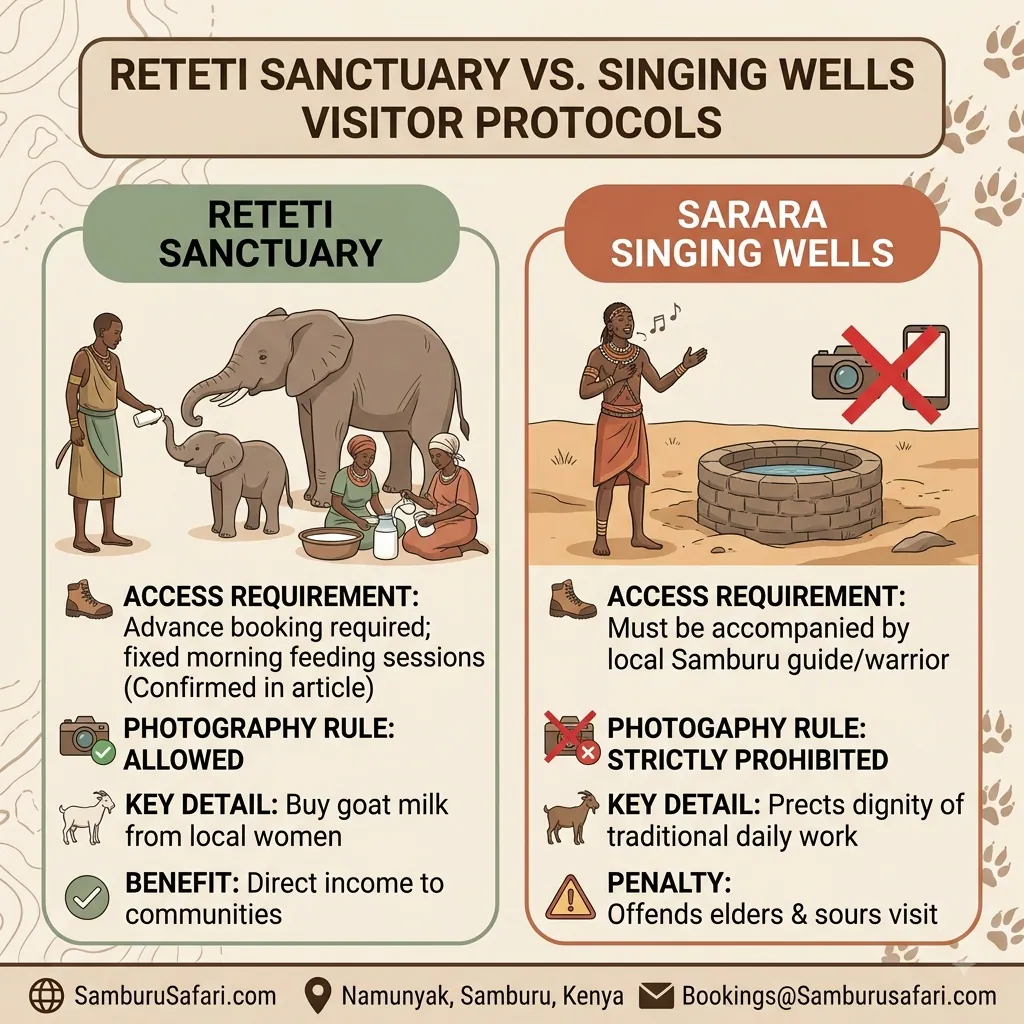
Most guidebooks mention only the midday feed. The sanctuary actually runs several distinct visitor windows through the day, and every one of them has to be pre-booked.
Slot | Who Can Access |
Sunrise feed | Guests staying at Sarara Camp and Reteti House |
Private morning feed | Pre-booked private groups, special permit required |
Midday feed (public) | The main public window, open to pre-booked day visitors |
Private afternoon feed | Educational groups and pre-booked private bookings |
Evening feed | Guests staying inside Namunyak Conservancy |
Exact times shift with the sanctuary’s schedule and the calves’ routine, so confirm your slot time when you book rather than working off a published figure. Full detail on the wider conservancy is in our Namunyak Conservancy guide.
Reteti Elephant Sanctuary operates on strict pre-booked visitor sessions to limit human crowding and maintain a tranquil environment for recovering calves. Access permissions vary significantly depending on whether you are a day visitor, staying inside Namunyak Conservancy, or booking exclusive private access. Reviewing these slot parameters ensures you select the correct time and permit for your Northern Kenya safari itinerary.
Visitor Slot | Access Eligibility | Mandatory Rules |
Sunrise & Evening Feeds | Namunyak Guests Only (Sarara / Reteti House) | Pre-booked via lodge; walking distance/short transfer. |
Midday Public Feed | Open to All Pre-booked Visitors | Strict 24-hr advance reservation; arrive 30 mins early. |
Private Morning & Afternoon | Special Educational / Private Groups | Exclusive permit required; customized conservation briefing. |
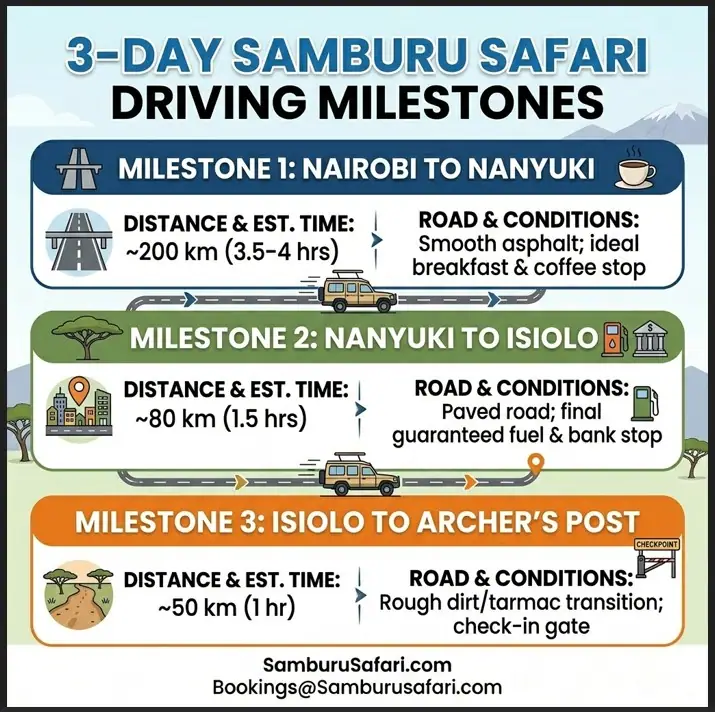
Leaving Archer’s Post gate, you drive north on the paved A2 for about 60 kilometres toward Marsabit. Cross the Sereolipi river bridge, pass the secondary school on your left, and take the immediate left onto the dirt road.
Once you turn off that tarmac, forget about cruising. The stretch that follows is pure corrugated washboard. In a standard tour van your teeth will rattle out of your head — this is strictly Land Cruiser country, especially if you want to make the public feed without a broken axle.
Route: Archer’s Post (A2) → 60 km north → Sereolipi river bridge → left turn → dirt track → Reteti visitor centre.
The full route up from Nairobi is mapped on our driving from Nairobi to Samburu page.
To skip the road entirely, fixed-wing charters land at Namunyak airstrip, roughly 20 minutes from the visitor centre. For high-end stays, helicopters can land on pads at Reteti House. Our fly-in safari package covers the Wilson Airport connections.
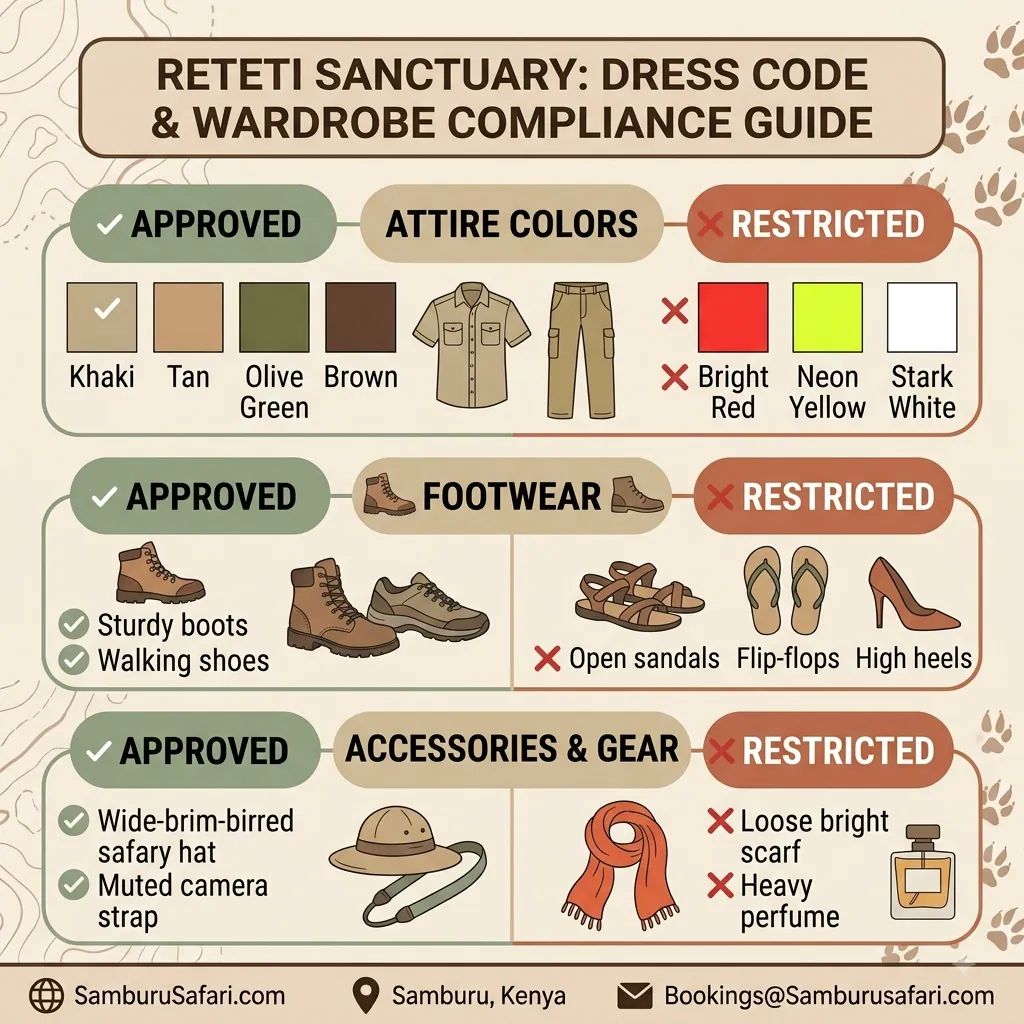
The sun here is unforgiving by mid-morning.
The full clothing list is in our Samburu safari packing list.
Visual cues play a vital role in calf rehabilitation, as bright colors can startle young elephants and disrupt their feeding routines. Reteti enforces a strict earth-tone wardrobe policy on the observation deck to keep the animals calm and receptive. Following these color and gear guidelines guarantees a smooth visit without requiring last-minute wardrobe adjustments.
Gear / Clothing Category | Recommended / Approved | Strictly Restricted |
Attire Colors | Khaki, Tan, Olive Green, Brown, Muted Dark Grey | Bright Red, Neon Yellow/Orange, Stark White |
Footwear | Closed-toe sturdy boots or walking shoes | Open sandals, flip-flops, high heels |
Accessories | Wide-brim safari hat, muted camera strap | Loose bright scarves, heavy perfume/fragrances |
Feedings happen under a roofed platform, so you can visit year-round. What changes with the seasons is the road.
Season | Months | Road & Driving Context | Verdict |
Dry season | Jan – Feb | Dry tracks; calves gather closely under the shade netting | High season |
Long rains | Mar – May | The lagas near Sereolipi swell; green landscapes | Green season |
Peak season | Jun – Oct | Cool evening air, firm dirt roads, strong game viewing in Samburu | Peak season |
Short rains | Nov – Dec | Sudden afternoon showers; fewer people at the midday feed | Shoulder season |
The month-by-month picture across the whole ecosystem is in our best time to visit Samburu guide.
Driving down the dusty track past Sereolipi the air warms fast. You smell crushed wild sage, warm clay, and the goat milk long before you reach the wooden steps.
Moses puts it plainly: “Reteti works because the community owns it. It isn’t an island in the bush — it belongs to the people living here.”
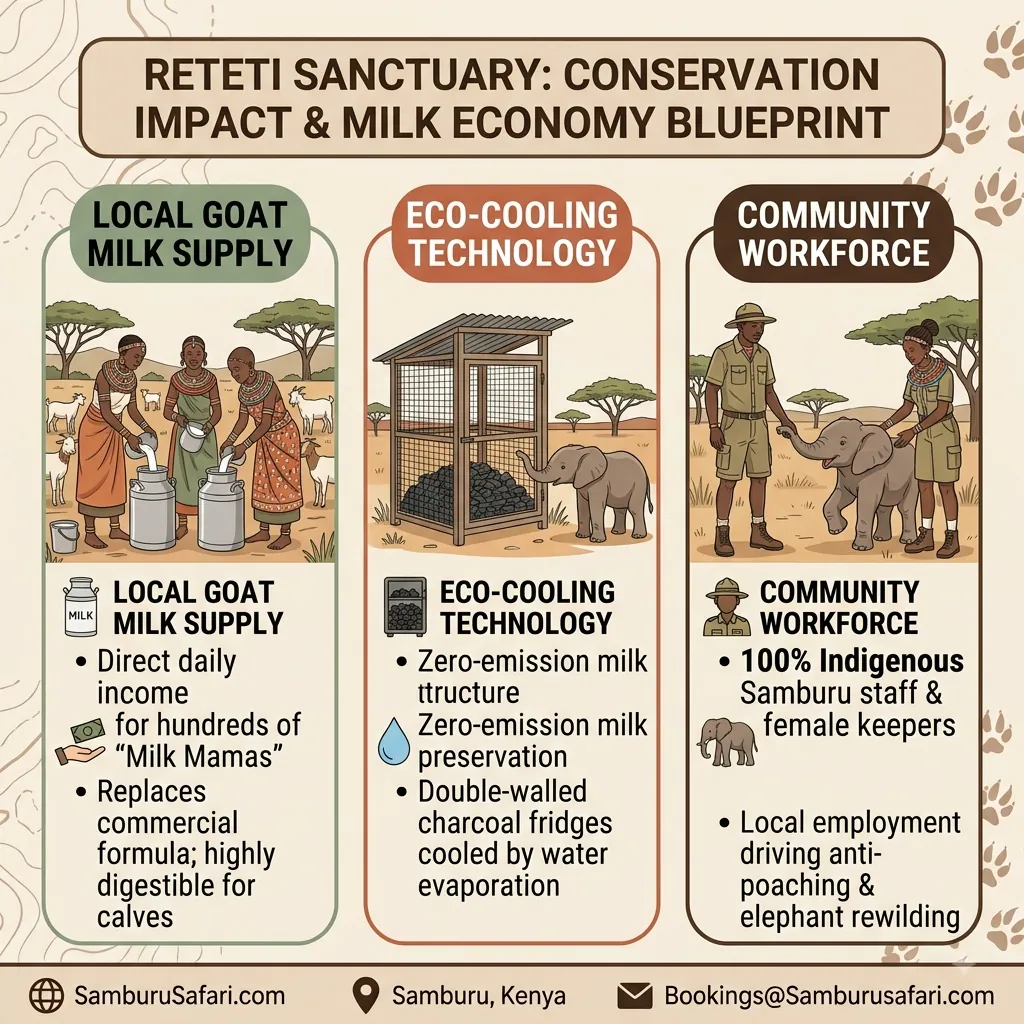
Imported formula caused severe digestion problems when keepers first tried it. The team switched to fresh local goat milk and the calves thrived.
Samburu women from the surrounding villages bring surplus goat milk to the sanctuary every morning. Buying locally puts cash straight into pastoralist households, which gives the whole community a reason to protect wild elephants rather than compete with them.
Reteti’s pioneering conservation model links orphaned calf rehabilitation directly with local Samburu household economies. By replacing commercial formula with fresh goat milk purchased from nearby pastoralist women, the sanctuary turns wildlife protection into a direct community asset. This breakdown illustrates how daily visitor contributions directly fuel the local ecosystem and keeper operations.
Metric / Component | Community & Wildlife Impact | Operational Details |
Local Goat Milk Supply | Direct daily income for hundreds of “Milk Mamas” | Replaces commercial formula; highly digestible for calves. |
Eco-Cooling Technology | Zero-emission milk preservation | Double-walled charcoal fridges cooled by water evaporation. |
Community Workforce | 100% Indigenous Samburu staff & female keepers | Local employment driving anti-poaching & elephant rewilding. |
Do not expect to pet or hold a calf. Reteti enforces a strict zero-touch rule for day visitors so the animals stay wild enough to go back to the bush.
I tell every guest to check their shutter before the feed starts. When the calves hear the keepers calling and come sprinting down the dirt path, people forget to press record entirely. They just watch.
The sanctuary is run entirely by the Samburu community, and it made history training Africa’s first female elephant keepers. They work in traditional beadwork alongside their field gear, using soft vocal calls passed down through generations of cattle handling.
No diesel generators humming near the paddocks. To store hundreds of litres of fresh milk in 35°C heat, keepers use charcoal fridges — double-walled wire enclosures packed with charcoal and soaked with water, cooling the interior as it evaporates.
No whistles, no bells. Keepers stand along the paddock fence and sing low Samburu chants. Each calf knows its own keeper’s voice and runs straight to its bottle station.
Reintroduction does not involve loading grown elephants onto trucks. Older calves wander the nearby hills through the day and come down to drink at the natural waterhole in front of Reteti House, mixing with wild herds off the mountains. The collar data behind those wild herds is tracked by the Save the Elephants research team.
You cannot turn up at the Namunyak gate and buy a ticket. Every visit is pre-booked through an authorised guide or directly with the sanctuary, at least 24 hours ahead, to keep visitor numbers low.
The midday heat. The main public slot lands in the hottest part of the day. The deck is thatched, but the walk from the parking area will have you sweating. Hat, water, no heroics.
Washouts on the Sereolipi track. In the November or April rains, the seasonal lagas along that dirt road can fill in under an hour. An experienced driver watches the weather in the hills so you do not end up on the wrong side of a crossing.
Observation from a distance. You are on a platform above the paddock. If you want a hands-on petting zoo, this is the wrong trip. If you want to see real community conservation working, it is hard to beat. It is also reliably the highlight of the north for children, which is why it anchors most of our family safari packages.
Visitors pay a mandatory conservation donation, with different rates for international guests, Kenyan residents, and citizens. Confirm the current figures when you book — they are included in our package quotes.
No. Reteti follows a strict zero-touch policy so the calves do not become habituated to people and can be returned to the wild.
About 1.5 to 2 hours from the central Samburu lodges. North on the paved A2 to Sereolipi, then left onto the dirt road into Namunyak Conservancy.
Lightweight cotton in muted earth tones — khaki, olive, tan, brown. Avoid bright red, neon, and bright white, which unsettle the calves.
Watching orphaned calves run in for their milk while learning how Samburu pastoralists protect their own wildlife is the kind of morning people remember years later. Browse the full range across our Samburu safari packages, or talk to our team about your dates.
Sanctuary access rules, route conditions, and booking protocols checked on the ground by our guides. Last updated July 2026.
Message us directly for custom itineraries and the latest seasonal offers.