
Quick Answer: The samburu special 5 refers to five rare mammal and bird species uniquely adapted to northern Kenya’s dry semi-arid ecosystem: the Reticulated Giraffe, Grevy’s Zebra, Beisa Oryx, Gerenuk, and Somali Ostrich. Unlike classic savanna wildlife down south, these species feature distinct physiological adaptations for extreme heat and water conservation, making Samburu National Reserve their prime sanctuary.
Written by Gerard Murero. Reviewed by Benson Kungu.
Special 5 Member | Savanna Counterpart | Key Visual Distinction |
Grevy’s Zebra | Plains Zebra | Radar-dish ears, pure white belly, fine narrow pinstripes |
Reticulated Giraffe | Masai Giraffe | Dark liver-red geometric polygons with crisp white grid lines |
Gerenuk | Grant’s Gazelle | Long slender neck, stands on hind legs, never drinks water |
Beisa Oryx | Common Antelope | Needle-straight 1m+ horns, black-and-white mask, high heat tolerance |
Somali Ostrich | Common Ostrich | Cobalt-blue neck and thighs on males (instead of pinkish-red) |
Heading north past Mount Kenya into the semi-arid scrublands opens up a starkly different wilderness from southern reserves. The dry plains along the Ewaso Nyiro River shelter five endemic species known as the samburu special 5.
These animals—the Gerenuk, Grevy’s Zebra, Beisa Oryx, Reticulated Giraffe, and Somali Ostrich—possess specialized evolutionary adaptations built for survival in arid terrain where daily temperatures frequently exceed 95°F.
Tracking these northern endemics on daily game drives requires matching their feeding habits, shade seeking, and water needs to specific micro-habitats. The wider trip machinery — gate fees, routes, lodges, seasons — is all laid out in the master Samburu safari guide. If your dates are already locked and you just want a plan built around these five animals, request a custom safari quote directly from our Nairobi team.
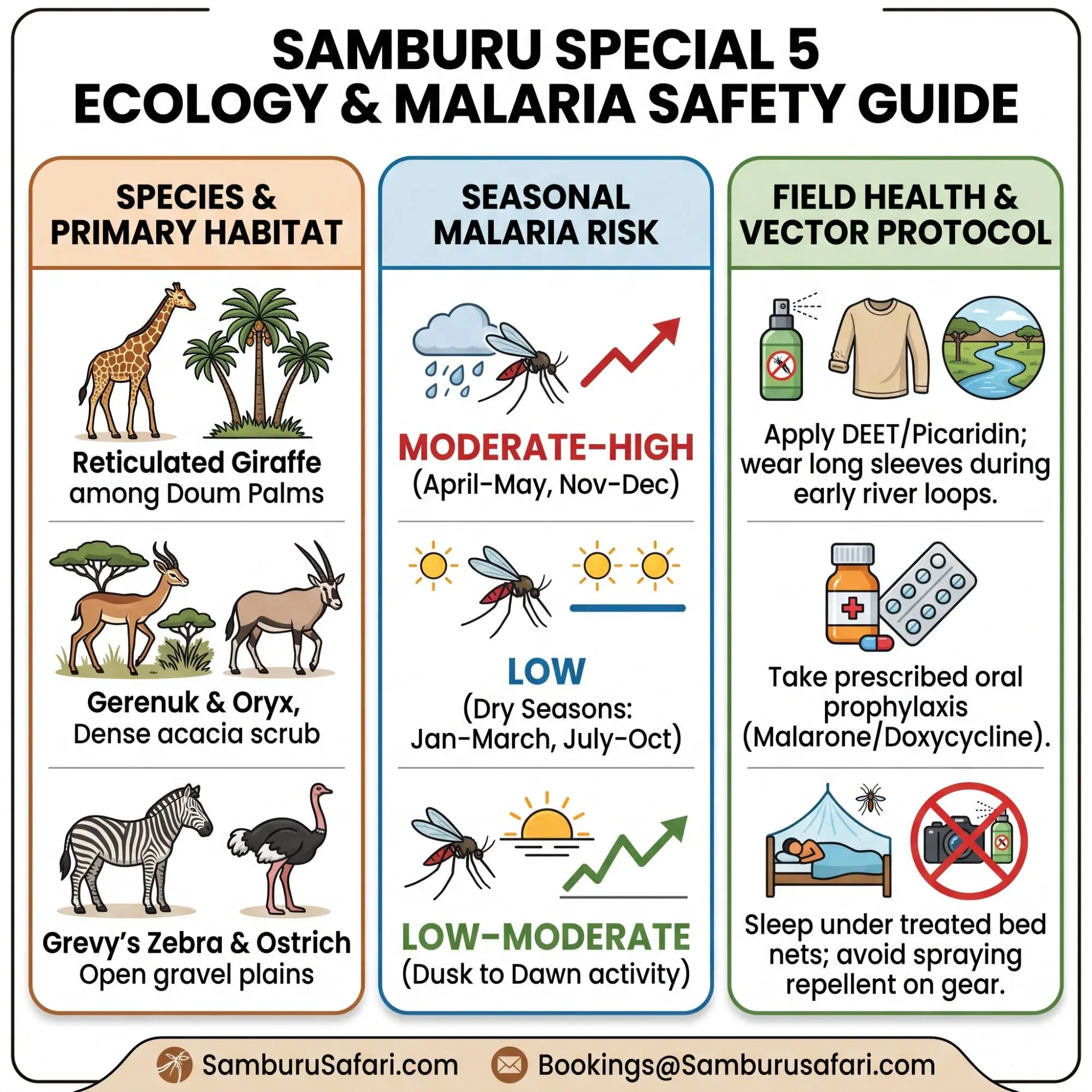
Tracking the Samburu Special 5 requires venturing into semi-arid scrublands and riverine micro-habitats where environmental factors dictate both animal sightings and health precautions. While Samburu’s arid climate maintains a lower baseline malaria risk compared to southern or coastal zones, mosquito activity spikes near water sources during post-rain months. Photographers and travelers scanning dense acacia thickets should pair wildlife tracking strategies with targeted vector protection. The matrix below connects each endemic species’ primary habitat with its corresponding seasonal malaria risk and field safety protocol.
Species & Primary Habitat | Seasonal Malaria Risk | Field Health & Vector Protocol |
Reticulated Giraffe (Riverine Doum Palms) | Moderate–High (April–May, Nov–Dec) | Apply DEET/Picaridin; wear long sleeves during early river loops. |
Gerenuk & Beisa Oryx (Arid Interior Scrub) | Low (Dry Seasons: Jan–March, July–Oct) | Take prescribed oral prophylaxis (Malarone/Doxycycline). |
Grevy’s Zebra & Somali Ostrich (Open Gravel Plains) | Low–Moderate (Dusk to Dawn activity) | Sleep under treated bed nets; avoid spraying repellent on gear. |
IUCN Status: Near Threatened (IUCN Red List)
Known in Swahili and Samburu dialects as Swara Twiga (“giraffe gazelle”), the gerenuk (Litocranius walleri) stands out for its long, slender neck. Gerenuks never graze on grass and do not drink surface water from the Ewaso Nyiro River. They extract all necessary hydration from green acacia leaves and succulent shoots.
Their reinforced hip lumbar joints allow them to stand completely erect on their hind legs, reaching leaves up to 2 meters off the ground. When tracking gerenuks through dense thorn scrub, cut your vehicle engine immediately. Their pale reddish coat blends into dry bushes, and engine vibrations make them freeze silently behind cover. The full gerenuk antelope profile covers their odd two-legged feeding stance in detail, plus the specific thorn-scrub loops where sightings run highest.
IUCN Status: Endangered (IUCN Red List)
The Grevy’s zebra (Equus grevyi) is the largest wild equid on earth, and northern Kenya holds their main remaining wild population.
Grevy’s zebras feature large, rounded, radar-dish ears that detect low-frequency predator movements across open gravel plains. They have an unstriped, pure white belly and narrow, closely spaced vertical pinstripes. Stallions do not keep permanent harems; instead, they defend solitary water territories along the Buffalo Springs plains.
IUCN Status: Endangered (IUCN Red List)
The Beisa Oryx has striking black-and-white facial markings and straight, needle-sharp horns over one meter long. When viewed from the side, its horns align in a single profile, historically giving rise to early “unicorn” tales among desert traders.
To handle harsh sun without dehydrating, the oryx uses a specialized vascular network called the carotid rete. This allows its core body temperature to safely reach 45°C (113°F) during midday heat without sweating away critical moisture, keeping blood flowing to the brain cool.
IUCN Status: Endangered (IUCN Red List)
The Reticulated Giraffe (Giraffa reticulata) is recognized by its dark liver-red geometric polygons separated by sharp, bright white lines. This pattern differs sharply from the blotchy, irregular patches seen on Masai giraffes.
You will find the highest density of reticulated giraffes in the Doum Palm (Hyphaene thebaica) groves along the riverbank. They use a 45-centimeter, dark blue-black prehensile tongue to strip leaves off Acacia tortilis branches without taking damage from sharp thorns.
IUCN Status: Vulnerable (IUCN Red List)
Unlike the pink-necked common ostriches found in southern parks, the male Somali Ostrich develops distinct cobalt-blue skin on its neck and thighs. This blue coloration becomes particularly vivid during the breeding season from September to November. Female Somali ostriches have dull grey-brown plumage; observers often mistake males for females during non-breeding months until blue thigh skin shows against golden grass.
Seasonal rainfall changes wildlife distribution across the reserve dramatically:
Seasonal Wildlife Tracking & Thermal Shimmer Schedule
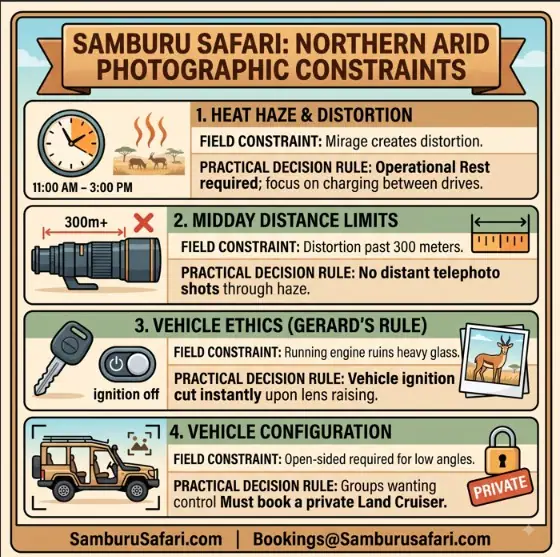
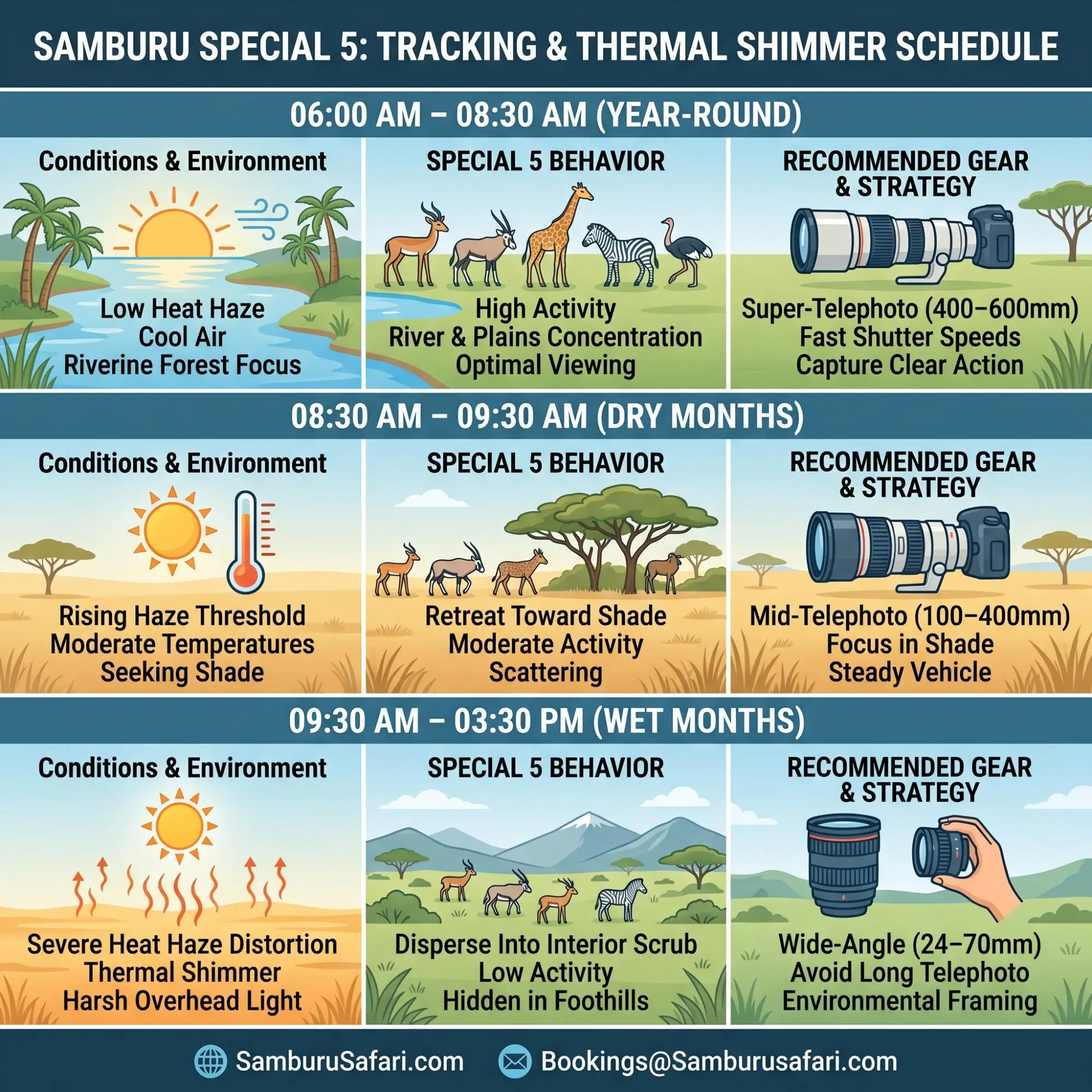
High daytime temperatures across northern Kenya create severe ground heat shimmer past mid-morning, limiting telephoto image sharpness. Aligning your game drives with early morning light ensures optimal wildlife encounters and clear optical conditions before thermal air turbulence sets in. During dry months, endemic species cluster along riverbanks, whereas wet season rains disperse animals into thick interior brush. Use this operational field guide to plan your daily tracking windows and focal length strategy around Samburu’s climate.
Time & Season Window | Special 5 Tracking Behavior | Optimal Focal & Viewing Strategy |
06:00 AM – 08:30 AM (Year-Round) | High activity along Ewaso Nyiro River & open plains | Super-telephoto (400–600mm); zero heat haze interference. |
08:30 AM – 09:30 AM (Dry Months) | Animals retreat toward shade; moderate heat haze | Mid-telephoto (100–400mm); scan shade under acacia thickets. |
09:30 AM – 03:30 PM (Wet Months) | Animals disperse into foothill scrub; severe air shimmer | Wide-angle (24–70mm); environmental framing, avoid long glass. |
While these animals range widely, your highest chance of spotting all five species during a single 3-hour morning game drive occurs in the open acacia-scrub transitional zone between Koitogor Hill and the Central Airstrip Plain. This area acts as an ecological bridge between dense riverbank forest and dry gravel flats.
Local drivers frequently point out an informal “sixth member” of the list: the Vulturine Guineafowl (Acryllium vulturinum). Seen in large flocks near Samburu Simba Lodge and Riverside Camp, this bird features an electric-blue breast, cobalt wing feathers, and a bare, crimson-eyed head. It is only the loudest introduction to the reserve’s birdlife — birdwatching in Samburu runs past 450 recorded species, from martial eagles to carmine bee-eaters.
Along the boundary of West Gate Community Conservancy where reserve land meets local grazing areas, you may occasionally spot hybrid zebras. These are rare crosses between resident Grevy’s stallions and local domestic donkeys or plains zebras. They show faint abdominal striping and intermediate ear shapes.
During severe dry spells, county conservation teams place emergency hay bales at designated tracking loops behind Archer’s Gate. Beisa Oryx, Reticulated Giraffes, and Grevy’s Zebras often congregate closely at these feeding stations, offering exceptional close-up photography opportunities.
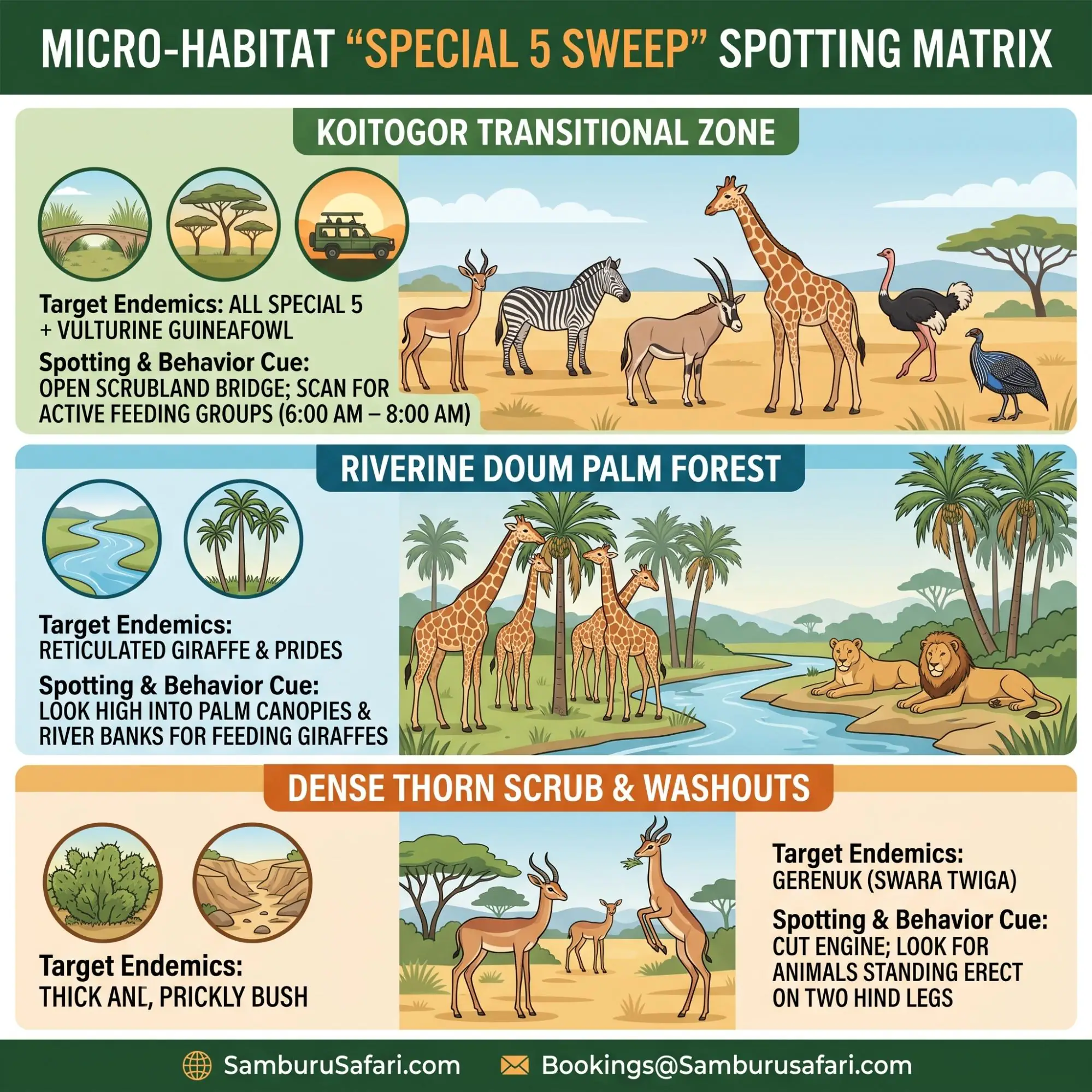
Finding all five endemic species in a single morning requires navigating distinct ecological zones across the reserve. The transitional bridge between Koitogor Hill and the Central Airstrip offers the highest probability for a full sweep. By understanding plant preferences and terrain traits, you can quickly spot camouflaged wildlife in dry brush. Refer to this quick-reference matrix to target specific hotspots and behavioral cues in the field.
Micro-Habitat Hotspot | Target Endemic Species | Key Spotting & Behavioral Cue |
Koitogor Transitional Zone | All Special 5 + Vulturine Guineafowl | Open scrubland bridge; scan for feeding groups between 6–8 AM. |
Riverine Doum Palm Forest | Reticulated Giraffe & Prides | Look high into palm canopies & river banks for feeding giraffes. |
Dense Thorn Scrub & Washouts | Gerenuk (Swara Twiga) | Cut engine; look for animals standing erect on two hind legs. |
Capturing clean photos of northern wildlife demands specific camera setups due to heat and fine dust:
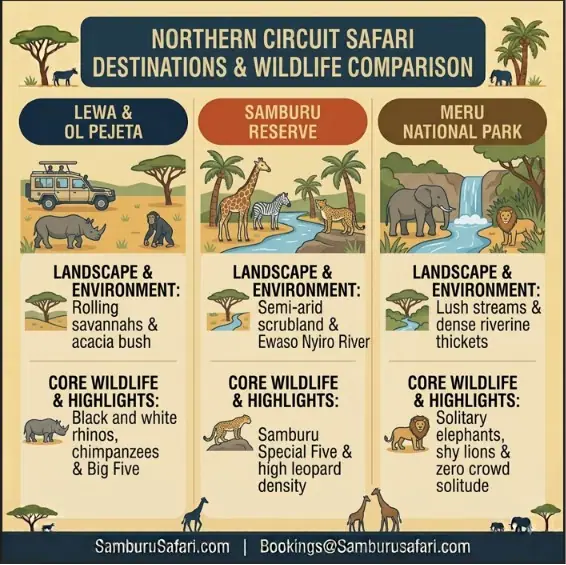
Our custom multi-destination itineraries pair the northern river circuits with neighboring Ol Pejeta Conservancy. This setup lets you track desert specialists up north before heading south to see East Africa’s largest black rhino sanctuary.
Every trip below bundles gate fees, vehicle, guide, and accommodation into one fixed price — the full range sits under our Samburu safari packages, including a custom photographic tour built around the Special 5.
The pricing table below outlines our primary multi-destination packages for 2027 travel dates, calculated for two adults sharing a private 4×4 Safari Land Cruiser.
Package | Trip & Lodges | Price Per Person |
Budget Overland Tier | 4D/3N road safari • Samburu Riverside Camp + Comfort Gardens Ol Pejeta • Private cruiser, driver-guide, full board | $1,480 — Get a quote |
Mid-Range Overland Tier | 4D/3N classic circuit • Samburu Simba Lodge + Sweetwaters Tented Camp • Waterhole views, rhino tracking, extended drives | $1,820 — Price this trip |
Luxury Fly-In Tier | 4D/3N premium air package • Elephant Bedroom Camp + Sanctuary Tambarare • Roundtrip bush flights, riverfront tents | $3,250 — Check dates |
Luxury Plus Sky Circuit | 4D/3N luxury flight loop • Sasaab Lodge + Ol Pejeta Bush Camp • All bush flights, open-front suites, night drives | $6,120 — Build my itinerary |
If you spend two full days in the reserve with an experienced guide, your chances of seeing all five species are over 90%. Reticulated Giraffes, Grevy’s Zebras, and Somali Ostriches are spotted daily. Gerenuks and Beisa Oryx require more patient scanning in dense acacia brush. The same two days usually hand you the northern big cats of Samburu as a bonus — leopards in the riverine forest and lion prides out on the gravel flats.
Early morning between 6:15 AM and 8:30 AM offers cool air, minimal dust haze, and active feeding behavior. By midday, most animals retreat into deep shade under acacia thickets to avoid intense sun.
These animals evolved specifically for semi-arid conditions. Their physiological adaptations—such as vascular cooling systems, low water dependency, and specialized feeding structures—allow them to thrive in dry scrubland environments where savanna species would struggle to survive.
Yes, species like Grevy’s Zebra and Reticulated Giraffe are actively monitored by community conservancies, the Kenya Wildlife Service, and local research foundations across northern Kenya.
No. The Masai Mara features classic savanna species like plains zebras and Masai giraffes. The Special 5 species are restricted to the northern dry circuit of Samburu, Buffalo Springs, Shaba, and neighboring conservancies.
Species profiles and sighting patterns logged on the river loops by our tracking guides. Last updated July 2026.
Message us directly for custom itineraries and the latest seasonal offers.