
Quick Answer: An all-inclusive samburu safari cost ranges from $1,480 to $6,120 per person for a 4-day trip, depending on whether you travel by road or regional flight. On a daily basis, expect to pay $180 to $280 USD for budget self-drive, $450 to $650 USD for mid-range guided safaris, and $900 to $1,600+ USD for luxury all-inclusive stays. Managing park entry permits, currency rules, and boundary bridge fees prevents unexpected expenses along the way.
Written by Angie Muthoni. Reviewed by Gerard Murero.
To give you an immediate picture of what a northern Kenya trip costs, here is how daily expenses average out across three main travel styles:
Safari Tier | Average Daily Cost (Per Person) | What’s Included in the Rate |
Budget Self-Drive / Camping | $180 – $280 USD | Public campsites, self-catering, fuel, 4×4 Hilux/Prado rental, park fees |
Mid-Range Guided Safari | $450 – $650 USD | Mid-range lodge (e.g., Samburu Simba), private 4×4 Cruiser, guide, park fees |
Luxury All-Inclusive | $900 – $1,600+ USD | High-end eco-camp (e.g., Sasaab, Elephant Bedroom), luxury meals, flights |
At our Nairobi desk, we constantly remind travelers that planning a northern safari budget requires looking beyond headline lodge rates. Unlike southern parks managed by central government agencies, Samburu National Reserve is managed locally by the Samburu County Government, which creates unique fee rules on the ground. If you are pricing the whole trip and not just the money side, the main Samburu safari guide pulls the lodges, seasons, and wildlife into one place. If the budget tier tempts you, the self-drive route has its own page covering exactly what that money does and does not buy.
Your total budget breaks down into four main operational categories:
Non-resident adults pay $85 USD per 24-hour period ($50 USD for children aged 5–17). Tickets run on an exact 24-hour timestamp from the minute you pass through the gate barrier. The complete gate ticket rate card — vehicle tariffs, camping fees, student rates — sits on its own page.
Renting a private, custom-built 4×4 Safari Land Cruiser with a pop-up roof costs $190 USD per person per day (based on two adults sharing). This covers vehicle usage, highway and park fuel, vehicle gate permits, and daily allowances for a TRA-licensed professional driver-guide.
High-end eco-camps like Sasaab or Saruni do not build staff quarters on-site in order to keep their environmental footprint low. Tour operators must pay a $30 to $50 USD per night driver outpost allowance to house and feed your driver in Archer’s Post village. If your custom quote includes a “driver allowance” line item, this is what it covers.
Nightly room rates vary widely based on comfort tiers:
Financial logistics in northern Kenya require specific advance prep. Once you pass Isiolo, standard banking services disappear.
The “Last ATM” Rule in Isiolo
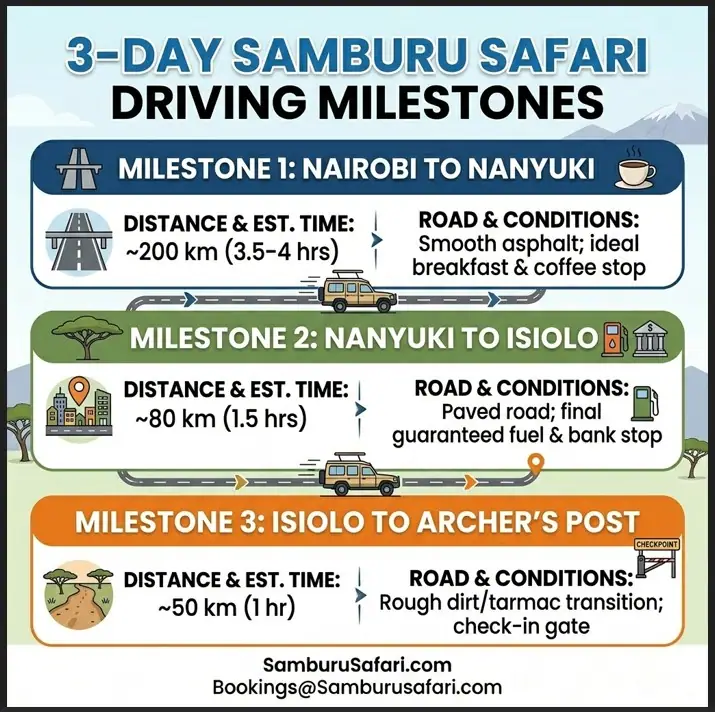
The last reliable spot to withdraw Kenyan Shillings (KES) or convert foreign currency at official bank exchange rates is along the A2 Highway in Isiolo town, located right past the main roundabout on your right (Equity Bank and KCB Bank). ATMs inside Archer’s Post village are frequently offline or completely out of cash.
Park entry passes are processed through the county’s official online payment channel — your operator or lodge can confirm the live portal for your dates. Cellular data signal drops down to weak 3G/E right at Archer’s Gate, so pay your invoices and download the PDF receipts to your phone storage while still in Isiolo or at your hotel in Nanyuki. Arriving at the barrier with nothing but a login and good intentions means a long wait in the sun.
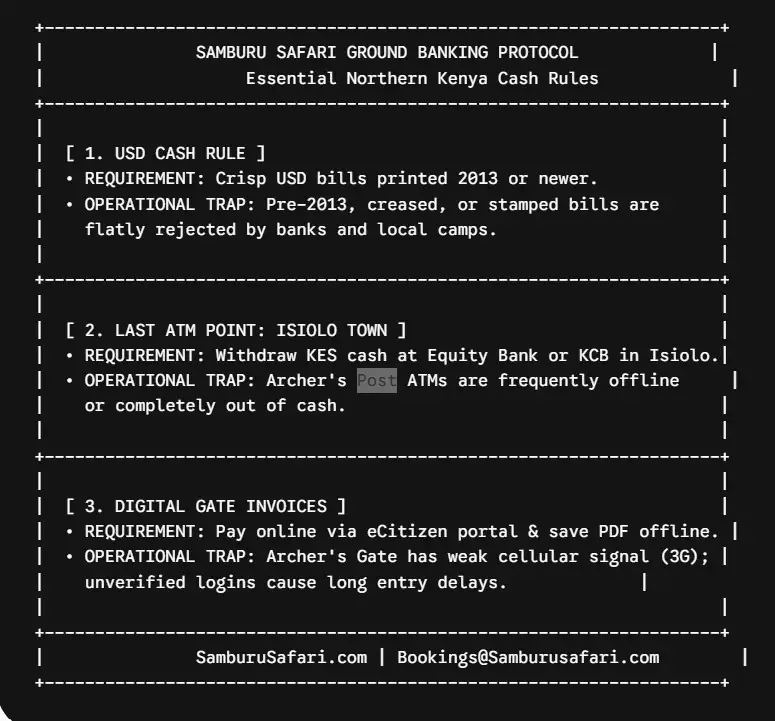
If you carry cash for tips, small lodge purchases, or guide expenses, leave old bills at home. Hotels, village elders, and local bank branches in Isiolo flatly reject US Dollar bills printed before 2013, as well as notes with small tears, ink stamps, or heavy creases. Under Central Bank of Kenya regulations, banks charge high processing fees on older paper money. Always bring crisp, unblemished USD notes printed from 2013 onward.
Navigating financial logistics in northern Kenya requires strict cash and digital payment preparation before leaving regional hubs. Once travelers pass Isiolo town, cellular networks weaken significantly and ATMs become unreliable or nonexistent. The following banking protocol breakdown synthesizes mandatory cash standards, digital gate portal prerequisites, and local payment channels. Audit these financial guidelines prior to departing Nairobi or Nanyuki to prevent gate delays or rejected payments.
Payment Channel | Requirement & Standard | Gate or Operational Trap |
USD Cash Notes | Crisp bills printed 2013 or newer | Pre-2013, creased, or stamped USD bills are flatly rejected across northern Kenya. |
ATM Cash Clearance | Withdraw KES at Isiolo town (Equity/KCB) | Post-Isiolo ATMs in Archer’s Post village are frequently offline or empty. |
Digital Gate Invoices | Pre-pay online & save PDF offline | Archer’s Gate has poor cellular signal (3G/E); unverified logins cause entry delays. |
Small everyday expenses—like buying extra bottled water at Archer’s Post shops or paying for tire repairs at the Jua Kali yard behind the Total station—run strictly on M-Pesa (Buy Goods Till / Paybill) or crisp KES notes.
One of the most common budget mistakes happens right along the Ewaso Nyiro River:
Samburu National Reserve sits on the north bank (managed by Samburu County), while Buffalo Springs National Reserve sits on the south bank (managed by Isiolo County). The concrete river bridge connects the two reserves.
If you cross the Ewaso Nyiro bridge during a game drive to follow a leopard sighting—even for ten minutes—you cross county lines. Isiolo County will charge you a fresh $80 USD entry fee per adult on the spot, as there is no reciprocal ticket agreement between the two counties. To avoid paying entry fees twice in one day, keep your game loops on your ticket’s home side of the river.
Minor out-of-pocket expenses can add up across a 4-day itinerary:
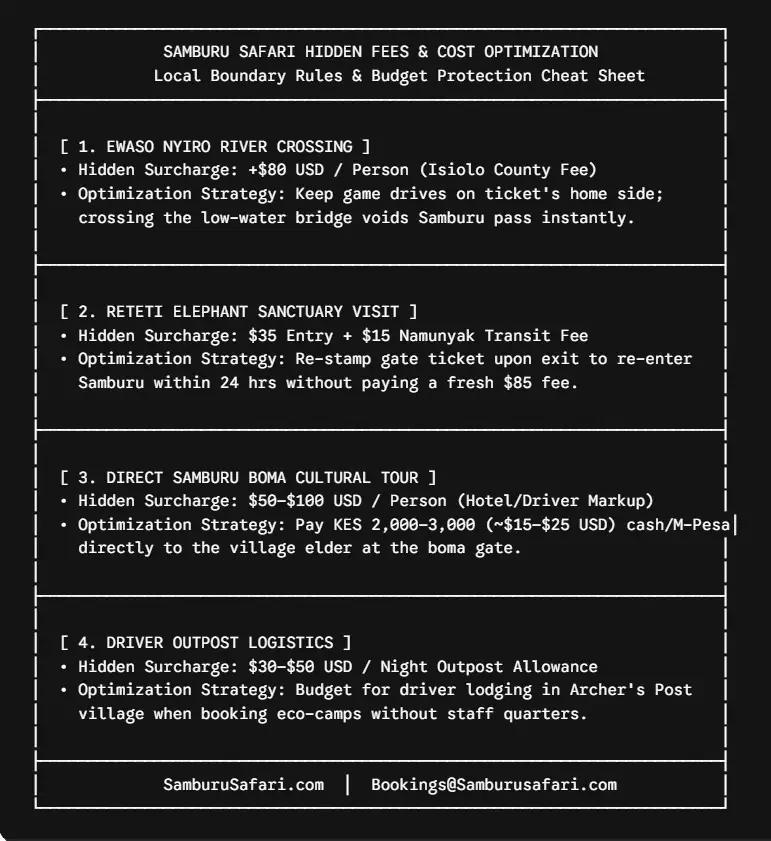
Unexpected local surcharges and boundary double-entry fees can rapidly inflate a northern Kenya safari budget. Knowing how county territorial lines work and leveraging official gate rules helps protect against unnecessary out-of-pocket expenses. The following table outlines primary hidden cost traps alongside verified money-saving strategies. Apply these tactics to keep your daily safari spending on budget.
Operational Scenario | Hidden Cost Surcharge | Cost Optimization Strategy |
Ewaso Nyiro River Crossing | +$80 USD/person Isiolo County fee | Keep game loops on ticket’s home side; crossing bridge voids Samburu pass. |
Reteti Sanctuary Visit | $35 entry + $15 Namunyak transit fee | Re-stamp ticket at gate exit to re-enter Samburu within 24 hrs without paying fresh $85 fee. |
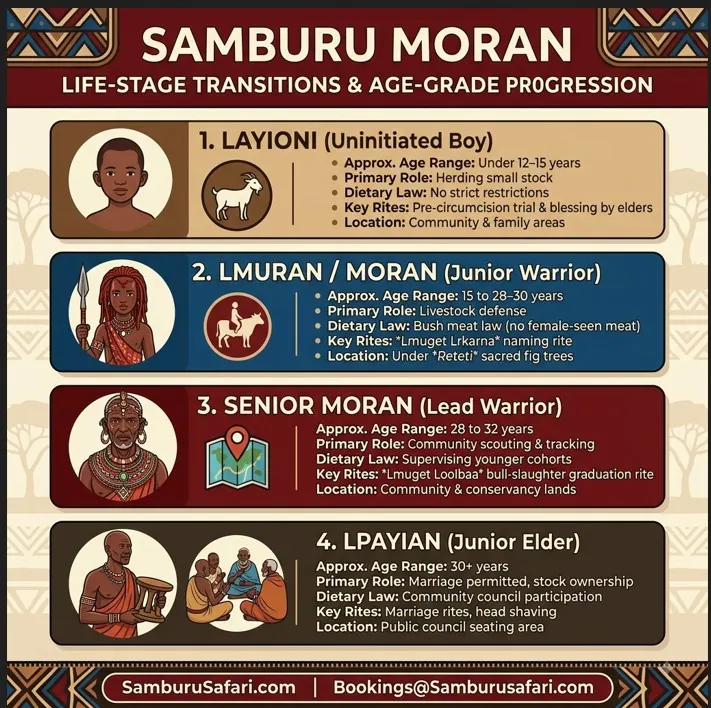
Samburu Boma Tour | $50–$100 USD/person (hotel desk markup) | Pay KES 2,000–3,000 (~$15–$25 USD) cash/M-Pesa directly to elder at boma gate. |
Driver Outpost Logistics | $30–$50 USD/night outpost allowance | Budget for driver lodging in Archer’s Post when booking eco-camps without staff quarters. |
How you reach the northern frontier impacts your overall package cost:
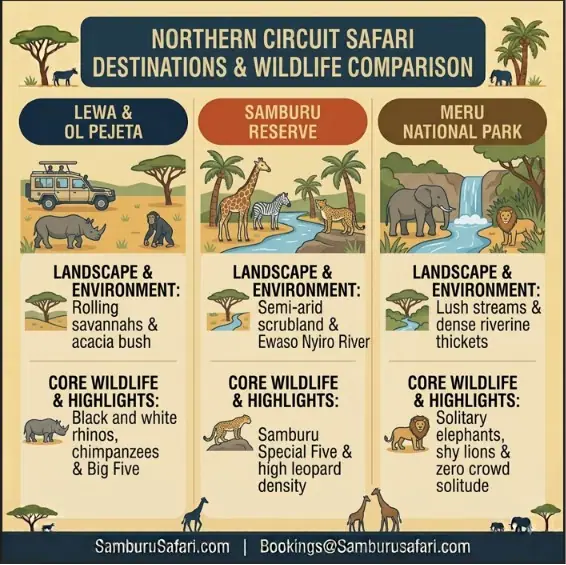
To avoid spending your entire stay in one park, we recommend combining your northern river drives with a highland sanctuary like Ol Pejeta Conservancy. This setup lets you track desert species up north before heading south to explore East Africa’s largest black rhino sanctuary.
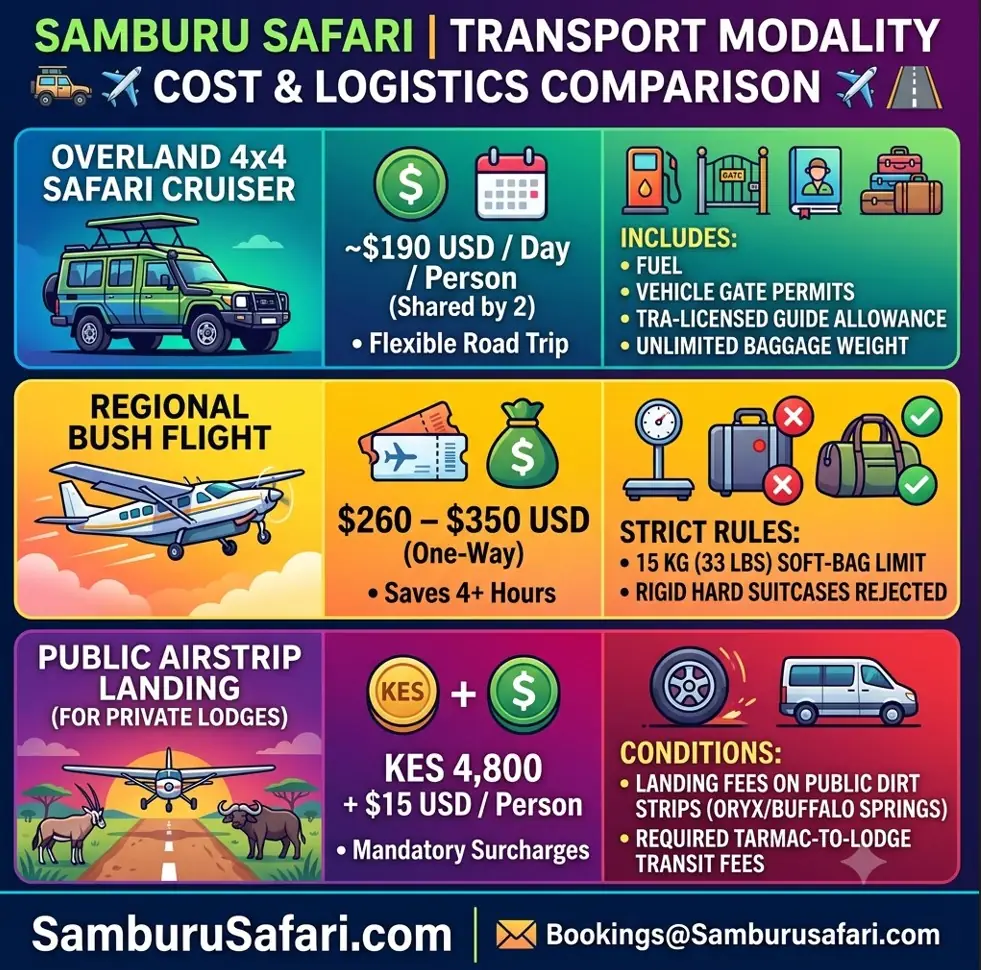
Deciding between an overland 4×4 road safari and a regional fly-in flight involves balancing transit speed, luggage constraints, and secondary landing fees. While flying saves over four hours of road travel, it introduces strict baggage weight caps and tarmac transit taxes. This comparison matrix highlights the financial and logistical trade-offs between road and air travel to Samburu. Use these benchmarks to select the transport modality that fits your group size and budget style.
Transport Vector | Cost & Fee Structure | Key Logistics & Constraints |
Overland 4×4 Cruiser | ~$190 USD/day/person (shared by 2) | Includes fuel, vehicle gate permits, guide allowance, and unlimited baggage weight. |
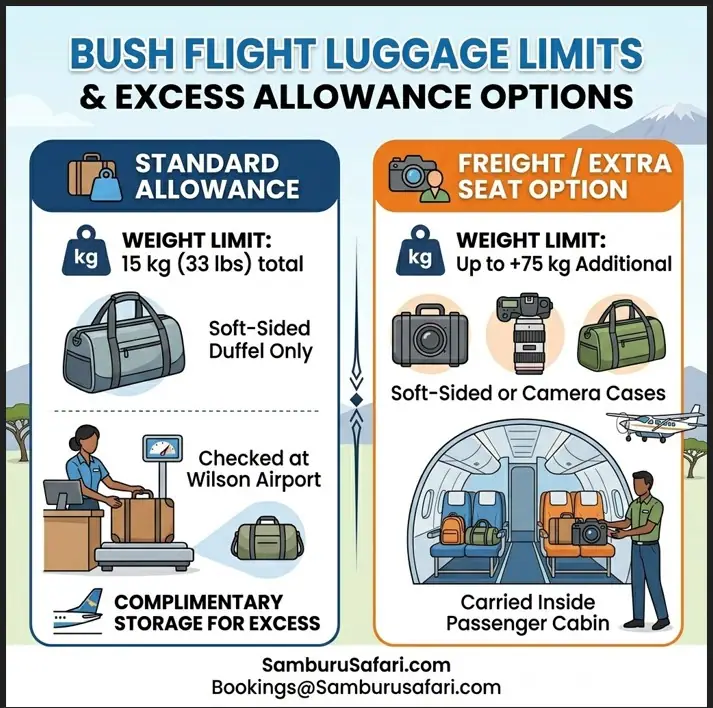
Regional Bush Flight | $260–$350 USD one-way flight ticket | Strict 15 kg (33 lbs) soft-bag limit; hard suitcases rejected at Wilson Airport. |
Public Airstrip Landing | KES 4,800 landing + $15/person transit fee | Landing on public dirt strips (Oryx/Buffalo Springs) for private lodges incurs tarmac taxes. |
The itemized numbers above tell you where the money goes. If you would rather have one fixed price cover all of it, browse the full range of Samburu safari packages and compare tiers.
The table below outlines our primary multi-destination packages for 2027 travel dates, calculated for two adults sharing a private 4×4 Safari Land Cruiser.
Package | Trip & Lodges | Price Per Person |
Budget Overland Tier | 4D/3N road safari • Samburu Riverside Camp + Comfort Gardens Ol Pejeta • Private cruiser, driver-guide, full board | $1,480 — Get a quote |
Mid-Range Overland Tier | 4D/3N classic circuit • Samburu Simba Lodge + Sweetwaters Tented Camp • Waterhole views, rhino tracking, extended drives | $1,820 — Price this trip |
Luxury Fly-In Tier | 4D/3N premium air package • Elephant Bedroom Camp + Sanctuary Tambarare • Roundtrip bush flights, riverfront tents | $3,250 — Check dates |
Luxury Plus Sky Circuit | 4D/3N luxury flight loop • Sasaab Lodge + Ol Pejeta Bush Camp • All bush flights, open-front suites, night drives | $6,120 — Build my itinerary |
Daytime temperatures reach 95°F, and fine dust blows through open vehicles on sand tracks. Packing sturdy, thick-soled boots protects your feet from sharp whistling thorn spikes along lodge paths. For camera bodies and lenses, the camera gear guide covers the dust covers and sealed bags that survive the sand loops. Sunglasses want to be polarized against the hard glare off the clay flats. Clothing recommendations, the 15kg flight limit, and the full paperwork checklist all sit in the Samburu safari packing list.
Timing matters for the budget too. Lodge rates swing with the seasons, and the month-by-month picture of when to go to Samburu shows exactly which weeks give you dry-season game viewing at shoulder-season prices.
The green shoulder months of April, May, and November offer lower lodge rates. Accommodation prices drop by 20% to 30% during these rainy periods, though public park entry fees stay fixed at $85 USD year-round.
Tipping is voluntary but customary. A reasonable benchmark is $15 to $20 USD per day for your professional driver-guide from your group, plus $10 to $15 USD per day in the central lodge tip box for general camp staff.
Most established lodges accept major credit cards (Visa and Mastercard) for bar bills and extras, though they often charge a 3% to 5% processing fee. Gate entry passes must be pre-paid through the county’s official online channel before you arrive — the gates themselves are cashless.
Rates and fee figures checked against operator invoices by our Nairobi desk. Last updated July 2026.
Message us directly for custom itineraries and the latest seasonal offers.