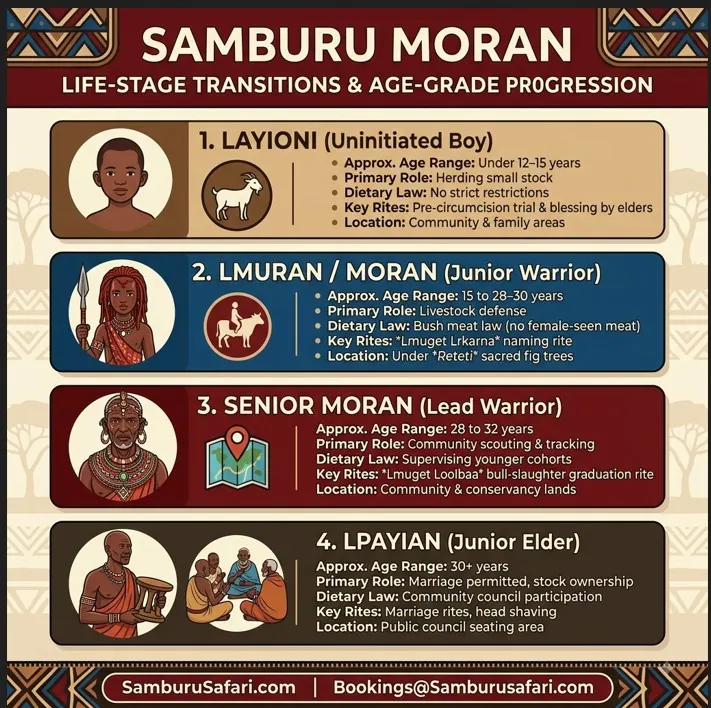

Pull into Westgate Conservancy and guests always ask the same thing: why are young Samburu warriors walking through the scrub carrying smartphones and GPS units instead of spears?
I stop the Cruiser near the river and explain. These Morans are running Warrior Watch, tracking big cats to keep them clear of village herds. The project behind it was founded in 2007 by Dr. Shivani Bhalla and Samburu leader Jeneria Lekilelei, and in that time the local lion population has gone from eight animals to more than fifty. It is one of the clearest cases anywhere of the Samburu people running conservation themselves rather than having it run at them.
The Ewaso Lions Project is an independent, community-led carnivore conservation initiative based in Westgate Community Conservancy, Kenya. Founded in 2007 by Dr. Shivani Bhalla and Jeneria Lekilelei, it uses GPS tracking, community monitoring through Warrior Watch and Mama Simba, and disease control to protect lions across 4,500 km² of northern rangeland — growing the local population from 8 to over 50.
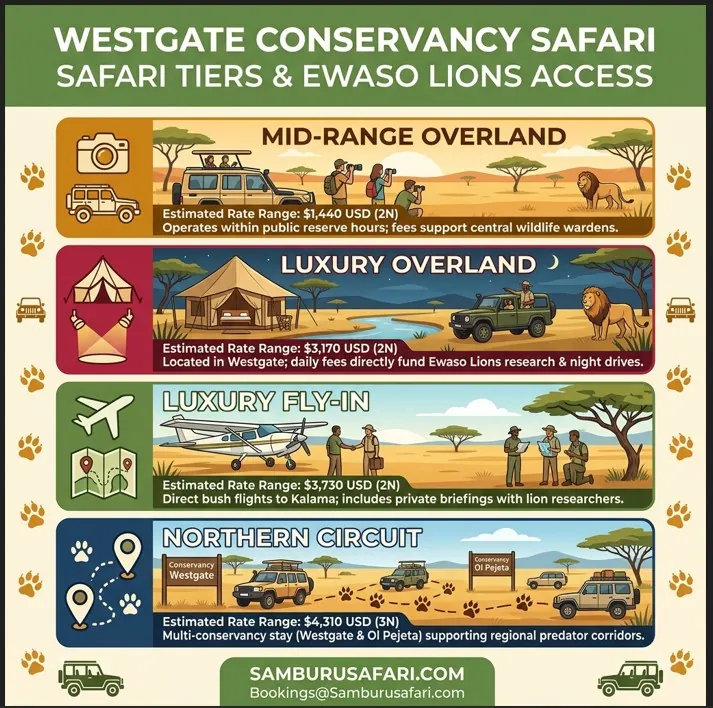
The gap between Samburu Simba Lodge at $1,440 and Sasaab Camp at $3,170 is location and access. Simba sits inside the public reserve, so we work to gate hours. Sasaab is built inside Westgate Community Conservancy, where your daily fees help fund the Ewaso Lions research base and we can run night drives straight out of camp.
Package Setup & Focus | Lodges / Camps | Transport & Details | Total Rate Per Person | |
2N Mid-Range Overland<br>Samburu Reserve & Westgate | Samburu Simba Lodge | • 3 Days private 4×4 Land Cruiser & guide<br>• Full board lodge stay & reserve permits | $1,440 USD | |
2N Conservation Luxury Overland<br>Westgate Community Conservancy | Sasaab Camp | • 3 Days private 4×4 Land Cruiser & guide<br>• Luxury suite stay & Westgate fees | $3,170 USD | |
2N Luxury Sky Fly-In<br>Westgate Community Conservancy | Sasaab Camp | • Return flights (WIL → Kalama Airstrip)<br>• Stationed 4×4 Land Cruiser game drives | $3,730 USD |
Package Setup & Focus | Lodges / Camps | Transport & Details | Total Rate Per Person | |
3N Northern Conservation Circuit<br>Westgate (2N) + Ol Pejeta (1N) | Sasaab Camp (2N) + Ol Pejeta Bush Camp (1N) | • 4 Days private 4×4 Land Cruiser & guide<br>• Conservancy fees & Ol Pejeta permits | $4,310 USD |
What your package covers: Full board at the named lodges, private or stationed 4×4 Land Cruiser with guide and fuel, Samburu Reserve daily permits ($85 USD/day non-resident) and conservancy fees, AMREF Flying Doctors evacuation cover, and scheduled regional bush flights on fly-in options.
Extra expenses to budget for: International flights, Kenya e-visas, personal travel insurance, premium cellar wines, driver-guide tips, and Reteti Elephant Sanctuary entry fees.
Planning around the conservation side of things? Send us your dates and we will build the route around it.
Ewaso Lions safari package rates and conservancy access
Choosing your accommodation tier in Samburu dictates how closely you interact with field lion conservation. While public reserve stays offer traditional daytime game drives, staying inside community conservancies like Westgate funds scout salaries and grants exclusive research access. This comparison shows how each package tier impacts predator protection and guest experiences.
Package Tier | Estimated Rate Range | Conservation Access & Direct Impact |
Mid-Range Overland | $1,440 USD (2N) | Operates within public reserve hours; fees support central wildlife wardens. |
Luxury Overland | $3,170 USD (2N) | Located in Westgate; daily fees directly fund Ewaso Lions research & night drives. |
Luxury Fly-In | $3,730 USD (2N) | Direct bush flights to Kalama; includes private briefings with lion researchers. |
Northern Circuit | $4,310 USD (3N) | Multi-conservancy stay (Westgate & Ol Pejeta) supporting regional predator corridors. |
While safari vehicles work the cats inside central Samburu Reserve, the project’s field base sits west of the reserve, in Westgate, along the Ewaso Nyiro.
That placement is deliberate. Lions cross unprotected community land constantly, following livestock, and an off-grid station out here puts biologists and Samburu scouts where the friction actually happens rather than where the tourists are. The conservancy is part of the wider northern circuit, and the daily fee you pay to enter is what keeps the scouts on salary.
Conservation Initiative | Target Group | Primary Field Action | Key Impact |
Warrior Watch | Samburu Morans (warriors) | GPS tracking & real-time herder alerts | Ends retaliatory spear hunting |
Mama Simba | Village women & matriarchs | Habitat restoration & native tree nurseries | Restores riverbank hunting cover |
Kura’s Pride | Pastoralist livestock dogs | Mobile rabies & distemper vaccination | Prevents disease spillover to wild cats |
Lion Watch | Safari driver-guides | Sightings & whisker-spot photos via app | Crowdsources ecosystem-wide population data |
Lion Kids Camp | Local primary students | Wildlife tracking & educational game drives | Builds local conservation leadership |
Jeneria Lekilelei launched Warrior Watch in 2010, and the logic behind it is worth sitting with. Young Samburu men had always proved themselves — or answered a livestock loss — by hunting lions with spears. Rather than campaign against the practice, the project recruited the same men.
Warrior Watch trains Morans in wildlife ecology, GPS navigation and conflict resolution. When lions move toward grazing areas, the warriors phone the herders and the livestock moves first. The spearing stopped because the people who used to do it now hold the data, which fits the way samburu warriors have always been the ones responsible for what happens out in the bush.
Across 4,500 square kilometres of community land, that is the whole intervention.
Warriors were only half the problem. Samburu women collect firewood and manage household stock, which puts them face to face with predators as often as anyone, and no early programme spoke to them at all.
Mama Simba — Mothers of Lions — was co-founded by Samburu matriarchs Mparasaroi Lemantaan and Munteli Lalparasaroi. It runs literacy classes, generates income through samburu beadwork, and puts women in charge of bush restoration along the river.
The restoration work is specific: clearing invasive species from the Ewaso Nyiro banks and planting native toothbrush trees, Salvadora persica. Those thickets give lions shade and stalking cover close to water, which is exactly what the riverbank had lost.
Community programs run by Ewaso Lions in Samburu
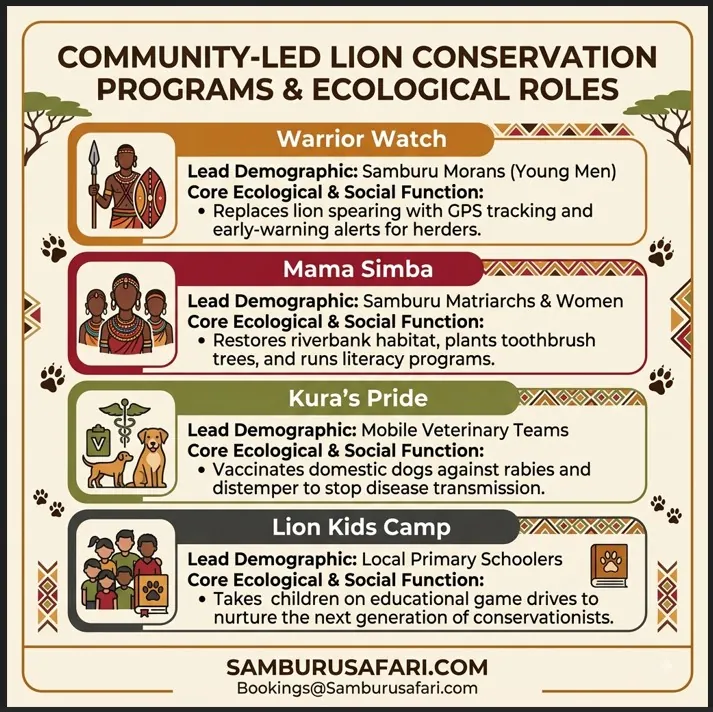
Community leadership is the cornerstone of big cat recovery in northern Kenya, transforming historical conflicts into active protection. By engaging every demographic—warriors, women, herders, and children—Ewaso Lions covers the complete social ecosystem of the rangelands. The matrix below outlines how each specialized group contributes to lion survival and habitat restoration.
Program Name | Lead Demographic | Core Ecological & Social Function |
Warrior Watch | Samburu Morans (Young Men) | Replaces lion spearing with GPS tracking and early-warning alerts for herders. |
Mama Simba | Samburu Matriarchs & Women | Restores riverbank habitat, plants toothbrush trees, and runs literacy programs. |
Kura’s Pride | Mobile Veterinary Teams | Vaccinates domestic dogs against rabies and distemper to stop disease transmission. |
Lion Kids Camp | Local Primary Schoolers | Takes children on educational game drives to nurture the next generation of conservationists. |
Northern lions rarely form the twenty-strong prides you see in the Mara. They split into small, mobile sub-groups and work the dry laggas, which makes them hard to count and harder to follow.
Ewaso Lions tracks over 50 individuals across the Samburu-Isiolo ecosystem without collaring every animal. Researchers photograph the whisker spots on each lion’s muzzle — the arrangement is fixed for life, like a fingerprint — and build identity profiles from them. Guides and scouts then use those profiles to follow pride splits, cub survival and territorial shifts without touching an animal.
How Ewaso Lions tracks and identifies lions without collars
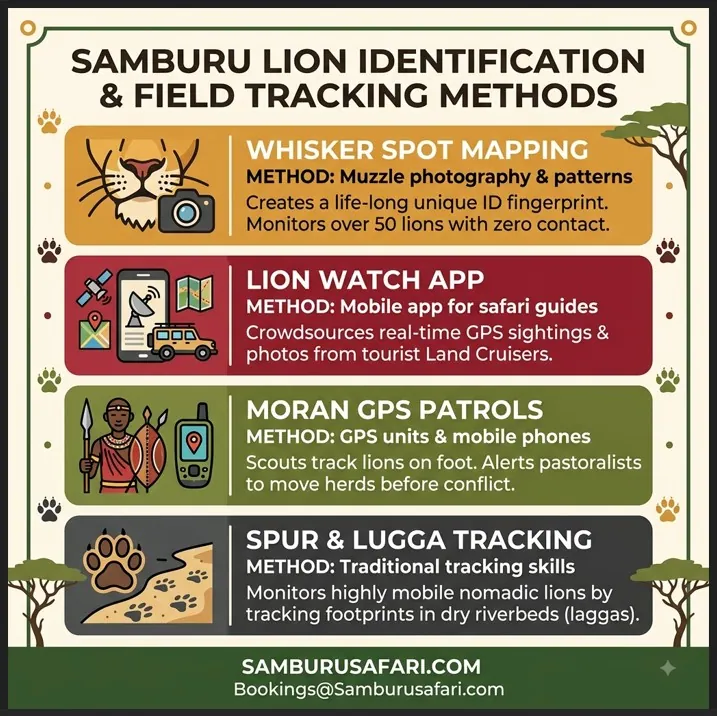
Tracking lions across 4,500 square kilometers of rugged community rangeland requires non-invasive field techniques that protect big cat welfare. Rather than relying solely on invasive radio collars, researchers and Samburu warriors use natural markers and digital tools to monitor individuals. This summary highlights the primary non-collaring methods used by Ewaso Lions field teams to identify cats and track pride recovery.
Tracking Method | Primary Tool / Technique | Conservation & Research Benefit |
Whisker Spot Mapping | Muzzle photography (whisker spot patterns) | Unique life-long “fingerprint” allows zero-contact identification of over 50 lions. |
Lion Watch App | Mobile app used by safari guides | Crowdsources real-time GPS sightings and photos from tourist Land Cruisers. |
Moran GPS Patrols | Handheld GPS units & mobile phones | Warrior Watch scouts track movements on foot to alert pastoralists before conflicts occur. |
Spur & Lugga Tracking | Traditional Samburu tracking skills | Follows footprint tracks in dry riverbeds (laggas) to monitor uncollared nomadic lions. |
In 2007 the early surveys found mostly nomadic, solitary lions scraping by on small livestock kills. That is what a squeezed population looks like.
As corridors opened across Kalama, Westgate and Namunyak, the picture changed. Researchers logged multi-generational prides forming — the Kalama Pride, Nanai’s Pride in Shaba — which is the strongest evidence available that secure community rangeland lets big-cat social structure rebuild itself.
Named for the project’s late rescue dog, Kura’s Pride deals with a threat nobody photographs: disease crossing over from village animals.
Pastoralist households keep dogs to guard stock. Unvaccinated, those dogs carry rabies and canine distemper, and both move readily into lions, leopards and wild dogs. Mobile clinics run annually across Westgate, Kalama and Namunyak, vaccinating thousands of dogs — which protects the families as much as the predators.
Lion Kids Camp. Five-day residential camps take Samburu primary school children into the reserves for their first game drive. Most have grown up beside lions without ever seeing one through binoculars.
Lion Watch app. Guides from lodges like Sasaab and Samburu Intrepids log sightings, GPS coordinates and pride numbers as they drive. It turns every tourist vehicle into a data point, and the resulting database covers ground no research team could survey alone.
Fee structures, escrow splits and how the conservancy money reaches households are covered in our guide to how tourism revenue reaches communities.
Conservation briefings at Sasaab. Guests inside Westgate can request an evening talk from a researcher or a Warrior Watch ambassador. Ask when you book, not when you arrive.
Wishlist donations. Travelers driving up from Nairobi can carry field supplies to the station — rechargeable headlamps, heavy-duty GPS handhelds, tracking binoculars.
Data contribution. Share your high-resolution muzzle shots with your guide and they go into the identity database. A good photo from a tourist vehicle is worth as much as one from a research vehicle.
Lions cover enormous territory. These animals range across thousands of square kilometres of open scrub. Sightings take patience, early starts and a guide who knows the river loops.
Community land has its own rules. In Westgate you stay on marked tracks and give way to herders moving zebu and camels. It is their grazing land before it is your game drive.
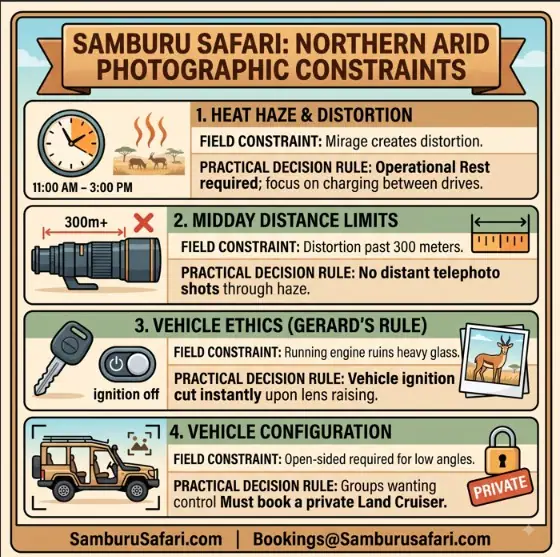
Midday is dead time. Cats lie up in thick acacia shade from about 11:00 AM to 4:00 PM. Drive at dawn and late afternoon.
Lion behaviour here makes more sense alongside the other predators working the same country, which our wildlife of Samburu section covers in detail. For road conditions, flights, permits and health precautions, start with planning your Samburu trip.
Where is the Ewaso Lions Project located? The main research camp is in Westgate Community Conservancy, on the western boundary of Samburu National Reserve in northern Kenya.
How many lions live in the Samburu ecosystem? The population across the Samburu-Isiolo ecosystem has grown from eight animals in 2007 to more than fifty today, through community conservation led by Ewaso Lions.
Can tourists visit the Ewaso Lions research camp? Guests staying at eco-lodges inside Westgate, such as Sasaab Camp, can arrange private visits or briefings with researchers by prior request.
Written by Gerard Murero — TRA silver-level guide working the northern rangelands routes through Samburu, Buffalo Springs and the community conservancies.
Reviewed by Benson Kungu — safari guide and photography specialist.
Message us directly for custom itineraries and the latest seasonal offers.