
Written by Patrick Mulei. Reviewed by Anthony Mule.
Rising over 2,000 metres above the Samburu plains, Mount Ololokwe is a massive sandstone mountain 50 kilometres north of Archer’s Post along the paved A2. Known locally as Ol Donyo Sabache, it sits inside Namunyak Community Conservancy. The Mount Ololokwe hike climbs 1,000 vertical metres up steep elephant paths into a dense, mist-fed cloud forest on top.
Metric | Details |
Location | Namunyak Community Conservancy, Samburu County (A2 Highway) |
Trailhead Elevation | ~1,000 m ASL (Sabache Eco-Camp) |
Summit Elevation | 2,000 m+ ASL, 1,000 m total vertical gain |
Hike Distance | ~12–14 km round trip including the plateau walk |
Trek Duration | 5–7 hours total (3–4 up, 2–3 down) |
Difficulty | Strenuous — steep ascent, high heat |
Terrain | Loose basalt scree, elephant paths, granite boulders, mossy forest |
All costs below cover two adults travelling together in a private 4×4 Safari Land Cruiser — licensed driver-guide, fuel, full-board accommodation, community ranger escorts, conservancy permits, and local guide fees.
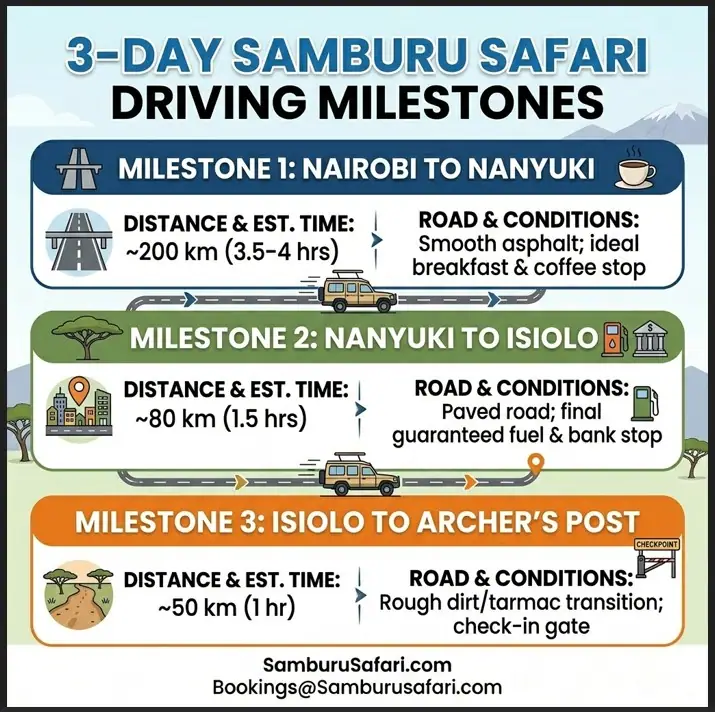
I see a lot of itineraries trying to force a day trip here after driving all morning from Nairobi. Do not do that to yourself. The A2 run through Isiolo takes five to six hours, and attempting 1,000 vertical metres the same afternoon is how people end up with heatstroke. Two nights minimum. If you want a slower pace, add a night at Ol Pejeta or Lewa on the way back.
Tier | Lodges Included | Total Per Person | |
Budget | Sabache Eco-Camp / Samburu Riverside | $1,220 | |
Mid-Range | Elephant Bedroom Camp | $1,760 | |
Luxury | Saruni Samburu | $2,620 | |
Luxury Plus | Sarara Camp / Reteti House (fly-in) | $4,320 |
Tier | Lodges Included | Total Per Person | |
Budget | Sabache (1N) + Samburu Riverside (1N) + Comfort Gardens Ol Pejeta (1N) | $1,790 | |
Mid-Range | Elephant Bedroom Camp (2N) + Sweetwaters Serena (1N) | $2,560 | |
Luxury | Saruni Samburu (2N) + Lewa Wilderness (1N) | $3,860 | |
Luxury Plus | Sarara Camp (2N) + Sirikoi Lodge Lewa (1N), fly-in | $6,250 |
Those Ol Pejeta pairings run in full on our Samburu and Ol Pejeta combo page, and the deeper northern route is on the 7 day northern Kenya circuit.
Included:
Not covered:
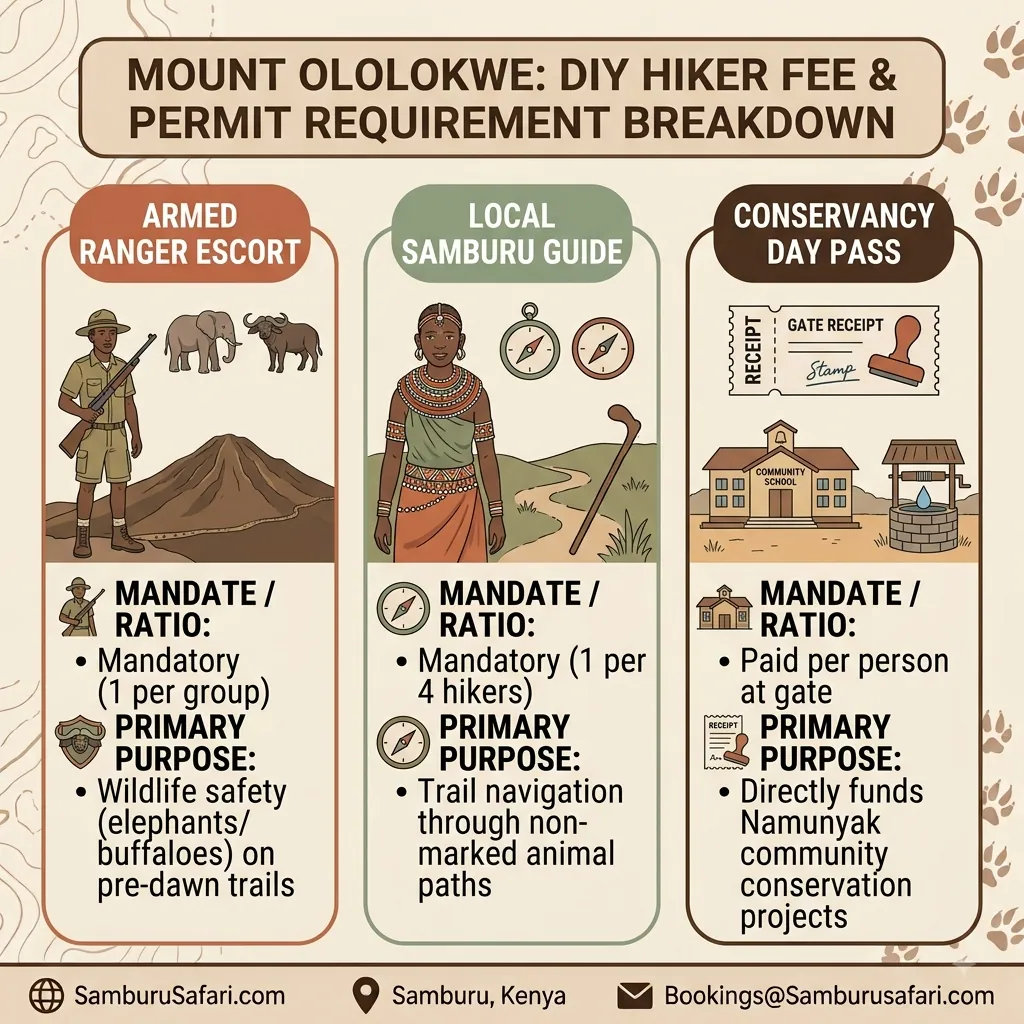
Self-drive travellers, Kenyan residents, and local hiking groups pay fees directly at the Sabache base camp gate. Expect separate charges for the conservancy day fee, the mandatory community mountain guide (roughly one guide per four hikers), the armed ranger escort required for pre-dawn starts, base campground pitching, summit plateau camping, and donkey porters if you are hauling gear up overnight.
Citizen, resident, and non-resident rates all differ, and they change. Confirm the current schedule with Sabache before you travel. The wider trip budget is broken down in our Samburu safari cost guide.
Self-drive hikers and independent groups visiting Mount Ololokwe must clear mandatory community and safety protocols at the Sabache Gate before step-off. Because the mountain is a high-density corridor for wild elephants and buffalo, solo unescorted trekking is strictly prohibited. Reviewing these required fees and permits ensures a seamless entrance at the conservancy boundary.
Requirement Category | Mandate / Ratio | Primary Purpose |
Armed Ranger Escort | Mandatory (1 per group) | Wildlife safety (elephants/buffaloes) on pre-dawn trails. |
Local Samburu Guide | Mandatory (1 per 4 hikers) | Trail navigation through non-marked animal paths. |
Conservancy Day Pass | Paid per person at gate | Directly funds Namunyak community conservation projects. |
Full route detail with fuel stops and road conditions is on our driving from Nairobi to Samburu page.
Sabache laga to the gully foot (1,000–1,200m): From base camp you cross a dry sandy riverbed before a gentle incline of basalt stone and thorny acacia scrub.
The elephant gully switchbacks (1,200–1,600m): The hardest section. Narrow zigzag paths cut into steep rock clefts by elephant herds, shifting from loose dirt scree to granite boulders where you need your hands.
Summit forest to the Southern Viewpoint (1,600–2,000m+): The cliff rim brings cooler air. From there it is another walk across thick cedar and olive cloud forest to the ledge, where you look straight down at the A2 winding through the plains.
Pack light but smart. Heat on the lower slopes drains you fast if you are carrying weight you do not need.
The full clothing and gear list for the wider trip sits in our Samburu safari packing list.
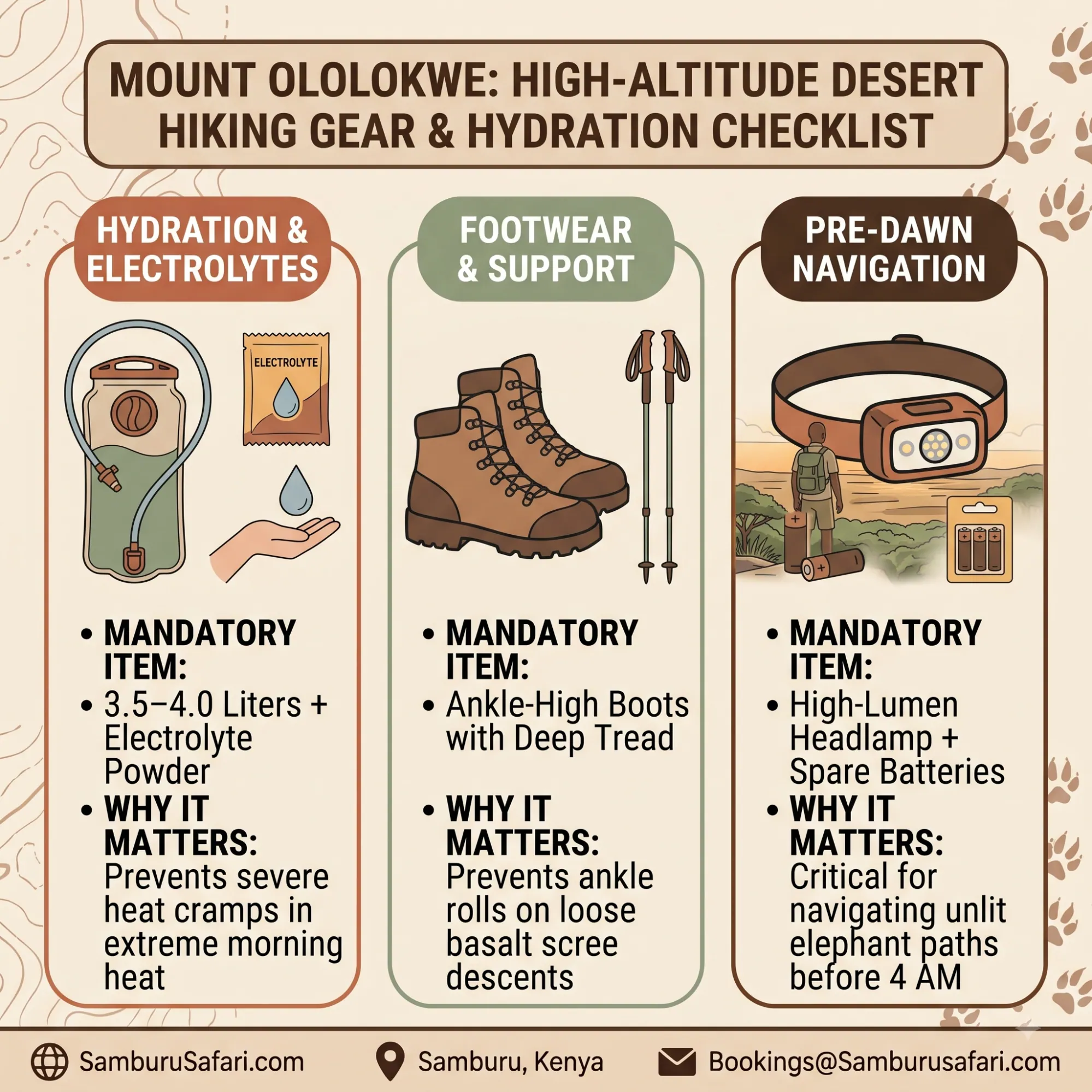
The drastic transition from hot, dry acacia scrub at the base to damp, mossy cloud forest at the summit demands specialized gear. Loose scree and exposed rock surfaces can easily cause heat exhaustion or ankle injuries without proper preparation. This checklist outlines the essential equipment required to complete the 14-kilometer trek safely.
Essential Gear Category | Mandatory Item | Why It Matters |
Hydration & Electrolytes | 3.5–4.0 Liters + Electrolyte Powder | Prevents severe heat cramps in extreme morning heat. |
Footwear & Support | Ankle-High Boots with Deep Tread | Prevents ankle rolls on loose basalt scree descents. |
Pre-Dawn Navigation | High-Lumen Headlamp + Spare Batteries | Critical for navigating unlit elephant paths before 4 AM. |
Season / Months | Weather & Trail Conditions | Rating |
June – September | Dry weather, firm trails, clear sunrise views | Best |
December – February | Warm, clear skies, low trail mud | Best |
March – May | Long rains, slick granite, flooded lagas | Avoid |
November | Short rains, sudden afternoon washouts | Risky |
Dry weather keeps the rock slabs grippy and the mornings clear over the Mathews Range. Heavy rain turns the granite into slides, and flash floods fill the lagas near base camp, cutting vehicle access entirely. The full month-by-month picture is in our best time to visit Samburu breakdown.
Brewing black tea at 3:00 AM at Sabache, it is pitch dark and dead quiet apart from basalt gravel under boots and the odd bat near the dry riverbed. Keep your headlamp beam right in front of you — this early stretch is loose stone waiting to turn an ankle before you even reach the main incline.
Our lead ranger checks his rifle chamber before we step off the track. Here are the local details standard guides leave out.
The Samburu do not call this mountain Ololokwe in their own language — that name belongs to a small dry stream nearby. The mountain is Ol Donyo Sabache.
Sabache refers to the silver clasp on a traditional Samburu woman’s beaded necklace. To local herders the mountain is a symbol of beauty and sanctuary. When severe drought hits the lowlands, elders make the climb to the summit springs to perform rain rituals.
No trail crew cut these paths. The switchbacks you hike were carved by wild elephant herds.
In dry seasons the herds climb these gullies to reach permanent springs hidden in the mountain forest. The broad smooth stone steps under your boots were flattened over centuries by elephants, long before any hiker arrived. Their movements across the wider ecosystem are still tracked today by the Save the Elephants research team.
You start in hot dry acacia scrub. Scramble over the top rim and you step into cool cloud forest hung with Old Man’s Beard lichen.
The summit forest shelters giant Encephalartos cycads — living botanical fossils from a lineage far older than any mammal, surviving here because the plateau traps cool moisture.
When you finally haul past the last boulder section you will be gasping and certain you have topped out. You have not.
The cliff rim is only the midway point. There is still a walk of an hour and a half or more across a forested plateau to reach the true edge at the Southern Viewpoint, where you stand on bare rock looking down at the thin black line of the A2 cutting through the Isiolo plains.
Do not start late. I mean it. If you are still on exposed granite by 9:00 AM, the heat coming off that black stone feels like someone holding a hairdryer to your face.
A 3:30 AM start puts you up the steepest rock in cool night air. By sunrise over the Mathews Range you are already past the unshaded sections and walking into forest shade.
Sabache Eco-Camp handles base logistics. If you camp on the summit plateau, they coordinate local Samburu porters who carry tents, water, and gear up the elephant tracks on their shoulders or by pack donkey.
You cannot hike or camp on Ololokwe alone. It is prohibited under Northern Rangelands Trust rules. The mountain is an active sanctuary for elephants, buffalo, and leopards drinking from the summit pools, so every party carries an armed Samburu ranger. Same principle as any guided walking safari in the conservancies.
Good endurance and steady footwork. The ascent gains 1,000 vertical metres over uneven elephant trails in three to four hours. If you can manage a full day walking on rough ground at home, you can do this with an early start.
No. The lower boulder gullies are tricky in the dark, and the trail branches onto animal paths where people get lost. Rangers also know where the elephant herds are feeding, which keeps your party at a safe distance.
Camping up top is superb for the stars over the Samburu desert. Arrange porters and armed rangers through Sabache at least 24 hours ahead so water and gear can be hauled up.
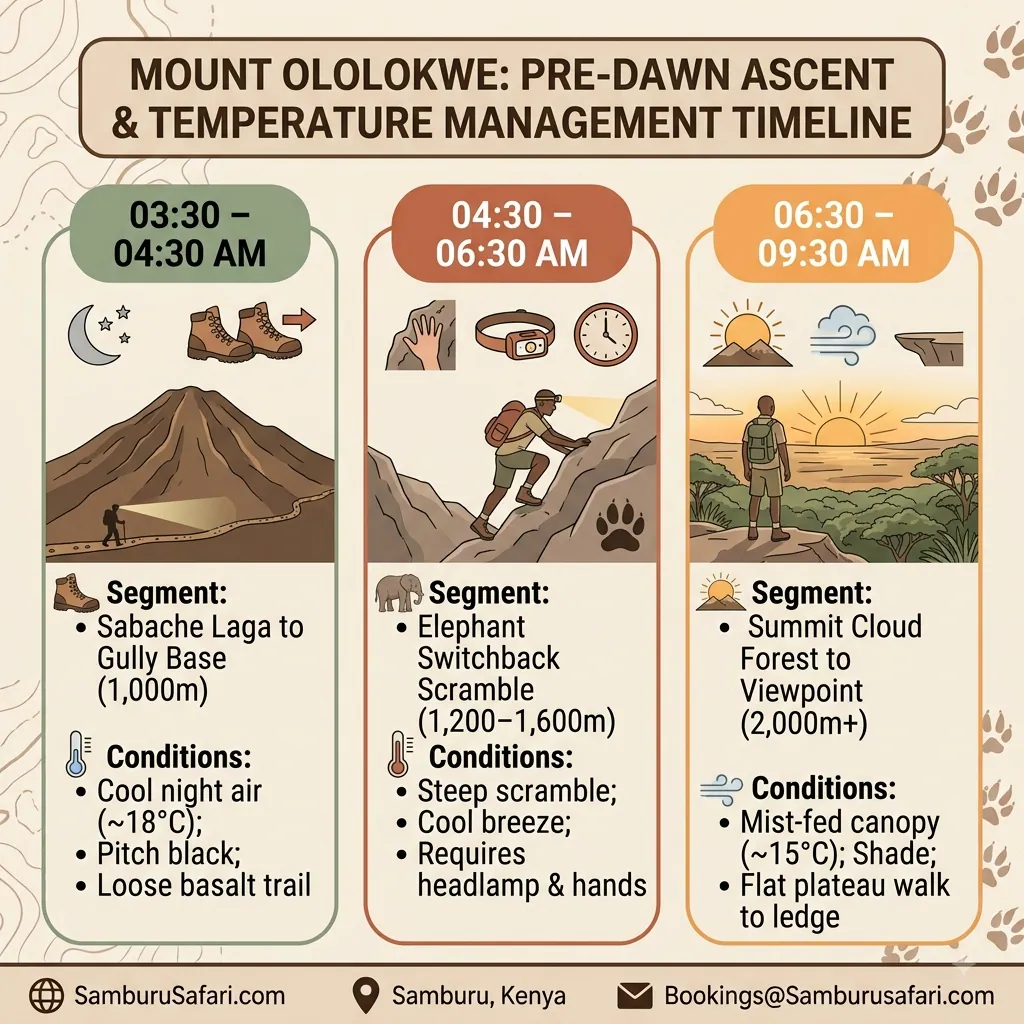
A successful climb on Mount Ololokwe depends almost entirely on beating the equatorial heat before sunlight strikes the open granite faces. Starting at 3:30 AM allows hikers to navigate the steepest 1,000-meter elevation gain under cool night skies. This timeline breaks down the ascent phases, altitude progression, and temperature changes from base camp to the summit plateau.
Time Slot | Trail Segment & Altitude | Microclimate & Conditions |
03:30 – 04:30 AM | Sabache Laga to Gully Base (1,000m) | Cool night air (~18°C); pitch black; loose basalt trail. |
04:30 – 06:30 AM | Elephant Switchback Scramble (1,200–1,600m) | Steep scramble; cool breeze; requires headlamp & hands. |
06:30 – 09:30 AM | Summit Cloud Forest to Viewpoint (2,000m+) | Mist-fed canopy (~15°C); shade; flat plateau walk to ledge. |
Scrambling ancient elephant paths to watch sunrise over the Samburu plains from the top of Ol Donyo Sabache is one of the rawest things you can do in Kenya. The mountain sits inside Namunyak Conservancy, which pairs naturally with Reteti and Sarara on a longer trip.
Browse the full range across our Samburu safari packages, or talk to our team to arrange transport, rangers, and accommodation.
Trail conditions, ranger requirements, and access rules checked on the ground by our guides. Last updated July 2026.
Message us directly for custom itineraries and the latest seasonal offers.