
Quick Answer: Save the Elephants Samburu operations centre on an active scientific research facility established in 1997 along the Ewaso Nyiro River. Tracking over 1,000 individual elephants across 66 thematic family groups, researchers use GSM and Iridium GPS collars linked to EarthRanger, speed-burst geofencing, dung cortisol analysis, and community beehive fences to protect northern Kenya’s elephant population.
Written by Gerard Murero. Reviewed by Benson Kungu.
Standing on the dusty riverbank at first light, you hear the deep rumble of a herd before you see anything through the Doum palms. The Ewaso Nyiro River is the lifeline of this dry country, and no organisation understands its elephant movement better than Save the Elephants.
Founded in 1997 by Dr. Iain Douglas-Hamilton, the research centre sits quietly on the edge of the reserve. Inside the main tracking room, researchers watch live satellite pings come in on the EarthRanger platform.
Field units fit GSM and Iridium satellite collars to key matriarchs and adult bulls. The screens map individual movements across northern Kenya in real time — a collared elephant completing a 150-kilometre trek from Oldonyiro back to the river shows up as a line drawn slowly across the map over days.
When a collared elephant approaches farm boundaries along conservancy edges, the system triggers “speed bursts” — high-frequency GPS pings every few minutes. Cross a virtual geofence and EarthRanger fires SMS alerts to local community rangers, letting teams intercept the herd before conflict starts.
Researchers sort Samburu’s elephants into three groups based on that tracking data:
Tracking collared matriarchs is not just science. It tells our guides where a family will be tomorrow, which matters enormously in a dry spell when the interior water dries up and the whole herd swings back toward the river. That same river corridor is where you find the rest of the Samburu Special 5 concentrated at the same time of year.
“Save the Elephants collar technology Samburu” / “EarthRanger elephant geofencing alerts”
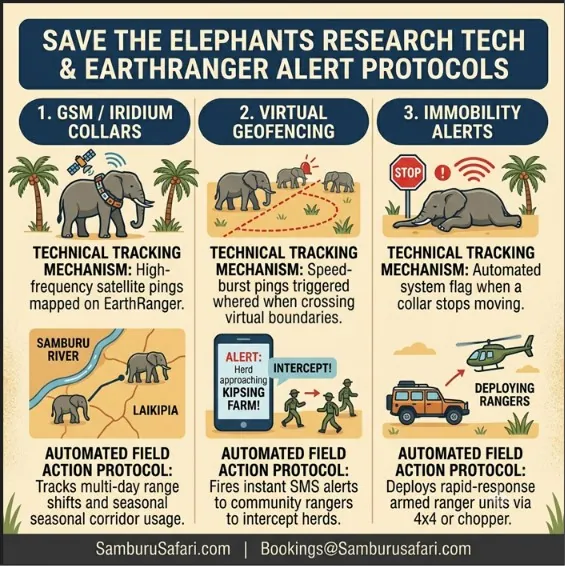
Save the Elephants utilizes a multi-tiered telemetry infrastructure to monitor over 1,000 elephants across northern Kenya. By pairing GSM and Iridium GPS tracking collars with the EarthRanger visualization platform, researchers track real-time spatial movements and behavioral changes across reserve boundaries. When collared matriarchs or bulls move into high-risk agricultural corridors, automated software triggers high-frequency tracking bursts and real-time alerts. The table below breaks down the primary research technologies, tracking mechanisms, and field action protocols used by STE.
Research Technology | Technical Tracking Mechanism | Automated Field Action Protocol |
GSM / Iridium Collars | High-frequency satellite pings mapped on EarthRanger | Tracks multi-day range shifts and seasonal corridor usage |
Virtual Geofencing | Speed-burst pings triggered when crossing virtual boundaries | Fires instant SMS alerts to community rangers to intercept herds |
Immobility Alerts | Automated system flag when a collar stops moving | Deploys rapid-response armed ranger units via 4×4 or chopper |
Save the Elephants is a research organisation first, but its tracking infrastructure has become a security layer across northern Kenya.
If a collared elephant stops moving for an abnormal stretch, EarthRanger registers an immobility alert. That flag means potential injury, natural death, or a poaching attempt.
When an anomaly is flagged, STE coordinates with armed ranger units from the Kenya Wildlife Service and the Northern Rangelands Trust. Response teams deploy by 4×4 or helicopter to the exact GPS coordinates.
Recognising over 1,000 elephants on sight takes decades of field records. STE researchers and trained guides identify individuals across 66 resident family groups using ear notches, tusk angles, and tail brush lengths. Samburu researchers like David Daballen map these features in field sketchbooks before anything gets logged digitally.
To make long-term tracking memorable, each family is named on a theme — the Storms, the Winds, the Royals, the Spices, the Biblical Towns, the Artists, the First Ladies. Once you know the system, a name tells you the lineage before you have even seen the animal.
Beyond the family units, researchers monitor roughly 120 adult breeding bulls. These move independently through the reserve during musth, following specific river loops to find receptive females across the 66 family lines.
The Doum palm groves along the river are the heart of it. Elephants headbutt and shake the trunks to bring down heavy palm nuts, and the fibrous husk gives them sweet calories through the dry months. Those same groves shelter reticulated giraffe browsing the upper canopy and, higher still, a fair share of the reserve’s 450-plus recorded bird species.
“Samburu elephant family names Save the Elephants” / “How Save the Elephants names herds”
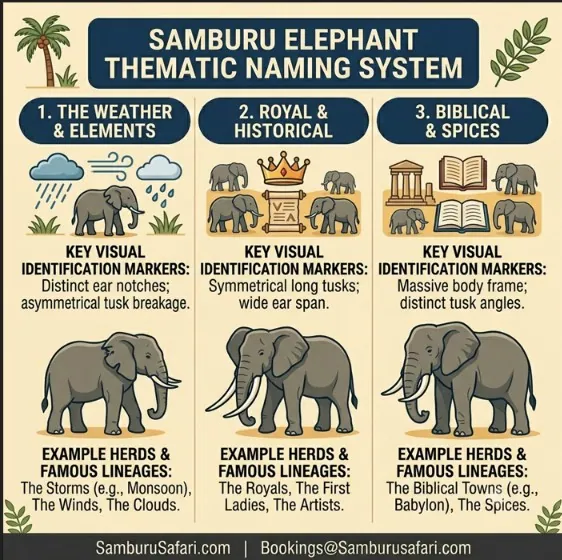
To track over 1,000 wild elephants individually without invasive tagging, Save the Elephants organizes resident herds into thematic family groups based on visual field identification. Researchers like David Daballen archive distinct physical traits—such as tusk curvature, ear notches, and tail structure—in field sketchbooks before digitizing the data. Each thematic family name instantly identifies an elephant’s social lineage to field researchers and safari guides. Review the table below to see key thematic naming categories, field identification features, and notable family lineages.
Family Naming Theme | Key Visual Identification Markers | Example Herds & Famous Lineages |
The Weather & Elements | Distinct ear notches; asymmetrical tusk breakage | The Storms (e.g., Monsoon), The Winds, The Clouds |
Royal & Historical | Symmetrical long tusks; wide ear span | The Royals, The First Ladies, The Artists |
Biblical & Spices | Massive body frame; distinct tusk angles | The Biblical Towns (e.g., Babylon), The Spices |
A common misconception is that the STE Research Centre works as an open public museum. It does not. This is an active scientific field station, and day-trippers cannot drop in unannounced.
The official conservation tourism partner is Elephant Watch Camp, founded by Oria Douglas-Hamilton and her daughter Saba. Guests staying there get behind-the-scenes access to the research station and game drives with guides who can name resident elephants on sight.
The camp’s eco-architecture is worth the trip on its own: built entirely from trees knocked down naturally by elephants along the riverbank. Canvas tents have open-sky bathrooms with hand-painted bucket showers, solar-heated water, and eco-toilets built around living acacias. No concrete anywhere.
To protect scientific operations and the animals themselves, visitors follow clear ground rules:
Field research here focuses on practical solutions for human-elephant coexistence along the conservancy borders.
Elephants have an innate fear of African honeybees (Apis mellifera scutellata). STE developed beehive fences — interconnected hives strung on wire around smallholder farms. An elephant touches the wire, the hives shake, the bees come out, and the animal leaves without a scratch on either side. Farmers also run chili-grease strings along border tracks.
To measure how human activity affects elephants without ever handling one, researchers collect fresh dung and run cortisol levels in the lab. It lets scientists track how road construction, drought, or vehicle traffic changes herd stress over time.
Trackers on a guided walking safari read the same dung by hand — warm and steamy means twenty minutes ago, beetles already tunneling means hours. Same evidence, different instrument.
“Save the Elephants beehive fences Samburu” / “Dung cortisol stress analysis elephants”
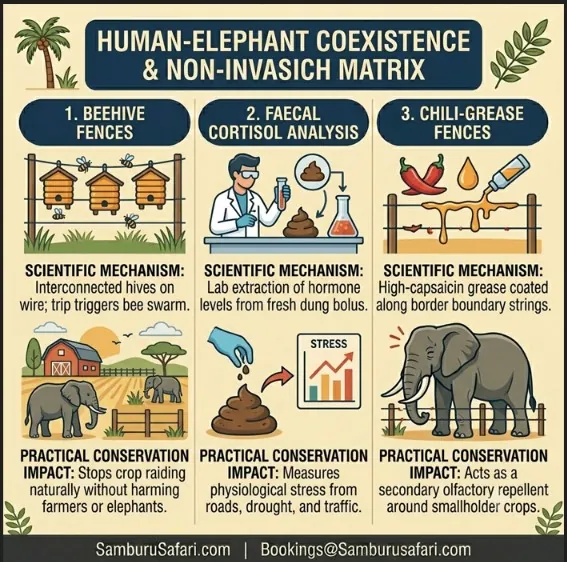
Mitigating human-elephant conflict requires non-invasive research methods combined with low-cost, community-led deterrence tools. Save the Elephants pioneered beehive fencing to harness elephants’ natural aversion to African honeybees, establishing peaceful agricultural buffer zones along conservancy edges. Concurrently, laboratory stress analysis allows researchers to monitor physiological impact without capturing or disrupting wild herds. The matrix below details STE’s primary coexistence tools, scientific mechanisms, and practical conservation impacts.
Coexistence & Research Tool | Scientific Mechanism | Practical Conservation Impact |
Beehive Fences | Interconnected hives on wire; trip triggers bee swarm | Stops crop raiding naturally without harming farmers or elephants |
Faecal Cortisol Analysis | Lab extraction of hormone levels from fresh dung bolus | Measures physiological stress from roads, drought, and traffic |
Chili-Grease Fences | High-capsaicin grease coated along border boundary strings | Acts as a secondary olfactory repellent around smallholder crops |
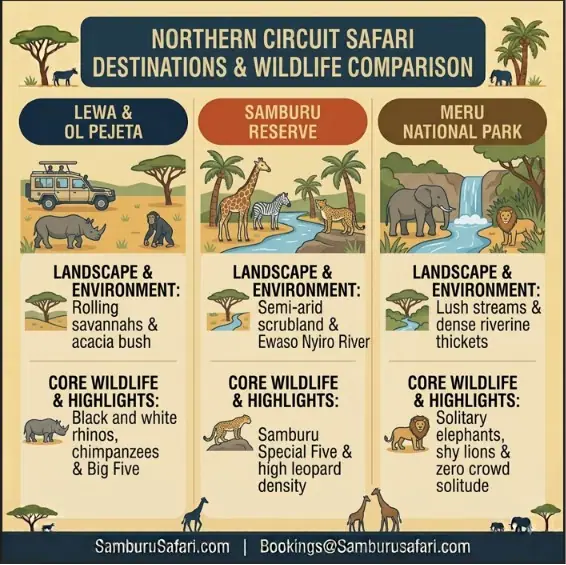
We design multi-destination itineraries pairing Samburu’s elephant circuits with neighbouring sanctuaries like Ol Pejeta, so you can track elephants up north before heading south for black rhinos and chimpanzees.
Every trip below rolls permits, vehicle, guide, and lodging into one fixed price, with the full range under our Samburu safari packages. If the whole trip is still unplanned, start with the master Samburu safari guide.
The table details our 2027 multi-destination packages for two adults sharing a private 4×4 Safari Land Cruiser.
Package | Trip & Properties | Price Per Person |
Budget Overland Tier | 4D/3N road safari • Samburu Riverside Camp + Comfort Gardens Ol Pejeta • Private cruiser, driver-guide, full board and river drives | $1,480 — Get a quote |
Mid-Range Overland Tier | 4D/3N classic road trip • Samburu Simba Lodge + Sweetwaters Tented Camp • Waterhole views, rhino tracking, extended riverine drives | $1,820 — Price this trip |
Luxury Fly-In Tier | 4D/3N premium air package • Elephant Bedroom Camp + Sanctuary Tambarare • Roundtrip bush flights, unfenced riverfront tents | $3,250 — Check dates |
Luxury Plus Sky Circuit | 5D/4N luxury flight loop • Elephant Watch Camp + Ol Pejeta Bush Camp • All regional flights, research station access, STE-trained guides | $6,850 — Build my itinerary |
Elephants have right of way on the river loops. Never block a family’s path to water, and never drive between a matriarch and her calf — a herd that closes ranks around its young is reading the same riverine thickets where the big cats of Samburu lie up by day. If a bull in musth shakes his head and flaps his ears, cut the engine, stay calm, and give him room. He is telling you something.
Much of this movement happens after the reserve gates close at dusk, which is why collar data shows so much cross-boundary traffic overnight. To see any of it yourself, you need a night game drive on conservancy land where spotlighting is legal.
The STE Research Centre is an active scientific field station, not an open museum. Guests staying at official partner lodges like Elephant Watch Camp receive behind-the-scenes tours and research briefings.
Save the Elephants monitors over 1,000 individual elephants across 66 family groups in the greater Samburu, Buffalo Springs, and Laikipia ecosystem.
They headbutt and shake the trunks to bring down heavy palm nuts. The fibrous outer husk is sweet and provides vital calories during the dry season, which is why the riverine groves stay busy through the worst months.
Collar movement patterns and family sightings logged on the river loops by our guides. Last updated July 2026.
Message us directly for custom itineraries and the latest seasonal offers.