
Quick Answer: The ewaso nyiro river is the primary life source of Samburu National Reserve, flowing from Mount Kenya before sinking into the Lorian Swamp. Framing northern Kenya’s dry scrubland, its mud-silted waters support riverline leopards, crocodile ambushes, elephant sand wells, and unfenced luxury tented camps.
Written by Gerard Murero. Reviewed by Benson Kungu.
Field Spec | Ewaso Nyiro River Profile |
Local Vernacular | Ewaso Ng’iro (Maa for “river of brown water”) |
Origin & Terminal | Mount Kenya / Aberdares → sinks into the Lorian Swamp (endorheic) |
Key Riverline Species | Elephant, Nile Crocodile, Leopard, Olive Baboon, Sandgrouse |
Border Role | Natural boundary between Samburu & Buffalo Springs reserves |
Top Riverfront Lodges | Elephant Bedroom Camp, Larsen’s Camp, Samburu Intrepids |
Best Viewing Hours | 06:15 AM – 08:30 AM & 04:30 PM – 06:30 PM |
Standing at the water’s edge at 6:15 AM, the air smells of wet silt and damp acacia bark. The cold sits on the water for another hour before the heat takes over.
The Ewaso Nyiro works unlike most large African rivers. It rises in the high glaciers and peat bogs of the Aberdares and Mount Kenya, runs east through dry northern scrubland, and then never reaches the sea. It empties into the desert sands of the Lorian Swamp near Habaswein, where the water sinks into the earth and evaporates. The river gives its whole body to keep this country alive.
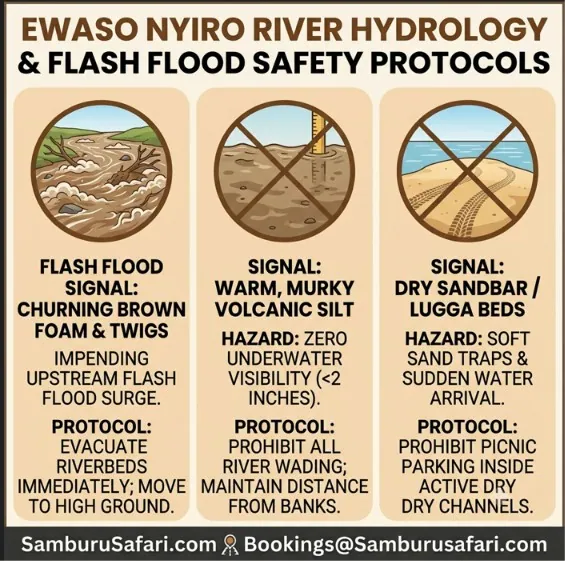
Reading water levels means watching weather that is nowhere near you. A heavy thunderstorm over Mount Kenya can push a silent five-to-ten-foot flash flood downstream under a cloudless Samburu sky. Guides watch the colour of the water. Churning brown foam and floating branches means you get out of the riverbed. Immediately.
Almost everything the north is known for lives off this water, including the Samburu Special 5 — the dry-country endemics that draw people up here in the first place.
“Ewaso Nyiro River depth and flash flood hazards” / “Ewaso Nyiro River flash flood warning signs”
Navigating the Ewaso Nyiro River requires understanding its unique endorheic hydrology and unpredictable riverbed currents. Originating in the distant peat bogs of Mount Kenya and the Aberdares, a sudden mountain storm can trigger a rapid flash flood upstream under completely clear Samburu skies. Field guides monitor subtle shifts in water silt, debris density, and foam patterns to avoid dangerous riverbed traps. The table below outlines the hydrological indicators, associated flood hazards, and mandatory guide reaction protocols along the river channel.
Hydrological Water Signal | Associated Riverbed Hazard | Mandatory Guide Safety Protocol |
Churning Brown Foam & Twigs | Impending upstream flash flood surge | Evacuate riverbeds immediately; move to high ground |
Warm, Murky Volcanic Silt | Zero underwater visibility (<2 inches) | Prohibit all river wading; maintain distance from banks |
Dry Sandbar / Lugga Beds | Soft sand traps; sudden water arrival | Prohibit picnic parking inside active dry channels |
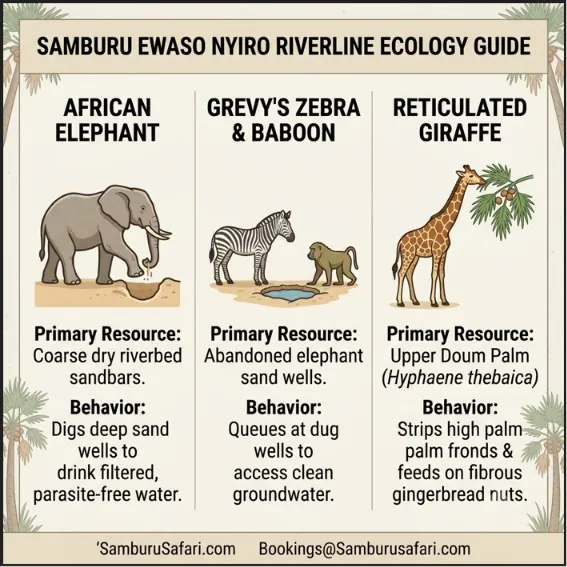
Even when brown surface water is running, elephants often ignore it. Watch a family gather on a dry sandbar and start digging with front feet and trunks, sinking holes deep into the coarse sand.
They do it because surface water is warm and thick with volcanic mud. Water pulled from two feet under the sand comes up filtered, cool, and parasite-free. Once the herd has drunk and moved off, baboons, warthogs, and hornbills queue up at the same wells. The Grevy’s zebra mares dig their own version further out in the dry luggas, for exactly the same reason.
The Save the Elephants research team has tracked this river-dependent movement by GPS collar since 1997, and their data shows how tightly the herds hold to this corridor through the dry months.
Both banks are lined with branching Doum palms (Hyphaene thebaica). Elephants headbutt and shake the thick trunks to bring down heavy orange-brown palm nuts, and the fibrous husk tastes surprisingly like gingerbread. The reticulated giraffe herds work the same groves from above, stripping the upper canopy nothing else can reach.
After bathing, elephants and warthogs coat themselves in wet reddish clay. It bakes dry in the sun, turns their skin terracotta, and works as armour against UV and biting flies.
“How elephants dig sand wells in Ewaso Nyiro” / “Ewaso Nyiro riverline animals”
The Ewaso Nyiro River corridor functions as the primary ecological lifeline for Samburu’s wildlife, driving unique foraging strategies and multi-species interactions along its banks. From elephants excavating underground filtration wells to reticulated giraffes reaching the canopy of Doum palms, each species utilizes specific riverline resources to survive northern Kenya’s dry spells. Local tracking teams rely on these ecological micro-habitats to locate specialized riverline wildlife. Use this field reference guide to understand how target species exploit the river ecosystem.
Target Riverline Species | Primary River Resource / Micro-Habitat | Specialized Foraging & Survival Behavior |
African Elephant | Coarse dry riverbed sandbars | Digs deep sand wells to drink filtered, parasite-free water |
Grevy’s Zebra & Baboon | Abandoned elephant sand wells | Queues at dug wells to access clean groundwater |
Reticulated Giraffe | Upper Doum Palm (Hyphaene thebaica) canopy | Strips high palm fronds and feeds on fibrous gingerbread-tasting nuts |
In Maa, Ewaso Ng’iro means “river of brown water.” Heavy volcanic silt turns it chocolate-thick, and underwater visibility drops to zero about two inches down.
That mud gives Nile crocodiles — some over 15 feet — complete cover. In low-water months they lie motionless in ten inches of shallows near the fords, entirely invisible to the impalas and baboons stepping down to drink.
The river forms the official border between Samburu on the north bank and Buffalo Springs on the south. Wildlife ignores the paperwork. At dawn, resident lion prides wade the shallow sandbars to hunt buffalo watering on the southern side, and the whole channel functions as a hunting corridor for the big cats of Samburu rather than a barrier.
Stop the vehicle near a river bend and listen to the upper palm canopy. The sharp “hek-k-k” alarm bark of olive baboons means a leopard is working the bank below. At dusk, between 6:15 PM and 6:45 PM, thousands of Lichtenstein’s and Black-faced Sandgrouse drop to the water’s edge to soak their belly feathers and carry water back to chicks miles away — one of the best sightings on a river list that runs to 450-plus recorded bird species.
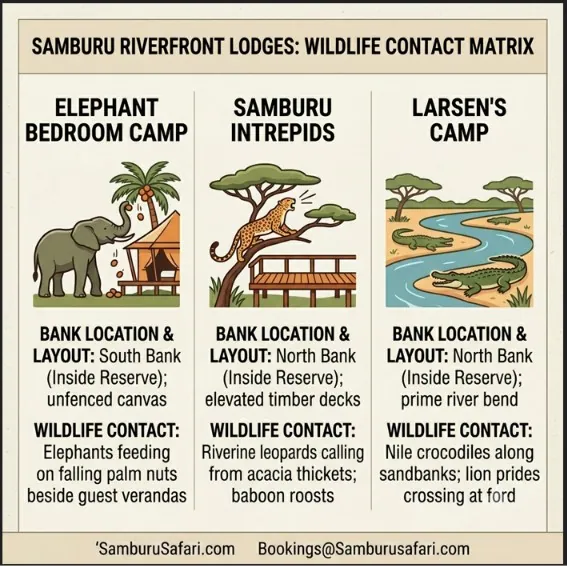
The riverfront properties — Elephant Bedroom Camp, Larsen’s Camp, Samburu Intrepids — sit directly on the bank with no perimeter fence. That open layout is deliberate. It lets wildlife move between the scrub and the water the way it always has.
At night, elephants walk the soft sand paths between guest tents to drink or feed on fallen palm nuts. Waking at 2:00 AM to the thud of an elephant headbutting a palm outside your canvas wall is a normal night here, as is the sound of a trunk working along the timber veranda. Escorts walk guests to their tents after dark for good reason.
Most of that after-dark movement happens where you cannot legally follow it inside the reserve. A night game drive on neighbouring conservancy land is the only way to watch it properly, with red-filter spotlights and a trained spotter.
“Best riverfront lodges Ewaso Nyiro Samburu” / “Unfenced river camps in Samburu”
Selecting a luxury tented camp situated directly on the banks of the Ewaso Nyiro River provides an immersive wilderness experience where wildlife moves freely through camp grounds. Because these premier properties operate without perimeter fences, animals naturally navigate the river paths to drink, forage, and cross between reserves at night. Each riverfront property offers distinct vantage points, accessibility, and nocturnal wildlife encounters. Review the matrix below to compare the riverfront layout, location benefits, and typical night visitors across top camps.
Riverfront Property | Bank Location & Layout | Common Night Visitors & Contact Dynamics |
Elephant Bedroom Camp | South Bank (Inside Reserve); unfenced canvas | Elephants feeding on falling palm nuts beside guest verandas |
Samburu Intrepids | North Bank (Inside Reserve); elevated timber decks | Riverine leopards calling from acacia thickets; baboon roosts |
Larsen’s Camp | North Bank (Inside Reserve); prime river bend | Nile crocodiles along sandbanks; lion prides crossing at ford |
The most common mistake we see is parking on a dry sandbar inside the river channel for a picnic lunch. It looks like solid ground. A rise upstream can trap a vehicle in heavy mud within minutes, and the water arriving with it does not announce itself.
Benson put it plainly on a river loop last dry season: if you can see sand, assume water has been there and will be again. We ate lunch on the high bank.
For anyone wanting to work the riverine forest at ground level rather than from a seat, a guided walking safari with an armed ranger runs in the bordering conservancies — and the trackers will show you crocodile slide marks you would drive straight past.
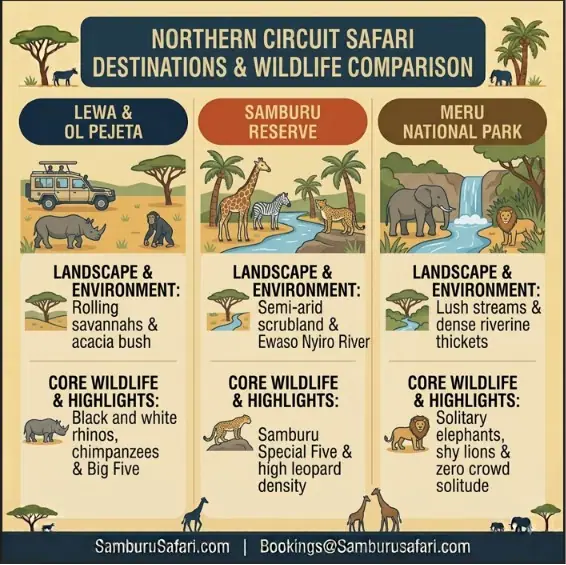
At Samburusafari.com, we build multi-destination itineraries that pair Samburu’s river circuits with neighbouring reserves like Ol Pejeta, so you can track riverline game up north before heading south for black rhinos and chimpanzees.
Every trip below rolls permits, vehicle, guide, and lodging into one fixed price, with the full range under our Samburu safari packages. If the trip is still taking shape, start with the master Samburu safari guide.
The pricing table details our 2027 multi-destination packages for two adults sharing a private 4×4 Safari Land Cruiser.
Package | Trip & Lodges | Price Per Person |
Budget Overland Tier | 4D/3N road safari • Samburu Riverside Camp + Comfort Gardens Ol Pejeta • Private cruiser, driver-guide, full board | $1,480 — Get a quote |
Mid-Range Overland Tier | 4D/3N classic circuit • Samburu Simba Lodge + Sweetwaters Tented Camp • Waterhole views, rhino tracking, extended drives | $1,820 — Price this trip |
Luxury Fly-In Tier | 4D/3N premium air package • Elephant Bedroom Camp + Sanctuary Tambarare • Roundtrip bush flights, riverfront tents | $3,250 — Check dates |
Luxury Plus Sky Circuit | 4D/3N luxury flight loop • Sasaab Lodge + Ol Pejeta Bush Camp • All bush flights, open-front suites, night drives | $6,120 — Build my itinerary |
It flows from Mount Kenya and the Aberdare Range through northern Kenya and ends in the Lorian Swamp, where the water evaporates into desert sand rather than reaching the ocean.
No. Swimming is extremely dangerous — high Nile crocodile numbers, submerged rocks, unpredictable currents, and the ever-present risk of a flash flood arriving from upstream.
The main riverfront properties are Elephant Bedroom Camp, Larsen’s Camp, Samburu Intrepids, and Samburu Riverside Camp — all unfenced, all with wildlife moving through at night.
River level notes and crossing hazards logged on the Samburu and Buffalo Springs banks by our guides. Last updated July 2026.
Message us directly for custom itineraries and the latest seasonal offers.