
Quick Answer: A walking safari in Samburu takes place in private community conservancies (such as Kalama, Westgate, and Sasaab) surrounding Samburu National Reserve. Led by armed rangers and Samburu Moran trackers, these 2-to-3-hour foot treks focus on wildlife tracking, ethnobotany, bush safety, and navigating dry riverbeds (luggas).
Written by Gerard Murero. Reviewed by Benson Kungu.
Stepping out of a Land Cruiser onto red silt changes everything. Senses sharpen. Sweat trickles under daypack straps, dried acacia pods crunch under boot soles, and every breeze suddenly matters.
Inside Samburu National Reserve proper, you cannot walk. County regulations forbid foot safaris inside the main gates, for the obvious reason that thick scrub and big game are a bad mix on foot.
So a legal walking safari heads into the community conservancies under the Northern Rangelands Trust. Kalama, Westgate, and Sasaab share unfenced borders with the reserve — the same wildlife you watched along the Ewaso Nyiro River by day crosses those boundaries freely — but conservancy rules allow trained teams to guide you through it on foot. If the wider trip is still unplanned, the master Samburu safari guide covers routes, seasons, and lodges around it.
Aspect | 4×4 Game Drive | Guided Walking Safari |
Primary Focus | Predators, large herds, covering big distance | Micro-ecosystems, tracks, plants, dung, animal behaviour |
Location | Inside Samburu National Reserve & conservancies | Exclusively in community conservancies (Kalama, Westgate, Sasaab) |
Pace & Distance | 20–40 km per drive in vehicle | 3–7 km slow-paced foot trek over 2–3 hours |
Sensation | Passive viewing from an elevated seat | High-sensory, active tracking at ground level |
Walking follows an early schedule, before the heat builds:
Walking in lion country demands total team discipline. Every trek runs with a two-person security escort.
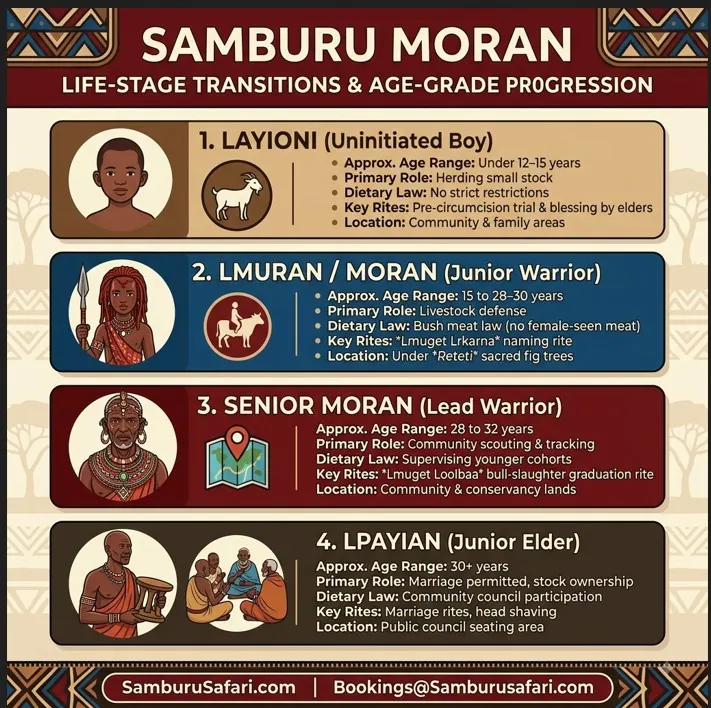
An armed ranger with a bolt-action rifle leads. Behind him walks a Samburu Moran carrying a spear and a wooden club (rungu). Guests move single-file, three to five meters apart.
Silence does the rest. If the tracker cuts fresh lion sign or hears a low growl in thick scrub, he raises a flat palm and everyone freezes. Two soft taps of the rungu against the ranger’s rifle stock is the stop signal. You learn that click fast.
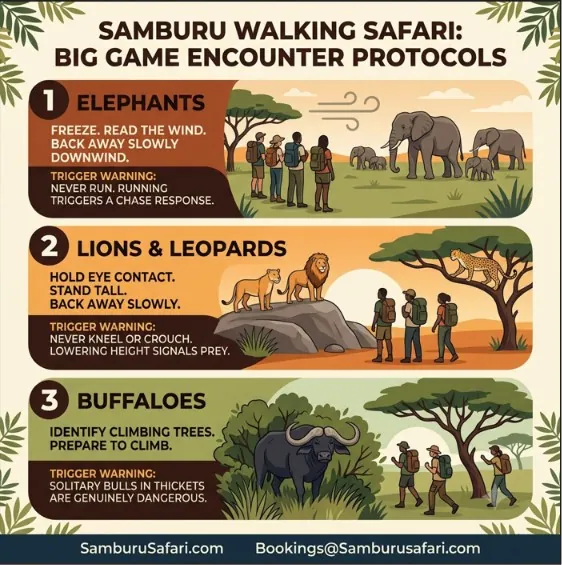
Bump into big game on foot and the protocols are physical and non-negotiable:
Stand still. Never run from an elephant. Ever — running triggers a chase response. Read the wind, avoid sudden movement, back away slowly downwind.
Hold eye contact and back away slowly. Stand tall, group together. Never kneel or crouch for a photograph; lowering your height makes you prey-shaped. The big cats of Samburu you photograph casually from a vehicle read you very differently at ground level.
Solitary bulls in thickets are the genuine danger. Guides pre-identify climbing trees — sturdy Acacia tortilis trunks — along every route.
“What to do if you encounter a lion on foot in Samburu” / “Samburu walking safari safety rules”
Encountering big game on foot requires immediate discipline, calm control, and an understanding of animal psychology at ground level. Unlike vehicle safaris where animals view the 4×4 as a non-threatening single unit, walking on foot places you directly into the food chain. Guided walks are strictly led by armed rangers and Samburu Moran trackers trained to de-escalate close wildlife encounters. The table below outlines the exact physical protocols and reaction guidelines for meeting major wildlife species on foot.
Target Big Game | Essential Human Reaction Protocol | Immediate Danger & Trigger Warning |
Elephants | Freeze instantly, check wind direction, back away downwind | Never run; running triggers an immediate chase response |
Lions & Leopards | Maintain eye contact, stand tall as a group, back away slowly | Never crouch or kneel for photos; lowering height signals prey |
Buffaloes | Back away silently; prepare to climb pre-identified acacia trees | Solitary bulls in dense riverine thickets are highly aggressive |
Walking at 6:15 AM, we check the wind constantly. Every hundred yards the guide crushes dry elephant dung into powder and drops it from an open hand. If the dust drifts toward a herd, we pivot 90 degrees and stay downwind.
Trackers read passage time from dung. Push a finger into a fresh ball: warm and steamy means that elephant passed twenty minutes ago. Dung beetles already tunneling through the centre means the herd moved down the lugga hours back. The Save the Elephants research team reads the same movements from collar data; the trackers just do it with their hands.
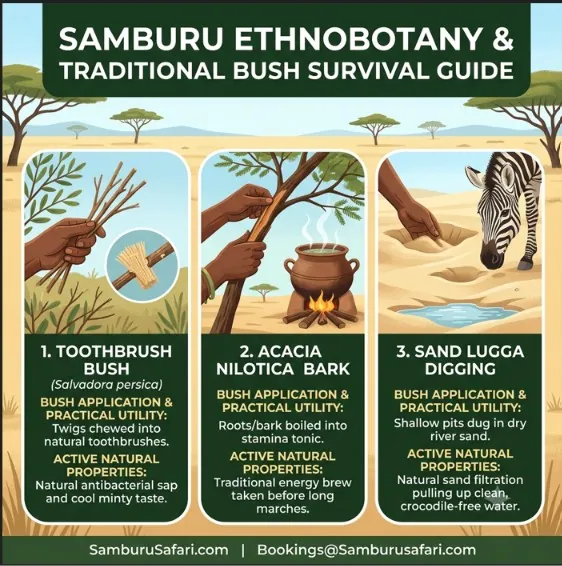
Along dry sand washouts like Nderoi Lugga, trackers share traditional Samburu plant uses:
Crossing dry sand beds, guides show how herders dig shallow pits to pull up clean water filtered by the sand — the same trick Grevy’s zebra mares use with their hooves, and it keeps you off the muddy banks where crocodiles wait.
“Traditional bush medicine Samburu walking safari” / “Samburu bush craft and tracking plants”
Beyond big game tracking, a walking safari in Samburu offers a rare look into traditional Samburu ethnobotany and survival skills. For centuries, local pastoralist communities have relied on arid flora and dry riverbed hydrology for medicine, hygiene, and clean water. Local Moran trackers pass down this knowledge during morning foot treks along sand washouts like Nderoi Lugga. Use this quick field reference guide to recognize the primary medicinal plants and bushcraft techniques used on foot in Samburu.
Traditional Plant / Element | Bush Application & Practical Utility | Active Natural Properties |
Toothbrush Bush (Salvadora persica) | Twigs chewed into natural toothbrushes | Natural antibacterial sap and cool minty taste |
Acacia nilotica Bark | Roots/bark boiled into stamina tonic | Traditional energy brew taken before long marches |
Sand Lugga Digging | Shallow pits dug in dry river sand | Natural sand filtration pulling up clean, crocodile-free water |
Camel-assisted walking safaris in Westgate and Sasaab open up multi-day treks. Camels led by Samburu herders carry the mobile camp, water bladders, and bush kitchen while you walk with a light daypack.
Anyone wanting a steeper physical challenge can take a guided ascent up the granite trails of Mount Ololokwe (Ol Donyo Sabachi), Samburu’s sacred table mountain. The summit forest opens onto the whole northern frontier.
The same conservancy ground works twice over. What you track on foot at dawn moves again after dark, and a night game drive with red-filter spotlights is the only legal way to follow it once the sun goes down.
On foot you also start noticing what the vehicle drives past — the 450-plus recorded bird species working the thickets at eye level, and the browse lines where a gerenuk has stripped a bush clean in a neat band between one and two meters up.
“Best time for walking safari in Samburu” / “Samburu walking safari weather conditions”
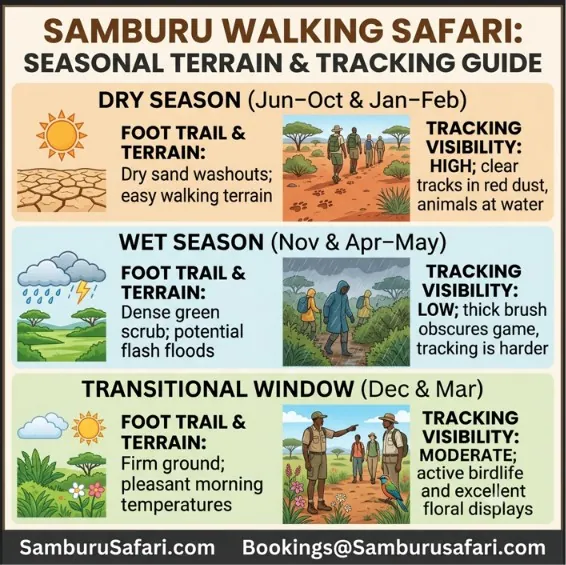
Seasonal shifts in northern Kenya directly influence visibility, ground temperatures, and wildlife tracking feasibility during a foot safari. While the dry months offer crisp footprint visibility and easy navigation along dry luggas, the wet seasons transform the landscape into dense scrub that alters animal behavior. Planning your trek around these seasonal conditions ensures optimal tracking success and comfortable walking temperatures. Review the matrix below to compare field conditions across Samburu’s primary travel seasons.
Travel Season & Months | Foot Trail & Terrain Conditions | Tracking Visibility & Wildlife Movement |
Dry Season (Jun–Oct & Jan–Feb) | Dry sand washouts; easy walking terrain | High visibility; clear tracks in red dust, animals at water |
Wet Season (Nov & Apr–May) | Dense green scrub; potential flash floods | Low visibility; thick brush obscures game, tracking is harder |
Transitional Window (Dec & Mar) | Firm ground; pleasant morning temperatures | Moderate visibility; active birdlife and excellent floral displays |
Real bush walking comes with genuine friction and rules worth knowing before you book.
Heat builds fast — past 30°C (86°F) by 8:30 AM. Carry water and sunscreen. The northern scrub is packed with Acacia reficiens red thorn, which punctures sneakers in minutes. Sturdy leather boots with thick soles and long trousers, not optional.
Guests sometimes expect to walk up close to lions. That does not happen. On foot, animals see or smell you from a long way off and move into cover, so the walk is about tracking, flora, and insect life rather than predator sightings. The daylight Samburu Special 5 are still better found from a vehicle.
Last July we took a wrong turn down a side branch of the lugga and backtracked twenty minutes through wait-a-bit thorns after the heat spiked earlier than expected. Scratched forearms, empty water bottle, foul mood. Then hot tea on cold granite at the finish, and every scratch was worth it.
We design itineraries pairing Samburu’s community conservancies with Ol Pejeta, so you can explore on foot up north before heading south for vehicle-based rhino tracking.
Every trip below rolls permits, vehicle, guide, and lodging into one fixed price, with the full range under our Samburu safari packages.
The table details 2027 multi-destination packages for two adults sharing a private 4×4 Safari Land Cruiser.
Package | Trip & Properties | Price Per Person |
Budget Conservancy Tier | 4D/3N overland safari • Comfort Gardens Ol Pejeta • Private cruiser, driver-guide, 1 guided morning walk in the Kalama corridor | $1,540 — Get a quote |
Mid-Range Conservancy Tier | 4D/3N classic road safari • Samburu Simba Lodge + Sweetwaters Tented Camp • Rhino tracking, waterhole viewing, bush walk with armed ranger in Westgate | $1,980 — Price this trip |
Luxury Fly-In Tier | 4D/3N premium air package • Saruni Samburu (Kalama) + Elsa’s Kopje (Meru) • Roundtrip bush flights, daily guided walks and kopje breakfasts | $3,650 — Check dates |
Luxury Plus Sky Circuit | 5D/4N luxury flight loop • Sasaab Lodge (Westgate) + Lewa Safari Camp • All regional flights and conservancy permits, multi-day camel-assisted mobile walk options | $6,420 — Build my itinerary |
Walking without a certified armed escort is illegal, whatever your daytime driving arrangements are. There is no independent version of this one — every foot trek runs with a ranger and a Moran tracker.
Boots first, everything else second. Sneakers do not survive northern thorn.
No. Foot safaris are prohibited inside the main gates for safety reasons. Guided walks take place in the neighbouring community conservancies — Kalama, Westgate, and Sasaab.
Two to three hours, covering three to seven kilometres at a slow pace in the early morning.
Most community conservancies set a minimum of 12 years, given the safety rules near big game.
Yes. Sturdy leather hiking boots with thick rubber soles, to resist two-inch acacia thorns and volcanic rock.
Yes. Every walk is accompanied by an armed ranger and an experienced Samburu Moran tracker who reads animal behaviour and enforces the safety rules.
Route notes and encounter protocols logged on the Kalama and Westgate walking trails by our rangers. Last updated July 2026.
Message us directly for custom itineraries and the latest seasonal offers.