
Quick Answer: Tracking big cats samburu populations—including lions, leopards, and cheetahs—requires understanding specialized desert hunting techniques along the Ewaso Nyiro River. From leopards stashing kills inside Doum palm fronds and lions resting on low acacia branches to cheetahs using red termite mounds as scanning perches, these predators have adapted uniquely to northern Kenya’s dry scrubland.
Written by Gerard Murero. Reviewed by Benson Kungu.
Field Spec | Samburu Big Cat Field Profile |
Primary Predators | Lion (Panthera leo), Leopard (Panthera pardus), Cheetah (Acinonyx jubatus) |
Top Leopard Hotspots | Doum palm groves along Ewaso Nyiro, Nderoi Lugga sandbanks |
Top Lion Hotspots | Lower Koitogor Hill acacia branches, Westgate boundary washouts |
Top Cheetah Hotspots | Central Airstrip gravel flats, open termite-mound plains |
Key Tracking Signal | Olive baboon “hek-k-k” alarm bark echoing near river crossings |
Best Viewing Window | 06:15 AM – 08:30 AM & 04:30 PM – 06:30 PM |
Travelers constantly compare northern Kenya against the southern plains when planning predator safaris. The comparison table below highlights key operational differences:
Category | Samburu National Reserve | Masai Mara National Reserve |
Pride Sizes | Small, fluid groups (2–4 lions) | Massive prides (10–20+ lions) |
Leopard Sightings | High density along Doum palm riverbanks | High density in riverine forests & valleys |
Cheetah Hunting Ground | Open volcanic gravel flats & termite mounds | Endless rolling grass savannas |
Safari Crowds | Low vehicle density; intimate sightings | High vehicle density near major kills |
Unique Cat Behavior | Lions resting in trees to avoid ground heat | Lions resting in open shade under bushes |
When the engine stops near the riverbanks at first light, the air smells of cold red dust and dry river silt. Then you start scanning, and you learn how little you actually see at first. A leopard can rest ten feet above your vehicle in a palm tree, hidden behind heavy fronds, while you stare straight through the branches and miss it entirely.
Finding cats here is different from the southern savanna parks. Prey is scattered thin across dry scrubland, so the predators have rewritten the rules to match. If the whole trip is still on the drawing board, the master Samburu safari guide sets out the routes, seasons, and lodges these sightings hang on.
Down in the Masai Mara, you often see large prides of fifteen to twenty lions resting together on open grass. Samburu lions do the opposite. They operate in small, flexible hunting units of two to four animals, splitting up during dry months to patrol riverline thickets and seasonal washouts, then reuniting only when there is bigger game to bring down. It is the same lean, adaptive strategy that defines the whole Samburu Special 5 — everything up here is built around scarcity.
Local Samburu pastoralists hold a deep respect for lions. Trackers still talk about Kamunyak, a resident lioness who made international news in the early 2000s by adopting and protecting a series of Beisa oryx calves — an oryx being the last animal you would expect a lion to mother. Her story hardened an existing tradition among Samburu warriors (Morans) of protecting resident lionesses along the conservancy boundaries.
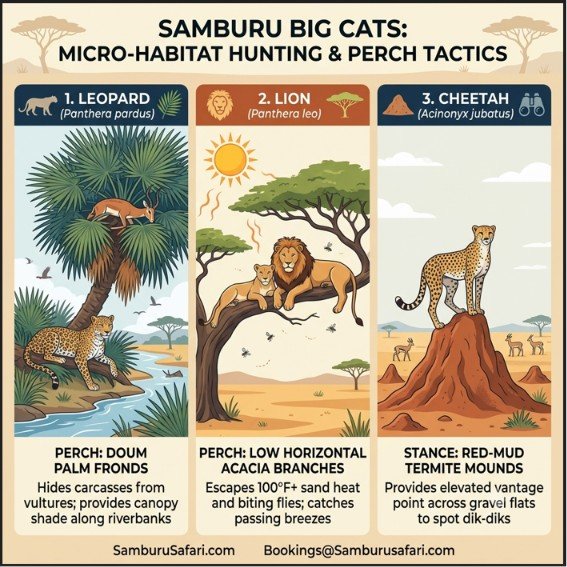
Each predator uses specific terrain features across the reserve to hunt and shelter from the heat.
Leopards in Samburu show two habits you rarely see elsewhere:
When searching for riverline leopards near the Old Samburu Lodge crossing, stop the vehicle and cut the ignition. Listen. The sharp, explosive “hek-k-k” alarm bark of olive baboons is your best early warning — baboons roosting high in the palm fronds spot a moving leopard long before any guide picks it out from the track. Those same baboons are one entry on a bird-and-mammal list running past 450 recorded species.
Between 11:00 AM and 3:00 PM, when the ground sand gets hot enough to burn your palm, lions near the base of Koitogor Hill climb onto the low, horizontal branches of Acacia tortilis trees. Six to ten feet up, they catch passing breezes and escape the biting flies breeding in the warm sand below.
Without tall grass for cover, cheetahs hunting near Central Airstrip rely on tall, red-mud termite mounds as observation perches. They climb these mounds to scan for dik-diks and gerenuk fawns before launching explosive sprints across the open volcanic gravel.
Local scouts from Westgate Conservancy monitor resident cats using whisker-spot patterns and track dimensions along the dry sand washouts. I was tracking with Benson near the Old Samburu crossing one morning when he read a fresh leopard print at 6:15 sharp and called it: she would be up a palm within the hour. She was. His rule holds — check the sand washouts at first light, before the cats climb into the canopies and vanish for the day.
“How do lions leopards and cheetahs hunt in Samburu” / “Samburu big cat tree climbing habits”
Desert big cats in Samburu adapt their hunting stances and resting positions to counter intense ground heat and sparse cover. From leopards stashing prey inside Doum palm fronds to lions climbing acacias and cheetahs utilizing termite mounds, each species leverages specific terrain features to maximize hunting success. The table below details these micro-habitat perches and their distinct survival advantages. Use this reference on game drives to scan the landscape effectively.
Big Cat Species | Micro-Habitat Perch / Stance | Hunting & Thermal Advantage |
Leopard | Doum palm (Hyphaene thebaica) fronds | Hides carcasses from vultures; provides canopy shade along riverbanks |
Lion | Low horizontal Acacia tortilis branches | Escapes 100°F+ sand heat and biting flies; catches passing breezes |
Cheetah | Red-mud termite mounds | Provides elevated vantage point across gravel flats to spot dik-diks |
Big cats treat the Ewaso Nyiro River as a corridor, not a border. Samburu’s northern bank offers dense riverine cover for leopards in the Doum palms, but crossing the bridge into Buffalo Springs opens up different hunting ground entirely:
“How to track lions and leopards in Samburu” / “Samburu big cat tracking signals”
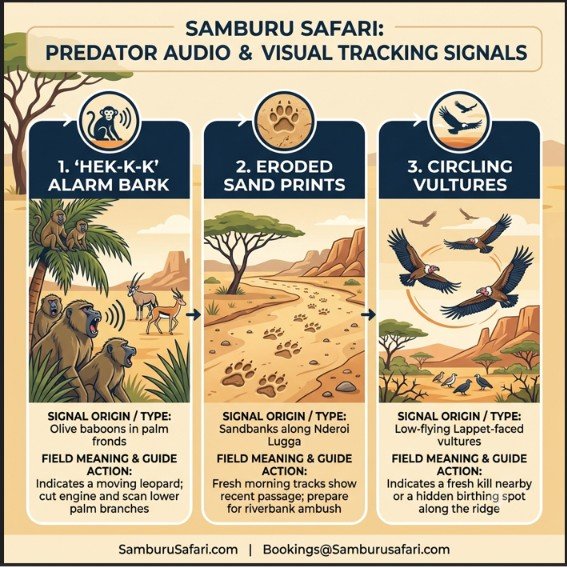
Tracking elusive big cats across Samburu’s dry scrubland relies heavily on reading indirect environmental indicators rather than direct sightings alone. Baboon alarm barks, fresh footprint trails in dry luggas, and scavenger flight patterns signal predator presence long before a cat is visually confirmed. Recognizing these field cues allows safari trackers to position vehicles strategically along active corridors. This quick reference guide breaks down key audio and visual signals used by expert tracking guides.
Tracking Signal | Signal Origin / Type | Field Meaning & Guide Action |
“Hek-k-k” Alarm Bark | Olive baboons in palm fronds | Indicates a moving leopard; cut engine and scan lower palm branches |
Eroded Sand Prints | Sandbanks along Nderoi Lugga | Fresh morning tracks show recent passage; prepare for riverbank ambush |
Circling Vultures | Low-flying Lappet-faced vultures | Indicates a fresh kill nearby or a hidden birthing spot along the ridge |
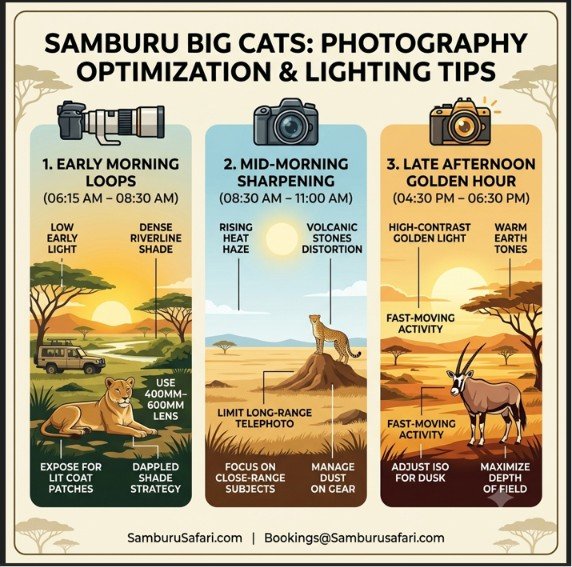
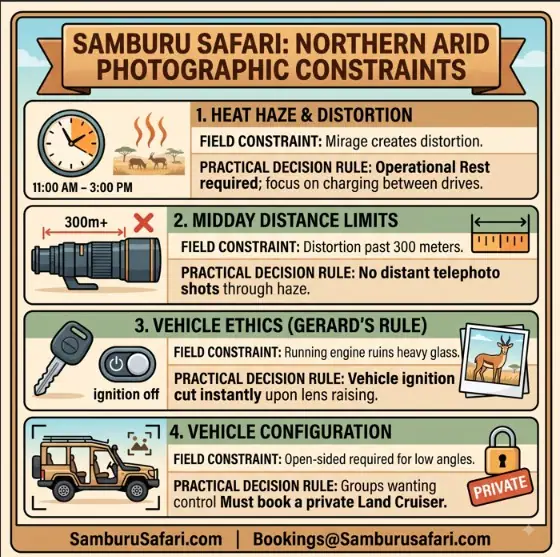
Photographing cats here throws up lighting and distance problems you do not get in the south:
“How to photograph big cats in Samburu” / “Samburu wildlife photography lens heat haze tips”
Capturing high-quality big cat images in northern Kenya presents distinct challenges, including heavy ground heat distortion, harsh sunlight, and dense palm canopy shade. Adjusting camera settings and lens choices according to time-of-day light windows is essential for sharp, well-exposed shots. The table below provides technical guidelines for managing heat haze, contrast, and telephoto reach across Samburu’s varied environments. Use these field parameters to configure gear before heading out on early morning loops.
Lighting Window | Environmental Challenge | Recommended Gear & Exposure Protocol |
06:15 AM – 08:30 AM | Low early light; dense riverline shade | Use 400mm–600mm lens; expose for lit coat patches on dappled shade |
08:30 AM – 11:00 AM | Rising heat haze off volcanic stones | Limit long-range telephoto shots; focus on close-range track subjects |
04:30 PM – 06:30 PM | High-contrast golden hour light | Balance warm earth tones; adjust ISO for fast-moving dusk activity |
Many of the best lodges in Samburu sit right on the riverbank with no perimeter fence. Knowing how the cats move after dark is what keeps your stay safe.
At riverfront properties like Elephant Bedroom Camp, Samburu Intrepids, and Larsen’s Camp, big cats use the soft-sand guest pathways as quiet hunting routes between 10:00 PM and 3:00 AM, walking between the tents while stalking baboons roosting overhead. That is exactly why escorts walk you to and from your tent at night — take it seriously. Seeing that behavior on purpose, rather than by accident on the way to bed, is the whole appeal of a conservancy night game drive, where spotlighting after dark is actually legal.
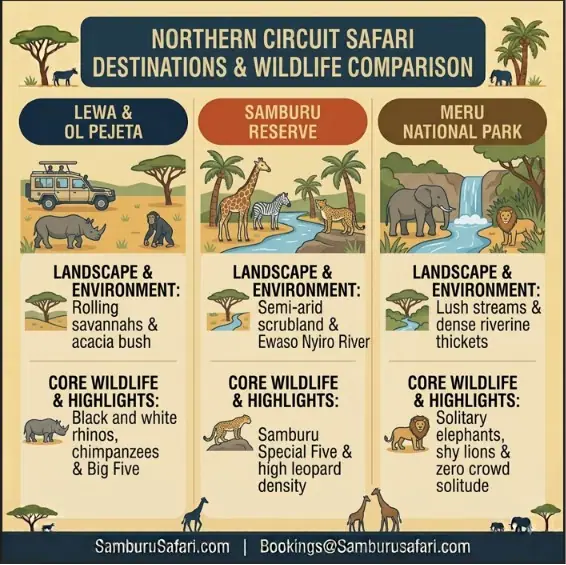
We build multi-destination itineraries pairing Samburu’s river circuits with neighboring Ol Pejeta Conservancy so you can track big cats up north before traveling south to see black rhinos and chimpanzees.
Every trip below rolls gate tickets, vehicle, guide, and lodging into one fixed price, with the full range under our Samburu safari packages.
The pricing table details our 2027 multi-destination packages for two adults sharing a private 4×4 Safari Land Cruiser.
Package | Trip & Lodges | Price Per Person |
Budget Overland Tier | 4D/3N road safari • Samburu Riverside Camp + Comfort Gardens Ol Pejeta • Private cruiser, driver-guide, full board | $1,480 — Get a quote |
Mid-Range Overland Tier | 4D/3N classic circuit • Samburu Simba Lodge + Sweetwaters Tented Camp • Waterhole views, rhino tracking, extended drives | $1,820 — Price this trip |
Luxury Fly-In Tier | 4D/3N premium air package • Elephant Bedroom Camp + Sanctuary Tambarare • Roundtrip bush flights, riverfront tents | $3,250 — Check dates |
Luxury Plus Sky Circuit | 4D/3N luxury flight loop • Sasaab Lodge + Ol Pejeta Bush Camp • All bush flights, open-front suites, night drives | $6,120 — Build my itinerary |
Leopards are solitary and secretive, so a sighting takes patience and a fair bit of luck. Samburu holds one of Kenya’s highest leopard densities along the Ewaso Nyiro, but the dense riverline vegetation means you can spend hours scanning empty branches. Early-morning drives along the river tracks give you the best odds.
By 9:30 AM, heat radiating off volcanic gravel creates thick distortion that softens telephoto shots, and dust from the unpaved tracks coats gear fast. Keep lenses bagged between sightings.
No. Leaving the marked tracks to follow cats is illegal and carries heavy county fines, and it wrecks the very habitat the sightings depend on. Stay on the track and let the cat come to you.
Lions, leopards, and cheetahs. Leopards work the Ewaso Nyiro riverine forest, lions patrol the river loops and rocky hills, and cheetahs hunt the open gravel plains near Central Airstrip.
They are easiest to track in the dry season (July to October, January to March), when water shortages pull prey toward the Ewaso Nyiro and the predators follow them to the riverline tracks daily.
Yes. Unfenced riverfront camps sit directly in wildlife corridors, and leopards and lions occasionally pad along the pathways after dark. Escorts walk guests between tents for exactly this reason.
Cat sightings and track reads logged on the riverline and Koitogor loops by our guides. Last updated August 2026.
Message us directly for custom itineraries and the latest seasonal offers.