
Quick Answer: The reticulated giraffe samburu population represents one of Africa’s most striking ungulate species, instantly recognizable by its dark liver-red geometric polygons framed by crisp white lines. Primarily inhabiting the riverine forests and acacia scrub along the Ewaso Nyiro River, these giants display specialized desert survival behaviors, from drinking in guarded groups to harvesting dry acacia pods in extreme heat.
Written by Gerard Murero. Reviewed by Benson Kungu.
Field Metric | Reticulated Giraffe (G. reticulata) Spec |
Samburu Population | ~1,500 – 2,000 individuals (Primary Kenyan stronghold) |
IUCN Status | Endangered |
Key Physical ID | Dark liver-red polygons framed by sharp, continuous white grid lines |
Average Height / Weight | 14–19 ft (4.3–5.8 m) | 1,800–2,600 lbs |
Primary Samburu Habitats | Riverine acacia woodlands, Doum palm thickets along Ewaso Nyiro |
Best Sightings Window | 06:15 AM – 08:30 AM & 04:30 PM – 06:30 PM |
Crossing into northern Kenya brings you face-to-face with one of East Africa’s most distinctive large mammals. Watching a tall silhouette step quietly out from behind a Doum palm tree stays with you forever. If the giraffe is your reason for coming north but the trip itself is still a blank page, the master Samburu safari guide covers the routes, fees, and lodges around these sightings.
Local Samburu pastoralists refer to this giraffe as Kuri, while Swahili speakers often call it Twiga ya Mtandao for its net-like body pattern. Unlike the blotchy, irregular patches of southern Masai giraffes, the reticulated giraffe features sharp, dark liver-red geometric polygons separated by narrow white grid lines.
When observing herds along the riverbanks, you will notice distinct age-based color shading:
The species is a central member of the Samburu Special 5, a group of endemic northern animals built for dry scrublands. According to conservation monitoring by the Giraffe Conservation Foundation, northern Kenya remains the primary strong refuge for wild populations of reticulated giraffes.
Watching giraffes drink along the Ewaso Nyiro River takes time and steady eyes. Their build makes getting a drink surprisingly dangerous.
To reach surface water, an adult giraffe must splay its two-meter-long front legs wide apart to lower its head down to the riverbed. This posture causes rapid blood pressure shifts and leaves the animal defenseless for 30 to 45 seconds.
During early morning tracking between 6:30 AM and 7:30 AM near the Old Samburu Lodge river crossing, we frequently observe sentinel behavior. Dominant giraffes stand guard on elevated banks, carefully scanning the water for Nile crocodiles before allowing mothers and calves to lower their heads to drink. One false move sends the whole group running.
Near the Samburu Simba Lodge floodplain tracks, male giraffes engage in ritualized combat known as “necking.” Standing side-by-side, rival bulls swing their thick, muscular necks to slam their heavy ossicones into each other’s flanks. The deep thuds echo across the open clearings framed by Doum palms (Hyphaene thebaica). Visitors often mistake these intense territorial battles for gentle play, but a solid blow can knock a competing bull off balance.
Living in dry terrain means reticulated giraffes must adapt their feeding habits and rest schedules to survive intense heat and mineral shortages.
During dry months from July to October, giraffes shift from browsing upper green leaf canopies to harvesting dry seed pods (Acacia tortilis) dropped onto the red sand. Using a 45-centimeter, dark blue-black prehensile tongue coated in thick saliva, they sweep pods off thorny low branches. Standing nearby in the quiet midday heat, you can hear the distinct crunching sound of dry acacia pods being crushed in their jaws. While the giraffes strip the upper canopy, the gerenuk works the very same trees from below, standing upright on its hind legs — two browsers, one acacia, zero competition.
Soils in the northern scrubland lack essential minerals. Because of this, giraffes in Samburu regularly engage in osteophagia. Near Koitogor Hill, you can spot giraffes picking up weathered animal bones or gnawing on mineral-rich volcanic basalt stones to extract phosphorus and calcium needed to support their massive skeletal frames.
During peak 11:00 AM sun, the sharp white grid lines on a giraffe’s coat function as thermal and visual camouflage. When standing motionless inside dappled light under Doum palm fronds or Acacia elatior trees, the white lines break up their outline so completely that safari vehicles passing 15 meters away often miss them.
Red-billed and yellow-billed oxpeckers ride on their backs, cleaning ticks from the deep grooves around their ossicones. When predators move through the grass, these birds hiss loudly, alerting the giraffes long before cats come into view. The oxpeckers are just two entries on the reserve’s list of more than 450 recorded species — birdwatching in Samburu is a full trip on its own.
To avoid predator ambushes, adult giraffes sleep standing up for 70% of the night in brief 5-minute cycles. When they do settle down for deep REM sleep—rarely lasting more than 20 minutes before dawn—they curl their long necks back over their rumps on elevated gravel ridges near West Gate border tracks. Seeing any of this night behavior takes a night game drive in the bordering conservancies, since the public reserve locks its gates at 6:00 PM.
Along the Buffalo Springs boundary, giraffes gather around natural alkaline mineral licks, sharing the flats with territorial Grevy’s zebra stallions guarding their water turf. This high sodium intake allows the giraffes to go longer without visiting the river compared to giraffes in wetter southern parks.
If you want to photograph female giraffes with young calves, head to the acacia-scrub stretch extending from Koitogor Hill toward King’s Point Viewpoint. It is the same corridor where the Beisa oryx herds cross at first light.
Female giraffes form nursery herds along this flat corridor. One or two adult females stay behind to guard up to ten calves while other mothers trek down to the river to drink. I was out with Benson near Koitogor Hill last month when he pointed out that morning game drives between 6:15 AM and 8:30 AM give you the best light for their liver-red coats against golden grass — after that, the shimmer takes over and everything softens.
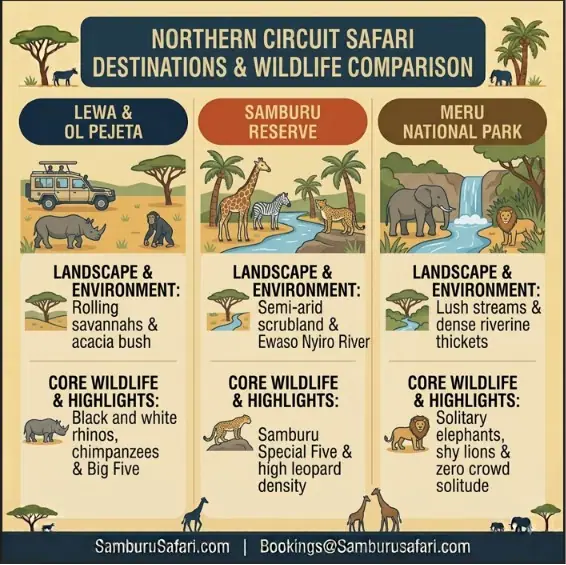
We organize multi-destination routes combining Samburu’s river circuits with neighboring Ol Pejeta Conservancy so you can track giraffes up north before heading south to see rhinos and chimpanzees.
Every trip below bundles gate tickets, vehicle, guide, and lodging into one fixed price. The complete range — including the custom photographic tour — sits under our Samburu safari packages.
The pricing table below outlines our primary multi-destination packages for 2027 travel dates, calculated for two adults sharing a private 4×4 Safari Land Cruiser.
Package | Trip & Lodges | Price Per Person |
Budget Overland Tier | 4D/3N road safari • Samburu Riverside Camp + Comfort Gardens Ol Pejeta • Private cruiser, driver-guide, full board | $1,480 — Get a quote |
Mid-Range Overland Tier | 4D/3N classic circuit • Samburu Simba Lodge + Sweetwaters Tented Camp • Waterhole views, rhino tracking, extended drives | $1,820 — Price this trip |
Luxury Fly-In Tier | 4D/3N premium air package • Elephant Bedroom Camp + Sanctuary Tambarare • Roundtrip bush flights, riverfront tents | $3,250 — Check dates |
Luxury Plus Sky Circuit | 4D/3N luxury flight loop • Sasaab Lodge + Ol Pejeta Bush Camp • All bush flights, open-front suites, night drives | $6,120 — Build my itinerary |
First-time visitors sometimes worry that dark-colored male giraffes are sick or covered in mud. In reality, rising testosterone levels cause the liver-red patches on dominant bulls to darken into deep mahogany or near-black as they mature. Darker coloration signals dominance to competing males.
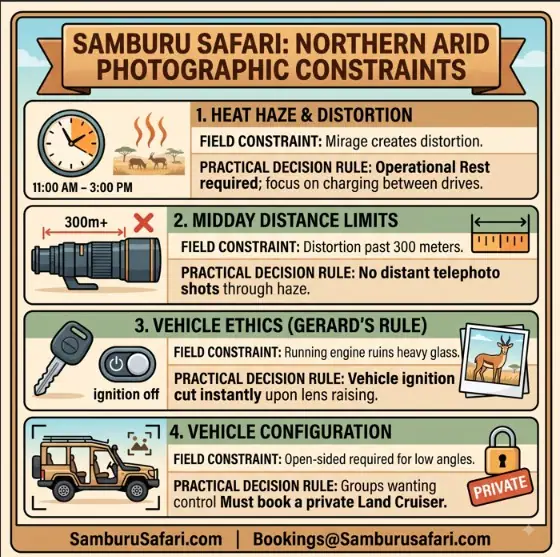
Giraffes are extremely cautious near water because lowering their heads makes them vulnerable to crocodiles and the big cats of Samburu. If a vehicle approaches too quickly or makes sudden engine noise, drinking groups will immediately retreat into the bushes without taking a drop. Keep your vehicle stationary and switch off the engine at least 100 meters back from river crossings.
Past 9:30 AM, intense heat radiating off volcanic gravel creates air shimmer that softens long telephoto lens shots. Plan your photography drives between 6:15 AM and 8:30 AM when the light is crisp and animals are actively moving across open ground.
The highest concentrations are found along the Ewaso Nyiro riverline tracks, in the Doum palm groves near Samburu Simba Lodge, and across the acacia scrub stretch between Koitogor Hill and King’s Point.
Reticulated giraffes feature sharp, dark liver-red geometric polygons separated by clean white lines. Masai giraffes, found in southern Kenya, have irregular, jagged, star-like patches surrounded by buff-brown background skin.
Yes, reticulated giraffes are listed as Endangered on the IUCN Red List due to habitat loss and historical poaching across East Africa. Protected reserves like Samburu play a vital role in their ongoing survival.
Sighting windows and hotspot notes logged on the Koitogor and riverline loops by our tracking guides. Last updated July 2026.
Message us directly for custom itineraries and the latest seasonal offers.