
Quick Answer: Taking a self drive samburu trip gives you total freedom to explore northern Kenya along Highway A2, but it requires serious 4×4 preparation. Navigating the unpaved sand tracks, rocky river drifts, and dry washouts inside Samburu National Reserve demands a high-clearance 4×4 Land Cruiser with two full-sized spare tires, tire pressure deflated to 18–20 PSI for deep sand, and offline landmark navigation.
Written by Gerard Murero. Reviewed by Angie Muthoni.
Driving yourself into northern Kenya is one of the great wilderness road trips in East Africa. The moment your wheels leave the paved A2 highway at Archer’s Post, the deep roar of your engine gives way to the sound of crunching sand and dry acacia branches scraping against the roof. Taking a self drive samburu safari lets you set your own schedule, but driving these remote tracks without a commercial guide requires real preparation. If you are still shaping the wider trip around the drive, our master Samburu safari guide covers the lodges, seasons, and wildlife waiting past the gate.
When you rent a vehicle or organize an overland journey through Samburusafari.com, our coordinator Angie Muthoni makes sure your 4×4 carries all required permits, recovery gear, and updated gate vouchers before you leave Nairobi. Out on the tracks, driving conditions shift quickly with the weather, so having the right gear inside your cab is critical.
Driving a light crossover SUV with low ground clearance or standard city street tires is a major mistake up north. Sharp volcanic basalt rocks along West Gate tracks easily slash tire sidewalls, and light rental SUVs often carry space-saver spares that leave drivers stranded in 98-degree heat. Northern terrain demands a heavy-duty, properly equipped 4×4 Land Cruiser.
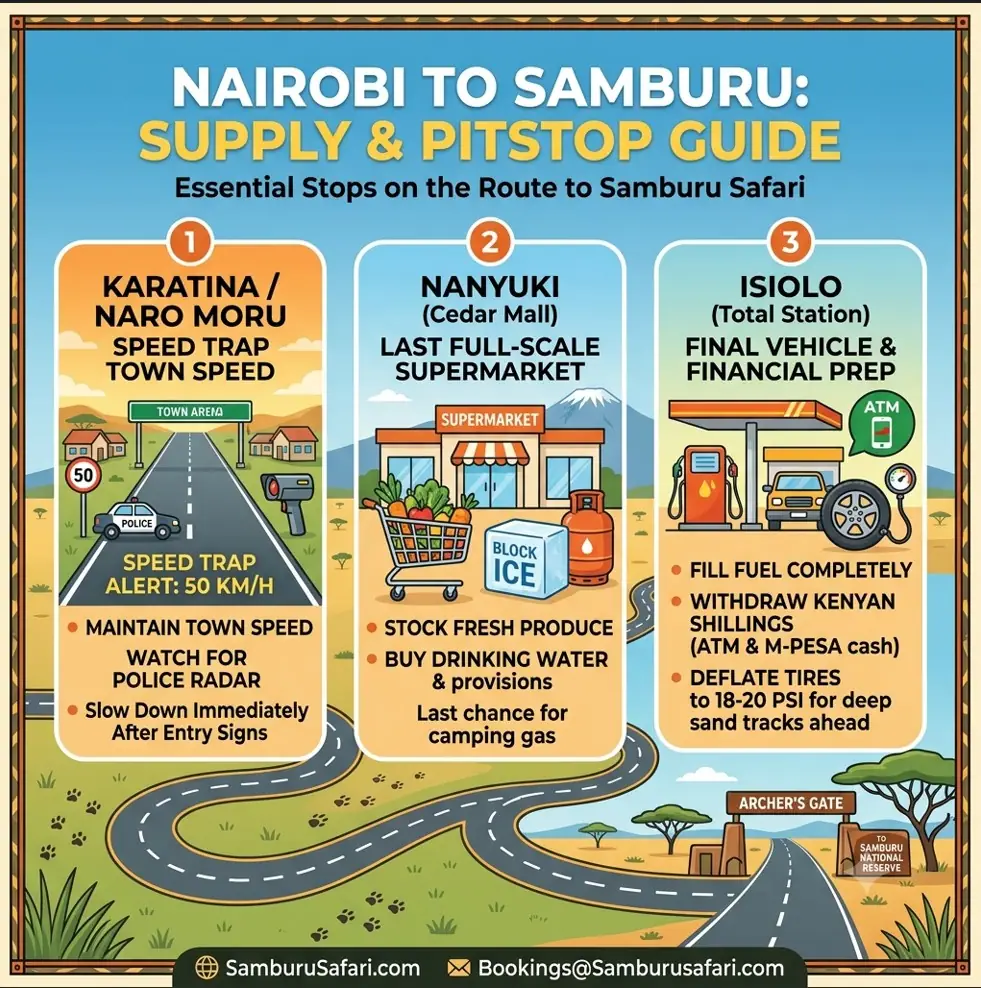
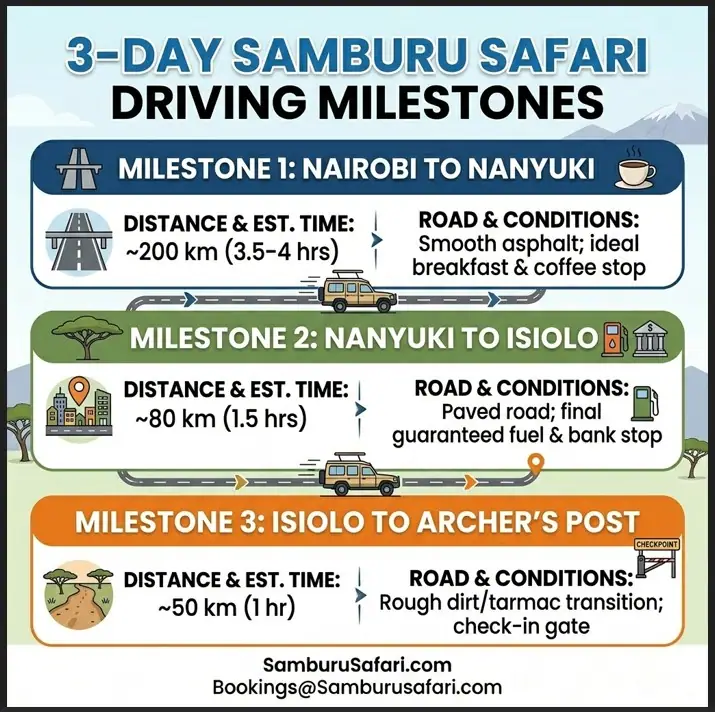
The route runs Nairobi → Thika Superhighway → Karatina → Nanyuki → Isiolo → Archer’s Post — roughly 310 kilometers taking 5.5 to 6.5 hours on paved tarmac. For the full stop-by-stop version with bypass shortcuts and coffee stops, read our dedicated guide on driving from Nairobi to Samburu; the notes below cover what matters most when you are behind the wheel yourself.
Driving the 310-kilometer stretch from Nairobi to Archer’s Post transitions quickly from modern dual-carriageways to remote northern frontier territory. Strategic stopping points ensure you lock in supplies, banking services, and fuel before local infrastructure thins out. Plan your drive around these three key waypoints to avoid logistical delays out on the trail.
Waypoint Stop | Primary Action | Driver Alert |
Karatina / Naro Moru | Highway Transit | 50 km/h radar speed traps operate past entry signs. |
Nanyuki (Cedar Mall) | Stock groceries, block ice, gas | Last full-scale supermarket before entering the reserve. |
Isiolo (Total Station) | Fill fuel, M-Pesa cash, deflate tires | Deflate tires to 18–20 PSI here before hitting sand tracks. |
If you do not own an expedition vehicle, Nairobi rental firms supply safari-ready 4x4s. Budget realistically:
Rental Vehicle Class | Typical Daily Rate | Best Suited For |
Toyota Hilux / Prado (Standard 4×4) | $130 – $180 USD/day | Dry-season trips on main reserve loops |
Land Cruiser 70-Series (Safari Spec, Rooftop Tent) | $200 – $280 USD/day | Camping trips, conservancy tracks, full independence |
Rental, fuel, and gate tickets stack up differently than a package price, so run your numbers through our guide on budgeting for Samburu before choosing between the two.
Standard city SUVs or 2WD saloon cars cannot handle the terrain inside the reserve. You need a dedicated high-clearance 4×4 Safari Land Cruiser or Hilux equipped for harsh wilderness tracks.
When driving the loops toward West Gate Conservancy or Kalama, the tracks switch from soft sand to sharp, jagged black volcanic basalt. These rocks do not poke small holes in your tread; they slice straight through tire sidewalls. Standard rubber plug repair kits cannot fix a slashed sidewall. Always make sure your rental vehicle carries two mounted, full-sized spare tires. Relying on a single spare leaves you completely vulnerable if you take a second puncture miles from camp.
Crossing dry, sandy riverbeds (luggas) tricks many first-time drivers into slamming on their brakes when tires begin to sink into fine river silt. Hitting the brakes or trying to shift gears mid-lugga buries a 3-ton Land Cruiser right down to its axles.
Stop at the Total station in Isiolo town to deflate your tire pressure from 35 PSI highway pressure down to 18–20 PSI. Once you reach a sandy lugga, shift into 4WD Low-Range, select 2nd gear, and maintain smooth, constant throttle momentum all the way across.
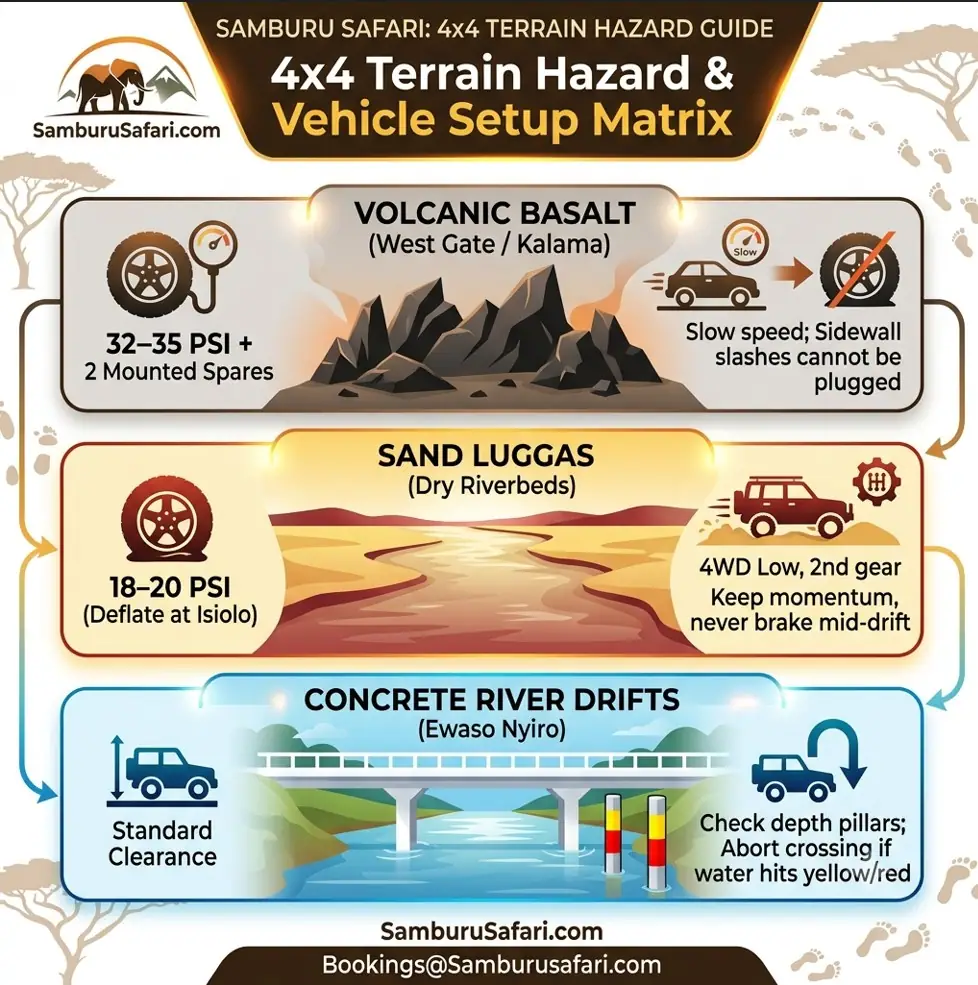
Navigating Samburu’s northern wilderness requires matching your vehicle setup to three distinct terrain hazards. While Highway A2 demands standard highway tire pressure, entering the reserve requires immediate mechanical adjustments to prevent stranded vehicles or destroyed sidewalls. Use this quick cheat sheet to configure your 4×4 before leaving the main tarmac at Archer’s Post.
Terrain Hazard | Setup & PSI | Driving Technique |
Volcanic Basalt (West Gate / Kalama) | 32–35 PSI + 2 Mounted Spares | Maintain slow speed; sidewall slashes cannot be plugged. |
Sand Luggas (Dry Riverbeds) | 18–20 PSI (Deflate at Isiolo) | 4WD Low, 2nd gear; keep momentum, never brake mid-drift. |
Concrete River Drifts (Ewaso Nyiro) | Standard Clearance | Check depth pillars; abort crossing if water hits yellow/red. |
When heavy rain falls upstream in the Laikipia highlands or the Aberdare Range under clear blue northern skies, dry river crossings inside the park can flash flood within 30 minutes.
Before crossing concrete river drifts—such as the main drift near Samburu Intrepids—always check the color-coded depth pillars at the drift approaches. If muddy water reaches the yellow or red painted warning bands, do not attempt to cross. Rushing river currents will easily sweep a heavy Land Cruiser off the concrete slab into deep water.
Along narrow riverbank tracks lined with thick groves of Doum palms (Hyphaene thebaica), you will frequently meet breeding elephant herds head-on. Because dense palm thickets form solid walls on both sides of the track with no pull-out bays for long stretches, you must be confident reversing your vehicle in 4WD Low-Range for up to 500 meters along twisting dirt paths without slipping into dry gullies.
If you stay at public river campsites and want to head out at 5:30 AM for dawn cat tracking, clear your paperwork the night before at Archer’s Gate. Gate barriers stay padlocked until 6:00 AM sharp. Ask the Senior Warden about official early-departure clearance when you settle your paperwork the evening before — some campsites can arrange it in advance. Never rely on informal payments to bend gate hours; wardens enforce the reserve regulations strictly, and an unauthorized dawn exit attempt earns you a fine, not a head start.
Budget overlanders make up a huge share of self-drive travelers, and the reserve caters to them with two campsite classes on both sides of the river.
Commercial safari vehicles carry long-range VHF radios to share real-time predator locations across the reserve. Without a guide radio inside your rental truck, finding elusive big cats like leopards near King’s Point can be tough.
A proven self-drive tactic is politely trailing commercial Land Cruisers at a safe distance. Stay back at least 50 meters, watch their directional indicators, and observe where experienced drivers pause to scan the riverline.
Offline navigation apps like Google Maps or Maps.me routinely direct self-drivers onto ancient, washed-out cable footbridges or non-existent river crossings near the old Samburu Lodge site. Digital GPS routing is unreliable inside the reserve. Ignore turn-by-turn phone prompts, keep an offline landmark map on your dashboard, and follow physical directional signs for key landmarks like Archer’s Post Bridge or Buffalo Springs Drift.
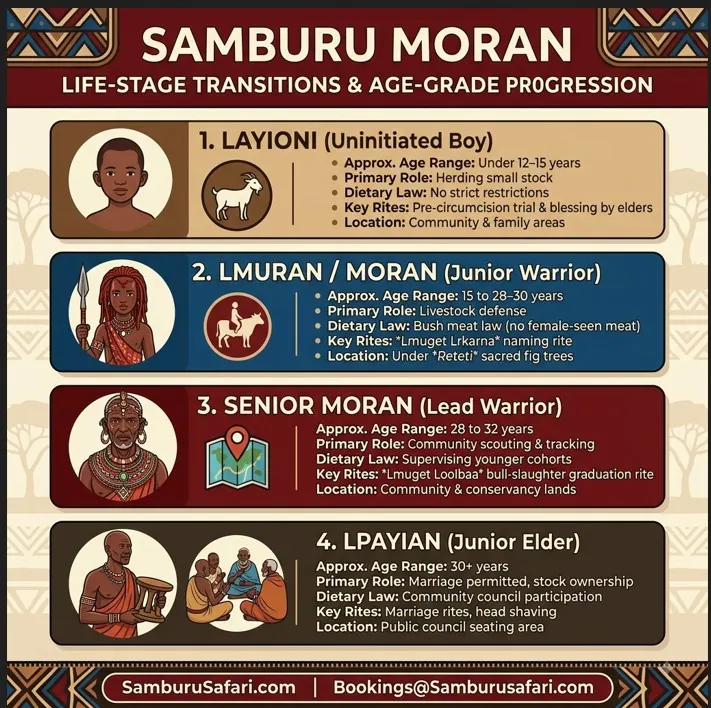
If you take dirt cut-offs through surrounding community conservancies—like West Gate, Lekurruki, or Namunyak—you may encounter informal Samburu moran rope barriers across the track. These community checkpoints collect cash transit fees (KES 1,000–2,000) that are separate from county park permits. Always carry spare cash in Kenyan Shillings or active M-Pesa balances.
Self-drivers pay two separate fee lines at the gate: per-person entry tickets and a daily vehicle tariff based on seating capacity.
Fee Line | Rate (Daily) |
Vehicles under 6 seats (saloon / small SUV) | KES 400 |
Safari 4x4s and minibuses (6–12 seats) | KES 1,000 |
Heavy overland trucks (13–25 seats) | KES 2,000 – 3,000 |
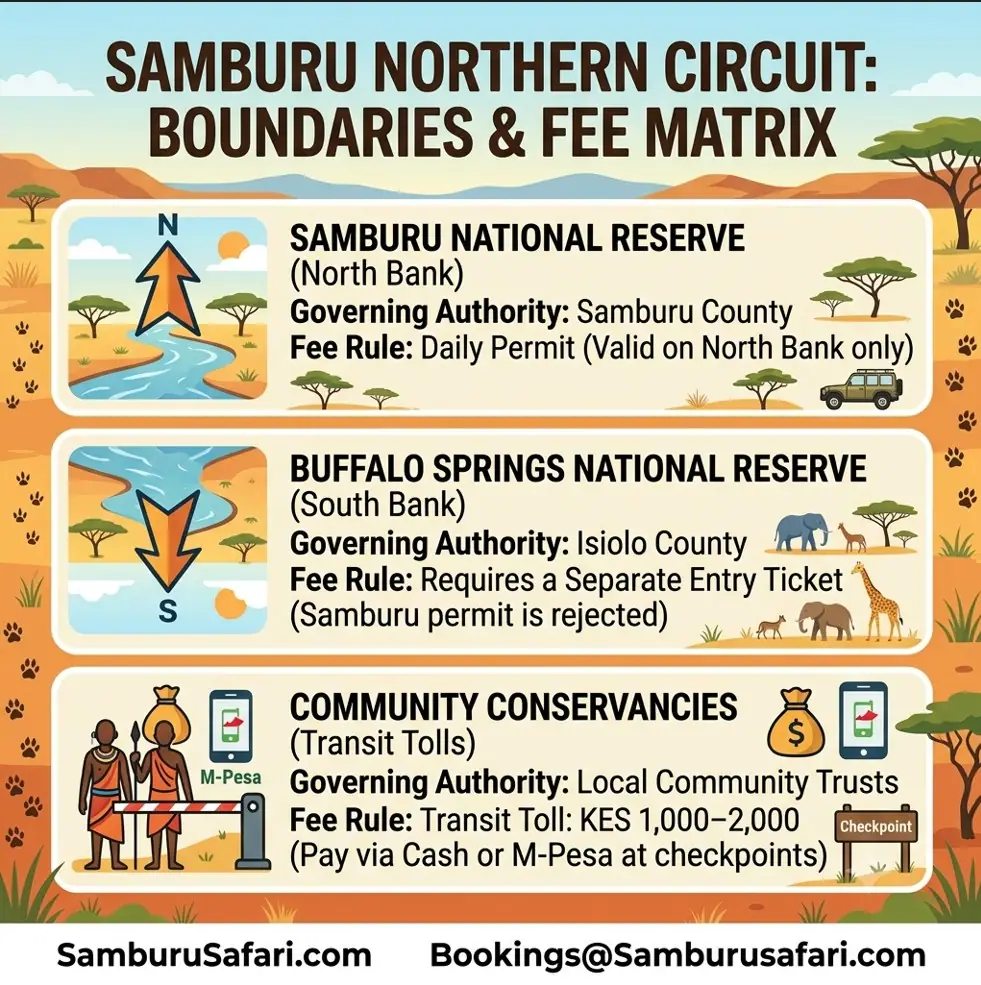
One trap catches nearly every first-time self-driver: a Samburu ticket does not cover Buffalo Springs. The two reserves sit on opposite banks of the Ewaso Nyiro under different county administrations, so crossing the river bridge or low-water drifts triggers a fresh daily entry fee payable to Isiolo County. Shaba, further east, bills separately again. For the complete per-person rate card, payment process, and the other gate traps, review our full gate fee breakdown.
A common trap for self-drivers in the northern circuit is assuming a single park ticket grants blanket access across neighboring wildlife areas. The Ewaso Nyiro River forms a strict administrative boundary where separate county governments and community trusts collect independent fees. Review this boundary checklist to prevent unexpected double-ticketing or barrier delays.
Reserve / Sector | Governing Authority | Entry & Fee Rule |
Samburu Reserve (North Bank) | Samburu County | Daily permit valid on north bank; invalid across river. |
Buffalo Springs (South Bank) | Isiolo County | Requires a separate entry ticket; Samburu permit rejected. |
Community Conservancies | Local Community Trusts | KES 1,000–2,000 cash/M-Pesa toll at moran checkpoints. |
If your vehicle snaps a leaf spring or punctures a radiator on corrugated dirt washboards, waiting for a replacement truck from Nairobi takes at least 24 hours.
Instead of waiting for a highway tow truck, contact local open-air mechanics (“Jua Kali”) located behind the Total station in Archer’s Post. These local technicians specialize in emergency leaf-spring re-stacking and radiator brazing using parts salvaged from northern supply trucks, getting your 4×4 back on the road in a few hours.
Both routes get you onto the same tracks — the difference is who carries the stress. Here is the straight comparison so you can pick what actually suits your trip:
Factor | Self-Drive Overland | Guided 4×4 Safari |
Navigational Stress | High (deep sand, no cell signal, GPS errors) | Zero (experienced local driver-guide) |
Predator Sightings | Lower (requires radio tracking or luck) | Higher (VHF radio network among guides) |
Daily Cost | Mid–high (fuel, 4×4 rental, camp fees) | All-inclusive (set price per day) |
Flexibility & Freedom | Maximum (total control over schedule) | Structured around lodge meal times |
While self-driving offers great independence, managing fuel logistics, gate permits, and vehicle maintenance in remote areas can be tiring. Many travelers prefer booking a guided multi-destination package that combines the dry northern tracks with a highland sanctuary down near Mount Kenya.
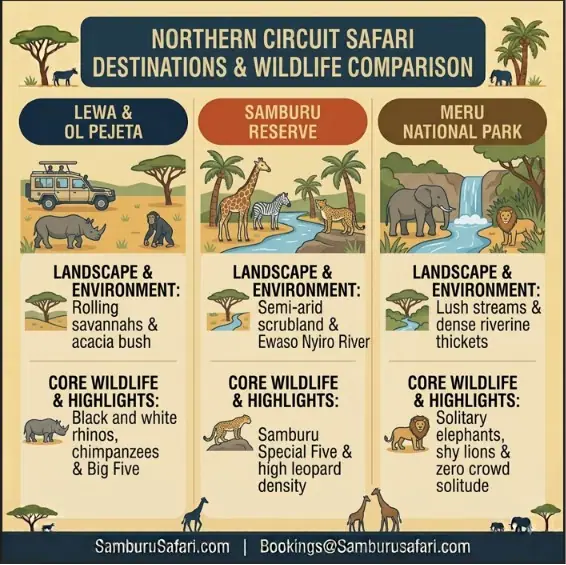
Our custom packages pair Samburu with neighboring Ol Pejeta Conservancy. This setup lets you track rare desert species up north on days one and two, and explore East Africa’s largest black rhino sanctuary on day three.
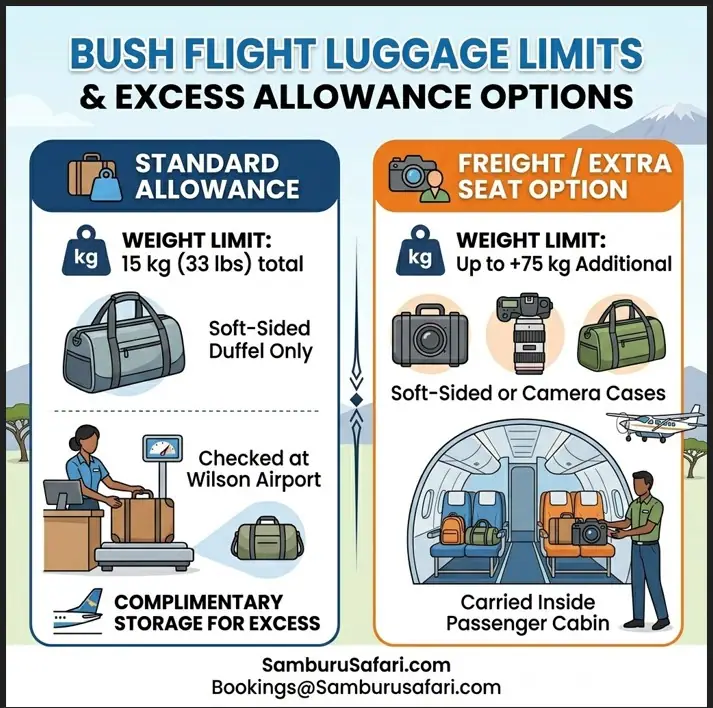
You can compare full property choices in our guide to luxury lodges in Samburu. If the drive itself is the part you would rather skip, the fly-in option puts you on the northern airstrips in under 90 minutes from Wilson Airport. For everything in between, our full range of Samburu safari packages covers guided road trips at every budget.
The pricing table below outlines total all-inclusive costs per person, based on two people traveling together in a private 4×4 Safari Land Cruiser for 2027 travel dates.
Package | Trip & Lodges | Price Per Person |
Budget Overland Tier | 4D/3N road safari • Samburu Riverside Camp + Comfort Gardens Ol Pejeta • Full board, private 4×4, daily game drives | $1,480 — 👉 Book Now |
Mid-Range Overland Tier | 4D/3N classic circuit • Samburu Simba Lodge + Sweetwaters Tented Camp • Waterhole views, extended field drives | $1,820 — 👉 Book Now |
Luxury Overland Tier | 4D/3N luxury tented stay • Elephant Bedroom Camp + Sanctuary Tambarare • Riverfront cat tracking, evening drives | $2,590 — 👉 Book Now |
Luxury Plus Overland Tier | 4D/3N luxury road & conservancy loop • Sasaab Lodge + Ol Pejeta Bush Camp • Dedicated cruiser & guide, night tracking | $5,280 — 👉 Book Now |
Keep these items inside your vehicle cab for safety:
Yes, a high-clearance 4×4 vehicle with low-range transfer gears is mandatory. Standard 2WD saloon cars or low-clearance crossovers will get stuck in deep sand luggas or suffer severe tire damage on basalt rock tracks.
No, there are no commercial fuel stations inside the reserve. You must fill your fuel tank completely at the Total station in Isiolo town or Archer’s Post before entering the main gate.
The dry months from July to September and January to February offer the easiest driving conditions on sand tracks and river drifts. For seasonal safari planning built around wildlife movements rather than road conditions alone, check our full month-by-month guide.
Message us directly for custom itineraries and the latest seasonal offers.