
Combining the Maasai Mara and Samburu on a single Kenya itinerary pairs two completely different wilderness worlds — the wide grassland plains of the south against the arid red dust and endemic species of the north. This guide breaks down transit connections at Wilson Airport, park entry fee differences, baggage limits, species contrasts, and complete 2027 pricing for a dual-ecosystem circuit.
Written by Angie Muthoni. Reviewed by Gerard Murero.
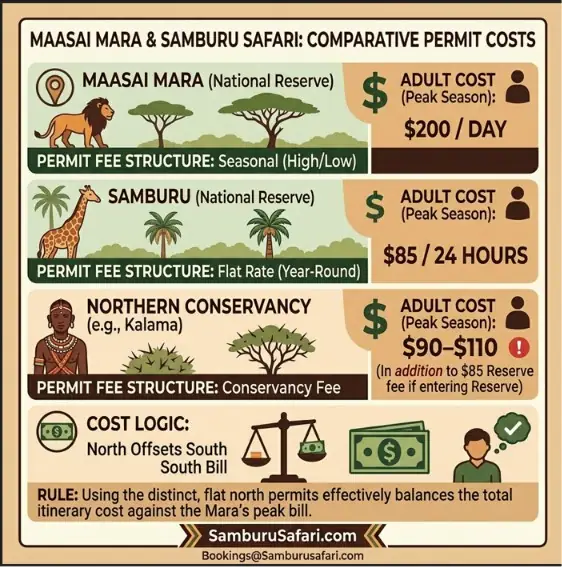
When budgeting a maasai mara and samburu safari, park entry fees make up a serious share of the total, and they differ sharply between south and north:
That disparity is the quiet argument for a dual circuit — the north offsets the Mara’s peak-season permit bill rather than doubling it.
Understanding the disparate permit cost structures is a pivotal part of any combined safari budget. This infographic isolates the quantitative fee data implicit in the text, creating a direct, high-value visual comparison between the Mara’s seasonal peak fees and Samburu’s flat year-round rates. This placement provides significant information gain, targeting transaction-oriented keywords while highlighting the financial logic: traveling to Samburu helps balance the significant cost of the Mara’s peak-season permits.
Reserve / Conservancy | Permit Fee Structure (PPS) | Adult Cost (Peak Season) |
Maasai Mara | Seasonal (High/Low) | $200 / Day |
Samburu (Reserve) | Flat Rate (Year-Round) | $85 / 24 Hours |
Northern Conservancy | Conservancy Fee (e.g., Kalama) | $90–$110 (In addition to $85 Reserve Fee if entering Reserve) |
Cost Logic | North Offsets South Bill | The distinct, flat north permit cost can balance the Mara’s high peak bill. |
There are three ways to move between the two, depending on budget and time:
Route: Mara airstrip → 45 min → Wilson Airport (wing swap) → 60 min → Kalama or Oryx airstrip. Transit: ~3.5 hours total. Best for: Short trips and luxury travellers.
Mara airstrips in use: Ol Kiombo, Musiara, Keekorok, or Mara Serena. Samburu: Oryx, Buffalo Springs, or Kalama.
The Wilson connection reality: Safarilink or Airkenya flights leave the Mara between 08:15 and 10:30 AM and land at Wilson. You stay airside for 45 to 60 minutes — enough for a coffee or a cold Tusker at the cafe while the Twin Otters reload — before boarding the early-afternoon flight north. Landing on Samburu’s red-dirt airstrips, your duffel picks up a light dusting of muru soil before it even reaches the Land Cruiser boot.
Full flight detail, airstrip transfers, and the luggage rules sit in our fly-in safari package guide.
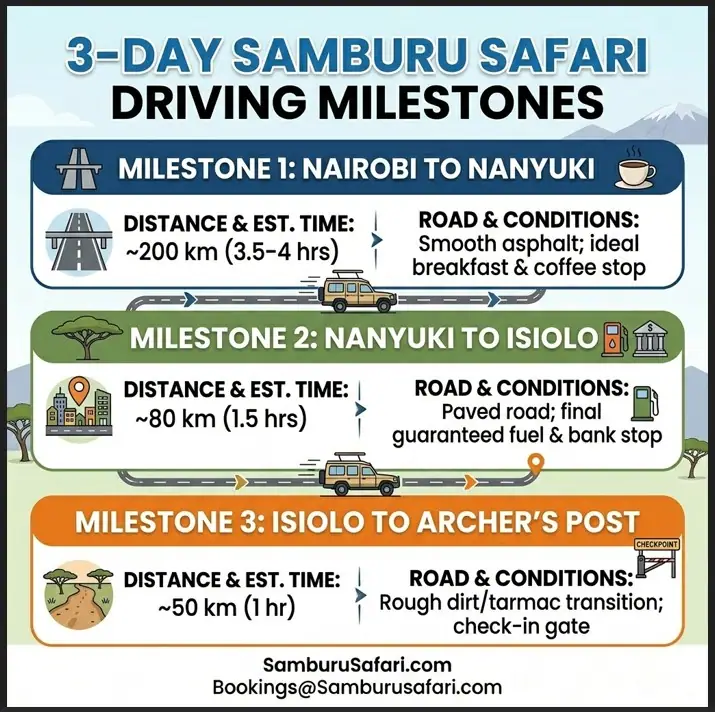
Route: Maasai Mara → 6–7 hrs → Ol Pejeta / Nanyuki → 3 hrs → Samburu Archer’s Gate. Transit: 2 days with rhino tracking. Best for: Value and road travellers.
Breaking the long overland drive with a night at Ol Pejeta avoids driver fatigue and gets you black and white rhino tracking in the bargain. Groups of four or more should price a private Land Cruiser hire for the whole run rather than booking seats leg by leg. Our Samburu and Ol Pejeta combo covers that northern half in depth.
Route: Mara airstrip → non-stop over Mount Kenya → Samburu airstrip. Transit: 75–90 minutes. Best for: VIP and multi-generational groups.
Direct charters bypass the Nairobi holding patterns and terminal weight re-checks entirely.
Six days is the honest minimum. If you have longer, the 7 day northern Kenya circuit opens up the conservancies and the Mathews Range on the northern leg. If you have less, the 3 day Samburu safari covers the north on its own without the Mara connection.
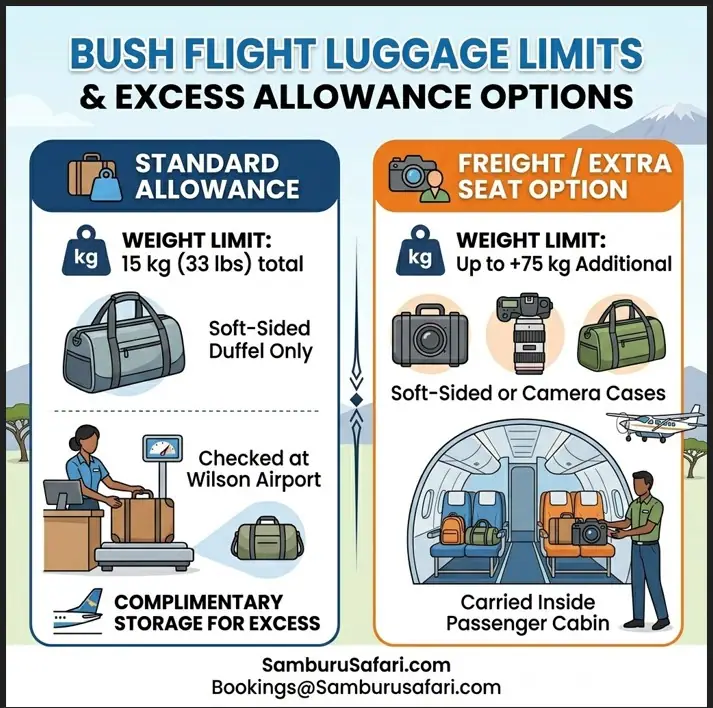
Connecting between Mara and Samburu airstrips via Wilson requires strict baggage planning:
Month Range | Maasai Mara Conditions | Samburu Conditions | Circuit Rating |
July – October | Great Migration river crossings. Peak visitor density. | Peak dry season; intense concentration along the Ewaso Nyiro. | Best overall circuit |
Dec – Feb | Clear skies, newborn wildlife, low grass, excellent big cat visibility. | Warm dry season; reliable viewing along sandbars and riverbanks. | Best photographers’ circuit |
April – May | Heavy long rains; tall grass; discounted lodge rates. | Rising Ewaso Nyiro; green terrain; quiet tracks. | Best value circuit |
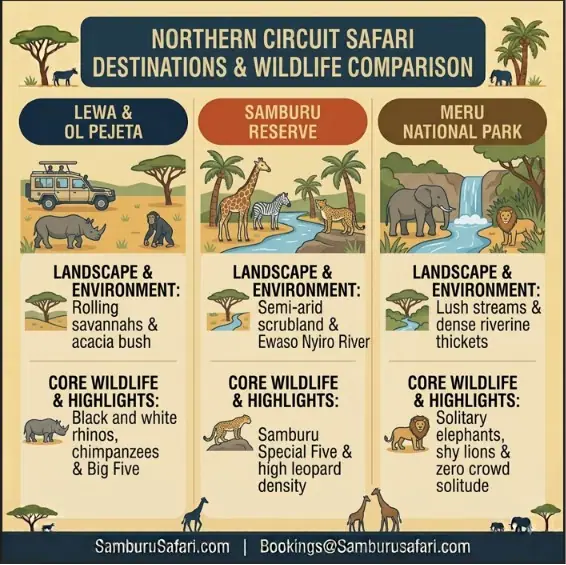
You will spot big cats faster in the Mara than almost anywhere in Africa. But Samburu holds species that simply do not occur in southern Kenya.
Feature / Metric | Maasai Mara Ecosystem | Samburu Ecosystem |
Primary Terrain | Open savannah & riverine forest | Arid shrubland & Doum palms |
Key Water Source | Mara & Talek Rivers | Ewaso Nyiro River |
Elevation & Climate | 1,500–1,800m (cool, crisp mornings) | 800–1,000m (hot, dry desert heat) |
Signature Species | Big Five, Great Migration, high big cat density | Samburu Special 5 |
Crowd Density | Moderate to high in peak season | Low to moderate, exclusive viewing |
Daily Entry Fee | $200 (peak) / $100 (low) | $85 year-round |
Best Transit | 45-min flight or 5.5-hr drive from Nairobi | 60-min flight or 5.5-hr drive from Nairobi |
In the Mara, sweeping oat-grass plains feed plains zebras with broad dark stripes and Masai giraffes with jagged, leaf-like patches. Fly north and those species hand over to their northern counterparts:
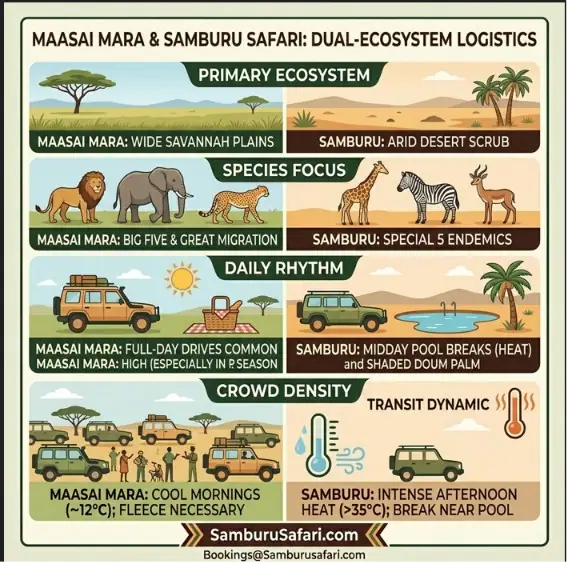
Pairing the expansive Maasai Mara with arid Samburu provides the ultimate contrast in Kenya’s wilderness, merging the Big Five grasslands with specialized northern endemics. This infographic is designed to visualize those differences at a glance, directly comparing ecosystem characteristics, crowd density, and typical daily rhythms. This strategic summary is optimized for mobile-first information gain and positions your content as the authoritative resource for planning a dual-ecosystem circuit.
Comparison Metric | Maasai Mara Circuit | Samburu Circuit |
Primary Ecosystem | Wide savannah plains | Arid desert scrub |
Species Focus | Big Five & Great Migration | Special 5 Endemics |
Daily Rhythm | Full-day drives common | Midday pool breaks (heat) |
Crowd Density | High (especially in peak season) | Low to Moderate |
Transit Dynamic | Cool mornings (~12°C); fleece necessary. | Intense afternoon heat (>35°C); break near pool. |
The main Samburu Reserve is unbeatable for classic riverfront elephant sightings. But spending at least one night in a neighbouring conservancy like Kalama or West Gate changes the trip. It is the only way you get to switch the engine off at 9:00 PM under a black sky and track leopards with a spotter light — strictly forbidden inside the National Reserve gates. Conservancies also permit off-road tracking and guided walking safaris with local warriors.
Tracking technique changes completely between the two. The Mara’s open horizons let a guide pick out lions or cheetah over a kilometre away. In Samburu, dry acacia thickets, Doum palm groves, and the laggas drop your line of sight to under 50 meters.
Gerard makes the point every time: up here you listen rather than scan. Alarm calls from vervet monkeys or white-browed sparrow-weavers, then fresh predator tracks in soft red river sand. The eyes come second.
By Day 3 in Samburu you will find red dust in every zipper pocket of your camera bag. Carry a blower bulb and a microfiber cloth in the daypack and clean the front element before every lens change.
The altitude swing catches people out. The Mara sits at 1,500 to 1,800 meters with crisp morning drives around 12°C, where a fleece is genuinely necessary. Fly north and you drop to 800–1,000 meters, with midday past 35°C.
That changes the daily rhythm entirely:
Do not bother packing formal dinner clothes for either park. Canvas trousers, light linens, and a sturdy pair of boots cover you at any dinner table on this circuit. Picaridin repellent and a travel-clinic conversation before you fly are sensible for both regions.
The altitude swing catches people out. The Mara sits at 1,500 to 1,800 meters with crisp morning drives around 12°C, where a fleece is genuinely necessary. Fly north and you drop to 800–1,000 meters, with midday past 35°C.
That changes the daily rhythm entirely:
Do not bother packing formal dinner clothes for either park. Canvas trousers, light linens, and a sturdy pair of boots cover you at any dinner table on this circuit. Picaridin repellent and a travel-clinic conversation before you fly are sensible for both regions.
We design balanced circuits combining three nights in the Maasai Mara with three in Samburu. Browse the full catalogue of Samburu safari packages, or start with the master Samburu safari guide if the northern half is new to you.
The table details our 2027 packages for two adults sharing a private experience, 6 days / 5 nights total circuit.
Package | Trip & Lodges | Price Per Person |
Budget Circuit Tier | 6D/5N overland road safari • Samburu Riverside Camp + Fig Tree Camp (Mara) • Private cruiser, driver-guide, full board and game drives | $2,380 — Get a quote |
Mid-Range Circuit Tier | 6D/5N overland & flight mix • Samburu Simba Lodge + PrideInn Mara Camp • Private cruiser, driver-guide, Ol Pejeta rhino tracking stopover | $3,150 — Price this trip |
Luxury Fly-In Tier | 6D/5N premium air package • Elephant Bedroom Camp + Tipilikwani Mara Camp • All bush flights, airstrip transfers, stationed open 4x4s | $4,850 — Check dates |
Luxury Plus Sky Circuit | 7D/6N luxury flight circuit • Saruni Samburu (Villa 5) + Governor’s Il Moran Camp • Regional flights, conservancy fees, private open 4x4s, spa, night drives | $8,920 — Build my itinerary |
Inclusions: Full board stay, private 4×4 Land Cruiser with guide, park and conservancy permits (Mara, Samburu, Ol Pejeta), AMREF evacuation cover, regional flights on fly-in options.
Exclusions: International flights, e-visas, personal insurance, premium drinks, laundry, tips, optional Mara balloon flight ($450–$500 USD).
Couples building this as a wedding trip should look at the honeymoon circuit, and families should check the family safari packages, which route around the age limits on walking activities in the north.
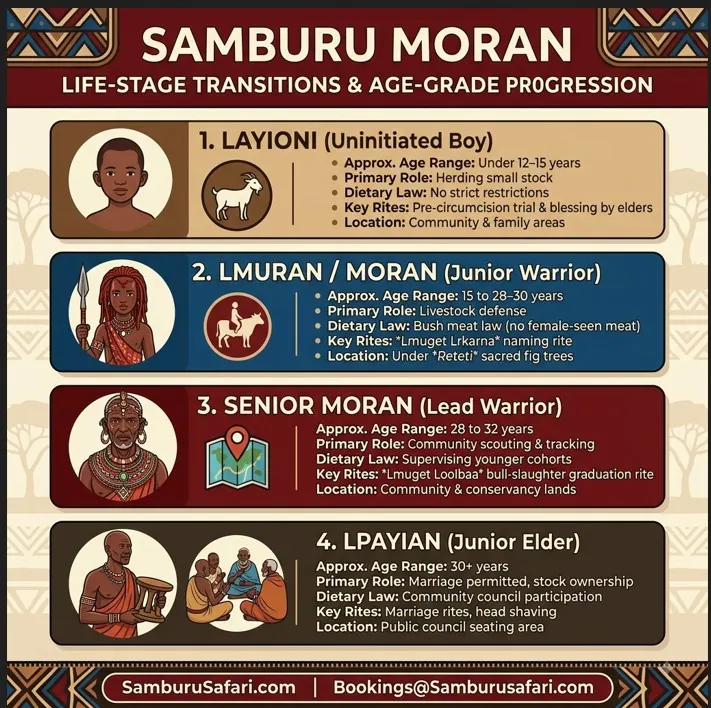
Cultural visits give you a genuinely different perspective in each region:
If you get to the seasonal singing wells, leave the cameras and phones in the Land Cruiser. Listening to Samburu warriors chant family songs while digging deep into a dry riverbed is a rare privilege, and watching it without a lens between you and the family makes it a far better memory than any photograph would.
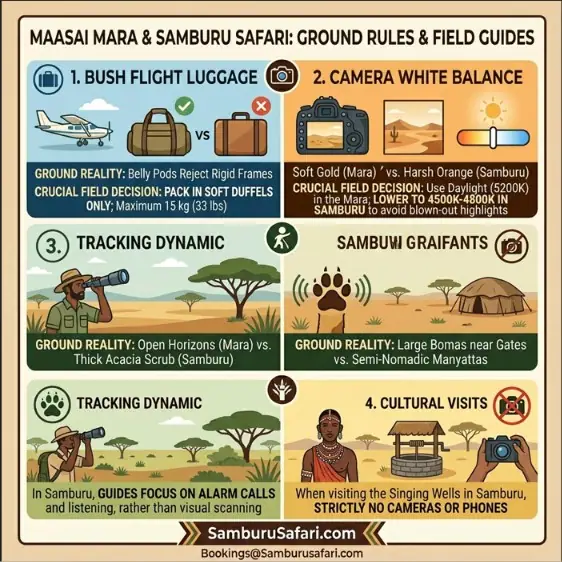
The success of a dual-ecosystem circuit depends entirely on executing precise logistics and respecting local ground realities. This authoritative, rule-oriented guide synthesizes critical field advice scattered throughout your article—from strict luggage rules to specialized camera white balance and culturally sensitive well-visiting practices. This final visual summary targets long-tail search queries by explicitly defining the ‘Ground Rules’ for a seamless Maasai Mara and Samburu combination safari.
Operational Focus | Ground Reality | Crucial Field Decision |
Bush Flight Luggage | Belly Pods Reject Rigid Frames | Pack in Soft Duffels only; maximum 15 kg (33 lbs). |
Camera White Balance | Soft Gold (Mara) vs. Harsh Orange (Samburu) | Use daylight (5200K) in the Mara; lower to 4500K-4800K in Samburu to avoid blown-out highlights. |
Tracking Dynamic | Open horizons (Mara) vs. Thick acacia scrub (Samburu) | In Samburu, guides focus on alarm calls and listening, rather than visual scanning. |
Cultural Visits | Large bomas near gates vs. Semi-nomadic manyattas | When visiting the singing wells in Samburu, strictly NO cameras or phones. |
At least six — three nights in the Mara and three in Samburu — to cover both ecosystems without rushing the game drives.
Scheduled flights connect via Wilson Airport in Nairobi for a short technical stop. Private charters and helicopters fly direct, non-stop over Mount Kenya, in about 80 minutes.
The Mara is open grassland savannah with exceptional big cat density. Samburu is a dry desert environment holding specialised endemic species like Grevy’s zebra and reticulated giraffe along the Ewaso Nyiro River.
Transit timings and park fees verified against operator schedules. Last updated July 2026.
Message us directly for custom itineraries and the latest seasonal offers.