
Shut off your Land Cruiser at Elephant Bedroom Camp at 6:00 PM and the first thing you notice isn’t what you hear—it’s what you don’t. No diesel generator rattling away under the doum palms. Just solar battery banks holding the lights up and water moving through the reed beds.
When travelers ask our team at Samburusafari.com about eco tourism in Samburu, we show them what it looks like from the driver’s seat: solar water pumps, community revenue shares, zero-waste camp kitchens. It sits inside a wider set of Samburu culture questions about who actually benefits when you visit.
Eco tourism in Samburu is a community-first conservation model where tourism revenue funds wildlife protection and pastoralist development across 95,000+ acres of rangeland. It runs mainly through community conservancies — Namunyak, Kalama, West Gate — partnered with the Northern Rangelands Trust. The leading lodges run on 100% solar, bottle their own water to cut single-use plastic, and split conservancy fees 60/40 between community services and ranger patrols.
Where your safari money lands should shape which accommodation you pick:
Eco-Tourism Aspect | Samburu National Reserve | Community Conservancies (Namunyak / Kalama / West Gate) |
Land Ownership | County government public land | Indigenous Samburu pastoralist communities |
Primary Revenue Recipient | Government treasury & county park fund | Direct community escrow (60% social / 40% conservation) |
Off-Grid Eco Standards | Mix of solar power & backup diesel generators | 100% off-grid solar, biogas & zero light pollution |
Night Drives & Bush Walks | Prohibited inside reserve borders | Allowed, guided by local Moran community scouts |
Conservation Impact | General park maintenance & wildlife management | Direct funding for mobile clinics, boreholes & school bursaries |
The jump between a public park lodge like Samburu Simba at $1,340 per person and an eco-villa like Saruni Samburu at $2,970 is mostly a question of where the money goes. Inside the national reserve, your fees go to county government gates. Out in Kalama, your daily conservancy fee pays the monthly salaries of Samburu rangers patrolling the habitat around you.
Tier | Lodges / Camps Included | Vehicle & Setup | Rate Per Person | |
Budget | Samburu Public Camp / Umoja Camp | Private 4×4 Land Cruiser & guide • Dome tents & camp chef | $940 USD | |
Mid-Range | Samburu Simba Lodge (Buffalo Springs) | Private 4×4 Land Cruiser & guide • Full board stone chalet | $1,340 USD | |
Luxury | Elephant Bedroom Camp (Samburu NR) | Private 4×4 Land Cruiser & guide • Gold-rated luxury tent | $2,240 USD | |
Luxury Plus | Saruni Samburu (Kalama Conservancy) | Private 4×4 Land Cruiser & guide • Eco-villa on Kitis Ridge | $2,970 USD |
Tier | Lodges / Camps Included | Vehicle & Setup | Rate Per Person | |
Budget | Samburu Camp (2N) + Sweetwaters Camp Ol Pejeta (1N) | Private 4×4 Land Cruiser & guide • Tented bush circuit | $1,265 USD | |
Mid-Range | Sarova Shaba (2N) + Sweetwaters Serena Ol Pejeta (1N) | Private 4×4 Land Cruiser & guide • Full board safari lodges | $1,890 USD | |
Luxury | Larsens Camp (2N) + Ol Pejeta Bush Camp (1N) | Private 4×4 Land Cruiser & guide • Luxury eco-canvas stay | $3,010 USD | |
Luxury Plus | Joy’s Camp Shaba (2N) + Lewa Safari Camp (1N) | Private 4×4 Land Cruiser & guide • High-end conservancy stay | $3,930 USD |
What your package covers: Full board at the named lodges or campsites, private 4×4 safari Land Cruiser with guide and fuel, Samburu Reserve daily permits ($85 USD/day non-resident) and conservancy fees, AMREF Flying Doctors evacuation cover, and bottled drinking water.
Extra cash to bring: International flights, Kenya e-visas, personal travel insurance, premium drinks, driver-guide tips, and Reteti Elephant Sanctuary entry fees.
Want a conservation circuit built around your dates? Send them to us and we will price it.
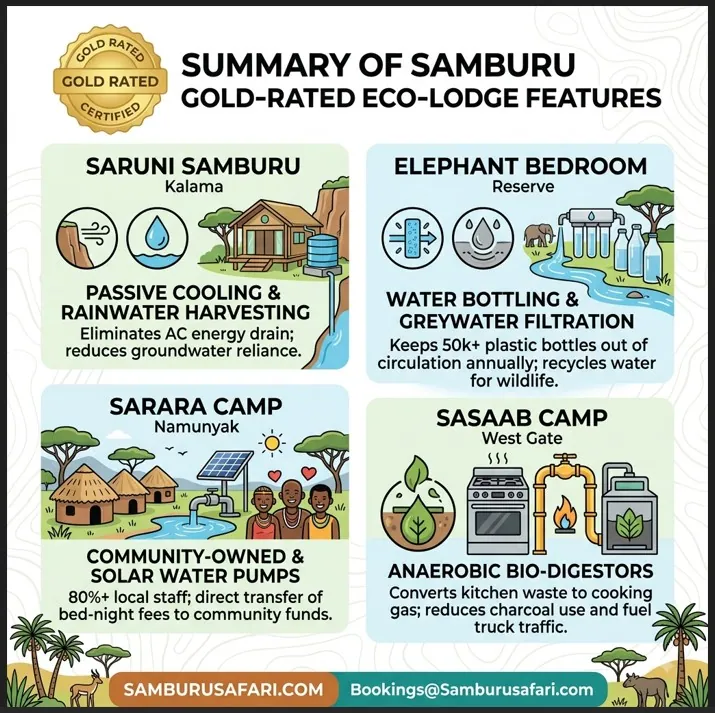
Green labels are cheap. Certification from EcoTourism Kenya is not, and four properties in this ecosystem hold it. Here is what each one actually runs.
Built into granite outcrops on Kitis Mountain, Saruni uses the cliff overhangs and the elevation breeze instead of air conditioning. Villa roofs catch rainwater for filtration, and the property runs on silent solar PV backed by battery banks.
On the Ewaso Nyiro, Elephant Bedroom runs an on-site reverse-osmosis plant that bottles into glass and keeps more than 50,000 plastic bottles a year out of circulation. Kitchen and laundry greywater goes through bio-reed filtration beds before it reaches the marsh watering points wildlife use.
Sarara is community-owned outright, with over 80% of staff drawn from local Samburu families. Gravity-fed solar pumps handle the water, single-use plastics are gone entirely, and every conservancy bed-night fee transfers straight to health and education funds.
Above the Ewaso Nyiro, Sasaab runs solar inverters for all guest suites. Sub-surface anaerobic bio-digestors turn kitchen waste into cooking gas, which takes the fuel trucks off the Isiolo road. These three conservancies sit at the heart of the wider northern circuit, and each one runs its own fee structure.
Eco friendly lodges Samburu with gold rating features
While many camps claim to be “green,” only four in the Samburu ecosystem hold the coveted Gold rating from EcoTourism Kenya. This certification requires rigorous audits of energy, water, waste, and community engagement. We have consolidated the defining eco-features of these leading properties to help you compare their conservation impact at a glance.
Accredited Lodge | Key Eco-Innovation | Direct Conservation Impact |
Saruni Samburu (Kalama) | Passive architectural cooling & rainwater harvesting. | Eliminates AC energy drain; reduces reliance on ground water. |
Elephant Bedroom (Reserve) | Reverse-osmosis water bottling & bio-reed greywater filtration. | Keeps 50k+ plastic bottles out of circulation annually; recycles water for wildlife. |
Sarara Camp (Namunyak) | 100% community-owned; solar gravity-fed water pumps. | 80%+ local staff; direct transfer of bed-night fees to community funds. |
Sasaab Camp (West Gate) | Sub-surface anaerobic bio-digestors for cooking gas. | Converts kitchen waste to fuel; reduces charcoal use and fuel truck traffic. |
Drive Kalama and Namunyak long enough and you watch pastoralists shift from skeptical neighbours to the people doing the protecting. That did not happen by goodwill. It happened because the Northern Rangelands Trust tied conservation to household income.
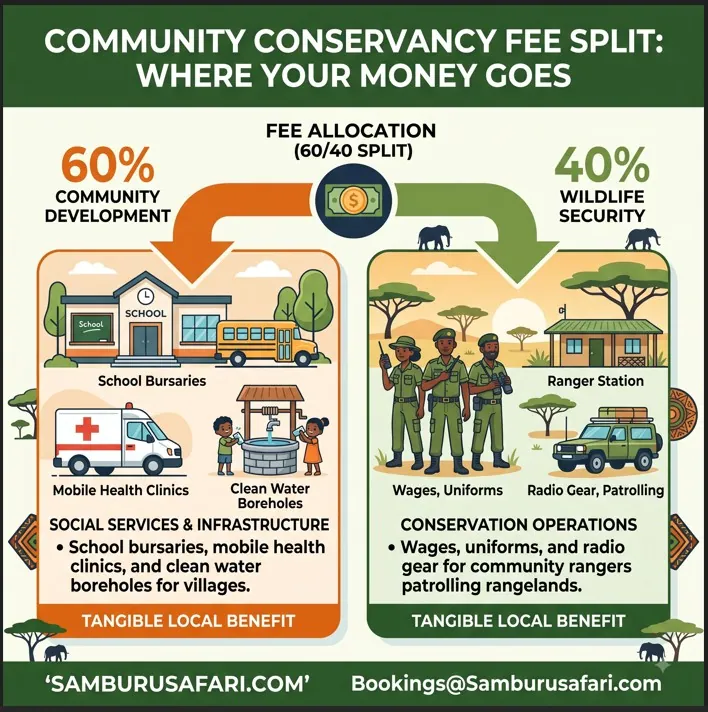
When you stay at an eco-lodge in a community conservancy, your daily conservancy fee — $100 to $120 USD — skips government treasuries. Escrow accounts split it automatically:
The same scout networks feed the monitoring behind the trust protecting Grevy’s zebra, which is why the sightings data from these conservancies is better than anything the reserve produces.
How do Samburu community conservancies use tourist fees?
The core of Samburu ecotourism is transparency in how tourism revenue benefits the people sharing their land with wildlife. When you pay a conservancy fee in Kalama, Namunyak, or West Gate, the funds skip government treasuries and land directly in community-managed escrow accounts. This explicit split transforms conservation from a conceptual idea into tangible household income and services.
Fee Allocation (60/40 Split) | Supported Project Type | Tangible Local Benefit |
60% Community Development | Social Services & Infrastructure | School bursaries, mobile health clinics, and clean water boreholes for villages. |
40% Wildlife Security | Conservation Operations | Wages, uniforms, and radio gear for indigenous community rangers patrolling rangelands. |
Environmental audits read like paperwork. Here is what the same features look like when you are out on safari.
No charcoal smoke in the riverine canopy, no food waste smell near the tents. Sub-surface bio-digestors break down kitchen scraps into methane and pipe it to the chef’s stove. It keeps fuel trucks off the road from Isiolo and takes the pressure off the doum palm stands, which is where camp charcoal used to come from.
County bylaws forbid camps from scooping sand or gravel out of the Ewaso Nyiro and the dry laggas for building repairs. Gravel gets trucked in from Isiolo quarries instead. The rule protects the subterranean water table that wildlife lives on through the dry months.
Drive past Kiltamany village at dusk and you will see the design working. Conservancy boreholes feed two separate troughs: livestock drink at the one near the village, bull elephants at a second trough a mile out in the bush. Keeping those water points apart is the cheapest night-time conflict prevention anyone has found up here, and it belongs to the same logic as the Warrior Watch lion project — stop the encounter before it becomes a killing.
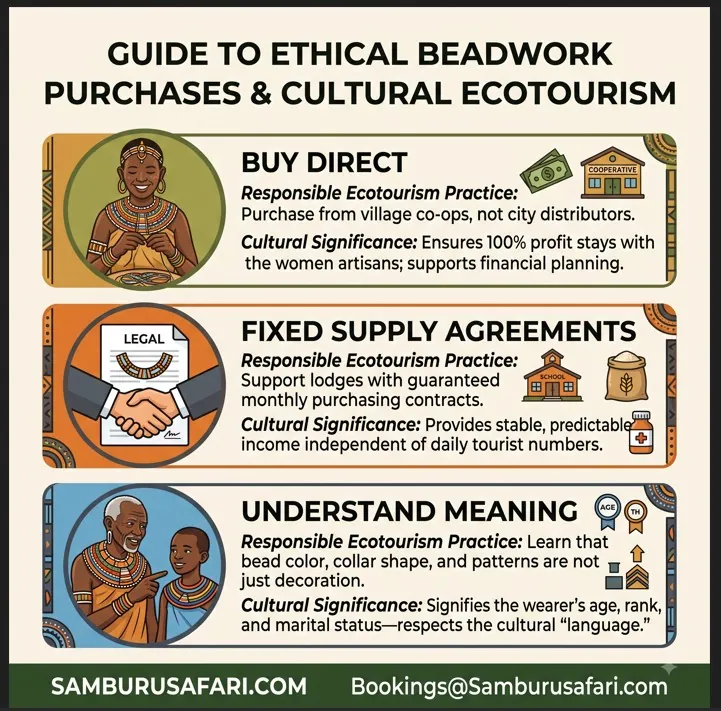
Room decor, keychains, gift shop stock: eco-lodges here buy all of it from cooperatives like Umoja Women’s Village and Unity Cultural Village near Archer’s Post rather than city distributors. Lodges sign fixed-rate supply agreements, so income arrives monthly instead of whenever a tour bus stops.
That matters more than it sounds. A fixed order means a matriarch can plan grain and school fees against it, and it is worth understanding what samburu beadwork signals before you buy — colour and collar shape carry age, rank and marital status, not just decoration.
If you want to see the workshops rather than the shop shelf, a cultural safari experience at Umoja puts you with the women doing the weaving.
How to buy ethical Samburu beadwork from women’s villages
Eco tourism must include respect for local culture and equitable economic exchange. Buying beadwork directly from women’s cooperatives like Umoja or Unity provides vital income that matriarchs can use for grain, medicine, and school fees. Understanding the social signals coded into the jewelry you buy adds depth to your experience and ensures your purchase supports true cultural preservation.
Ethical Action | Responsible Ecotourism Practice | Cultural Significance |
Buy Direct | Purchase from village co-ops, not city distributors. | Ensures 100% profit stays with the women artisans; supports financial planning. |
Fixed Supply Agreements | Support lodges with guaranteed monthly purchasing contracts. | Provides stable, predictable income independent of daily tourist numbers. |
Understand Meaning | Learn that bead color, collar shape, and patterns are not just decoration. | Signifies the wearer’s age, rank, and marital status—respects the cultural “language.” |
Real ecotourism comes with real compromises.
Solar limits during rain. Eco-lodges run on battery arrays. Through the heavy April–May and November cloud, generation drops. Hairdryers are banned outright, and tent lighting may run on low-beam LED at night.
Higher nightly rates. Off-grid water treatment, biogas systems and conservancy levies all cost money, and eco-lodge rates sit above standard hotels because of it.
Dust and open-air design. Gold-rated tented camps use airflow rather than air conditioning. Fine red dust comes through the mesh on windy afternoons and settles on everything.
Season, road conditions, park fees and health precautions all move together, and our planning a samburu safari section covers each before you fix dates.
What makes eco tourism in Samburu different from other parks? It centres on community-owned conservancies run alongside pastoralist families. Fees support local schools, healthcare and water infrastructure while protecting wildlife corridors.
How do eco-camps in Samburu get electricity? Most run on 100% solar photovoltaic systems backed by battery banks — quiet power, no diesel generator noise.
Can I visit community conservancies while staying inside the reserve? Yes. Your guide can drive from Samburu National Reserve into Kalama or West Gate for game drives or cultural visits on payment of the daily conservancy fee.
Written by Gerard Murero — TRA silver-level guide working the northern rangelands routes through Samburu, Buffalo Springs and the community conservancies.
Reviewed by Benson Kungu — safari guide and photography specialist.
Message us directly for custom itineraries and the latest seasonal offers.