
Written by Patrick Mulei. Reviewed by Anthony Mule.
Buffalo Springs National Reserve covers 131 square kilometres directly south of Samburu National Reserve across the Ewaso Nyiro River. Named for the clear freshwater spring at its centre, the reserve is open rolling lava plains, basalt terraces, and dense toothbrush thickets. It holds northern Kenya’s specialty species — Grevy’s zebra, reticulated giraffe, Beisa oryx — with far fewer vehicles than its northern neighbour.
All rates below are for two adults travelling together in a private 4×4 Safari Land Cruiser — licensed driver-guide, fuel, full-board accommodation, park permits, and local taxes.
If you are looking at the 2-night budget option with public camping, be ready for warm afternoons; the public sites have no pool. Travelling with kids, or if heat bothers you, paying up for a lodge with a pool earns its keep between 1:00 PM and 3:30 PM every single day.
For three nights, adding Ol Pejeta or Lewa on the drive back to Nairobi gives the trip a much better rhythm than doubling back in one long haul.
Tier | Lodges Included | Total Per Person | |
Budget | Buffalo Springs public camp / Samburu Riverside | $1,210 | |
Mid-Range | Ashnil Samburu Camp | $1,680 | |
Luxury | Elephant Bedroom Camp | $2,520 | |
Luxury Plus | Riverfront camp on the Buffalo Springs side (fly-in) | $4,380 |
Tier | Lodges Included | Total Per Person | |
Budget | Ashnil Samburu (2N) + Comfort Gardens Ol Pejeta (1N) | $1,780 | |
Mid-Range | Ashnil Samburu Camp (2N) + Sweetwaters Serena Camp (1N) | $2,520 | |
Luxury | Elephant Bedroom Camp (2N) + Lewa Wilderness (1N) | $3,840 | |
Luxury Plus | Buffalo Springs riverfront (2N) + Sirikoi Lodge Lewa (1N), fly-in | $6,310 |
Full write-ups on the two camps above sit in our Ashnil Samburu Camp review and Elephant Bedroom Camp review. The Ol Pejeta pairings run on our Samburu and Ol Pejeta combo page.
Included:
Not covered:
Optional upgrades: an excursion to Reteti Elephant Sanctuary, a guided night drive in the neighbouring conservancies, a day trip up Mount Ololokwe, or a side drive east into Shaba National Reserve. Each carries its own entry or ranger fee, confirmed at booking.
Park fees for Buffalo Springs are administered by the Isiolo County Government, and tickets stay valid for 24 hours from entry.
Visitor Category | Gate Requirements |
International non-residents | Included in all our package quotes |
Kenyan residents (EAC) | Valid EAC passport or alien ID plus permit |
Kenyan citizens | Valid Kenyan national ID |
Vehicle entry | Charged daily by vehicle class at the entry gate |
Useful to know: because Buffalo Springs and Shaba are both Isiolo County, one ticket covers both within the same 24 hours. Cross the river north into Samburu and you are in a different county paying again. Current rates sit on our Samburu park fees page.
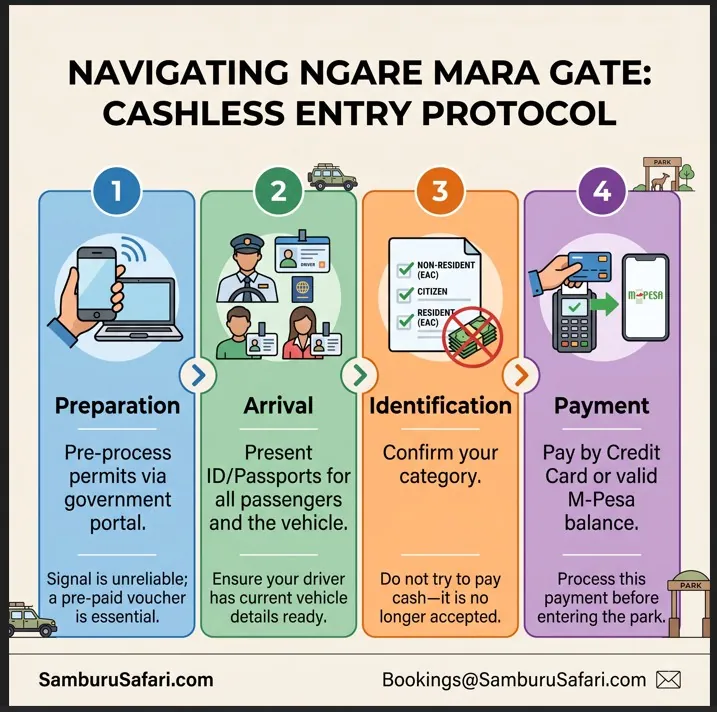
Coming up the tarmac from Isiolo I almost never drive all the way to Archer’s Post. The safari vans stack up there. I branch off early at Ngare Mara Gate on the western side — quiet track, faster permit processing, and you are out on a game drive twenty minutes before the vans at Archer’s Post have finished their paperwork.
Gate processing rules:
Do not plan to pay cash at Ngare Mara or Archer’s Post. Isiolo County runs cashless. Have your driver process permits in advance, or carry a card and an active M-Pesa balance. Signal drops at Ngare Mara, so a pre-paid voucher saves you an hour standing in the heat.
When the river floods in the November or April rains, the low causeway connecting Buffalo Springs to Samburu goes completely under. If your lodge is on the Samburu side but your drive is down here, you re-route via the higher bridge at Archer’s Post — another 45 minutes onto your morning.
How to get permits for buffalo springs at ngare mara gate cashless
I almost always advise my guests to enter Buffalo Springs via Ngare Mara Gate to save an hour on paperwork. This gate handles permit processing faster, but it is strictly cashless and often loses signal, meaning your entire day can stall without pre-planning. Follow these four steps to ensure a smooth, twenty-minute transition from the tarmac to your first game drive.
Step | Action Required | Pro-Driver Tip |
1. Preparation | Drivers should pre-process permits via government portal. | Signal is unreliable; a pre-paid voucher is essential. |
2. Arrival | Present ID/Passports for all passengers and the vehicle. | Ensure your driver has current vehicle details ready. |
3. Identification | Confirm your non-resident/citizen/resident category. | Do not try to pay cash—it is no longer accepted. |
4. Payment | Pay by Credit Card or valid M-Pesa balance. | Process this payment before entering the park. |
The full list is in our Samburu safari packing list.
Turning off the tarmac onto the red dirt, the air is warm and dry. You smell crushed sage, warm dust, and wet clay along the river channels. This reserve has its own history and its own feel, and it is not simply Samburu with fewer cars.
The crystal-clear pool that gives the reserve its name was not dug by rangers. Local accounts hold that the crater was opened by a wartime bomb striking the plain and breaking into a high-pressure underground aquifer, which then filled with clean water.
However it formed, the practical fact stands: the crater is walled with stone today and clear spring water still flows out into the dry plains.
In the southeastern sector sits an ancient volcanic terrace of olivine basalt, known locally as the Champagne Ride, named for the bubbly texture of the old lava flow and the rolling ridges over the southern plains. Driving it gives you long clear views across open ground where Grevy’s zebra and Beisa oryx herd together away from heavy bush.
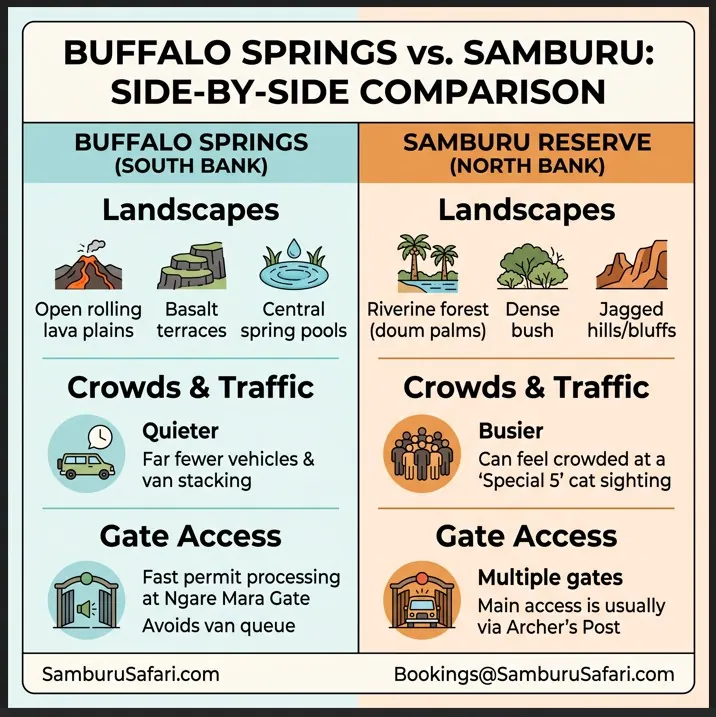
The river forms the boundary — Samburu County on the north bank, Isiolo County on the south. Cross the causeway or bridge into Samburu Reserve without buying a separate ticket and the rangers at the crossing will turn you straight back around. The full three-way breakdown is on our Samburu vs Buffalo Springs vs Shaba comparison.
Buffalo springs vs samburu national reserve main differences for safari
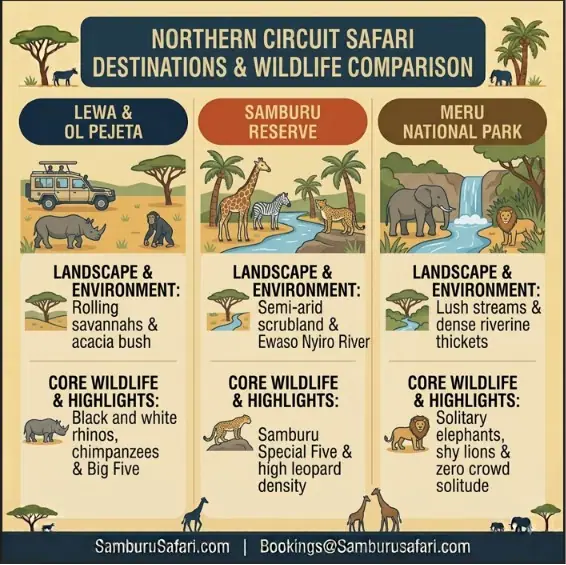
While they are part of the same ecosystem and share a river boundary, Buffalo Springs and Samburu National Reserve offer distinctly different landscapes and safari dynamics. Understanding these subtle differences is key to choosing your primary base of operations for a northern Kenyan safari. Here is a quick breakdown based on terrain, traffic, and access.
Feature | Buffalo Springs (South Bank) | Samburu Reserve (North Bank) |
Landscapes | Open rolling lava plains; basalt terraces; central spring pools. | Riverine forest (doum palms); dense bush; jagged hills/bluffs. |
Crowds & Traffic | Quieter. Far fewer vehicles and van stacking. | Busier. Can feel crowded at a “Special 5” cat sighting. |
Gate Access | Fast permit processing at Ngare Mara Gate (avoids van queue). | Multiple gates; main access is usually via Archer’s Post. |
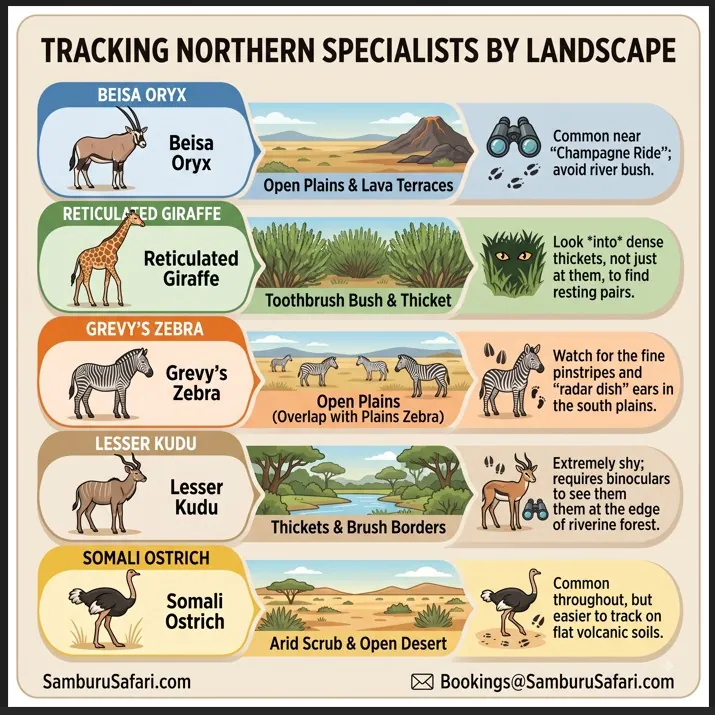
Plains zebra graze the open southern plains here alongside endangered Grevy’s, and the two species overlap on this side of the river in a way you rarely see further north. For anyone working through the Samburu Special 5, it makes the comparison easy — the wide stripes and small ears against the fine pinstripes and radar dishes, in the same binocular view.
Buffalo springs special five wildlife tracking by habitat type
Buffalo Springs is famous as the place where the “Samburu Special 5” northern species are easier to spot than anywhere else. Because the terrain is flatter and less dense, we can reliably predict where each species will be herding or hiding based entirely on the landscape. This table summarizes how we use the park’s geometry to track these unique animals.
Specialist Species | Preferred Habitat | Local Tracking Secret |
Beisa Oryx | Open Plains & Lava Terraces | Common near “Champagne Ride”; avoid river bush. |
Reticulated Giraffe | Toothbrush Bush & Thicket | Look into dense thickets, not just at them, to find resting pairs. |
Grevy’s Zebra | Open Plains (Overlap with Plains Zebra) | Watch for the fine pinstripes and “radar dish” ears in the south plains. |
Lesser Kudu | Thickets & Brush Borders | Extremely shy; requires binoculars to see them at the edge of riverine forest. |
Somali Ostrich | Arid Scrub & Open Desert | Common throughout, but easier to track on flat volcanic soils. |
I tell every guest the same thing: look at a toothbrush bush at 2:00 PM, see nothing, then look again at root level. I have had clients stare at one bush for five minutes convinced it was empty, until a full-grown male rolled over in the shade two metres inside the branch line.
The soil here is crushed basalt and fine red volcanic earth. After drinking at the springs or the river, elephants suck that iron-rich powder up their trunks and spray it over wet skin, which leaves the herds here a far more intense rust-red than elephants in other parks.
Deep inside the reserve the Isiolo River runs into the larger Ewaso Nyiro. The junction makes a shallow channel where family herds gather twice daily to drink and bathe, and camps built on the bluffs above it look straight down on elephants wading in the current.
The terrain here is flatter and less dense than Samburu, so tracking cheetah and lion is genuinely easier — predators cannot vanish behind thick brush, and you get longer views of animals crossing open ground. Predator behaviour differs noticeably either side of the river.
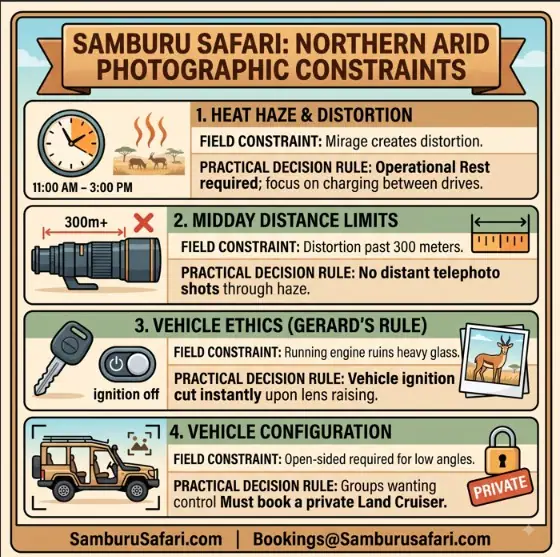
Midday heat. There is far less shade here than in Samburu’s river forest, and the open lava plains heat fast after 11:00 AM. Drive early, 6:30 to 9:30, then again from 4:00 PM.
Volcanic scree. Tracks near the Champagne Ride cross old basalt flows scattered with sharp stone. A standard minivan punctures constantly out here. A proper 4×4 on all-terrain tires handles it without drama.
Solitude. On the south side of the river you will often drive two hours without meeting another vehicle. If you prefer quiet watching over a crowded cat sighting, this is the better side.
June to October and January to February. In dry weather wildlife concentrates on the river and the permanent springs. Our best time to visit Samburu guide covers the full year.
The spring pool holds clear freshwater, but swimming depends on current park management and ranger advisories, since wildlife uses it too. Most travellers use their lodge pool instead.
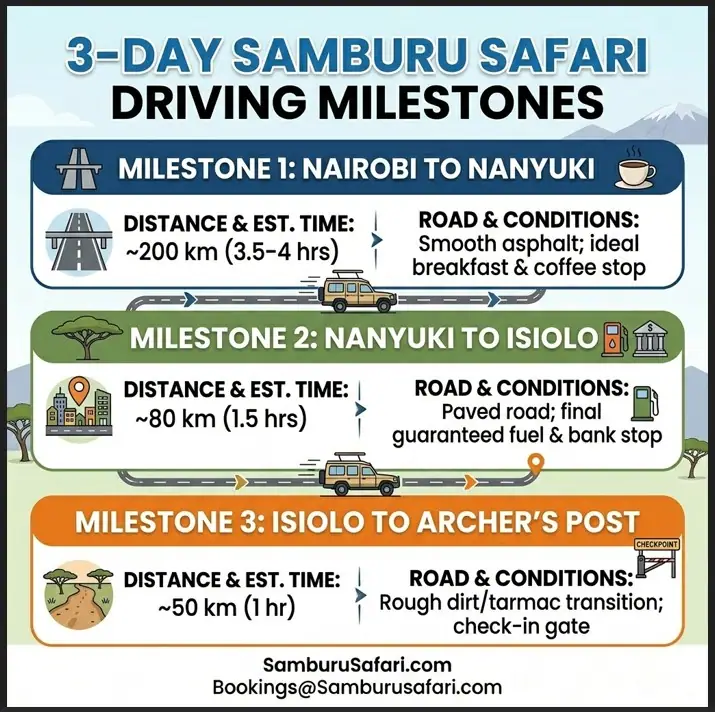
Roughly 320 kilometres, about a five-hour drive north via the paved A2 through Nanyuki and Isiolo.
From elephants dust-bathing in red volcanic soil to the clear water of the spring pool itself, Buffalo Springs is a quieter, more rewarding side of this ecosystem than most itineraries give it credit for. Browse the full range across our Samburu safari packages, or talk to our team about permits, transport, and lodges.
Gate access, track conditions, and river crossing rules checked on the ground by our guides. Last updated July 2026.
Message us directly for custom itineraries and the latest seasonal offers.