
Written by Patrick Mulei. Reviewed by Anthony Mule.
Shaba National Reserve is a 239-square-kilometre wildlife sanctuary directly east of Samburu National Reserve and Buffalo Springs along the Ewaso Nyiro River. Shaped by ancient volcanic activity, the terrain is black basalt lava fields, freshwater spring ponds, and dense river palms. It is best known as the place where Joy Adamson raised her leopard Penny, and as a filming location for Survivor: Africa.
All rates below cover two adults travelling together in a private 4×4 Safari Land Cruiser — licensed driver-guide, fuel, full-board accommodation, park permits, and local taxes.
If you are looking at Shaba, remember that driving the black lava fields takes longer and eats tires faster than cruising Samburu’s riverbanks. On the 2-night option I usually pair early morning drives in Shaba with late afternoons along the river. For three nights, stopping at Ol Pejeta or Lewa on the way back to Nairobi gives the trip a far better rhythm.
Tier | Lodges Included | Total Per Person | |
Budget | Funan Special Campsite / Shaba Gate area | $1,180 | |
Mid-Range | Sarova Shaba Game Lodge | $1,650 | |
Luxury | Elephant Bedroom Camp (Samburu) + Shaba day drive | $2,480 | |
Luxury Plus | Saruni Samburu + private Shaba excursion (fly-in) | $4,250 |
Tier | Lodges Included | Total Per Person | |
Budget | Sarova Shaba (2N) + Comfort Gardens Ol Pejeta (1N) | $1,740 | |
Mid-Range | Sarova Shaba (2N) + Sweetwaters Serena Camp (1N) | $2,490 | |
Luxury | Sarova Shaba (1N) + Saruni Samburu (1N) + Lewa Wilderness (1N) | $3,780 | |
Luxury Plus | Reteti House (2N) + Sirikoi Lodge Lewa (1N), fly-in | $6,180 |
Our full write-up on the mid-range option is in the Sarova Shaba review, and the Ol Pejeta pairings run on our Samburu and Ol Pejeta combo page.
Included:
Not covered:
Optional add-ons: a day excursion to Reteti Elephant Sanctuary, a guided night game drive in the neighbouring conservancies, or a side trip up Mount Ololokwe. Each carries its own entry or ranger fee, confirmed at booking.
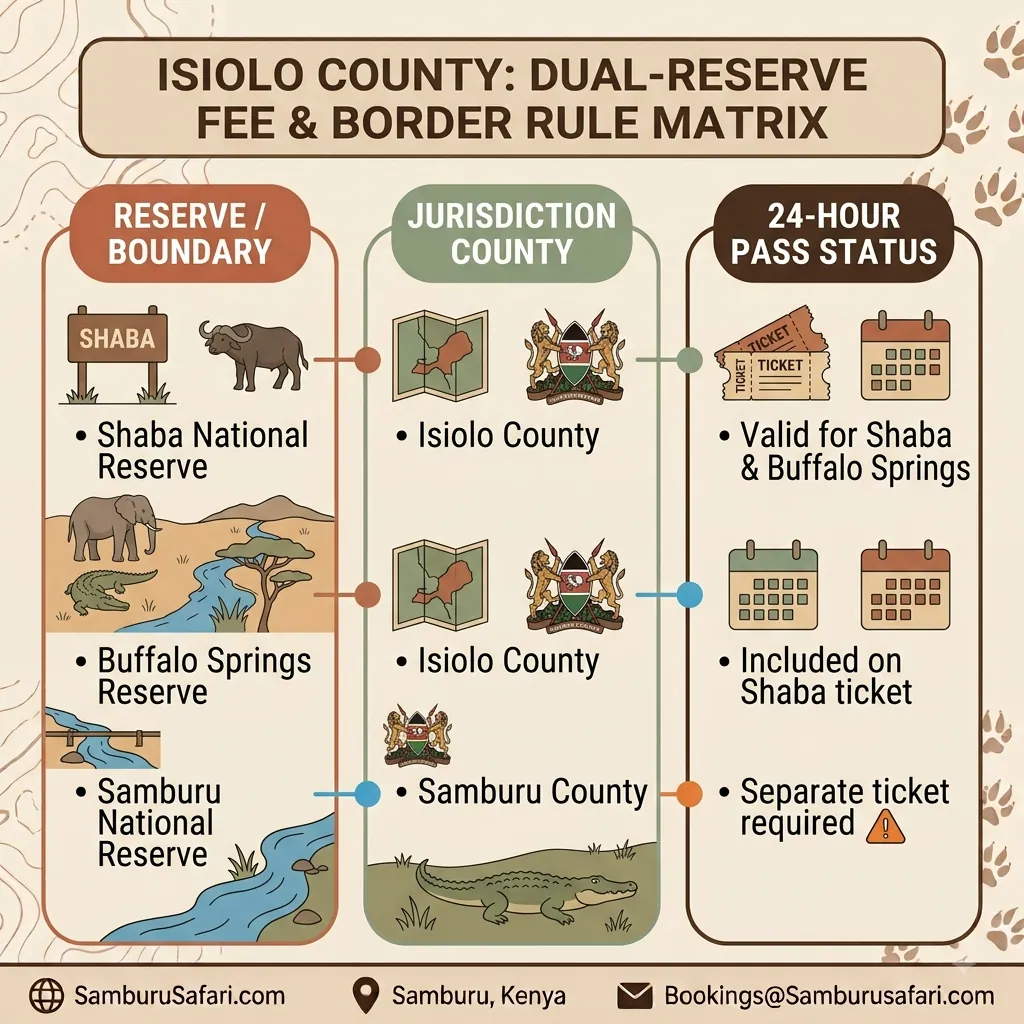
Shaba’s park fees are managed by the Isiolo County Government, and gate tickets stay valid for 24 hours from entry.
Visitor Category | What You Need at the Gate |
International non-residents | Included in all our package quotes |
Kenyan residents (EAC) | Valid resident work permit or ID |
Kenyan citizens | Valid Kenyan national ID |
Vehicle entry | Paid daily per vehicle at Shaba Gate |
One thing worth knowing: because Shaba and Buffalo Springs are both Isiolo County, a single ticket covers both within the same 24 hours. Cross the river into Samburu National Reserve and you are in a new county, paying again. Current rates and the full county fee logic sit on our Samburu park fees page.
Navigating park fees across the Ewaso Nyiro River requires understanding county jurisdiction boundaries. Because Shaba National Reserve and Buffalo Springs are both managed by Isiolo County, a single 24-hour gate permit grants cross-reserve entry. However, crossing into Samburu National Reserve enters Samburu County, requiring a completely separate entry pass.
Reserve / Boundary | Jurisdiction County | 24-Hour Pass Status |
Shaba National Reserve | Isiolo County | Valid for both Shaba and Buffalo Springs. |
Buffalo Springs Reserve | Isiolo County | Included on the same 24-hour Shaba ticket. |
Samburu National Reserve | Samburu County | Separate ticket required upon crossing the river. |
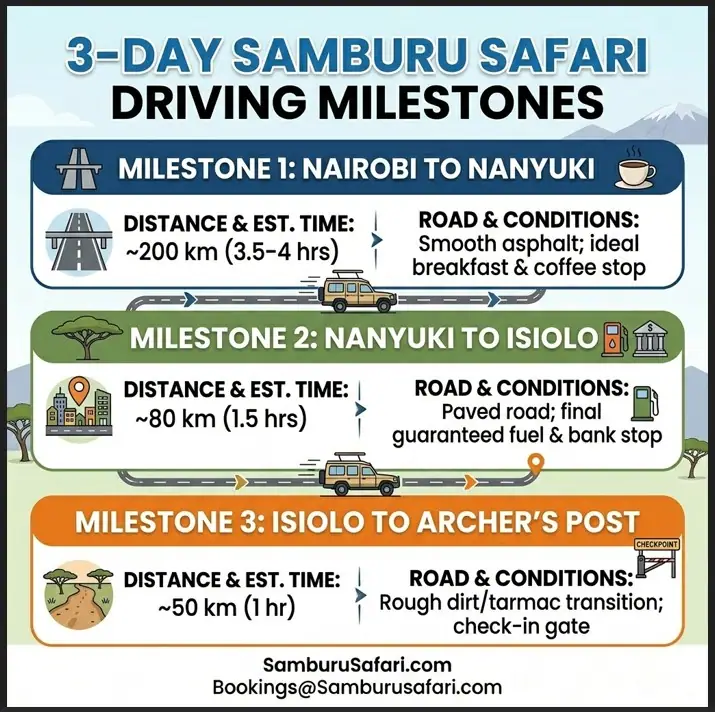
Nairobi to Shaba takes roughly five and a half hours on the paved A2, past Thika, Nyeri, and Nanyuki, then down the slopes of Mount Kenya into Isiolo.
Cross through Isiolo and drive east on the A2 tarmac until the main Shaba Gate signpost. Once you turn through the gate the tarmac ends and you are straight onto unpaved volcanic dirt and rough basalt track. Full route detail with fuel stops is on our driving from Nairobi to Samburu page.
Crossing the boundary into Shaba the air gets noticeably hotter. You smell dry sulphur, warm basalt dust, and wet palm along the river channels.
Online guides treat Shaba like a quiet clone of Samburu. It is not. Here are seven things standard travel pages skip.
Sarova Shaba sits over natural freshwater springs that bubble out of the volcanic soil before feeding into the river.
The clear spring ponds hold small native fish. After a long dusty morning you can sit on the stone ledges with your feet in cool spring water and let them nibble away while weavers build nests in the palms overhead. Gimmicky, ticklish, and genuinely reviving in that order.
Evenings at Sarova Shaba centre on the heavy timber deck above the muddy current. Staff run a crocodile feeding from the platform, and large Nile crocodiles gather in the shallows below as scraps go down. It is a remarkably close look at them with no engine running. Confirm the timing at reception on arrival, since it shifts.
Most people know Joy Adamson for Elsa the lioness. Fewer realise she spent her final years here in Shaba rehabilitating a hand-reared leopard called Penny, and that she was killed in the reserve in January 1980.
Her old field camp site sits deep in the reserve along the riverbank — a quiet, historical spot that very few visitors ever ask to see. Ask your guide; most will happily route past it.
Forget flush toilets, lawns, or perimeter fences. Shaba has no serviced public campsites. You pitch at designated special campsites like Funan.
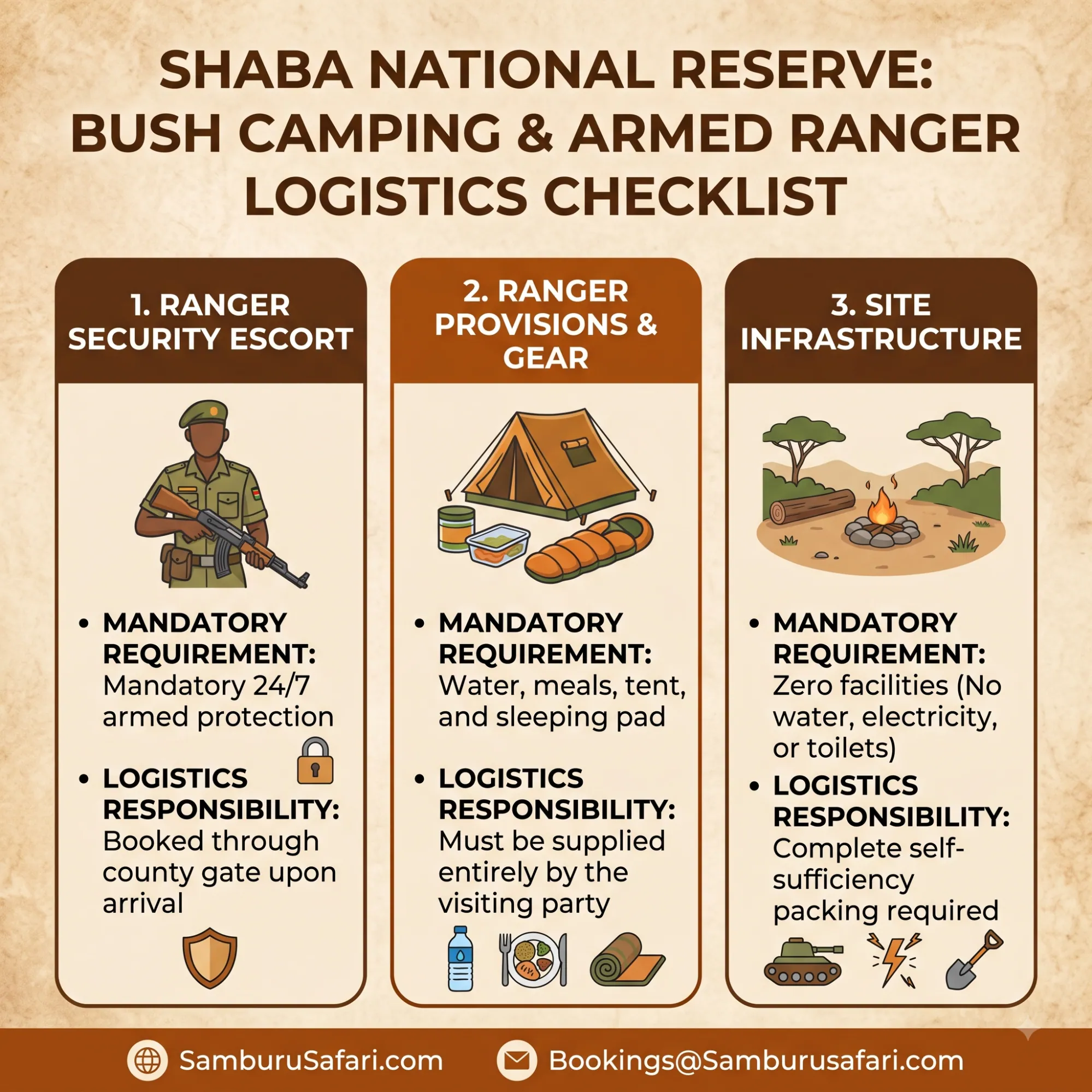
County rules require armed rangers for night security. Here is what the brochures leave out: those rangers arrive with no food, no water, and no sleeping gear. Our cruiser carries extra tents, pads, water containers, and meals for the ranger escort. Fail to feed and shelter your rangers and you will have a very uncomfortable night. The wider rules are covered in our camping in Samburu guide.
Camping at Shaba’s designated special campsites like Funan offers an un-fenced, authentic wilderness experience without crowd interference. However, Isiolo County mandates armed ranger security for all overnight stays. Hikers and self-drive campers must provide full provisions and shelter for their assigned ranger escorts, as base campsites lack water, fuel, and food services.
Operational Component | Mandatory Requirement | Logistics Responsibility |
Ranger Security Escort | Mandatory 24/7 armed protection | Booked through county gate upon arrival. |
Ranger Provisions & Gear | Water, meals, tent, and sleeping pad | Must be supplied entirely by the visiting party. |
Site Infrastructure | Zero facilities (No water, electricity, or toilets) | Complete self-sufficiency packing required. |
Volcanic activity shaped this whole landscape, and the ground is littered with jagged black lava rock and dry stone lagas.
I once took a standard tour van on highway tires onto the tracks out here. The rock went through two sidewalls inside three kilometres. Heavy-duty all-terrain tires on a proper 4×4 are not optional here — they are what stops you sitting in 38°C heat waiting for help. Anyone considering self-driving should read the vehicle spec before booking a rental.
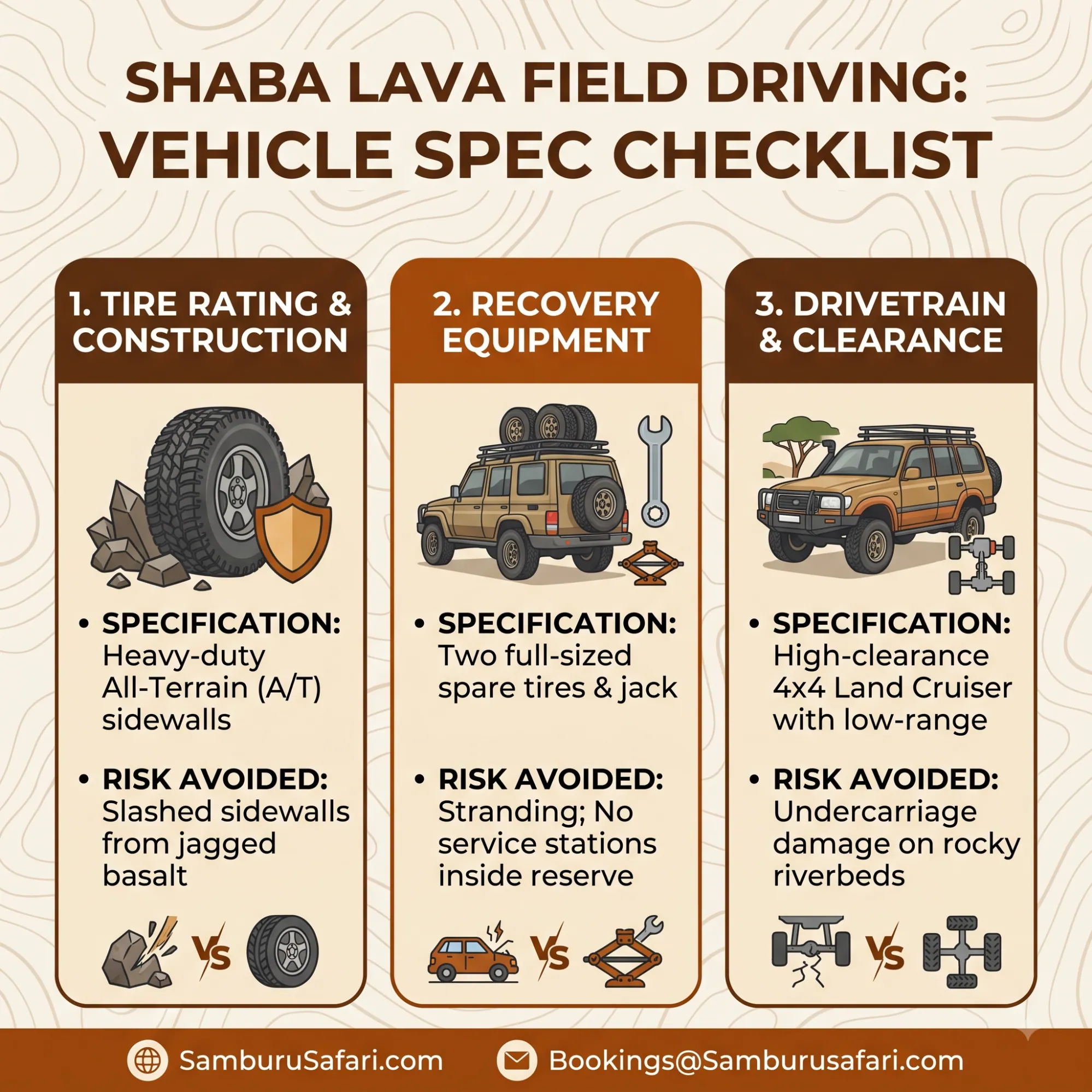
Shaba’s terrain is dominated by razor-sharp black basalt lava fields and dry stone lagas that easily destroy standard highway tires. Driving through the reserve demands heavy-duty all-terrain equipment and high ground clearance to handle the heat and rough rock. Following these vehicle specs prevents costly tire punctures and breakdowns far from mechanics.
Vehicle Component | Recommended Specification | Critical Risk Avoided |
Tire Rating & Construction | Heavy-duty All-Terrain (A/T) sidewalls | Prevents slashed sidewalls from jagged basalt lava. |
Recovery Equipment | Two full-sized spare tires & jack | Avoids strandings; no service stations inside reserve. |
Drivetrain & Clearance | High-clearance 4×4 Land Cruiser with low-range | Prevents undercarriage damage on rocky riverbeds/lagas. |
Shaba is a serious birding destination. The short-grass glades between the black volcanic rocks hold species you will struggle to find elsewhere in Kenya, and the cliffs and river palms add raptors and Vulturine Guineafowl to the list.
Serious birders come specifically for it, and the wider ecosystem list runs well past 450 recorded species.
Shaba’s black rock and total lack of crowds have drawn film crews for decades. In 2001, producers built a fortified thorn boma here to shoot Survivor: Africa, with contestants living inside under guard by local Samburu Morans to keep lions and hyenas out. That tells you plenty about how raw this landscape still is.
Volcanic heat. Black basalt absorbs sun all day, so mid-afternoon inside Shaba feels hotter than neighbouring Samburu. Windows down or aircon running, drink constantly, and keep drives to early morning and late afternoon.
Search effort. Wildlife is spread thin across vast unfenced volcanic scrub. You will not find ten vehicles stacked around a single lion. You have to track actively, which is the point.
Fill up in Isiolo. Once you turn through Shaba Gate there are no fuel stations or workshops inside the reserve. Full tank before you enter.
June to October and January to February. Animals gather on the Ewaso Nyiro and the natural springs, and the tracks are firm. Our best time to visit Samburu guide covers the full year.
Roughly 314 kilometres, a five and a half to six-hour drive north via the paved A2 through Nyeri, Nanyuki, and Isiolo.
Samburu has higher wildlife density and easier viewing along the open river tracks. Shaba gives you far greater privacy, dramatic volcanic scenery, and real history without the crowds.
From crocodiles off the deck at Sarova Shaba to the black lava trails under Mount Shaba, this reserve is a genuinely quiet adventure. Browse the full range across our Samburu safari packages, or talk to our team about transport, permits, and lodges.
Park access, camping rules, and track conditions checked on the ground by our guides. Last updated July 2026.
Message us directly for custom itineraries and the latest seasonal offers.