
Shaba hits you first with silence, then with the smell of wet earth and sulphur as artesian water bubbles up through black volcanic rock. Sitting on the timber deck at dusk, you will not hear another engine. You hear spring water trickling and a lion calling somewhere across the lava hills.
When clients ask for an honest Elewana Joy’s Camp review, we point at three things: wilderness isolation, deep history, and springs that pull game right up to your tent deck.
Written by Patrick Mulei. Reviewed by Anthony Mule.
These quotes cover two adults travelling together. Every rate includes Joy’s Camp full board accommodation, private or stationed 4×4 Land Cruiser transit with guide and fuel, park entry permits, and AMREF emergency evacuation cover.
Package Setup | Transport & Details | Best Suited For | Rate Per Person |
2N Overland 4×4 Safari — Joy’s Camp (Shaba) | 3 days private 4×4 & guide • Full board stay and Shaba permits | Road travellers and short breaks | $2,840 — Get a quote |
2N Luxury Fly-In Safari — Joy’s Camp (Shaba) | Return flights Wilson → Chaffa • Stationed 4×4 game drives | Limited time, fast transfers | $3,400 — Check dates |
Package Setup | Transport & Details | Best Suited For | Rate Per Person |
3N Overland Northern Circuit — Joy’s Camp (2N) + Lewa Safari Camp (1N) | 4 days private 4×4 & guide • Shaba and Lewa conservancy fees | Multi-reserve tracking across Laikipia and Shaba | $4,015 — Price this trip |
3N Luxury Sky Circuit — Joy’s Camp (2N) + Elewana Tortilis Camp (1N) | All internal bush flights • Private guide transfers and permits | Bush-to-bush luxury by air | $4,650 — Build my itinerary |
Inclusions: Full board stay, private or stationed 4×4 Land Cruiser with guide and fuel, Shaba Reserve fees, AMREF evacuation cover, and regional bush flights on fly-in options.
Exclusions: International flights, visas, personal travel insurance, cellar wines, tips, and Reteti Elephant Sanctuary entry.
That Lewa leg extends naturally into our 7 day northern Kenya circuit if you have the time for it.
Joy’s Camp is the only operator running daily game drives inside Shaba National Reserve proper. While vehicles from other lodges work the central Samburu circuits, guests here have 239 square kilometres of volcanic terrain, oases, and gorges effectively to themselves.
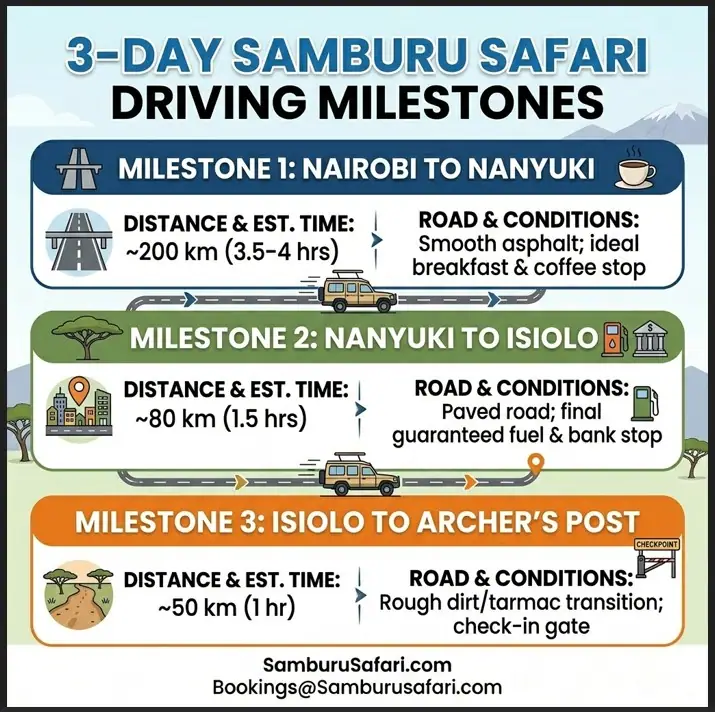
You track reticulated giraffe, Beisa oryx, and lions without seeing another vehicle for hours. To reach central Samburu, your guide simply drives west toward Archer’s Post — a 45-minute run, which is the honest cost of this much solitude.
Joy’s Camp sits on the site of Joy Adamson’s final tented home, where she rewilded Penny the leopard. The on-site museum holds original photographs, letters, and artefacts from her years out here.
Patrick’s field verdict: “Tour the museum before your afternoon drive and take ten minutes over Joy’s hand-typed notes. Standing where she fed Penny makes the evening drive across Shaba feel like a different trip entirely.”
Seventeen artesian springs feed a green oasis in the middle of the lava fields. The lounge and suites overlook the primary spring pond, floodlit after dark so you watch lions, elephants, buffalo, and oryx drink through dinner.
Anthony’s field tip: “If you want big cats from camp, ask your guide to work the spring marsh behind Tent 4 at dawn. The prides use the volcanic ridge as a lookout before coming down to drink.”
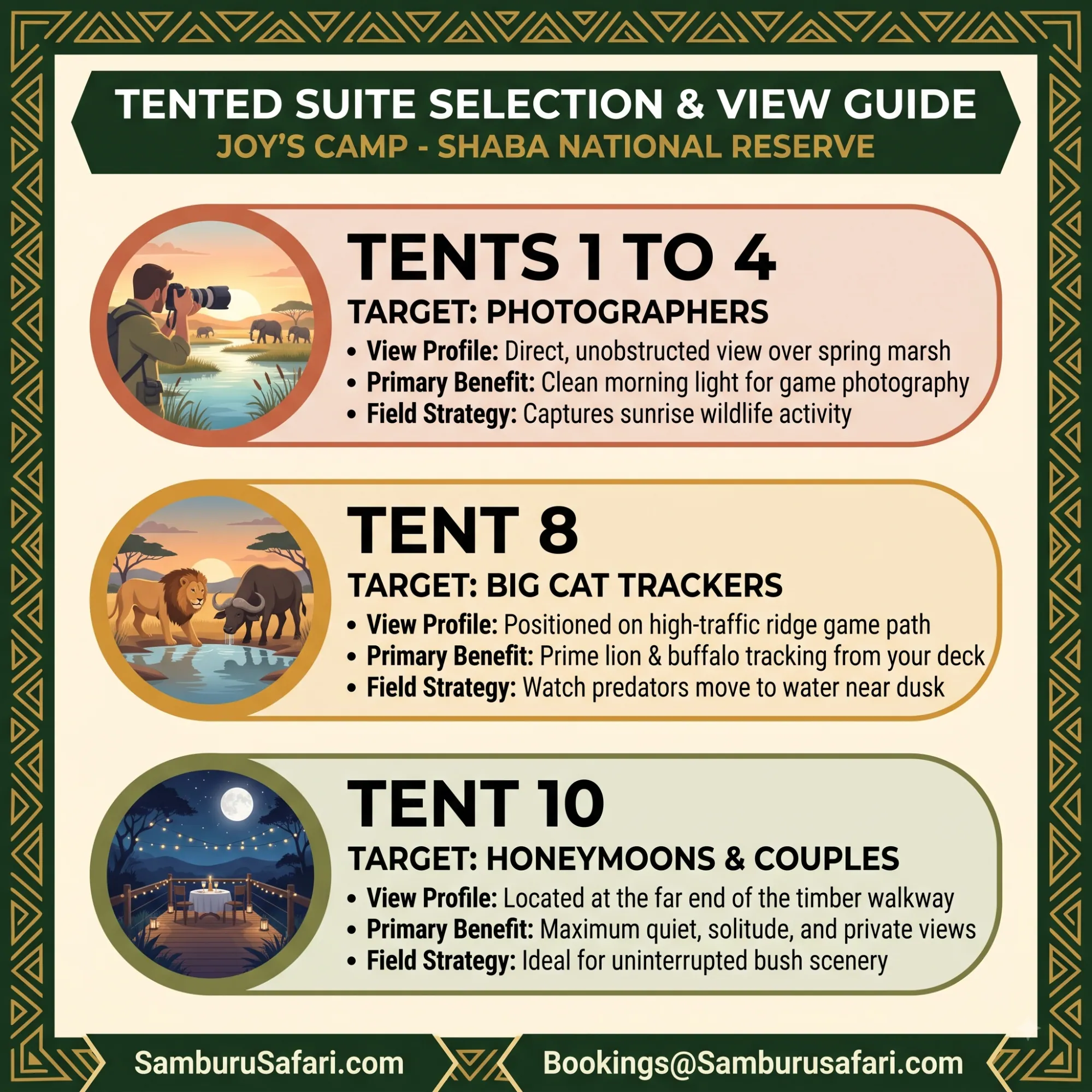
Selecting the right tented suite at Elewana Joy’s Camp depends on whether you prioritize morning photography angles, direct big cat tracking, or ultimate privacy. All ten suites overlook the primary spring-fed marsh, but specific locations offer distinct vantage points. Positioned along high timber walkways and active wildlife corridors, each tent yields different field benefits. Use the breakdown below to match your itinerary style with the ideal tent assignment.
Suite Selection | View & Location Profile | Primary Traveler Benefit |
Tents 1 to 4 | Direct, unobstructed spring marsh view | Clean morning light for photographers |
Tent 8 | High-traffic ridge game path | Prime lion & buffalo tracking from deck |
Tent 10 | End of walkway, maximum isolation | Quiet, private setting for honeymoons |
Unless you actively enjoy a dusty six-hour drive from Nairobi, fly into Chaffa. The 15-minute transfer alone justifies the fly-in package.
Chaffa airstrip sits in neighbouring Nakuprat-Gotu Conservancy on Shaba’s border, and the drive from there to camp takes 15 minutes, against 45 to 60 minutes of rough transit from Buffalo Springs. Full flight logistics sit on our fly-in safari package page.
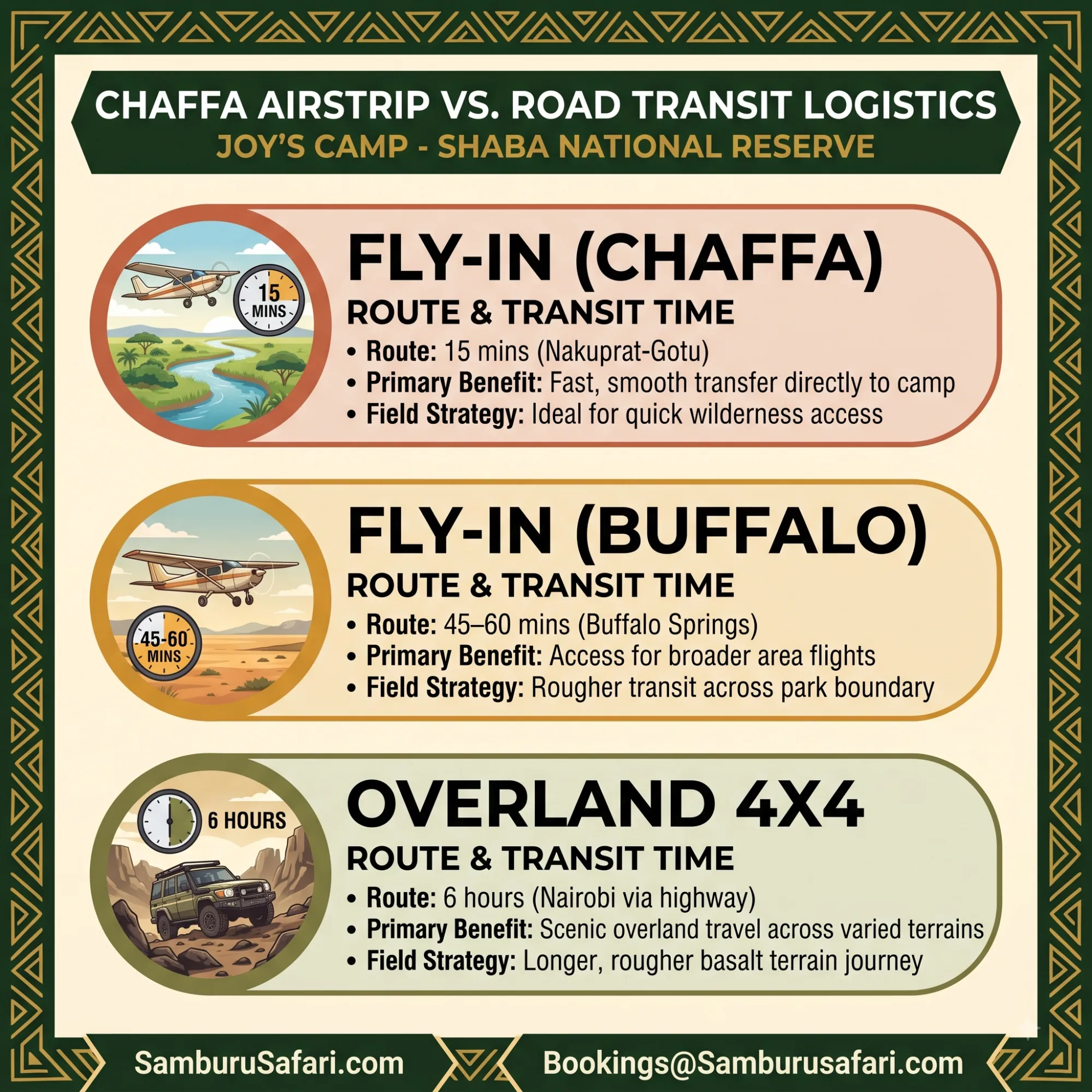
Arriving at Joy’s Camp involves choosing between a brief domestic flight or an overland road expedition through northern Kenya. While fly-in packages utilize the adjacent Chaffa Airstrip for minimal transfer times, road transit offers scenic overland travel across varied terrains. The rough volcanic soil and black cotton dirt inside Shaba make transfer efficiency a major factor. Compare the transit routes below to choose the best arrival method for your schedule.
Arrival Method | Route & Transit Time | Terrain & Transfer Experience |
Fly-In (Chaffa) | 15 mins (Nakuprat-Gotu) | Fast, smooth transfer directly to camp |
Fly-In (Buffalo) | 45–60 mins (Buffalo Springs) | Rougher transit across park boundary |
Overland 4×4 | 6 hours (Nairobi via highway) | Scenic road trip, rougher basalt terrain |
Every suite runs to 80 square metres, raised on high timber platforms under shade thatch.
Rather than the usual British colonial styling, the tents draw on Borana and Somali pastoralist design — hand-woven nomadic textiles, bold cloth patterns, and custom glasswork reflecting northern Kenya’s pastoral cultures.
Each suite has a private veranda with sun loungers, an en-suite with double vanities, and a hot shower fed by spring water. For canvas alternatives at every price point across the ecosystem, see our roundup of the best tented camps in Samburu.
Drawing on its Cheli heritage within the Elewana Collection, the kitchen blends Northern Italian cooking with fresh Kenyan produce — handmade pastas, risottos, organic salads, served on your deck or at bush dinners.
Moses recommends coffee on the veranda at 6:00 AM, when the birds come awake across the marsh. It is the quietest half hour of the day and most guests sleep through it.
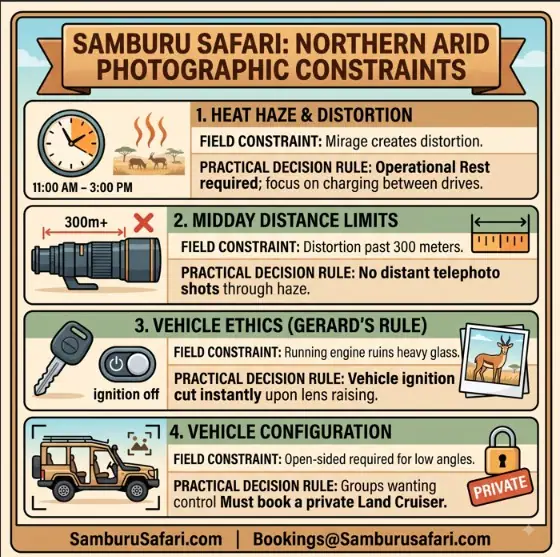
By 2:00 PM the black basalt works like an oven. Ceiling fans help, but the fix is a dip in the spring pool before the afternoon drive.
Power runs on a split system: 24/7 solar for lighting and hot showers, with 220V in-tent sockets on generator hours in the morning and evening. A 24-hour lounge station charges camera gear at any time, which is where you leave the batteries overnight.
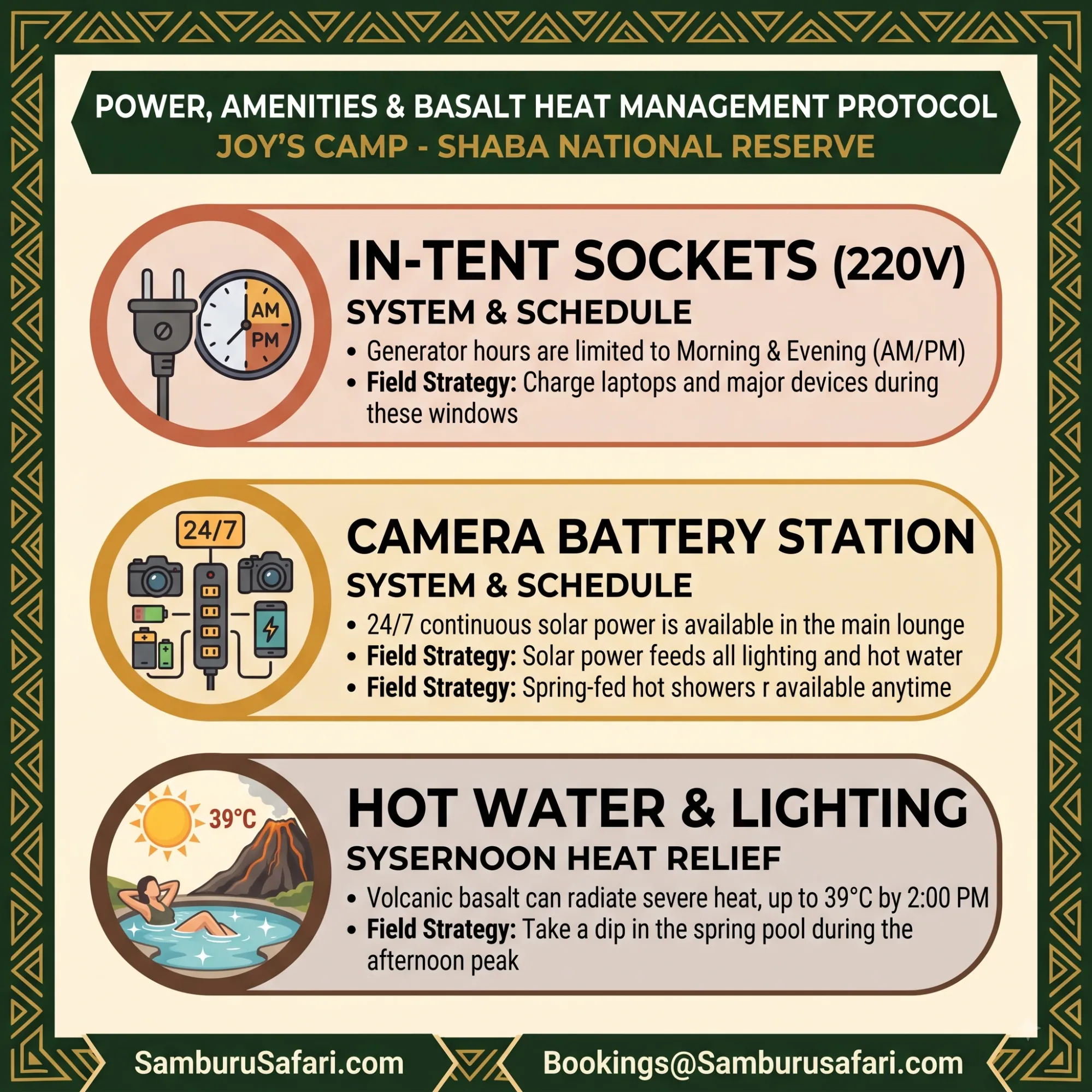
Managing daily comfort in Shaba Reserve requires adapting to high basalt rock temperatures and a split power grid. Solar energy handles constant lighting and spring water heating, while heavy electrical charging runs on generator windows. A central lounge station provides continuous battery support for photography gear throughout the day. Use this field protocol to optimize camera charging and stay cool during peak afternoon heat.
Operational Feature | System & Schedule | Field Strategy / Tip |
In-Tent Sockets (220V) | Generator hours (AM/PM) | Charge devices during morning & evening |
Camera Battery Station | 24/7 continuous solar (Lounge) | Leave main camera batteries overnight |
Hot Water & Lighting | 24/7 continuous solar power | Spring-fed hot showers available anytime |
Afternoon Heat Relief | Volcanic basalt heat (39°C) | Dip in spring pool during 2:00 PM peak |
Feature / Factor | Joy’s Camp (Shaba) | Saruni Samburu (Kalama) | Elephant Bedroom (Samburu) |
Vibe / Environment | Spring-fed oasis and lava terrain | High mountain ridge views | Classic riverbank forest |
Crowd Levels | Ultra-low, exclusive in Shaba | Low, private conservancy | Moderate to high, core park |
Best For | Couples, history lovers, isolation | Honeymooners, panoramic views | First-timers wanting river game |
Distance to Core River | 45 minutes | 30 minutes | On the riverbank |
Full write-ups sit in our Saruni Samburu review and Elephant Bedroom Camp review. For the resort-scale option in the same Shaba landscape, see Sarova Shaba.
Terrain friction. Black cotton soil and sharp volcanic rock will test your Land Cruiser’s suspension. It is bumpier than central Samburu. You also will not share a single sighting.
Distance to the core river loops. Sitting deep in Shaba means 45 minutes to reach the main Samburu river circuits.
Socket windows. The 220V in-tent sockets only run during generator hours, so plan camera charging around morning and evening — or use the lounge station.
Compare every property in our roundup of the luxury lodges in Samburu, or browse full routes across our Samburu safari packages.
Children are welcome, but supervision has to be constant. The camp is completely unfenced and built around open water where wildlife drinks day and night.
The dry season, July to October and January to March, when animals concentrate on the camp’s springs. The green season (April–May and November) brings lush vegetation, lower rates, and excellent birding.
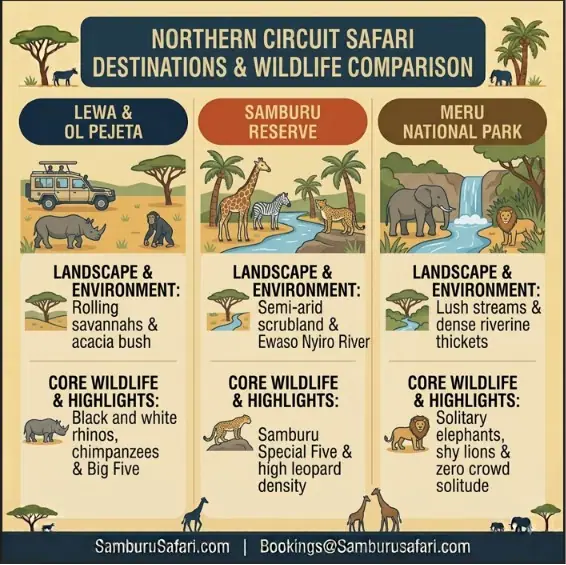
The Samburu Special 5 — reticulated giraffe, Grevy’s zebra, Beisa oryx, Somali ostrich, and gerenuk — alongside lions, leopards, and elephant herds.
No. It sits inside Shaba National Reserve, part of the greater Samburu ecosystem just east of Samburu and Buffalo Springs.
A 15-minute 4×4 drive, which makes the fly-in transfer quick and comfortable.
Suite layouts and rates verified directly with camp reservations. Last updated July 2026.
Message us directly for custom itineraries and the latest seasonal offers.