
Quick Answer: Staying at tented camps in samburu offers immersive bush living along the Ewaso Nyiro River and neighbouring conservancies. Guests experience canvas bucket showers, dawn wake-up trays, solar battery limits, and night warrior escorts while watching wildlife move through unfenced riverine corridors.
Written by Angie Muthoni. Reviewed by Gerard Murero.
The right camp depends on your budget, whether you are travelling with children, and whether you want riverfront action inside the reserve or exclusive activities in a private conservancy.
Tented Camp | Location / Reserve | Price Tier | Best For | Key Feature |
Elephant Bedroom Camp | Samburu NR (riverfront) | Luxury | Intimate wildlife | Elephants roaming directly through camp |
Samburu Intrepids | Samburu NR (riverfront) | Mid-range | Families | Interconnected family tents & kids’ club |
Soroi Larsens Camp | Samburu NR (riverfront) | Mid-range / luxury | Classic safari | Private riverfront decks & photo hide |
Sasaab Camp | Westgate Conservancy | Ultra-luxury | Couples / honeymoon | Open canvas suites & private plunge pools |
Saruni Samburu | Kalama Conservancy | Ultra-luxury | Views & culture | Clifftop eco-suites with 360° views |
Samburu Riverside Camp | Near main gate | Budget | Value travellers | Direct Ewaso Nyiro views on a budget |
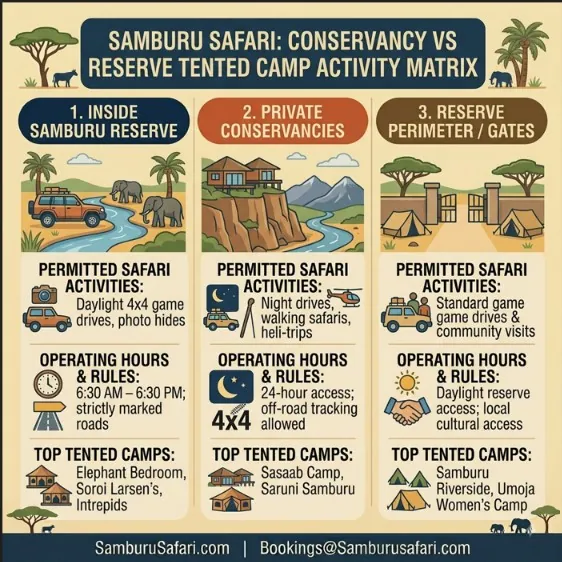
Travellers heading north are often confused about where camps sit relative to the park gates:
” Samburu conservancy vs reserve tented camp activities” / “night game drives walking safaris Samburu camps”
Choosing between a tented camp inside Samburu National Reserve and one in bordering private conservancies significantly impacts available safari activities. Reserve camps offer immediate access to core wildlife circuits along the Ewaso Nyiro River, operating strictly within official daylight hours. Conservancy camps operate with total operational flexibility, enabling night game drives, foot tracking, and helicopter charters. The comparison below breaks down permitted activities, operating hours, and location privileges across both zones.
Location Category | Permitted Safari Activities | Operating Hours & Rules | Top Tented Camps |
Inside Samburu Reserve | Daylight 4×4 game drives, photo hides | 6:30 AM – 6:30 PM; strictly marked roads | Elephant Bedroom, Soroi Larsen’s, Intrepids |
Private Conservancies | Night drives, walking safaris, heli-trips | 24-hour access; off-road tracking allowed | Sasaab Camp, Saruni Samburu |
Reserve Perimeter / Gates | Standard game drives & community visits | Daylight reserve access; local cultural access | Samburu Riverside, Umoja Women’s Camp |
Elephant Bedroom Camp (inside reserve, riverfront) — Set on the shaded banks under ancient Doum palms, with 12 spacious canvas tents on elevated wooden decks, each with a private plunge pool over the water. True to the name, family herds walk through camp, drinking from the plunge pools or feeding on fallen palm nuts beside guest verandas. Access via Samburu main airstrip.
Soroi Larsens Camp (inside reserve, riverfront) — Classic luxury canvas with private timber decks facing the river, a dedicated photography hide over a watering hole, and a riverfront dining deck. Guided naturalist walks run around the camp perimeter.
Sasaab Camp (Westgate Conservancy) — On a high ridge overlooking the Ewaso Nyiro, with nine Swahili-Moroccan open-air canvas suites, each over 100 square meters, each with a private plunge pool and open-air bathroom. It is the launchpad for helicopter safaris into the Suguta Valley, camel safaris, and village visits to the Singing Wells. Flights land at the private Sasaab airstrip.
Saruni Samburu (Kalama Conservancy) — Perched on granite boulders, with open-front clifftop canvas and stone villas and views running to Mount Kenya. Night drives, kopje stargazing, and walking safaris all run from the door. Flights land at Kalama airstrip.
Samburu Intrepids (inside reserve, riverfront) — 28 canvas tents raised on timber decks along the river, and the standout choice for families thanks to interconnected suites, a large pool, and an active kids’ club run by local Samburu naturalists.
Ashnil Samburu Camp (Buffalo Springs side) — On the southern riverbank inside Buffalo Springs, with 56 modern luxury canvas tents facing the water, a large swimming pool, conference facilities, and quick access via the Buffalo Springs gate.
Value-focused travellers will find simple, clean canvas accommodation along the river perimeter near Archer’s Post gate — full board, hot bucket showers, and river views at accessible prices. Samburu Riverside Camp is the best known of these.
Just outside the reserve near Archer’s Post, the community-run Umoja camp is operated by a local Samburu women’s cooperative. Staying there supports women’s empowerment work, artisan beadwork projects, and village schools directly.
If you want to go lower still and pitch your own tent, camping in Samburu covers the public and special campsites, their facilities, and the ranger escort rules.
Sleeping under canvas in northern Kenya works on all your senses at once. At 5:30 AM a steward knocks softly on the tent frame and leaves a thermos of hot Kenyan coffee, ginger tea (chai ya tangawizi), and biscuits on your verandah. Unzip the door and the light coming through the Doum palms is red.
Tented living here splits into two architectural styles: elevated timber platforms and ground-level pads. Elephant Bedroom Camp and Samburu Intrepids raise their suites three to six feet off the dirt, which puts a solid barrier between you and anything crawling through the leaf litter at night — camel spiders, scorpions, the occasional spitting cobra.
Eco-tented properties use overhead canvas bucket showers rather than piped plumbing. Ask for hot water and a steward fills an elevated pulley bucket with 20 litres of solar- or wood-fire heated well water. That ration gives you five to seven minutes of steady hot water. Plan accordingly.
Canvas amplifies everything. At night you hear the low rumbles of elephants wading through river mud, lion roars carrying up the dry washouts, and hyenas laughing along the camp perimeter, all straight through the tent wall.
“Samburu tented camp bucket showers elevated decks” / “tented camp styles Samburu”
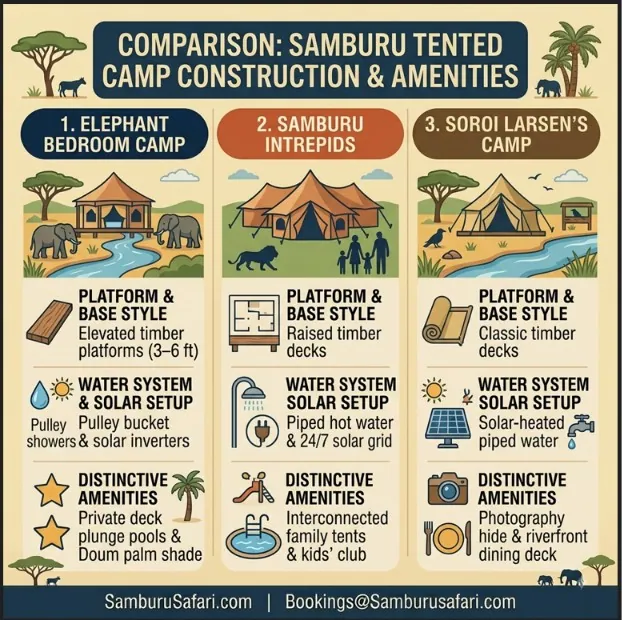
Tented accommodation in Samburu generally splits into two architectural styles, each offering distinct advantages for comfort and wildlife viewing. Raised wooden platforms provide an elevated barrier against ground insects, while ground-level pads offer direct proximity to riverine paths. Additionally, water systems vary between eco-friendly solar bucket showers and traditional piped plumbing. Review the matrix below to compare structural designs, shower mechanics, and unique living features across top tented properties.
Tented Property | Platform & Base Style | Water System & Solar Setup | Distinctive Amenities |
Elephant Bedroom Camp | Elevated timber platforms (3–6 ft) | Pulley bucket showers & solar inverters | Private deck plunge pools & Doum palm shade |
Samburu Intrepids | Raised timber decks | Piped hot water & 24/7 solar grid | Interconnected family tents & kids’ club |
Soroi Larsen’s Camp | Classic timber decks | Solar-heated piped water | Photography hide & riverfront dining deck |
Living alongside wild animals in an unfenced camp comes with local rules.
At riverfront camps, vervet monkeys and olive baboons have learned to slide canvas zippers open. Staff will hand you carabiners or small brass locks to clip your tent door zippers together. Never keep fruit or snacks inside the tent — primates will open bags to find them.
Between 1:00 PM and 3:30 PM, solar heating drives strong thermal wind gusts along the river corridor. Loose awnings slap against frames if they are not cinched, and the fine red volcanic dust goes straight through standard mesh. Premium suites have double-layered fine-mesh windows with heavy velcro skirts along the bottom edge. Keep them sealed through the afternoon wind and your bedding and camera gear survive it.
“Samburu tented camp safety rules” / “primate zipper clips emergency whistle Samburu”
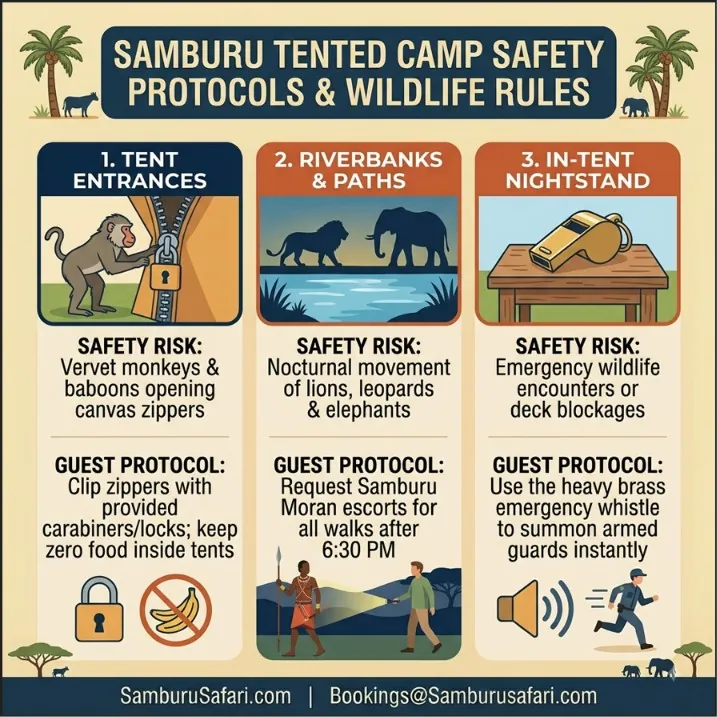
Staying in an unfenced tented camp along the Ewaso Nyiro River requires adherence to specific wilderness protocols to manage wildlife interactions. Camps implement practical security measures—from door security to night movement—to ensure guest safety without compromising the bush experience. Following these simple operational steps prevents wildlife intrusions and ensures a seamless stay under canvas. The table below highlights essential safety protocols, environmental triggers, and guest actions across Samburu tented camps.
Camp Feature / Area | Safety Risk & Constraint | Guest Protocol & Action Required |
Tent Entrances | Vervet monkeys & baboons opening canvas zippers | Clip zippers with provided carabiners/locks; keep zero food inside tents |
Riverbanks & Paths | Nocturnal movement of lions, leopards & elephants | Request Samburu Moran escorts with spears/torches for all walks after 6:30 PM |
In-Tent Nightstand | Emergency wildlife encounters or deck blockages | Use the heavy brass emergency whistle to summon armed guards instantly |
Wilderness camps balance guest comfort against the realities of a solar grid.
Tented properties run on solar arrays coupled to battery inverters. In-tent sockets work around the clock for low-wattage devices — phone chargers, camera batteries, CPAP machines. Generator boosts for heavy charging run in a strict 10:00 AM to 4:00 PM window when solar production peaks. Hair dryers will trip your tent breaker.
Canvas tents have no deadbolts. Nightstands at the riverfront camps carry heavy brass emergency whistles instead. If wildlife blocks your timber deck at night, blowing it brings armed Samburu Morans with searchlights within seconds.
Because the riverbanks are active wildlife corridors for elephants and leopards, camps enforce evening movement rules. After 6:30 PM, guests are escorted to and from tents by Samburu warriors with flashlights and traditional spears.
Around the same hour, camps set up central campfire circles (bomas) near the bank, seating set back at least 15 meters from dense brush, with Moran guards watching the perimeter while guests take drinks under the stars.
If you would rather compare the stone-and-thatch alternatives to canvas, our review of the luxury lodges in Samburu covers the cliff-top villas and eco-lodges side by side.
We design multi-destination itineraries pairing Samburu’s tented camps with private sanctuaries like Ol Pejeta, so you sleep under canvas up north before heading south for vehicle-based rhino tracking.
Every trip below rolls permits, vehicle, guide, and lodging into one fixed price, with the full range under our Samburu safari packages. If the trip is still taking shape, start with the master Samburu safari guide.
The table details our 2027 multi-destination packages for two adults sharing a private 4×4 Safari Land Cruiser.
Package | Trip & Camps | Price Per Person |
Budget Tented Tier | 4D/3N road safari • Samburu Riverside Camp + Comfort Gardens Ol Pejeta • Private cruiser, driver-guide, full board | $1,480 — Get a quote |
Mid-Range Tented Tier | 4D/3N classic circuit • Samburu Intrepids or Ashnil Samburu + Sweetwaters Tented Camp • Riverfront tented stays, rhino tracking, extended drives | $1,820 — Price this trip |
Luxury Fly-In Tier | 4D/3N premium air package • Elephant Bedroom Camp + Sanctuary Tambarare • Roundtrip bush flights, private deck plunge pool, riverfront stay | $3,250 — Check dates |
Luxury Plus Sky Circuit | 5D/4N luxury flight loop • Sasaab Lodge or Saruni Samburu + Ol Pejeta Bush Camp • All bush flights, conservancy permits, open-front suites, spa, night drives | $6,420 — Build my itinerary |
One mistake I see repeatedly on self-drive bookings: guests leave food inside a parked vehicle at camp. Baboons work out the smell in minutes and will tear window rubber to get at it, and the repair bill lands on you. Lock the vehicle, and keep it empty.
The other honest caveat is noise. Canvas walls mean you hear everything, which most guests love and a few genuinely do not. If you are a light sleeper, ask for a tent at the end of the row rather than beside the mess.
Elephant Bedroom Camp, Soroi Larsens Camp, Samburu Intrepids, Ashnil Samburu Camp, and Samburu Riverside Camp all sit along the banks of the Ewaso Nyiro.
Camps inside the main reserve sit right on the prime wildlife river loops but must follow county daylight hours and stay on the roads. Conservancy camps like Sasaab or Saruni offer night game drives, guided bush walks, and off-road tracking.
Yes. Modern tented camps run 24/7 solar-inverter electricity in guest tents for charging and for CPAP machines. Wi-Fi is usually available in the central lounge, though speeds vary in remote river valleys.
Yes. Armed Samburu Moran guards escort guests after dark. Following the camp protocols — clipping door zippers, keeping food out of tents, requesting night escorts — keeps you safe.
Camp details and facilities verified directly with reservations teams. Last updated July 2026.
Message us directly for custom itineraries and the latest seasonal offers.