
Quick Answer: A night game drive samburu experience takes place inside bordering community conservancies like Kalama, Westgate, and Sasaab rather than the main national reserve, which enforces a strict dusk curfew. Using red-filter searchlights, guides track nocturnal wildlife including striped hyenas, aardvarks, leopards, and white-tailed mongooses across open scrubland.
Written by Gerard Murero. Reviewed by Benson Kungu.
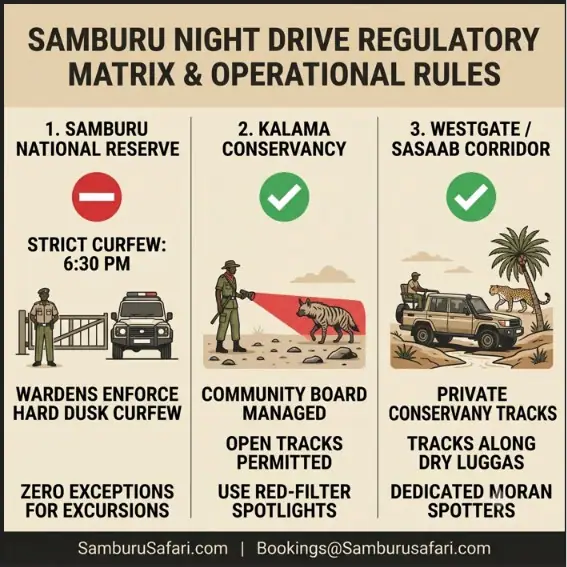
Booking inside Samburu National Reserve expecting to go spotlighting after dinner leads to disappointment. The county enforces a hard 6:30 PM dusk curfew inside the main reserve, and wardens do not bend it.
So you go next door. A legal night drive runs in the bordering community conservancies: Kalama, Westgate, and the Sasaab/Ngutuk Ongiron corridors.
These conservancies share unfenced borders with the reserve. Wildlife moves freely across those boundaries at sunset, which means we track the same leopards and elephants you watched along the Ewaso Nyiro River by day. Collar data from the Save the Elephants research team shows just how much of that cross-boundary movement happens after dark. If the wider trip is still unplanned, the master Samburu safari guide covers routes, seasons, and lodges around it.
“Is night game drive allowed in Samburu” / “Samburu night game drive rules”
Night game drives are strictly prohibited inside the main boundaries of Samburu National Reserve due to a non-negotiable 6:30 PM park curfew. However, world-class spotlighting operates legally in the surrounding community conservancies that share an unfenced border with the reserve. The table below details the legal status, operating boundaries, and key enforcing authority across the Samburu ecosystem. Understanding these distinction ensures your itinerary is booked in the correct conservancy zones without risking heavy fines.
Territorial Zone | Night Drive Legal Status | Enforcing Authority & Operating Terms |
Samburu National Reserve | Illegal (Strict 6:30 PM curfew) | Samburu County Wardens; zero exception for night excursions |
Kalama Conservancy | Legal (Unrestricted night access) | Community Board; open tracks, red-filter spotlights permitted |
Westgate / Sasaab Corridor | Legal (Unrestricted night access) | Westgate Conservancy; private spotter tracks along lug |
Booking a lodge deep inside the main reserve means a long transfer to reach a night-drive conservancy. This table classifies lodges by night drive accessibility:
Lodge / Camp | Location | Night Drive Logistics | Transfer Required? |
Saruni Samburu | Kalama Conservancy | Step straight into night drives from the lodge door | No |
Sasaab Lodge | Westgate / Ngutuk Ongiron | Direct access to Sasaab private conservancy tracks | No |
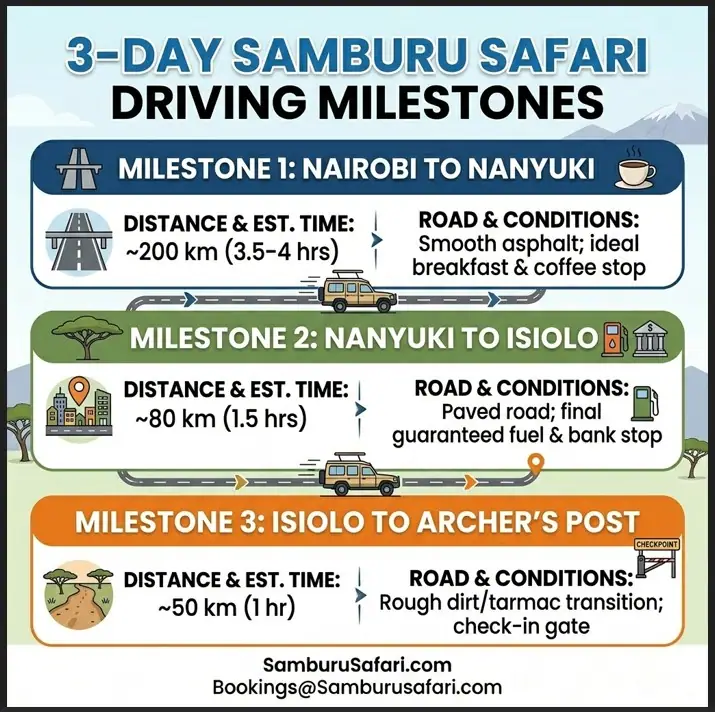
Elephant Bedroom Camp | Inside Samburu Reserve | Must exit via Archer’s Gate to Westgate or Kalama before 6:30 PM | Yes (30–45 min transit) |
Samburu Simba Lodge | Buffalo Springs side | Limited access; requires early exit to Kalama corridor | Yes (45+ min transit) |
Here is what actually happens on the ground between sunset and dinner:
If you are staying inside the national reserve and adding a conservancy night excursion, individual 2027 costs break down as follows:
Do not let the daytime heat fool you. By 8:30 PM, cold air rushes off Mount Ololokwe through the open sides of the cruiser. You will get cold. We pack heavy fleece blankets and hot water bottles, but bring a windproof jacket, trousers, and a warm beanie of your own.
Driving through washouts like Nderoi Lugga, the tires crush wild sage and the whole cab fills with the smell of it. Cool air sinking toward the river traps scent trails from baboons roosting on the sandbanks, and that is what pulls hunting leopards out into the open.
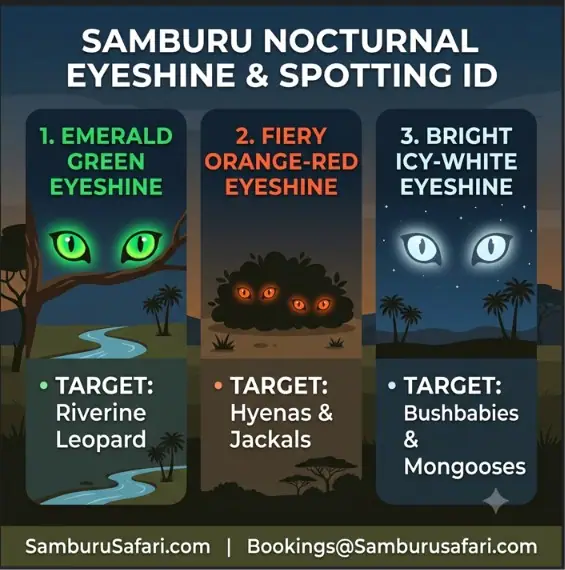
Spotters use searchlights with red filters, since white light blinds predators outright. The beam sweeps the branches looking for eyeshine — light bouncing off the back of an eye:
Learn to read eyeshine and the drive changes completely. The big cats of Samburu you hunted for all morning in palm canopies suddenly announce themselves from a hundred yards out.
“How to identify eyeshine on night safari” / “Samburu night drive animals eyeshine”
Scanning the dark thorn scrub with a red-filter searchlight reveals hidden nocturnal wildlife long before an entire animal comes into full view. The back of a mammal’s eye contains a reflective layer called the tapetum lucidum, which bounces specific light wavelengths back toward the spotter. Learning to distinguish color hues and eye height allows you to identify elusive predators and scrub dwellers instantly. Use this quick field identification guide to read the night during your conservancy spotlighting drive.
Light Reflection Color | Canopy & Ground Position | Target Nocturnal Species |
Brilliant Emerald Green | Mid-tree branches or low scrub | Leopard, African Wildcat, Small-spotted Genet |
Fiery Orange-Red | Ground level along gravel tracks | Striped Hyena, Black-backed Jackal, Lion |
Bright Icy-White | High palm branches or open sand washouts | Greater Galago (Bushbaby), White-tailed Mongoose |
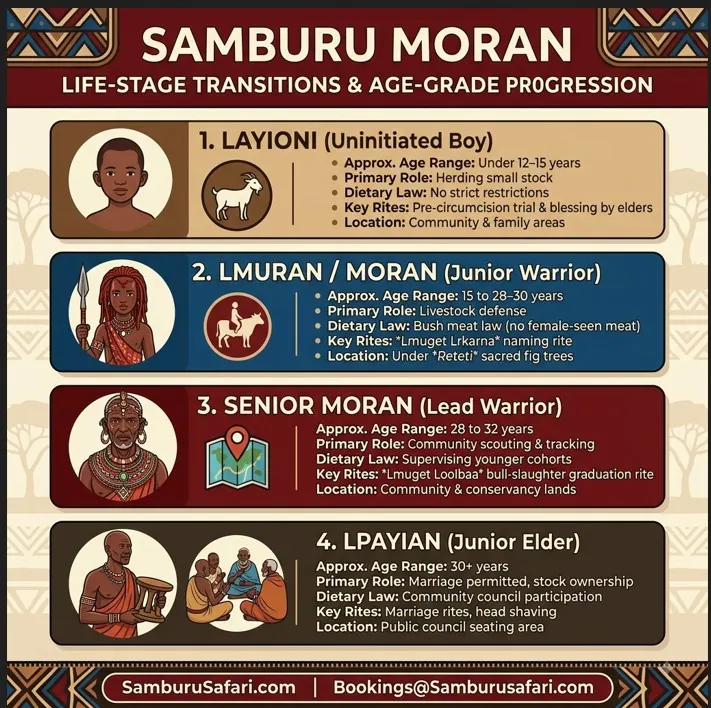
Night drives work because local Samburu Morans ride as spotters alongside our guides. Raised in these hills, they pick up movement in the dark long before anyone else in the vehicle does.
When big game turns up in the dark, safety comes down to strict protocol:
Big Game Protocol (Elephants & Lions): If a herd or a pride approaches the vehicle, we cut the searchlight, kill the engine, and stay completely still. We never put bright light directly into an elephant’s face. That keeps the herd calm and everyone in the rig safe.
When the sun drops, the daytime cast settles and something else takes over.
Daytime drives rarely turn up the shy, solitary Striped Hyena (Hyaena hyaena). Night drives across the stony basalt flats of Kalama give you a real chance. Startle one and the long mane along its spine goes straight up. These are the same flats where Beisa oryx form their defensive rings by day, and the hyenas know exactly where the calves are.
Spotters running the dry riverbeds past Kalama Gate scan the bases of red termite mounds around 9:00 PM for fresh diggings. Aardvarks emerge after dark to feed on ants, moving with their snouts pressed to the gravel.
Heavy White-tailed Mongooses work the riverine acacia thickets after dark, searching sandy tracks for puff adders and spitting cobras and using that bushy white-tipped tail as a waving decoy during a strike.
The browsers stay out too. A gerenuk standing upright against a thornbush at night, lit side-on in red, is one of the odder silhouettes in the northern bush. Overhead, the roosting half of the reserve’s 450-plus bird species sit dead still, hoping the genets pick a different tree.
“What animals are active at night in Samburu” / “Striped hyena night drive Samburu”
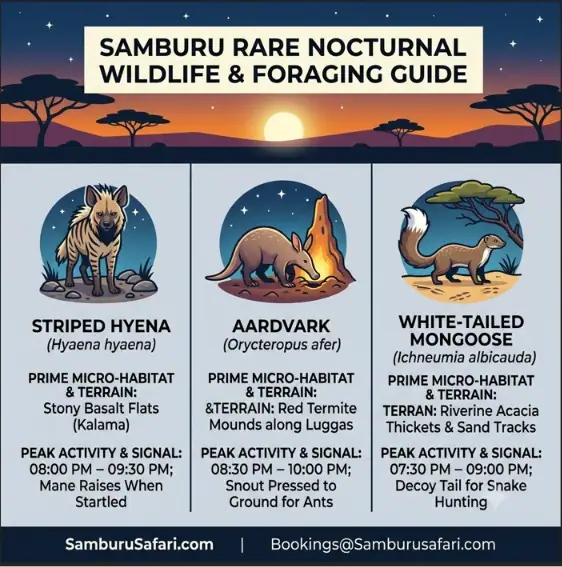
As daytime heat dissipates across northern Kenya, a specialized cast of nocturnal hunters and burrowing mammals emerges across the dry washouts and stony basalt flats. These rare species rely on thermal drops, scent trails trapped in cool river air, and deep termite mound structures to hunt without competing with daytime predators. The guide below highlights the prime nocturnal activity windows, terrain preferences, and unique behaviors of Samburu’s rare night dwellers. Target these micro-habitats during your 7:00 PM to 9:00 PM spotlighting window for optimal sightings.
Rare Target Species | Prime Micro-Habitat & Terrain | Peak Activity Window & Tracking Signal |
Striped Hyena | Stony basalt flats (Kalama) | 08:00 PM – 09:30 PM; long spine mane raises when startled |
Aardvark | Red termite mounds along luggas | 08:30 PM – 10:00 PM; snouts pressed to ground searching for ants |
White-Tailed Mongoose | Riverine acacia thickets & sand tracks | 07:30 PM – 09:00 PM; uses bushy white tail as strike decoy for snakes |
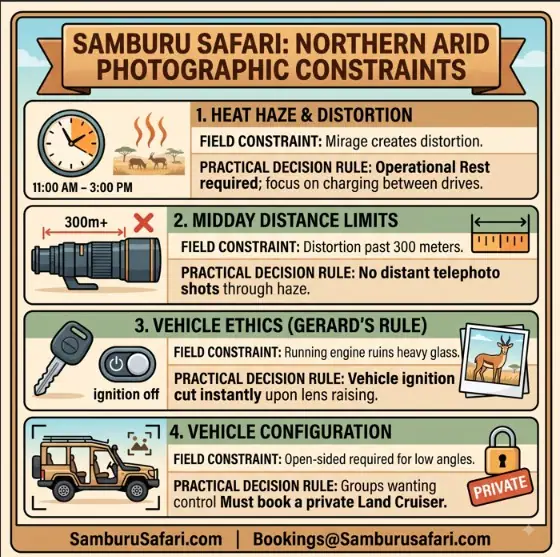
Standard autofocus fails in the dark and a phone captures nothing but blurry shapes under red light. If you are running a proper setup, start here:
Anything less than that, leave the camera in the bag and use your eyes. You will see more.
Night drives are not a non-stop action movie. You can spend an hour scanning scrub and springhares before anything big shows.
Last October I sat 40 minutes in the dark along a Kalama washout, listening to springhares rustle, before a young leopard stepped out of the Doum palms. Forty minutes of nothing. Then emerald green eyes swinging toward the red beam, and every quiet minute paid for itself.
If you would rather cover this same conservancy ground at walking pace in daylight, a guided walking safari with an armed ranger is the other half of the experience.
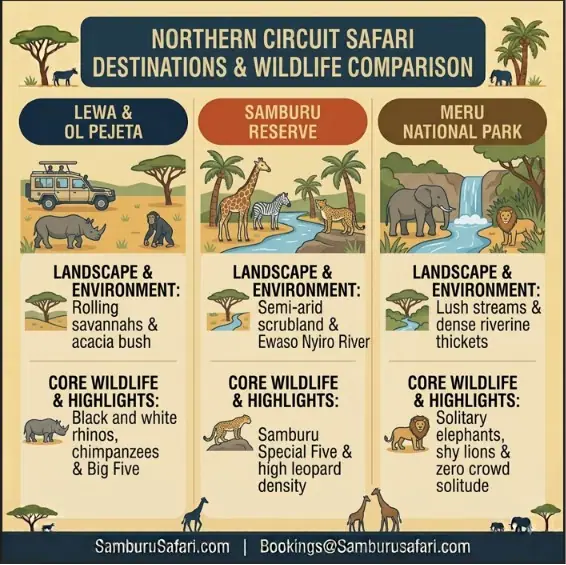
We design itineraries pairing Samburu’s bordering conservancies with Ol Pejeta, so you get legal night drive access up north before heading south to track black rhinos. The nocturnal specialists out here are the reason the northern circuit rewards a second look, much as the Samburu Special 5 reward it by daylight.
Every trip below rolls permits, vehicle, guide, and lodging into one fixed price, with the full range under our Samburu safari packages.
The table details 2027 multi-destination packages for two adults sharing a private 4×4 Safari Land Cruiser.
Package | Trip & Properties | Price Per Person |
Budget Conservancy Tier | 4D/3N overland circuit • Comfort Gardens Ol Pejeta • Private cruiser, driver-guide, 1 guided evening drive in the Kalama corridor | $1,540 — Get a quote |
Mid-Range Conservancy Tier | 4D/3N classic road safari • Samburu Simba Lodge + Sweetwaters Tented Camp • Rhino tracking, waterhole viewing, dedicated spotlighting excursion in Westgate | $1,980 — Price this trip |
Luxury Fly-In Tier | 4D/3N premium air package • Saruni Samburu (Kalama) + Elsa’s Kopje (Meru) • Roundtrip bush flights, unlimited night drives on the Kalama kopjes | $3,650 — Check dates |
Luxury Plus Sky Circuit | 5D/4N luxury flight loop • Sasaab Lodge (Ngutuk Ongiron) + Lewa Safari Camp • All regional flights and conservancy permits, open-front villas, private spotters | $6,420 — Build my itinerary |
Driving your own vehicle at night inside the conservancies is prohibited outright, whatever your daytime arrangements. Every night drive runs with an official 4×4 and a certified local spotter. There is no self-drive version of this one.
Dress for the wind, not the afternoon heat. That is the single mistake we see most often.
No. Night drives are not permitted inside the main gates because of the 6:30 PM dusk curfew. They are legally conducted in bordering community conservancies like Kalama, Westgate, and Sasaab.
Nocturnal drives target animals rarely seen by day: striped hyenas, aardvarks, white-tailed mongooses, genets, bushbabies, and hunting leopards or lions.
Yes, with licensed guides and local spotters. Animals read a vehicle as a single non-threatening object. Guides hold safe distances, use red spotlights, and enforce the in-vehicle rules for good reason.
Night drive timings and eyeshine notes logged on the Kalama and Westgate corridors by our spotters. Last updated July 2026.
Message us directly for custom itineraries and the latest seasonal offers.