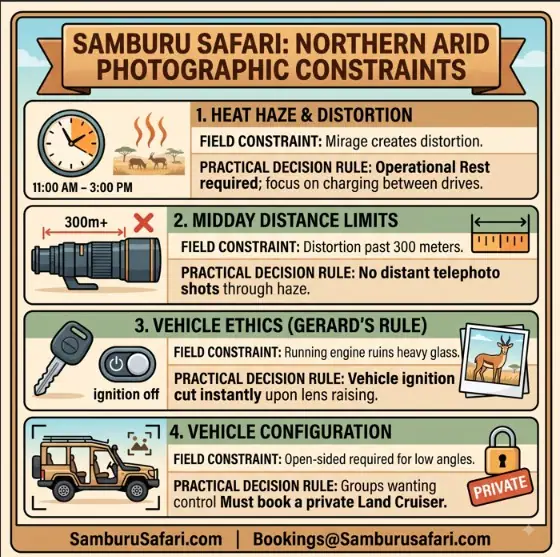

Pull the Land Cruiser up to a riverside clearing on the Ewaso Nyiro and everyone reaches for the long glass. That reflex is the easy part.
The harder part is knowing what happens next — how an elephant matriarch reads a sound she cannot place, what a herder sees when a 500mm barrel swings toward him from a vehicle window. Sharp focus and clean light will not save a picture taken badly. Travellers who ask our team at Samburusafari.com about photography ethics usually arrive expecting gear advice and leave with something closer to fieldcraft, most of it rooted in the Samburu people and how they expect to be treated on their own ground.
“Photography ethics Samburu drone rules and etiquette” / “Photography ethics Samburu drone rules and etiquette” / Photography ethics Samburu drone rules and etiquette
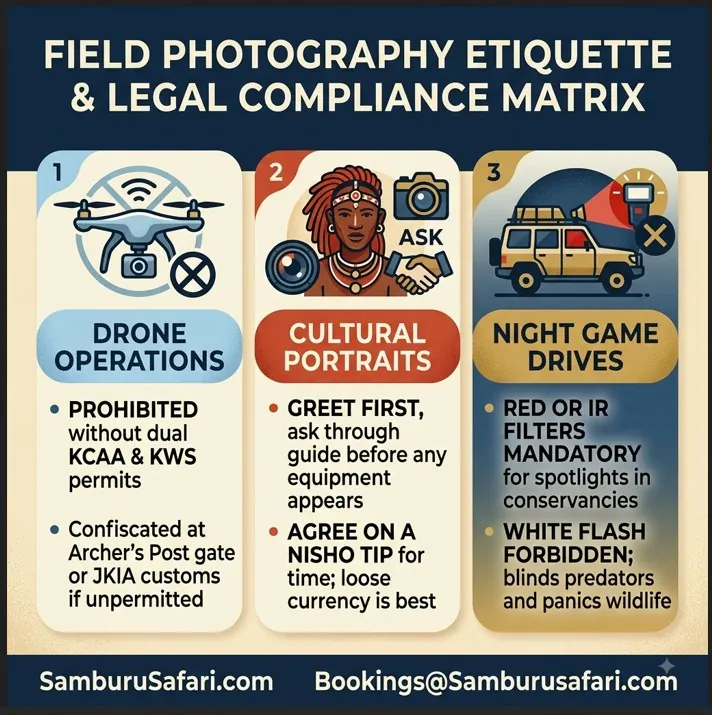
Following strict field photography rules protects wildlife welfare and respects indigenous Samburu communities. Non-compliance risks legal penalties, heavy spot fines, or equipment confiscation at border checkpoints. This matrix summarizes regulatory boundaries, required permits, and essential field behavior for photographers.
Photography Category | Key Regulatory Rule | Required Permit / Etiquette Protocol |
Drone Operations | Prohibited in reserves/conservancies | Dual KCAA & KWS permits (pre-approved) |
Cultural Portraits | No unannounced lens targeting | Agree on a Nisho tip or pay village entry |
Night Game Drives | No white flash or halogen beams | Red or IR filter mandatory in conservancies |
Flying a recreational drone over Samburu National Reserve, Buffalo Springs or the neighbouring conservancies is illegal without dual permits from the Kenya Civil Aviation Authority and the Kenya Wildlife Service. There is no grey area here and no talking your way through it.
Most people never get as far as the reserve. Customs officers at Jomo Kenyatta International Airport find unpermitted drones routinely, and without a KCAA temporary import permit approved weeks before you fly, yours goes into bonded storage until your departure. You collect it on the way home.
Out in the bush the problem is different. Electric drone motors put out a high whine that elephants hear as swarming honeybees — Lotorog in Northern Maa — and a matriarch who thinks bees are coming will trumpet, panic and drive her herd straight at whatever is nearby, which is usually a safari vehicle. Rangers at Archer’s Post and Westgate confiscate unauthorised drones at the gate.
Pointing a long lens at a pastoralist from fifty yards without a word is a boundary breach, and it is read exactly that way. The hostility that follows is earned.
If you want portraits along public roads or the dry laggas, there is a sequence:
Greet first. Camera down. Have your driver-guide call out a proper greeting in Maa — Sopa! — and let a human exchange happen before any equipment appears.
Say what you want. Ask through your guide before the camera comes up.
Agree a Nisho tip. A small negotiated payment for their time. Carry 200 and 500 KES notes loose in a pocket, because fumbling a stack of 1,000s while someone waits sets the wrong tone entirely.
Use the cooperatives. At community-managed villages near Archer’s Post — Umoja Women’s Village, Unity Cultural Village — the entry fee ($20–$30 USD) covers photography rights, and a cultural safari experience there removes the negotiation from the equation. Those fees run into village healthcare escrows and school tuition, which is the mechanism behind how tourism revenue reaches communities across the north.
Ground-level hides — the subterranean Saruni hide in Kalama, the Soroi Larsens hide on the Ewaso Nyiro — put your lens at eye level with drinking animals. They also work as acoustic chambers.
Last August in the Kalama hide, a client left his mechanical shutter on. One burst off the concrete wall sounded like a gunshot. A bull that had just stepped up to the water went straight back into the scrub in a cloud of dust, and the two hours we had spent waiting went with him. We now check silent shutter settings at the lodge, before anyone gets in the vehicle.
July to October and January to March. As natural water dries up across the north, animals concentrate on the permanent conservancy waterholes, and a hide that is quiet in May will be busy in September.
“Samburu photo hide rules and camera settings” / “Samburu photo hide rules and camera settings” / Samburu photo hide rules and camera settings
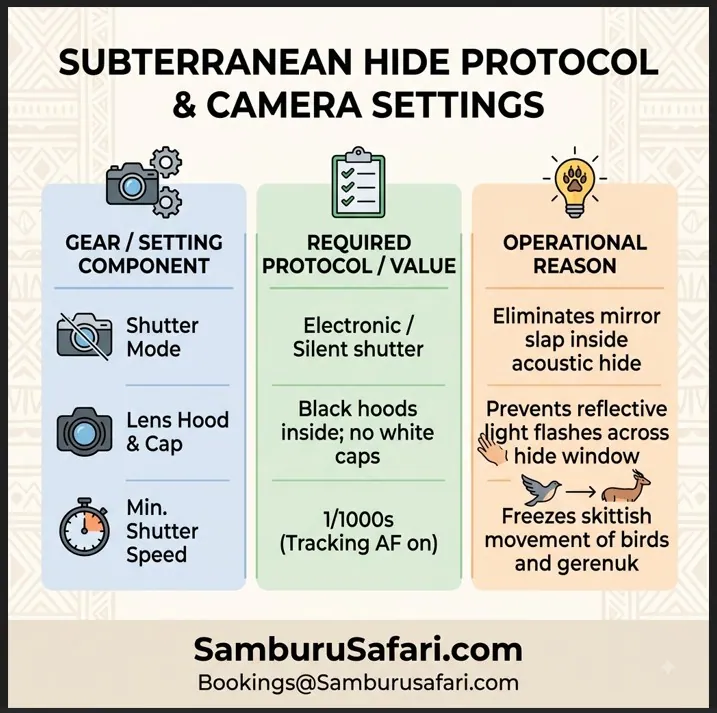
Photographing wildlife from subterranean hides like Kalama or Soroi Larsens requires zero acoustic footprint and careful camera configuration. Acoustic reverberation off concrete walls can easily startle animals away from waterholes for hours. Use this quick technical setup guide before entering any ground-level hide.
Gear / Setting Component | Required Protocol / Value | Operational Reason |
Shutter Mode | Electronic / Silent shutter | Eliminates mirror slap inside acoustic hide |
Lens Hood & Cap | Black hoods inside; no white caps | Prevents reflective light flashes across hide window |
Min. Shutter Speed | 1/1000s (Tracking AF on) | Freezes skittish movement of birds and gerenuk |
The distance rules decide your focal length, not the other way round. Wardens enforce a 20-metre buffer from general wildlife and 30 metres from elephant nursery herds.
To fill the frame from behind that line, work in the 400–600mm range, or a 100-400mm zoom with a good 1.4x teleconverter. The extender is what lets you hold detail on a leopard in an acacia while the vehicle stays where it belongs.
Night drives are prohibited inside Samburu National Reserve after 6:30 PM. The private conservancies — Kalama, Westgate, Namunyak — allow spotlight tracking, and they are strict about how.
Red filters are mandatory. Spotlights carry red or infrared filters. A direct white halogen beam blinds a leopard or lion mid-stalk, which costs the animal a meal.
No white flash. Strobes blind predators outright and panic shy nocturnal species — aardvark, striped hyena, bushbabies.
Settings that work: Open up to f/2.8 or f/4, push ISO to 6400 or 12800, and dial in about -1.0 EV to stop the red beam blowing out your highlights.
Those conservancies each run their own rules and permits, covered across the wider northern circuit.
Photographing something endangered — black rhino at Sera, a leopard on the Ewaso Nyiro — means stripping the GPS tags before anything goes online.
Turn off location services on the camera body and the phone. Removing EXIF geotag metadata stops anyone extracting exact coordinates from an uploaded file, which is not a hypothetical risk for rhino. The same photographs are worth something in the other direction: right-flank images passed to researchers feed the census behind the trust protecting Grevy’s zebra, so strip the location and hand over the frame.
Through the dry months, nursery herds (Olchoro) gather on the Ewaso Nyiro sandbars with newborn calves.
Hold 30 metres and switch the engine off — properly off, not idling. Revving, driving between a matriarch and a drinking calf, or hammering the shutter brings on defensive ear-flapping (Lbaar) and mock charges. When she flaps hard and kicks red dust, that is not a photo opportunity. Back off.
Off-road driving is banned inside the reserve. Cutting off the track for a better angle crushes Salvadora persica — the toothbrush trees — and breaks up the sandy riverbank. Guides caught doing it face spot fines of Ksh 10,000 to 50,000 and can lose their licence, which is why a good driver will refuse the shot no matter how politely you ask.
“Safe distance from elephants Samburu photo safari” / “Safe distance from elephants Samburu photo safari” / Safe distance from elephants Samburu photo safari
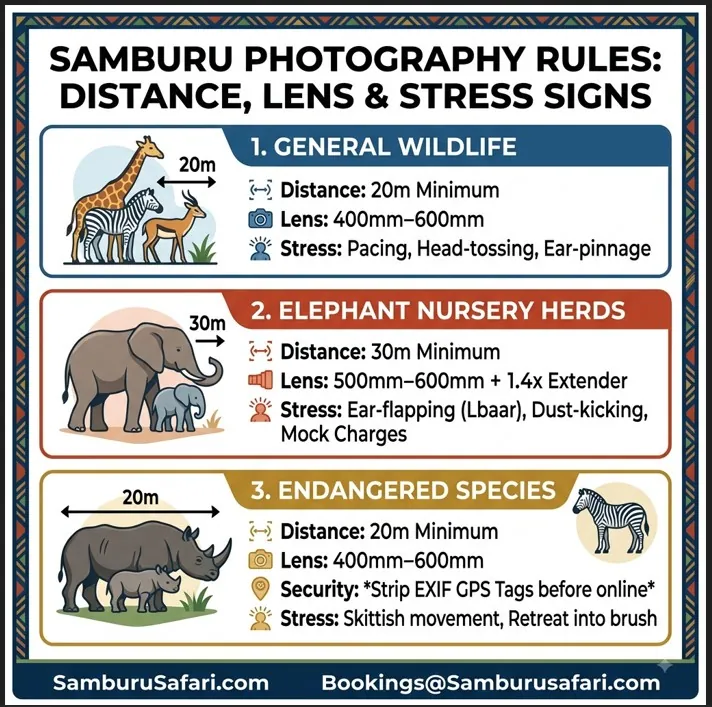
Maintaining safe distance buffers ensures ethical wildlife interactions and avoids triggering dangerous defensive responses. When photographing nursery herds along the Ewaso Nyiro, focal length selection must substitute for physical proximity. The guide below outlines buffer rules, focal recommendations, and warning signs of animal distress.
Target Wildlife Scenario | Mandatory Distance Buffer | Recommended Focal Length | Key Distress / Stress Sign |
General Wildlife | 20 metres minimum | 400mm – 600mm | Pacing, head-tossing, ear-pinnage |
Elephant Nursery Herds | 30 metres minimum | 500mm – 600mm + 1.4x Extender | Ear-flapping (Lbaar), dust-kicking, mock charges |
Endangered Species | 20 metres minimum | 400mm – 600mm (Strip EXIF GPS) | Skittish movement, retreat into brush |
The gap between Samburu Simba at $1,390 and Saruni Samburu at $3,270 is location and hide access. Simba sits inside the public reserve on gate hours. Saruni is inside Kalama Conservancy beside the private hides, where the daily fee pays community rangers and we can run night drives straight out of camp.
Package Tier | Hotels / Camps Included | Transport & Setup | Total Rate Per Person | |
Budget Tier | Umoja Women’s Camp / Bandas | 3 Days private 4×4 Land Cruiser & guide • Full board stay | $930 USD | |
Mid-Range Tier | Samburu Simba Lodge | 3 Days private 4×4 Land Cruiser & guide • Full board stone chalet | $1,390 USD | |
Luxury Tier | Elephant Bedroom Camp | 3 Days private 4×4 Land Cruiser & guide • Luxury riverfront tent | $2,250 USD | |
Luxury Plus Tier | Saruni Samburu (Kalama) | 3 Days private 4×4 Land Cruiser & guide • Cliffside villa near photo hide | $3,270 USD |
Package Tier | Hotels / Camps Included | Transport & Setup | Total Rate Per Person | |
Budget Tier | Samburu Camp (2N) + Sweetwaters Camp Ol Pejeta (1N) | 4 Days private 4×4 Land Cruiser & guide • Tented bush circuit | $1,280 USD | |
Mid-Range Tier | Samburu Simba (2N) + Sweetwaters Serena Ol Pejeta (1N) | 4 Days private 4×4 Land Cruiser & guide • Full board safari lodges | $1,890 USD | |
Luxury Tier | Elephant Bedroom (2N) + Ol Pejeta Bush Camp (1N) | 4 Days private 4×4 Land Cruiser & guide • Luxury eco-canvas stay | $3,050 USD | |
Luxury Plus Tier | Saruni Samburu (2N) + Lewa Safari Camp (1N) | 4 Days private 4×4 Land Cruiser & guide • High-end conservancy hides | $4,280 USD |
What your package covers: Full board at the named lodges or campsites, private 4×4 safari Land Cruiser with guide and fuel, Samburu Reserve daily permits ($85 USD/day non-resident) and conservancy fees, AMREF Flying Doctors evacuation cover, and bottled drinking water.
What you need extra cash for: International flights, Kenya e-visas, personal travel insurance, premium drinks, driver-guide tips, and Reteti Elephant Sanctuary entry fees.
Need a vehicle configured for photography — beanbags, open hatch, a guide who understands light? Send us your dates.
Road conditions, permits, flights and health precautions shift with the season, and our planning a samburu safari section covers them before you lock anything in.
Can I fly a drone in Samburu National Reserve? No. Flying a recreational drone inside the reserve or the surrounding conservancies is illegal without dual permits from KCAA and KWS, and unpermitted drones are seized by customs at JKIA on arrival.
Is photography included when visiting Samburu cultural villages? Yes. At organized cultural villages such as Umoja Women’s Village, photography rights are part of the entry fee ($20–$30 USD).
Can I take night photographs with a flash in Samburu? No. White flash is forbidden on night drives in the conservancies because it blinds predators and panics nocturnal species. Spotlights must carry red or infrared filters.
Written by Benson Kungu — photo safari specialist and safari guide, working the hides and open-vehicle routes across Samburu, Buffalo Springs and Kalama.
Reviewed by Gerard Murero — TRA silver-level guide covering the northern rangelands and community conservancies.
Message us directly for custom itineraries and the latest seasonal offers.