
Standing on the riverbank at noon you can look straight across the Ewaso Nyiro from Samburu into Buffalo Springs. It looks like the same wild country. Drive across the bridge and you have entered a different county management system, different gate logistics, and very different crowding.
When travellers ask about samburu vs buffalo springs vs shaba, they want ground facts. This guide covers how the three neighbouring reserves actually operate, how fees work across county lines, and which one fits your travel style.
Written by Patrick Mulei. Reviewed by Anthony Mule.
These quotes cover two adults travelling together in a private 4×4 Safari Land Cruiser. Every price includes full board accommodation, vehicle transit with guide and fuel, park entry permits, and AMREF emergency evacuation cover.
Tier | Lodges Included | Transport & Setup | Rate Per Person |
Budget | Samburu public campsite / Umoja Camp | 3 days private Land Cruiser & guide • Dome tents and camp chef | $980 — Get a quote |
Mid-Range | Samburu Simba Lodge (Buffalo Springs) | 3 days private Land Cruiser & guide • Full board stone lodge | $1,480 — Price this trip |
Luxury | Samburu Intrepids (Samburu NR) | 3 days private Land Cruiser & guide • Luxury riverfront tent | $1,980 — Check dates |
Luxury Plus | Joy’s Camp (Shaba NR) | 3 days private Land Cruiser & guide • Exclusive spring suite | $2,890 — Build my itinerary |
Tier | Lodges Included | Transport & Setup | Rate Per Person |
Budget | Samburu camp (2N) + Sweetwaters Camp (1N) | 4 days private Land Cruiser & guide • Camping and tented stay | $1,360 — Get a quote |
Mid-Range | Sarova Shaba (2N) + Sweetwaters Camp (1N) | 4 days private Land Cruiser & guide • Full board chalets | $1,990 — Price this trip |
Luxury | Soroi Larsen’s (2N) + Ol Pejeta Bush Camp (1N) | 4 days private Land Cruiser & guide • Luxury riverfront tents | $2,980 — Check dates |
Luxury Plus | Joy’s Camp (2N) + Lewa Safari Camp (1N) | 4 days private Land Cruiser & guide • High-end circuit stay | $4,180 — Build my itinerary |
Inclusions: Full board at the named lodges or campsites, private 4×4 with guide and fuel, daily park permits, AMREF evacuation cover, daily bottled water.
Exclusions: International flights, visas, personal travel insurance, alcoholic drinks, guide tips, and Reteti Elephant Sanctuary fees.
The Ol Pejeta pairing above is covered in detail on our Samburu and Ol Pejeta combo page.
Split into two tables so they stay readable on a phone.
Feature | Samburu National Reserve | Buffalo Springs | Shaba |
Managing Council | Samburu County | Isiolo County | Isiolo County |
Shared Permit Rule | Separate permit required | Shared ticket with Shaba | Shared ticket with Buffalo Springs |
Primary Entry Gate | Archer’s Post Gate | Ngare Mara Gate | Shaba Gate |
Feature | Samburu National Reserve | Buffalo Springs | Shaba |
Terrain | North bank — red murram, riverine forest, Doum palms | South bank — open savannah, acacia scrub, spring pools | Black volcanic basalt, lava fields, spring oases |
Vehicle Crowds | High (15+ cars at a cat sighting) | Moderate, spread across open plains | Low to none, often zero other vehicles |
Signature Sight | River loops and high predator density | Majit natural swimming pool | Joy Adamson’s historic camp site |
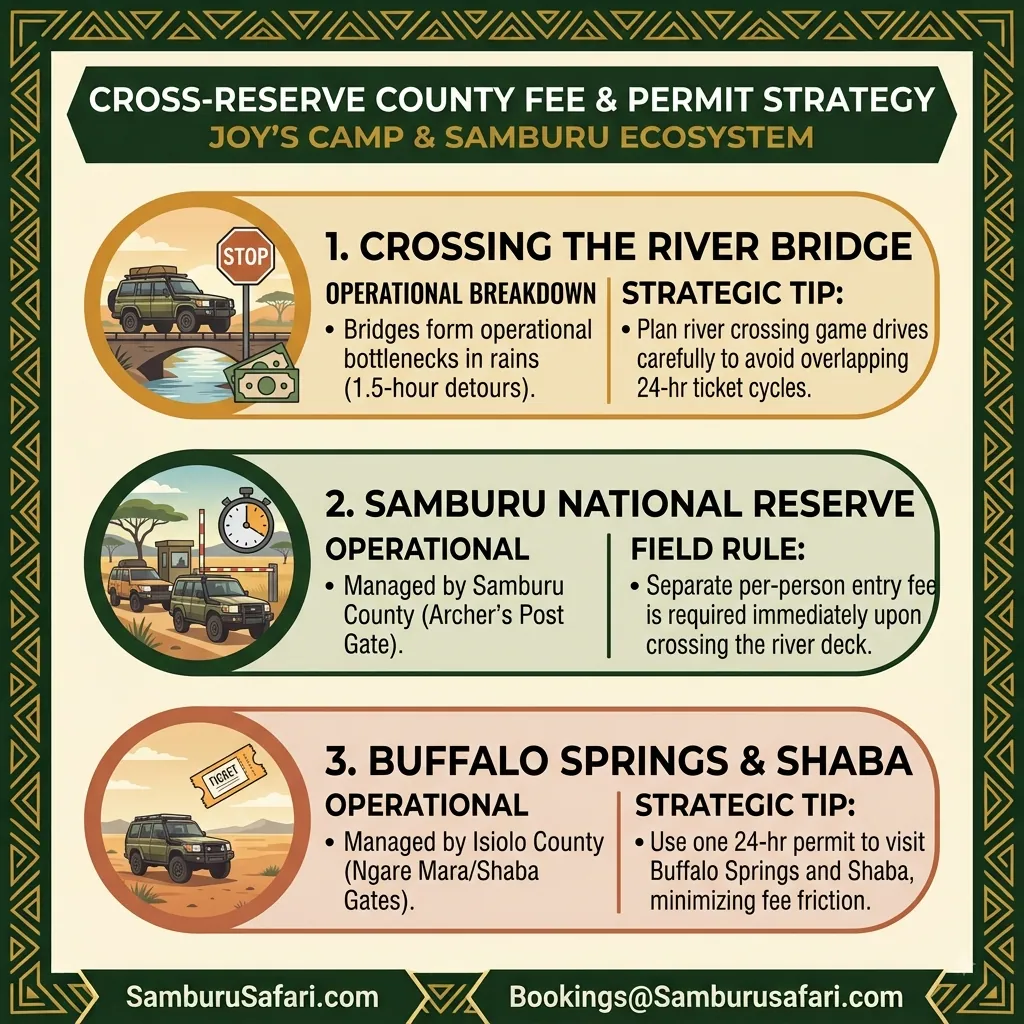
Here is the detail that routinely catches DIY drivers: Samburu National Reserve is managed by Samburu County, while Buffalo Springs and Shaba both fall under Isiolo County.
Why that matters to your wallet — your Isiolo County ticket covers both Buffalo Springs and Shaba inside the same 24-hour window. Morning drive in Buffalo Springs, break, afternoon in Shaba, no extra permit.
But the moment your tyres cross the central bridge into Samburu Reserve, you are in a new county and paying a fresh per-person fee on the spot.
Our drivers time game drives so the 24-hour permits stay synced rather than overlapping. Exact rates and the full payment process sit on our Samburu park fees page, and the wider trip budget is broken down in our Samburu safari cost guide.
Navigating park permits across Samburu, Buffalo Springs, and Shaba requires an understanding of county administrative boundaries. Samburu National Reserve is managed by Samburu County, while both Buffalo Springs and Shaba fall under Isiolo County. An Isiolo County permit grants entry to both Buffalo Springs and Shaba within a single 24-hour window, whereas crossing into Samburu Reserve requires a new permit. Use the operational breakdown below to plan your daily game drive routes and keep permit costs synchronized.
Reserve / Territory | Managing County | Permit Validity & Coverage | Strategic Field Tip |
Samburu Reserve | Samburu County | 24-Hour Samburu permit only | Cross bridge only when ready to switch reserves. |
Buffalo Springs | Isiolo County | 24-Hour shared Isiolo permit | Combines with Shaba entry under 1 daily ticket. |
Shaba Reserve | Isiolo County | 24-Hour shared Isiolo permit | Visit Shaba on same 24-hr ticket as Buffalo. |
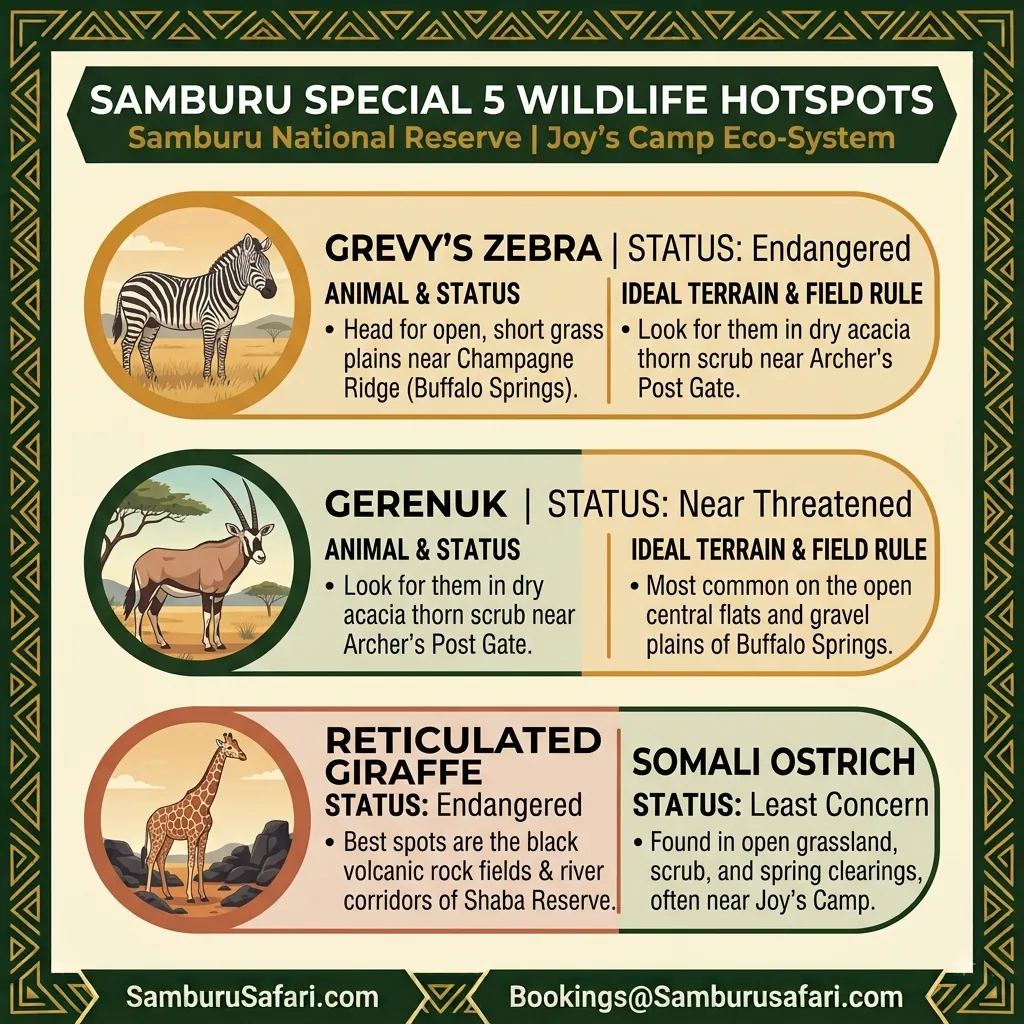
The Samburu Special 5 are strict northern specialists — you will not find them in the Mara or Amboseli. They also do not spread evenly across the three reserves.
The Samburu Special 5 are specialized northern species adapted to arid terrain, but they are not evenly distributed across the three reserves. Finding specific species requires targeting distinct habitats, from dense riverine forests to open basalt plains. For instance, Grevy’s zebras favor wide-open plains, while gerenuks thrive in dry acacia scrub near reserve gates. Use the species hotspot matrix below to target the best reserve and terrain for each animal.
Special 5 Wildlife | Primary Reserve Hotspot | Ideal Terrain & Environment |
Grevy’s Zebra | Buffalo Springs | Champagne Ridge open plains |
Gerenuk | Samburu & Buffalo Springs | Dry thorn scrub near Archer’s Gate |
Beisa Oryx | Buffalo Springs | Open central flats & gravel plains |
Reticulated Giraffe | Shaba Reserve | Black volcanic rock & river corridors |
Somali Ostrich | Buffalo Springs & Shaba | Open grassland & spring clearings |
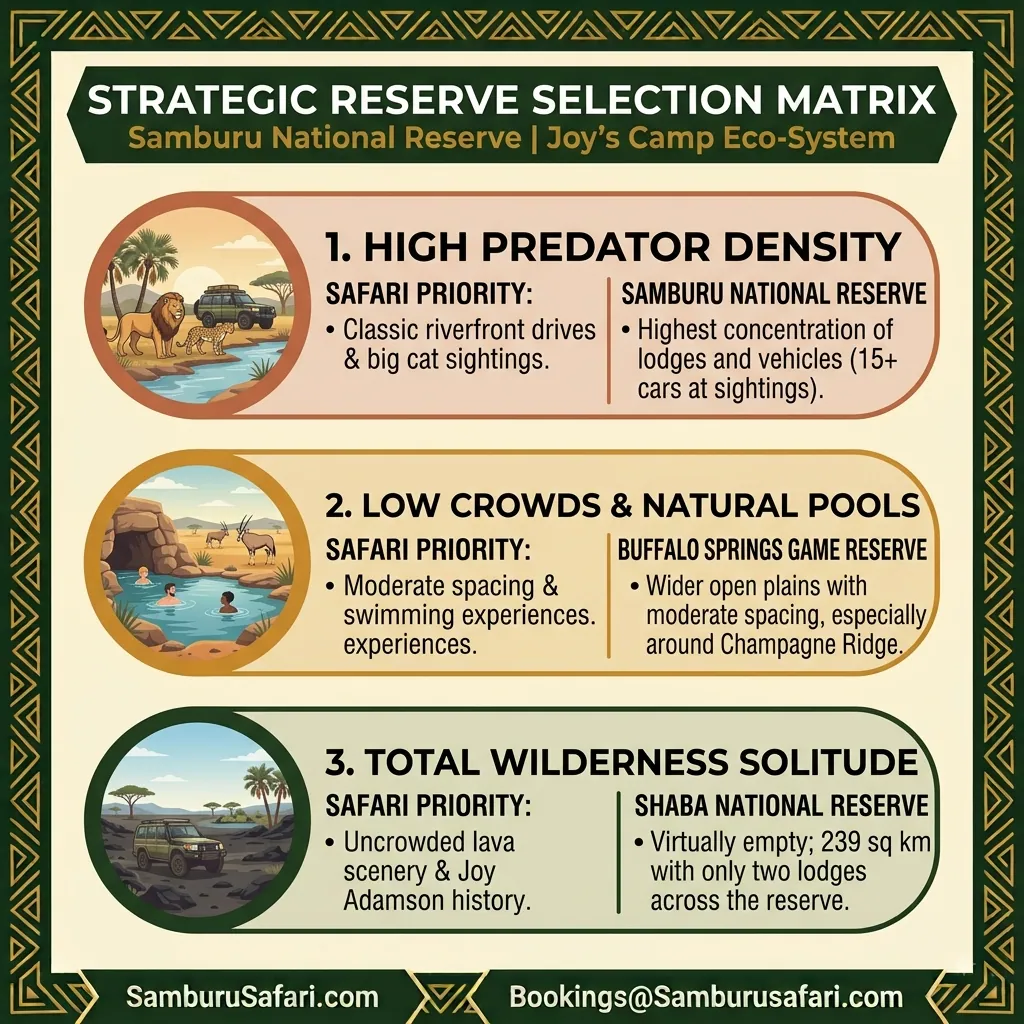
Vehicle density varies drastically across the three borders:
Moses’s field note: finding leopards in Samburu means watching the low acacia branches along the river loops early, before the heat pushes the cats into thick brush. After nine you are looking at empty trees.
Choosing the right reserve depends on whether your priority is dense predator sightings, lower vehicle counts, or complete wilderness solitude. Samburu offers classic riverfront game drives but experiences higher vehicle traffic at cat sightings. Buffalo Springs balances open plains with moderate crowds and unique natural pools, while Shaba offers uncrowded lava landscapes. Review the comparison matrix below to match your travel preferences with the right reserve.
Safari Priority | Recommended Reserve | Core Advantage / Feature |
High Predator Density | Samburu Reserve | High cat concentration along river loops |
Low Crowds & Swimming | Buffalo Springs | Open plains & crocodile-free Majit pool |
Wilderness Solitude | Shaba Reserve | 239 sq km territory with zero crowd friction |
Inside Buffalo Springs sits a crystal-clear, spring-fed natural pool that rangers call Majit. Local accounts hold that the crater was opened by a wartime bomb that struck the plain and broke into an underground aquifer, which then filled with clean artesian water.
Whatever its origin, the practical point stands: unlike the Ewaso Nyiro, Majit holds no Nile crocodiles, is walled with stone masonry, and is safe to swim in through the hot afternoon hours.
Shaba is not only about solitude. This is where Joy Adamson, of Born Free, spent her final years rewilding Penny, a hand-reared leopardess, a story she documented in Queen of Shaba.
Her original campsite sat beside the natural spring where Joy’s Camp stands today. Standing on the edge of the volcanic gorge at sunset, you understand why she chose this exact patch of northern Kenya. It is as fiercely wild now as it was then.
Choosing the right gate saves you real time on corrugated dirt:
The concrete river bridge linking Samburu to Buffalo Springs becomes an operational bottleneck in the rains. Sudden upstream rainfall sends flash floods that submerge the deck completely, cutting vehicle transit for hours and forcing a 1.5-hour detour back through Ngare Mara Gate on the highway.
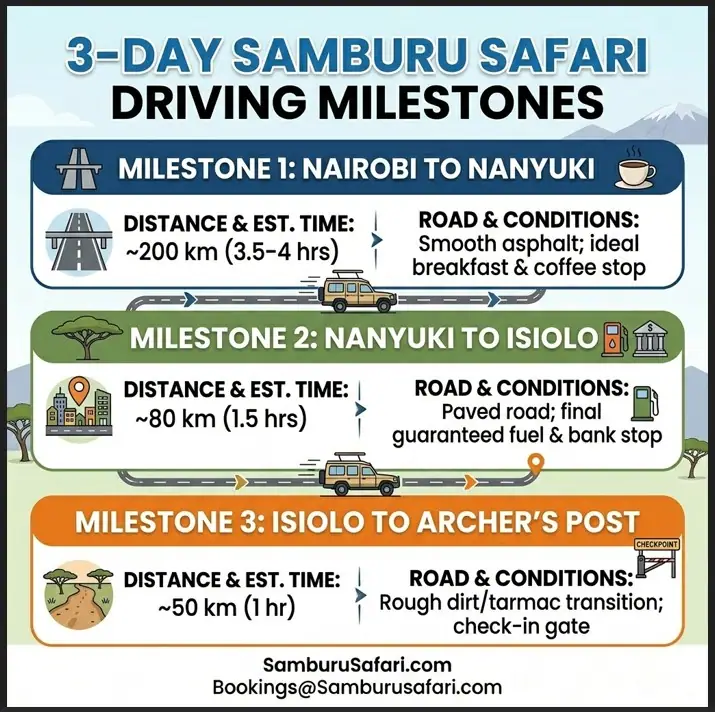
Full route detail for the drive up is on our driving from Nairobi to Samburu page.
The river dictates everything up here.
The dry heat (July–October & January–February): As the bush dries to crisp yellow scrub, animals lose their scattered water pockets. Wildlife swarms the riverbanks in Samburu and crowds the permanent springs in Buffalo Springs and Shaba. Sighting success peaks — and so do vehicle numbers on the river tracks.
The green and the floods (April–May & November): The bush turns to dense green thickets and animals disperse into the hinterland because water is everywhere, which makes tracking harder. Rain in the distant highlands can also send a wall of water down the river, submerging the bridge and stranding vehicles on either side for hours.
The full month-by-month picture is in our best time to visit Samburu breakdown.
Compare properties across all three reserves in our roundup of the luxury lodges in Samburu, or browse full routes across our Samburu safari packages.
No. Samburu is Samburu County, Buffalo Springs is Isiolo County, so crossing the river bridge means a separate entry permit. The Isiolo ticket does cover both Buffalo Springs and Shaba within a single 24-hour window.
Samburu has the highest cat sightings and the riverfront lodges. Buffalo Springs gives you open plains, fewer crowds, and the Majit spring pool. Shaba offers complete solitude, lava scenery, and the Adamson history.
Yes, in the natural Majit spring pool. It is spring-fed, walled with stone, and free of crocodiles, unlike the river itself.
Reserve boundaries, gate access, and permit rules checked on the ground by our guides. Last updated July 2026.
Message us directly for custom itineraries and the latest seasonal offers.